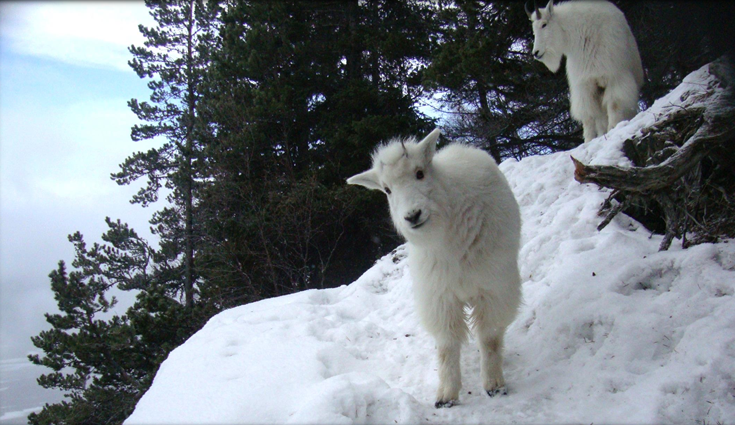
State biologists are tracking Haines-area mountain goats to understand their habitat and range better. (Photo courtesy Alaska Department of Fish and Game)
This is Lingít Word of the Week. Each week, we feature a Lingít word voiced by master speakers. Lingít has been spoken throughout present-day Southeast Alaska and parts of Canada for over 10,000 years.
Gunalchéesh to X̱’unei Lance Twitchell, Goldbelt Heritage Foundation and the University of Alaska Southeast for sharing the recorded audio for this series.
This week’s word is jánwu, or mountain goat. Listen to the audio below to learn how to say jánwu.
The following transcript is meant to help illustrate the words and sentences.
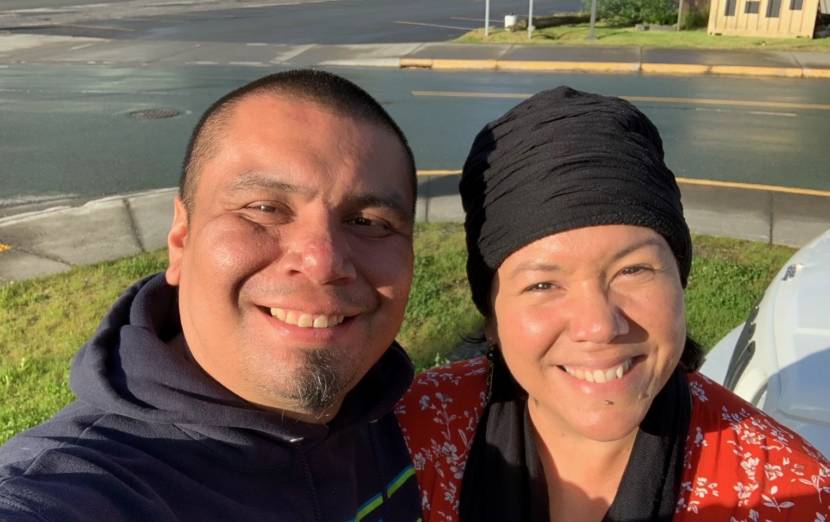
Xeetli.éesh Lyle and Daxkilatch Kolene James pose for a selfie. (Courtesy photo)
It’s Valentine’s Day in Lingít Áaní and two local Lingít language learners shared their love language and the story of how it began.
Xeetli.éesh Lyle and Daxkilatch Kolene James almost met at a party. Lyle led a group of dancers in, and Kolene was impressed.
“I claimed at the table, ‘There’s my husband,’” she said.
She approached his father at the party and asked if he was single. Lyle’s father went and told him.
“And I never saw him,” she said.
Lyle said he lost his nerve.
“And then I almost got the nerve to go up to her table and talk to her, but as soon as I got close, I got scared and I walked out,” Lyle said. “So I actually didn’t get to meet her that evening.”
Lyle’s father went back to Kolene and told her his son was too nervous. She said at the time, she was busy with work, school and raising her kids. She told herself she didn’t have time for romance, anyway.
“Couple months passed,” she said. “My best friend invited me out to go dancing, and so I did, and we ran into each other again on the dance floor, and I gave him my number, and the rest is history.”
Now, after decades of being together, they use Lingít to show their love for each other.
“When I’m at work, I’ll send her a text of ‘Ḵúnáx̱ ix̱six̱án ax̱ sháawadi á!’” Lyle said. “And what that translates to is, ‘I love you very much, my precious wife.’ And to translate it even more is, ‘You are the one I choose to stand with very much.’”
Kolene said messages like that, in their Indigenous language, make her feel precious.
“[It] made me feel special,” she said “I know that it’s authentic. It feels really beautiful.”
A group of University of Alaska Southeast students in Ḵaakal.áat Florence Marks Sheakley’s class saw the value of saying you care for someone in Lingít, too. They made a list of other terms of endearment.
Lingít terms of endearment. (Courtesy of Ḵaakal.áat Florence Marks Sheakley)
To express care for the people you love outside of romantic relationships, Lyle has some phrases, too.
“‘I éek’ ax̱aaheen!’ means like ‘I believe in you.’ And then ‘I tóo yei yatee!’ ‘It’s in you,’” he said.
Kolene says those affirmations apply to anyone learning Lingít, too. She echoed the words of her teacher, who says the language belongs to everybody.
“It’s been part of the land and part of who we are since time immemorial, and that feels really good. So keep trying,” she said.
Lyle agreed. It’s good advice in language learning, and in love.
“Don’t be afraid to make mistakes,” he said.
Sagu ix̱six̱áni yágiyee — happy Valentines Day!
A Lingít Valentine from KTOO. (Graphic by Adelyn Baxter/KTOO)
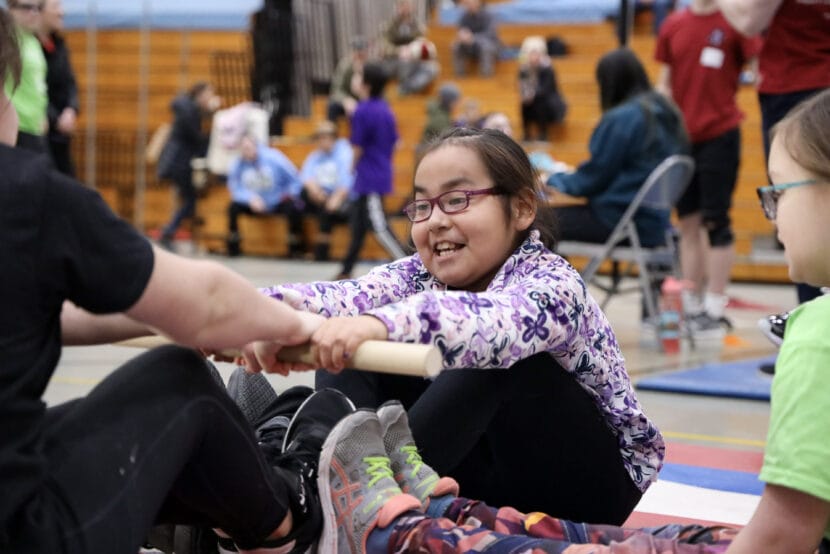
Harborview Elementary student Chloe Kinville-James participates in the Inuit stick pull at the Native Youth Olympics Junior Celebration at Dzántik’i Héeni Middle School gym on Saturday, Feb. 8, 2025. (Photo by Clarise Larson/KTOO)
Peyton Lott patiently sat on a mat in the Dzántik’i Héeni Middle School’s gym on Saturday morning, waiting for her next competitor in the Inuit stick pull event.
“I love doing these because it shows what strength [was] within the people who did them,” she said.
The game involves two students facing each other and holding a wooden stick — one with an inside grip and the other with an outside grip with no gaps between their hands. Then, they grip and pull against one another until someone breaks free with the stick in hand, winning the match.
Last weekend, Lott and nearly 100 other elementary-age athletes competed in that event and others as a part of the Native Youth Olympics 2025 Junior Celebration.
Lott is Lingít and Yupik, and a fifth grader at Harborview Elementary. She got involved with the games three years ago after walking past the club while waiting for her mom to pick her up from school.
Now, she’s pretty hooked.
“I wake up early the day of the competition — this is the only time when my parents tell me to go to sleep I will,” she said.
The competition opened with a cultural dance and song performance. The event was hosted by the Central Council of the Tlingit and Haida Indian Tribes of Alaska in partnership with the Juneau School District.
On Friday and Saturday, students competed in six distinct events. All the games are rooted in Indigenous hunting and survival traditions used in the Arctic. Now, competitions for games like these are held across the state as a way to foster community and promote physical fitness during the cold winter months.
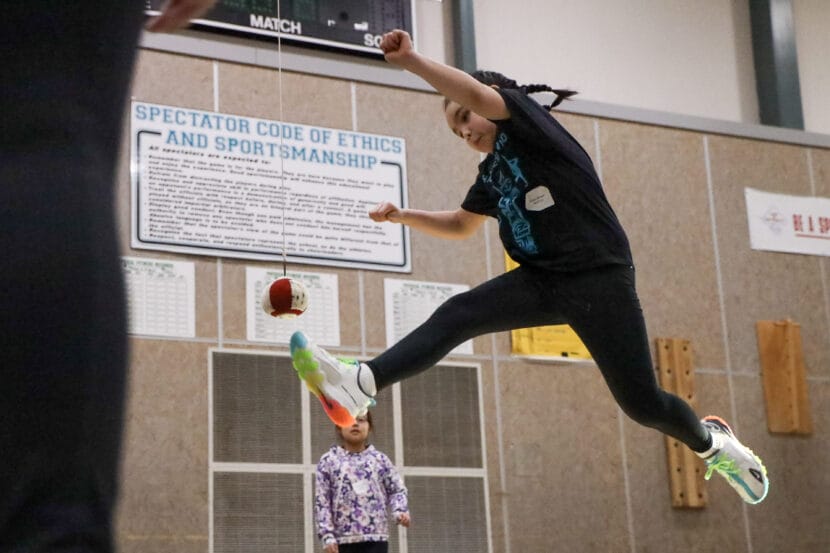
Adeia Brown participates in the one-foot high kick at the Native Youth Olympics Junior Celebration at Dzántik’i Héeni Middle School gym on Saturday, Feb. 8, 2025. (Photo by Clarise Larson/KTOO)
Kaytlynne Lewis is a coach and traditional game specialist for Tlingit and Haida.
“These games originate from Alaska, specifically and traditionally,” she said. “Long ago, before cell phones, radios, any sort of technology, hunters created these games to communicate with one another out in the Arctic.”
Just like the students, she too was a young athlete who practiced the games growing up in Alaska. She said the games are more than just about testing your physical fitness — it’s about connecting with your community and celebrating Alaska’s Indigenous traditions.
“I’ve had some athletes say, ‘I was never rooted to my culture. I was never connected to my culture. And since I started the games, I feel more closer, and I feel a sense of identity,’” she said. “That is very impactful to me.”
Mila Neely, a freshman at Juneau-Douglas High School: Yadaa.at Kalé, helped measure the height of athlete’s kicks during the one-foot high kick. She volunteered with other high school athletes to help with the games.
“I’ve been doing NYO since I was in fifth grade. So like, this is my fifth year doing it,” she said.
Neely said it’s special for her to be able to help teach the next generation of athletes. She said traditional games are unique from other sports in more ways than one.
“It’s such a positive sport,” she said. “Like, you go to other sports and people will be talking trash about the other team, or even just wanting to win. In traditional games, so many times I’ve seen people give another person a tip that will help them succeed further than them in the games because it’s really just like being the best that you can be.”
In early April, Neely and other high school and middle school students in Juneau — and across the state — will compete in their own traditional games as a part of Sealaska Heritage Insitute’s 2025 Traditional Games.
Frost crystals on a window pane. (Creative Commons photo by Tim)
This is Lingít Word of the Week. Each week, we feature a Lingít word voiced by master speakers. Lingít has been spoken throughout present-day Southeast Alaska and parts of Canada for over 10,000 years.
Gunalchéesh to X̱’unei Lance Twitchell, Goldbelt Heritage Foundation and the University of Alaska Southeast for sharing the recorded audio for this series.
This week’s word is kaxwaan, or frost. Listen to the audio below to learn how to say kaxwaan.
The following transcript is meant to help illustrate the words and sentences.
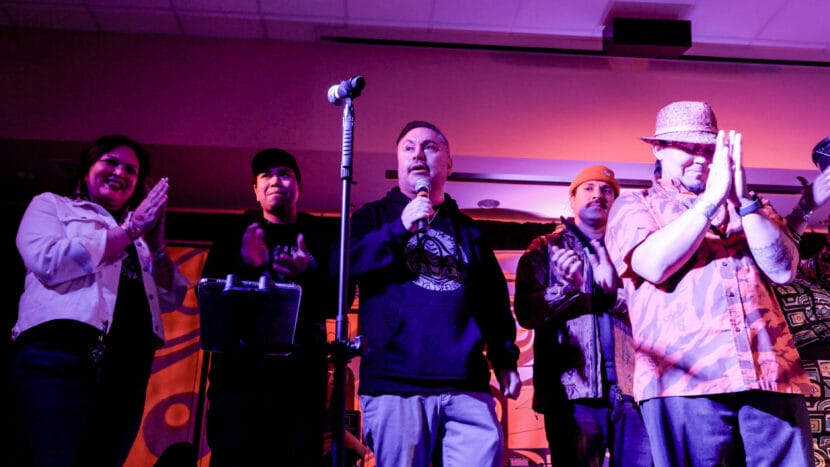
Lgeik’i Heather Powell Mills (left) and Lduteen Jerrick Hope-Lang (center, with microphone) at the Hít Wóoshdei Yadukícht, “Dancing Our House Together” on Feb. 1, 2025 in Sitka. (Photo by J. Joshua Diltz)
One of Alaska’s most famous bands, Portugal. The Man, joined Native American Music Awards winner Samantha Crain and Lingít artist Ya Tseen for two sold out shows in Juneau and Sitka last weekend. They were raising money and community awareness for an effort to rebuild a Kiks.ádi clan house in Sitka.
The event was called Hít Wóoshdei Yadukícht, which means “Dancing Our House Together.” Each ticket was a donation toward the goal of rebuilding a Sitka clan house, called the Point House.
After the music faded, the lights dimmed and the hall cleared out, Kiks.ádi clan member and organizer Lduteen Jerrick Hope-Lang said the event was a success.
“By broadening the audience with music as the vessel, you are able to bring a large, mixed group of people into a room and say, ‘This is worth fighting for, and you can be an ally,’” he said.
Lgeik’i Heather Powell Mills is a member of the X̱aay Hít clan house in Hoonah. She helped organize the fundraiser, and for her, it’s personal. She grew up with a clan house — a community home that unites all generations of a clan, and holds their stories — and she wants others in her community to have that resource.
“The benefit of that is the strength of identity, the strength of community, the strength of family,” she said. “And being able to have a place that you can walk into and feel like it’s a safe place to be who you are.”
Powell Mills said clan houses hold clan history, and allow members like her – and ones yet to come – to understand their identity and know that they belong.
“They carry the names of our ancestors within their walls. They hold our most precious objects: our at.oo,” she said. “The stories and the names and the spirit that’s put into these places is such a powerful, immensely knowledgeable way of being.”
Point House originally sat along the water in downtown Sitka. Hope-Lang said Sitka had 43 clan houses at one point, and few remain standing and in tribal hands. Colonialism and the attempted eradication of Lingít communities left generations of children with only bread crumbs, he said — pieces of language, arts traditions and family history.
“Those bread crumbs were the pieces that we had to pick up and put back together for ourselves, nourish ourselves with,” he said.
Now, he said he’s seeing those crumbs turn into full loaves through language and cultural revitalization efforts across Southeast Alaska, but he wants to go further. He wants future generations to have the tools to make their own nourishment, and rebuilding the Point House offers that chance.
“My ultimate goal for this whole project is that we don’t just give them bread, that we give them the whole kitchen. That we give them all the opportunity to be who they are, not bits and pieces,” Hope-Lang said. “You don’t have to go here to get language. You don’t have to go here to get art. You don’t have to go here to get your stories. That they become centralized.”
Hope-Lang said they don’t know the final amount last weekend’s shows raised yet, but he’s still working to raise everything they need to start construction. Point House is just the beginning, he said.
The show also benefited a fundraiser for researching rare disease, made on behalf of the daughter of two Portugal. The Man members, Frances. Hope-Lang says this was an act of reciprocity, as a “thank you” to the band for donating their time.
Learn more about the Point House project at pointhouse.org.
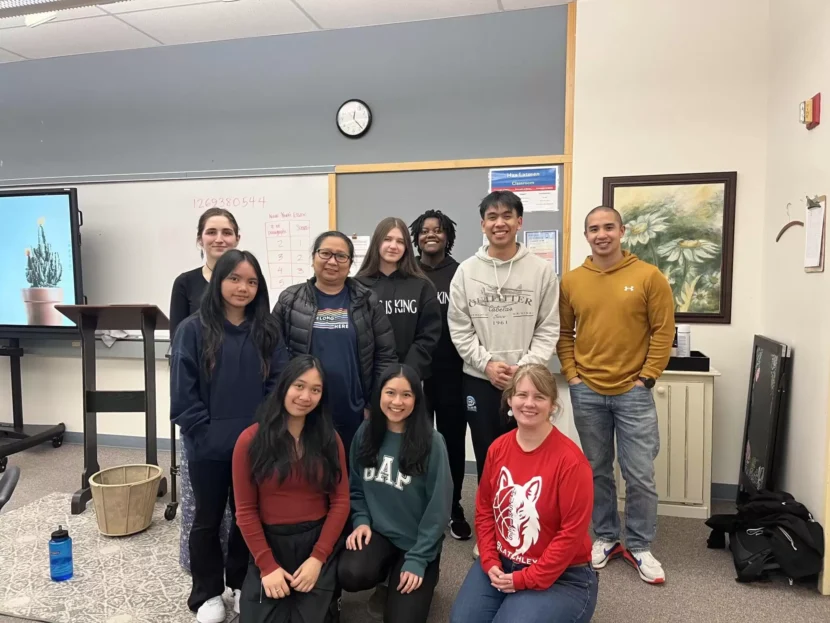
Members and advisors of Sitka High School’s Barkadas Club smile for a picture during a January 2025 meeting. (Meredith Redick/KCAW)
On a rainy Wednesday around lunchtime, the students in Room 211 at Sitka High are passing around Styrofoam takeout containers of egg rolls. They’re here for the weekly meeting of the Barkadas Club.
The word “barkadas” translates to “group of friends” in Tagalog. Senior Julia Nabua started the club in 2023 after attending a camp for young Filipino Americans in Washington State.
“All my friends all talked about a Filipino club and it sounded really interesting, so I wanted to start one here too,” she said.
She said she wanted a space where Filipino American students could take pride in their culture – and for some, learn more about their own heritage.
“Usually we don’t really learn much about it in school or at home, because, you know, we’re in the U.S.,” she said.
A little over six percent of Sitkans identify as Filipino or Filipino American, according to the most recent data. Julia’s mother, Bennie Grace Nabua, is an advisor for the club. In 2022, she helped develop a scholarship for Filipino students in Sitka and drafted a municipal resolution declaring October to be Filipino American History Month. She said she was eager to support Julia’s idea to start a club.
“Julia, you know, finding herself and and having a better and deeper appreciation of her identity as a Filipino teenager in the US, I was kind of like, ‘Oh, I think it will be super great, you know, to have that space,’” she said.
The Barkadas have extended their reach far beyond the walls of Room 211. The club partners with the Tulong Aral scholarship fund, which provides scholarships for graduating Filipino American students to pursue higher education. The club has also coordinated two “Salo-Salos,” or community gatherings, to celebrate Filipino American History Month.
Last year’s Salo-Salo brought in more than a hundred people. Bennie Grace said the students did most of the work to organize the event.
“The Salo-Salo gatherings that we have been having for the past two years are big projects — fundraisers, connecting with businesses, asking for solicitations,” she said. “Most of them are done by the students, and — how should I say it? They have really been independent about doing a lot of the work.”
Sitka High teacher Jarred Rivera is a faculty advisor for the Barkadas and a Filipino-American. He said growing up, Sitka’s Filipino American community hosted a lot of community events.
“I remember when I was young, we had huge potlucks,” Rivera said. “The whole community was invited, and it was a big thing. It was huge, and, and then, you know, that went away but now, since the Barkadas club started, you know, we’re getting a lot of buy-in from the community and stuff.”
The club has attracted a diverse group of students, including many who aren’t Filipino American. Senior Desirae Hutton said she initially joined to support Julia, her friend since sixth grade.
“When she told me she was starting this group, she was like, ‘Can you come for this first meeting? I’m nervous,’” Hutton said. “And I was like, ‘I got you. I’ll be there.’”
Hutton has been a member since that first meeting. She’s now the club treasurer.
“I’ve never been a part of a heritage-type of club, so being here and learning about this different stuff has been really interesting,” she said. “And it’s also been cool, though I’m not Filipino, being able to still be involved how I am, that’s just fun and cool, getting to learn something new.”
Julia said she hopes the club continues to grow, even in her absence. She’s already mentoring younger students to take over club leadership after she, Hutton, and vice president Rex Adres graduate this spring – and she said even after graduation, she hopes to serve as a resource for future members.
Close
Update notification options
Subscribe to notifications
Subscribe
Get notifications about news related to the topics you care about. You can unsubscribe anytime.