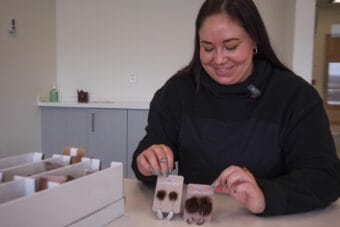
“Aanaq? Am I Your Sunset?” by Lani Hulse was written to support Typhoon Halong-impacted families in partnership with the Western Alaska Disaster Relief Fund. (Lani Hulse)
When writer Lani Hulse heard the news about Typhoon Halong, she was across the country in Hawaii, where she lives.
“I just, I couldn’t help with each video that I watched online — people posting about the disaster, and afterwards — I just could not just sit there,” Hulse recalled. “I was like, there’s something I can do.”
Hulse was in the middle of writing a novel, part of a journey to reconnect with her Yup’ik culture. The author, who spent periods of her upbringing in Bethel, has family roots in the Yukon Delta village of Kotlik, which suffered damage from the October storm. Her father was also a principal across schools in the region, including Kipnuk.
“I was like, wait, I could do something creative and connect with a nonprofit, and get something rolling, have something physical that’s positive and connects to my culture as well,” Hulse said.
Hulse began coordinating with the Alaska Community Foundation to host a fundraising sale of the children’s book she was inspired to write. It’s called “Aanaq? Am I Your Sunset?” and 50% of each sale goes directly to the Western Alaska Disaster Relief Fund to support families impacted by Typhoon Halong. The other 50%, Hulse said, will cover the cost of production and taxes involved.
The storybook was inspired by a moment Hulse experienced with her son, Ashton. At the end of a stressful day, Hulse said that the two went for a drive.
“During the drive, the most captivating sunset caught my attention and I paused. And I was like, ‘Oh my gosh.’ I was like, ‘Ashton, look at that sunset. It’s so beautiful,’ ” Hulse remembered. “And my son was quiet for a second, and he asked, ‘Am I your sunset?’ I lost my breath for a moment.”
Hulse said that the book came from this seed of connection and meaning between parent and child. The story follows the layout of a poem, an adult responding to a child asking the same question in a backdrop of Yup’ik culture.
“And then each page, it’s almost like a poem goes over like, ‘Yes, you are my sun. You are my moon.’ And there’s lots of culturally significant imagery in there as well, like eating salmonberries, tundra tea, as well as, like, fishing and Northern Lights,” Hulse said.
Hulse said that she hopes the book will find buyers among those looking to support relief efforts, but she also hopes copies find their ways into the hands of those affected by the typhoon.
The book features a journal section where families can record shared memories together.
“I can’t imagine what these families are going through right now, and I wanted to bring something positive to their life,” Hulse said. “The main part of this story is what matters most is family moments with your family, these sweet moments throughout your day.”
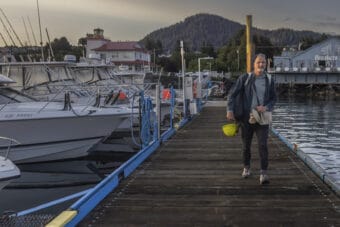
Caroline Van Hemert, pictured above sailing in Canada’s Northwest Territories as part of a larger trip with her family through the Northwest Passage. The journey will be featured in her upcoming book. (Patrick Farrell)
Three Haines artists were recently recognized by the Rasmuson Foundation, which announced its Individual Artist awardees earlier this month.
Shannon Kelly Donahue took home one of the $10,000 awards, which will help fund her work on a personal memoir that involves travel to Ireland. Andrea Nelson was another awardee. She’s building a collection of sculptural taxidermy to shed light on the northern fur trade.
Writer, biologist and part-time resident Caroline Van Hemert also took home an award. She recently finished sailing the Northwest Passage with her family, and the trip is among the adventures that will inform her new memoir, titled “Upwellings.” The book is about finding hope and joy in the natural world amid climate change and environmental collapse.
Van Hemert sat down with KHNS to talk about the $10,000 award and the project it will help fund.
This transcript has been edited for length and clarity.
Caroline Van Hemert: I’m working on a book project right now. So that’s what the Rasmuson specifically is helping to support. And it’s a combination of artist time, and I’ll be using some of my funds for some specific travel, hopefully doing a little bit more in Southeast Alaska, not too far from home. And then maybe make a trip up to the Arctic as well.
Avery Ellfeldt: You said the award is supporting specifically your new book. Could you tell us a little bit more about that? What’s it called? What’s the focus, and where are you at in that process right now?
CVH: It’s tentatively titled Upwellings, which actually comes from a moment when I was sitting at our cabin on Lynn Canal and looking out and watching a bunch of gulls beat up wind on a day probably very similar to what is happening now, with some fierce north winds, and trying to understand what they were doing and why they were doing it. And that led me into lots of other questions about the exceptions and extensions to the natural world that often get overlooked. And so the book is a memoir, but it’s kind of a collection of both home-based and travel-based pieces, really, each of them starting with a specific encounter with a wild species that then helps me contemplate bigger questions about climate change and also our relationship to the natural world.
AE: In the Rasmuson blurb about your award specifically, it says you’ll work on your memoir to confront the “collapse” you’ve observed by way of wildlife health research. Could you tell me a little bit more about that – what they might mean by collapse?
CVH: In terms of collapse, I’m referring to some of the ecological and environmental situations that have been unfolding. And I think it’s an alternative, again, to that, that narrative of gloom. We are so inundated with, you know, the story of the end of the world as we know it, which is not entirely untrue. But I think trying to draw on examples from the natural world of existing creativity and solutions and things that we don’t always think about when we look outside and see these massive changes.
AE: Has there been an example of collapse or change or shift that you’ve experienced and that’s made a large impact on you, or that you think has been particularly compelling or jarring to observe?
CVH: Where we live on Lynn Canal is very close to the Davidson Glacier. Anyone who spent any time in or around Haines knows that feature and knows how rapidly it’s changing. So it’s hard not to look at things like that and feel sort of the overwhelm of how rapidly our landscape is shifting.
Sometimes there’s a sense that you can almost run from the bad news by going to the places that we love. But I think this book has come about in part because there isn’t really a running from those experiences so much as trying to figure out, how do you grapple with them? And what are some of the ways that we can both acknowledge the state of change, but gather the joy and the wonder that I think ultimately motivates all of us to think differently, and maybe live differently, in a larger collective way.
The Kimball organ with its bottom panel removed for tuning in the State Office Building in Juneau on March 6, 2025. (Photo by Jamie Diep/KTOO)
A Juneau musician is giving his final organ performance in the State Office Building this Friday. T.J. Duffy is retiring after 16 years of live concerts on the nearly century-old instrument.
The theater organ concert will mostly feature holiday music, according to a press release. He will also perform Christmas carols that audience members can sing along to.
In the release, Duffy said he is retiring as a state employee at the end of the year and thought it would be a good time to retire from the organ concerts as well.
The Kimball organ is located in the State Office Building and is the only publicly available instrument of its kind in Alaska. Duffy is one of several musicians who regularly perform on Fridays.
The nearly 100-year-old instrument is nearing the end of its usable life. Repairing it would cost more than $250,000 and requires shipping it to Portland, Oregon for a year.
Duffy’s final concert will be this Friday at noon at the State Office Building.
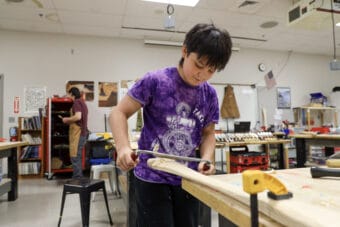
Rasmuson Individual Artist Awardees CJ Harrell, Flordelino Lagundino, and Neech Yanagut Yéil Laine Rinehart. (Photos courtesy of the artists)
The Rasmuson Foundation announced their list of Individual Artist awardees, and eight Juneau projects made the list. The 50 total awards go to artists across the state, who will receive $10,000 each toward a project they have planned.
For Juneau-based artists like CJ Harrell, the grants support deeply personal projects. Harrell plans to make block print portraits depicting a dozen of the Southcentral Alaska homes they lived in growing up.
First, they plan to travel to see the homes as they are now, and meet the current residents. The grant helps pay for that. Harrell said that gives them confidence to take on the project.
“I realized, like, oh man, this would take me years to save up for otherwise and even that,” they said. “Like, I don’t know if I would be brave enough to do this if I didn’t have that funding and that support.”
The project will delve into themes of poverty and abundance in rural Alaska, including Harrell’s experience growing up with a parent struggling with substance abuse.
“The experience of being both isolated, but also so surrounded by nature and other wonderful spaces and resources and beauties too,” Harrell said. “And how that can soften the blow when you’re dealing with other challenges.”
Harrell said the project reflects experiences many Alaskans have had, but it’s still uniquely theirs.
Awardee Flordelino Lagundino is also using his grant funding to tell a story he knows intimately. He’s putting on a play with Juneau nonprofit Theater Alaska that he first saw 20 years ago. The Romance of Magno Rubio is about a young Filipino farmworker finding his way in America. And he said the play is quite an undertaking.
“It’s a really, actually difficult script to produce. It’s mostly in poetry,” Lagundino said. “Lots of poetry in it, there’s singing, there’s lots of movement.”
He also received a grant from the Juneau Community Foundation. Lagundino is using some of the funding to fly in a young Filipino director he met when the man was only a high school student, and to hire more Filipino actors to fill out the roles.
Theater Alaska, which he founded with other Juneau thespians in 2020, puts on a lot of shows for free, or by donation. Lagundino said it would have taken years to fundraise to put on a dynamic play like this without grant funding.
The story is set in California in the 1930s. Lagundino said the setting is familiar to Juneau’s own migrant worker history.
“The workers of this town, a lot of them have been Filipino and helped make this place,” he said.
The Romance of Magno Rubio will run this June and July.
Rasmuson also awarded Ravenstail Weaver Neech Yanagut Yéil Laine Rinehart a grant for a project he’s been working toward for years: weaving a tunic completely out of jánwu, or mountain goat hair. It’s a traditional material for weaving in Southeast Alaska. Rinehart began collecting the fiber from weaving mentors and naturalists as he learned weaving.
“The core reality of it is just the relationship that you have to have with other people to make something like this happen,” he said.
And he plans to document the process of using the fiber from its raw material into becoming the woven tunic.
“It really allows you the ability to slow down and recognize, like, how much work has gone into this craft to get it from, say, the side of a mountain somewhere in Southeast Alaska,” he said. “And then just getting it to that point where you can even spin with it is just such a celebration.”
Rinehart said the grant helps him to financially support himself while devoting time and attention to the project. And he said it gives him the chance to reflect on why working with traditional materials is important to understanding weaving, and Lingít peoples’ long history working with the land and all of its inhabitants.
The Rasmuson Foundation also awarded grants to the following Juneau artists: musicians Annie Bartholomew and the Heists, Drag King Max Stout, Lingít scholar and writer X̱ʼunei Lance Twitchell, and the weaving and documentary team Gunaashaa Lisa Fisher and Gemini Waltz Media. The artists have a year to complete the project.
Editor’s note: Gunaashaa Lisa Fisher is a member of KTOO’s board.
A black bear munches on grass off of Vanderbilt Hill Road near the pioneer home on April 20, 2025. (photo by Jim Weindorf)
Artists have an opportunity to have their bear-themed art work depicted on trash cans in Juneau built to keep the animals out — and win a $10,000 award.
Norwegian Cruise Line Holdings is partnering with the Alaska Department of Fish and Game to host an art contest. Selected artists will have their art turned into miniature murals that will be printed on bear-resistant trash infrastructure in downtown Juneau.
Fish and Game’s Abby McAllister said this is a way to raise awareness about the risks unsecured trash creates for bears and encourage people to throw away their trash properly.
“How do we get people to use our very resistant cans downtown?” she said. “Well, let’s draw their attention to these cans with art.”
When bears get into trash, they learn to turn to garbage and people for food, which can make them dangerous. The state has to euthanize bears that have become aggressive while looking for food in city streets and neighborhoods.
A press release from Norwegian Cruise Lines said panel will narrow down the entries to three finalists, and then the public will vote on the best via social media. Norwegian will award $10,000 to the person whose entry is chosen, a portion of which will go towards a local charity the artist chooses.
That design will go on an enclosure of bear-resistant cans near the cruise ship docks. Additional designs will be on new trashcans around downtown in bear hot spots. The City and Borough of Juneau is funding and installing the new canisters using cruise passenger fees allocated in fiscal year 2025.
McAllister said the current bear-resistant cans in Juneau aren’t user-friendly.
“Not everybody knows how to work it,” she said. “So I see people struggle with it for just a half second, and even that is long enough sometimes to deter folks.”
The new cans have more of a “mailbox” design, she said, where people pull open the canister, drop their trash in, and close it. She hopes that the new infrastructure will prevent more bears from getting into trash and save bear lives.
Submissions are open today, Dec. 9, through Feb. 13.
Raven helmet of Ḵ’alyáan in the Sheldon Jackson Museum, Sitka, circa 1906. Photo by William Thomas Shaw. University of Washington Libraries, Special Collections, NA2935.
More than 200 years ago, Lingít and other Alaska Native people waged battles against invading and oppressive Russian colonists in Sitka. To this day, those battles are a symbol of Lingít resistance to colonialism. A Kiks.ádi warrior named Ḵ’alyáan led the attacks, and in 1804 he wore a carved Raven helmet during one of the battles.
In the early 1900s, the helmet was separated from the Kiks.ádi. It’s considered at.oow — a sacred, living clan item — but the Raven helmet has been behind glass at the Sheldon Jackson Museum since 1906.
Listen:
Aanyaanáxch Ray Wilson is the Kiks.ádi clan leader and lives in Juneau. He said that at.oow hold spirits and clan members treat them like relatives.
“So when we don’t have our items, we can’t use them,” he said. “And there it is sitting right in a museum in Sitka and we can’t use it, and it belongs to us. It’s really hard to accept.”
Wilson is 92, and said the colonial legacy of the last two centuries have left Lingít people with only pieces of their history and cultural practices. But when they bring at.oow back into ceremonies, those items help restore what has been lost.
“The main thing is that it’s coming back to help our people. We all need help,” Wilson said. “These are really trying times, and they don’t seem to get any better. We need the culture to come back to make our people stronger again.”
According to recorded history, this is how the Raven helmet ended up in the Sheldon Jackson Museum: three Kiks.ádi men, including a descendant of Ḵ’alyáan, brought it to Alaska’s Territorial Governor John Brady. Brady co-founded the Presbyterian-run Sitka Industrial and Training School, which is now known as Sheldon Jackson College.
The helmet has been in the campus museum since. The state bought the museum and its collection in the 1980s.
But for years, Kiks.ádi leaders have said that isn’t how sacred clan items are given away. According to the Kiks.ádi’s recent petition for repatriation, at.oow are under cultural patrimony, which means all clan members own the item, and no individuals can give away sacred clan objects without the clan’s approval.
So for decades, the Kiks.ádi have been trying to get the helmet back from the state, arguing that it was not ever the state’s property. And last month, the Alaska State Museums finally agreed to start the process of returning ownership to the Kiks.ádi.
A spokesperson for the Alaska State Museums said in an email that the museums have been working with the Sitka Tribe of Alaska to “develop and nurture collaborative working relationships.” They said this repatriation is just one of several projects the two organizations are working on together.
Righting the wrongs of the past
Clan member Lduteen Jerrick Hope-Lang has been fighting to repatriate the helmet, just like his grandmother did two decades before. He said the process involved digging into the history of how the helmet changed hands.
“If you’re asserting you have the right to anything, there must be proof,” Hope-Lang said. “I want to see it.”
The written records claiming ownership start with the Presbyterian church, which ran the Sitka Industrial and Training School. Then, the Alaska State Museums bought the school’s museum and its collection in the 1980s.
Hope-Lang reached out to Jermaine Ross-Allam. He’s the director of the Presbyterian church’s Center for Repair of Historical Harms, and was instrumental in the fight to repatriate the helmet. Ross-Allam searched the church’s archives to find records of the helmet. He said he found records detailing how men brought the hat to the school.
“But, of course, there were no appropriate ceremonial protocols,” he said.
He said the act wasn’t authorized because it didn’t involve those protocols, so the church never had a right to the helmet in the first place. Therefore, the church didn’t have the right of possession when it sold the helmet as part of the museum’s collections to the state decades later.
Ross-Allam hopes righting the wrongs of the past inspires others to do the same, even if it feels like it’s too late.
“That should give people confidence to continue to engage in more acts of repair and solidarity,” he said. “No matter how big the repair job seems to be.”
Changing the narrative
Hope-Lang said it’s still painful for him to read the way the state dismissed his grandmother in documents from previous requests.
“When you look at the letters, when she’s asking for the piece, even just for cultural use at our bicentennial in 2004 and the way that she was spoken to,” he said. “The way that she was written about kind of as though she had no qualifications as a Kiks.ádi Lingít woman whose ancestors wore that piece, that’s still painful to read.”
Now, Hope-Lang looks forward to a future when the helmet will always be in Kiks.ádi hands. He said the knowledge of clan ownership makes a difference.
“It changes the narrative,” he said. “When you go in and you look at this piece, you’re not saying it belongs to somebody else, it belongs to you.”
He said young clan members won’t know the pain of not being able to claim it, and to use it for ceremony.
“The exciting thing is for the young people below us, who will become the caretakers, the future ancestors, that they won’t know this trauma,” Hope-Lang said. “This won’t be passed on to them.”
And Yeidikook’áa Brady-Howard, Sitka Tribe of Alaska chairwoman, said reclaiming this helmet is one story of many sacred items coming back to their people.
“And so those items that are scattered across the country are literally our ancestors living away from their homeland, in a sense,” she said.
Brady-Howard said the Raven helmet’s return comes at a time when the relationships between Indigenous people and organizations like churches and museums are changing for the better.
“I don’t feel that we can view the repatriation without also viewing it in the larger lens of colonialism and trauma,” she said. “But also truth, reconciliation and healing.”
The Alaska State Museums said there are still several steps before the repatriation process is complete. It must submit a notice to the Federal Registrar saying it intends to repatriate the item, and remove the helmet from its own collection.
Close
Update notification options
Subscribe to notifications
Subscribe
Get notifications about news related to the topics you care about. You can unsubscribe anytime.