Arts & Culture

Tongass Voices: Svitlana Bell on quilting for Ukrainian pride and independence

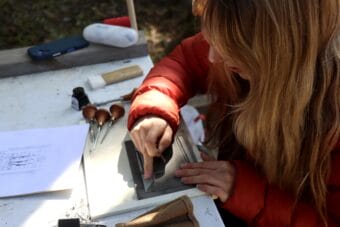
Svitlana Bell at her quilting station in Juneau on Oct. 23, 2025. (Photo by Yvonne Krumrey/KTOO)

This is Tongass Voices, a series from KTOO sharing weekly perspectives from the homelands of the Áak’w Kwáan and beyond.

Svitlana Bell moved to Juneau from Ukraine after a few years of seasonal work to marry her husband and send more money back to her family. 

Bell cleans houses during the day, but in the evenings, she spends hours quilting. Her quilts are intricate and full of color, with soft, curved lines. She sells her quilts — which are based on works by Ukrainian artist Lyubov Panchenko  — to raise money for supplies for her brother Serhii Matviichuk who’s fighting on the front lines in Ukraine. 

Bell will be showing her quilts at Changing Tides this Friday from 4 p.m. to 7 p.m. during Gallery Walk.

Listen:

The following transcript has been lightly edited for clarity.

Svitlana Bell: 

I do these numbers for myself to make a plan – what is first piece to another, and how connection. It’s like “eat elephant in small pieces,” you know? Make all together and that is it. It’s just like a Lego, yes.

I’m Svitlana Bell. This design, (by) Lyubov Panchenko, Ukrainian artist and she wasn’t so famous, because in Soviet Union you cannot be different. It was a different time. But she made a lot of beautiful pieces, and right now they are in museum in Kyiv. 

She died in 2022 in Bucha when it was occupied by Russians and she was starving because she cannot leave house. It was very difficult time.  

And when I find here these designs, I contact with that museum, I ask, “Can I try?” because I’m just learning to do quilt – I do only three years. I clean houses, I see a lot of blankets or stuff, and think, “I should try it!”

And Lyubov Panchenko’s design, I asked permission. They approved it and said, “Please try it, do it.” And so I was so happy. So I’m very excited. I hope someday when war finish there, and I will bring some of the best pieces to that museum. 

Svitlana Bell’s quilt made from a design by Ukrainian artist Lyubov Panchenko. (Courtesy of Svitlana Bell)

You know, I have to rush, because I know if I sell, I can send money. If you have somebody who you love, you will do anything.

And, of course, how I can help brother here. He is in — like all Ukraine — in difficult time now, and he do what he has to do. But you always in risk.

I can show you some pictures they make. Here they look very tired. And you see they just came back from front line for couple days to rest.

Drones, mines, shootings that can just with one shot, can destroy all car and everybody in (it). Yeah, it’s very scary. Sometimes, like, we don’t breathe. 

And waiting when he will be back and he say, “I’m safe now.” Because, yeah, war is war.

I think every immigrant – even before war from another countries – made such a huge decision – especially a woman who has kids – this, they are so brave. You need be so brave to be immigrant.

It’s America. It’s a lot of cultures here. It’s make this America beautiful and big and strong.

‘Our biggest weekend of the year’: Artisans count on sales and connections at Juneau Public Market

Doug Chilton holds up a mirror for a customer to see a pair of silver earrings at Juneau Public Market on November 29, 2025. (Photo by Alix Soliman/KTOO)

Listen to this story:

Over Thanksgiving weekend, Centennial Hall in downtown Juneau was bustling with people browsing for holiday gifts fashioned by around 175 vendors. 

Juneau Public Market ramped up the holiday shopping season with hundreds of people buying handmade art, jewelry, clothes and other goods. Vendors from near and far said it’s one of the most meaningful markets of the year for them. 

One ceramicist has been selling her kitchen wares at Juneau Public Market for more than 40 years. Betty Bell lives in Milton, Washington. She travels for the market and to see her daughter and grandkids, who live in Juneau. She said this annual visit is meaningful for her family. 

“It’s allowed me to get to know my grandchildren,” Bell said. 

Bell said market sales pay for her plane ticket every year. Now that she’s 91 years old, she sells her pottery almost exclusively at this market, but it used to make up about a quarter of her annual sales when she was throwing more clay. 

“Juneau has embraced me and supported me over the years, and I’ve kind of become your local, out-of-town potter,” she said. 

That sense of community connection is what brings many artisans back year after year. Vendors pay between $250 and $1,200 for a booth space, and many say they rake in a large portion of their annual sales from this market alone. 

Carley Thayer is an Aleut jewelry maker. Her business, Bering Sea Designs, features sharp lines, soft fur and colors of the ocean — inspired by the coastal cliffs of Unalaska, where she spent her early years.

“I make sea otter fur and metal jewelry,” she said. “So I’ve got earrings and bracelets and necklaces, some big pieces, like this body piece here that was on the Alaska Fashion Week runway.”

Carley Thayer sells handmade jewelry made of metal and otter fur at Juneau Public Market on November 29, 2025. (Photo by Alix Soliman/KTOO)

She said that selling her jewelry at Juneau Public Market makes up about half of her annual sales. But it’s about more than just the money for her.

“Growing up here, you know everybody, so it’s like a family reunion,” Thayer said. “It’s fantastic. We love Public Market.”

A woman wearing a pair of her earrings she’d purchased from Thayer in the past briefly stopped by the booth. 

“It’s really incredible to see your art walking around,” Thayer said after greeting her.

It was Bailey Mccallson’s first time as a vendor at the market with his business, Tuskworthy Premiums LLC. He’s a Yupik artist who traveled from Fairbanks to sell his earrings and sculptures made of carved walrus ivory. He said selling art through markets and online is important, “especially for Native people in communities where job security is hard.”

Mccallson has been a full-time artist for six years. Beyond the income, he said it’s allowed him and other Native artists to maintain their way of life. 

“They can stay in their homes rather than moving into the cities and be there for the elders so that apa doesn’t lose his grandchildren who pull the nets for him while they’re fishing and just to keep those cultural values strong and held together,” he said. 

Camille Jones owns Treetop Tees, a shop in downtown Juneau with shirts featuring locally-inspired designs. One of her favorites right now is an Eaglecrest chairlift, packed with cartoon animals representing each lift.

“Porcupine, black bear, hooter and ptarmigan — especially with black bear closing — I was like, we need to commemorate all four ski lifts,” she said. 

She said the market is important for business, particularly in the winter when tourists aren’t strolling into her storefront. 

“This is our biggest weekend of the year,” Jones said. 

Juneau resident Peter Metcalfe started hosting Juneau Public Market in 1983. He said vendors make somewhere between $5,000 and $8,000 on average over the three-day weekend. He said Black Friday this year was one for the books. 

“A couple of my longtime vendors said they did more in two hours than they’d done in all three days of previous events,” Metcalfe said. 

He said most makers are based in Alaska, and a little more than half are Juneau locals. 

“I can’t put a figure on how important this is for Juneau’s cottage industries, but I know many people who participate — it means a lot to their annual incomes, and it keeps them in the game,” he said. 

Artisans said it’s a warm and welcoming space that brings the art community together during the holiday season.  

Metcalfe said he generates revenue from the $10 per person entrance tickets, while most of the vendor fees pay what it costs to put on the event, including rental space and staffing.

Metcalfe is 74 years old. After he had a heart attack while running on Brotherhood Bridge Trail in 2021, he says people have been asking him about the market’s future.

“I do have a succession plan, and they introduce themselves as the heir and the spare,” he said with a chuckle. 

They’re his nephews. 

“So this will continue on within the Metcalfe family,” he said. 

Shoppers can continue gathering gifts locally at Juneau’s Gallery Walk this Friday. 

Juneau’s Vera Starbard earns Emmy nomination for ‘Molly of Denali’ Thanksgiving episode

Vera Starbard poses at a slight side profile wearing blue earring and a black dress.
Vera Starbard poses in a KTOO studio in Juneau on Nov. 24, 2025. (Photo by Jamie Diep/KTOO)

Listen here:

Lingít and Dena’ina writer and playwright Vera Starbard recently clinched her fourth Emmy nomination for the PBS Kids show, “Molly of Denali.” She was nominated for Outstanding Writing for a Preschool Animated Series for an episode called “Thanks-for-giving.”

The episode aired last November and follows Molly and her friends as they learn why some Alaska Native people don’t celebrate Thanksgiving. 

Starbard, who is currently Alaska’s State Writer Laureate, said she’d been pitching the episode since early in the show’s creation.

“It was sort of a, ‘let me at it,’” she said. “You know, I want to tell a Thanksgiving episode from a Native perspective. I don’t personally celebrate Thanksgiving.”

In the episode, Grandpa Nat, Molly’s grandfather, talks about why he doesn’t celebrate Thanksgiving and calls it a time of mourning. He talks about “new people” who outlawed many Indigenous traditions and destroyed different cultural pieces.

“Ah, sometimes people do awful things when they don’t understand other people’s way of life,” he says in the episode. “Remembering it makes my heart feel heavy.”

Starbard said the scene explaining that traditions were outlawed was the core of what she wanted to convey with the story.

“It wasn’t something lost, like I think when we hear about it, it’s as if we forgot it, that Native people just sort of blacked it out for some reason. It was taken from us,” she said. “It was very forcefully and violently taken from us. And that is difficult to do in a show like ‘Molly’ when you’re trying to, you know, talk to four year olds and eight year olds. You don’t want to re-traumatize people with it, but you do want to tell the truth, and you want to tell the full truth that really hasn’t been told to us in our history books.“

In the rest of the episode, Molly and her friends host a community-wide celebration highlighting Alaska Native traditions. That includes time to mourn. In the episode, Molly asks her aunt about it. 

“How can you be sad and celebrate?” Molly asks. 

“When we remember our ancestors together and talk about what was lost, we know we’re not alone,” Auntie Merna replies. “Then we can all heal together and celebrate what we have.”

Communal grieving through ceremonies like a Lingít ku.éex’ — also known as a potlatch — was also outlawed. Starbard said she wanted to bring that into the show.

“I don’t see many people talking about communal grief outside of Native communities,” Starbard said. “I think Native communities, we talk about it a lot, and I don’t see that many other places. This, to me, was a gift the Native people could give the rest of the world. This is how you grieve together, and it’s a good thing to grieve together.”

Starbard said this fourth nomination means a lot to her. But it’s a bittersweet moment. She thought about her dad when she learned she was nominated again. She brought her mom and sister to the Emmy ceremony for her previous nomination and wished she could have brought her dad as well.

“He had said, ‘Oh, but next time you’re nominated, I’ll go to that one.’ And he passed away a couple months ago, and that was definitely on my mind, just that he was so confident that I would be nominated again for my work, but also sad that he can’t be there,” she said. 

The winner of Outstanding Writing for a Preschool Animated Series will be announced at the Children’s & Family Emmy Award ceremony March 2.

Tongass Voices: S’eiltin Jamiann Hasselquist on the power of traditional foods

S’eitlin Jamiann Hasselquist serves chili made with beef, deer, and mountain goat meat in the Traditional Foods and Medicine Kitchen on Nov. 19, 2025. (Photo by Yvonne Krumrey/KTOO)

This is Tongass Voices, a series from KTOO sharing weekly perspectives from the homelands of the Áak’w Kwáan and beyond.

S’eitlin Jamiann Hasselquist has been hosting weekly community soup nights this month in the Traditional Foods and Medicine Kitchen inside Sealaska Heritage Institute’s new Indigenous Science Building in Downtown Juneau. 

She and her team use traditional Lingít foods to make soup for anyone who wants to try some — and maybe bring home the recipe to make themselves.

Last week, the group prepared chili with beef, deer and mountain goat meat. The last soup night is Wednesday from 6 to 7 p.m. 

Listen:

The following transcript has been lightly edited for clarity.

S’eiltin Jamiann Hasselquist: Can you hear it sizzling? We have so many good things in here. We have g̱uwakaan, deer; jánwu, mountain goat and wasóos, cow.  

And then cow, you know, wasóos. Most of us know cow. But we don’t know that it’s called wasóos in Lingít, and so to share that part is kind of fun. 

Lingít x̱’éináxS’eiltin yoo x̱at duwasáakw. Yéilx̱ x̱at sitee. Deisheetaan áyá x̱at. Yéil S’aag̱i Hít dáx̱. My people come from Angoon and the Raven’s bones house and my Lingít name is S’eitlin. Most people know me by Jamiann. 

I think it’s a really beautiful way to bring community together, especially in a time of need, when SNAP benefits have been delayed or whatever it is, it’s putting our families and members of our community into very stressful positions where they’re having to make choices between food and whatever else is important.

And so being able to provide a night where we can gather together and share a meal and just enjoy each other’s company and show each other like we’re not alone, that we’re here to support each other. I think that’s really important. 

There was a child who was in here, I think last week. They had never tried deer meat before, so it was their first time. They were probably 10 years old, and others. I never tried mountain goat before. You know, I’ve been cooking with it now. It cooks a lot like deer, and it tastes pretty similar to deer, but a little bit different. 

And then cow, you know, wasóos. Most of us know cow. But we don’t know that it’s called wasóos in Lingít, and so to share that part is kind of fun. 

I think it’s really nice to be able to share these out with people in the community, because it should be a part of our regular diet, and because of, you know, harms that have happened, distances between relations of the Earth and us as people, and what we ate in our diets, what we use for plant medicines, there’s  been a huge disruption in that. 

And so to be able to bring it into a dish like chili, to share it with everyone and have them try it, I hear things like, “Oh, I remember tasting this when I was a kid,” or “I’ve never had this in my entire life.” So there’s a wide range of emotions that go along with feeding this traditional food to our people. 

That animal, they had a life going on, and they give that life to be here. And so um I will thank it for its life and its spirit still being with us through this process, and tell it the healing that it’s bringing to the people.

That some people have never tried you before. They don’t know the taste. Some people, it’s going to transport them back to when they were children, 30 years ago. Maybe, you know, some people think that they never were going to try this again. 

It makes me emotional when I’m talking to them, but I also feel it’s very appropriate, and it’s something that has to be done to be able to respect the spirit of whatever that is that’s here, to help us learn, to help us return, to re-remember.

Maggie McMillan to lead Juneau Arts and Humanities Council

Maggie McMillan will start in her new role as the Juneau Arts and Humanities Council’s Executive Director in December. (Courtesy of Maggie McMillan)

Maggie McMillan is the new Juneau Arts and Humanities Council Director.

The JAHC announced the hire Friday, more than six months after the former director stepped down in May.

“Between my love for art and my love for the community, it was just like a pillar I’ve always had my eye on,” she said. “And if I had the opportunity to try to lead it, I really wanted to try.”

McMillan served as Juneau Chamber of Commerce director for three years, before taking a role in donor relations earlier this year at the Central Council of the Tlingit and Haida Indian Tribes of Alaska. 

She said she’s excited to bring her experience in economics to the JAHC. 

“I’m really excited to figure out how we make it a more profitable nonprofit,” McMillan said.

Phil Huebschen led the local arts organization for two years before resigning following the JAHC board’s decision to remove diversity, equity and inclusion language from its website. The board said the language cuts were temporary, and in response to the Trump administration’s threat to cut federal funding to organizations that use DEI language in their programming.

Stacy Katasse served as the interim director as the search for a new director stretched on. In August, the JAHC increased the salary range for the role to between $110,000 and $140,000.

The announcement comes shortly after the Juneau Assembly reallocated $5 million dollars originally intended for a new Capital Civic Center building toward glacial outburst flood mitigation. 

The proposed new convention center and performing arts venue would replace the JACC and Centennial Hall. Voters rejected a ballot proposition intended to fund the construction in 2019.  

McMillan starts her new role at the JAHC on Dec. 1. 

First screen adaptation of ‘Two Old Women’ told in severely endangered Athabascan language

A still from the screen adaptation of Velma Wallis' 1993 novel, "Two Old Women."
A still from the screen adaptation of Velma Wallis’ 1993 novel, “Two Old Women.” (Deenaadàį’ Productions)

Fairbanks-based Alaska Native filmmakers from Deenaadàį’ Productions are bringing an award-winning 1993 book to the screen for the first time.

“Two Old Women” is an adaptation of Velma Wallis’ novel of the same name – and in the new film, the story is told entirely in Gwich’in. It premiered in Hawai’i last month, with homecoming showings scheduled in Alaska in December.

Wallis’s 1993 book is based on an Athabascan legend and takes place in a time before colonization. The story follows a pair of elderly women, Ch’idzigyaak and Sa’, who are left behind by their tribe, which faces starvation amid a harsh winter and shortage of food. The main characters then battle against the elements, relying on their ancestral knowledge and each other to survive in Alaska’s wilderness.

Filmmaker Princess Johnson remembers when she first read the book as a teenager, and she said adapting it for the screen is something she’s been wanting to do for more than 20 years.

“I felt that, when I initially read it, I could see it. You know? I could visualize it,” she said. “And, at that time, I was still very early in my filmmaking career and my filmmaking journey.”

In the years since then, Johnson has worked as a creative producer on the PBS Kids series “Molly of Denali” and produced six episodes of the latest season of HBO’s “True Detective.” Now, she’s added to her resume writing, directing and producing the 14-minute short for “Two Old Women,” a proof-of-concept for what she hopes to develop into a feature film.

In the screen adaptation, Ch’idzigyaak and Sa’ speak to each other in Gwich’in. In fact, the film is entirely in the Athabascan language, which is considered severely endangered.

Johnson said she got some pushback early on from production companies and others who thought the language piece would be a hard sell, but she said that part was non-negotiable.

“There’s just such a richness and a nuance. I think we would actually lose a lot if it was in English. It wouldn’t be as believable or, like, pull us into that authenticity of a pre-contact piece,” she said.

Gwich’in has about 300 speakers in Alaska, according to the Alaska Native Language Center, and 205 in Canada, per the country’s most recent census data, from 2021.

Taa’aii Peter, a producer on the project who also helped with the translation, is an advocate of Indigenous knowledges, languages and rights. He said experiencing Gwich’in on the big screen can be a source of pride, a way to uplift the language and even an educational tool.

“Art is such a powerful medium of communication. It’s inspirational, can be life changing and transformational for people,” said Peter, who also has a background in film production and previously served as the vice chancellor of rural, community and Native education at the University of Alaska Fairbanks.

Peter said the end product is just one part of what can give art that power. Behind the end product are the people – and the process – and he said the filmmakers brought together Gwich’in speakers and culture bearers so that, together, they could figure out how to best tell “Two Old Women” in a language that carried the story for thousands of years.

He said that decision “just makes complete sense.”

“And then it’s also this form of helping to make this contribution to advancing the important focus on language and language work that’s happening within our community and within a lot of other Indigenous communities,” Peter said.

The short film was shot in three days at Borealis Basecamp, north of Fairbanks, and at Gather, which is a social space downtown. But it’s been in the making for about five years. The filmmakers say, during that time, they used the project to build community in other ways, too, like running hide-tanning workshops where people could learn traditional practices while making clothing that appears in the film.

Like Peter, Johnson said the workshops, contributions and other inputs are just as important as what winds up on the screen.

“To me, like, in its best form, filmmaking can be a form of healing. It can be a form of medicine,” she said.

The film stars Margaret Henry John and Brenda K. Newman as Sa’ and Ch’idzigyaak, with Chief Galen Gilbert of Vashraii K’oo, Alaska, appearing as Chief Dajalti’. The 14-minute short will be screened in Fairbanks as part of an event at Morris Thompson Cultural and Visitors Center on Dec. 5, which starts at 5 p.m. It’ll also be shown at the Anchorage International Film Festival on Dec. 13 at 3 p.m.

Site notifications
Update notification options
Subscribe to notifications