KRNN

Artist teaches formline in prison by day, Tsimshian by night

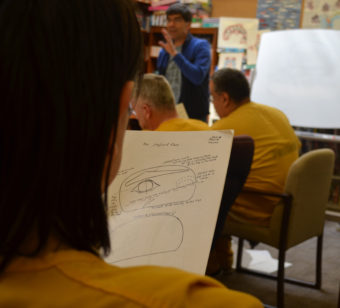
Littlefield examines one of David A. Boxley's handouts. He says handouts like these, and Boxley's ability to break things down make him a great teacher. (Photo by Scott Burton/KTOO)
Tsimshian artist and teacher David A. Boxley just wrapped a pair of intensive, weeklong workshops on formline design and Tsimshian language in Juneau. He’s been at Lemon Creek Correctional Center teaching formline by day, and at the Walter Soboleff Building teaching Tsimshian language by night.

Entering the maximum security prison—with its checkpoints, razor wire barricades, metal detectors and armed guards—it’s hard to imagine an art class. Until you get to the library.

“I have nine hard-working fellas sitting around a big conference table with elbows flying, and pencils and erasers moving quickly, and they’ve got templates, and booklets with all the information and diagrams to help them produce the eagles, ravens, wolves and killer whales that they’re working hard to produce,” says Boxley who is best known in Juneau for the two-story high clan house front he made for the Walter Soboleff Building.

Nine men attended David A. Boxley's four-day formline design class. (photo by Scott Burton/KTOO)
Nine men attended David A. Boxley’s four-day formline design class. (photo by Scott Burton/KTOO)
William Littlefield holds his drawing. He hopes to make and teach art professionally when he is released. (Photo by Scott Burton/KTOO)
The men wear bright yellow prison onesies and are of diverse cultural backgrounds. They look focused and work silently. Colorful examples of formline art are taped to the shelves of books, and natural light filters in through two skylights. Boxley circles the room observing the students’ work. Among them is aspiring Tlingit artist William Littlefield from Sitka.

“There’s been a few people that has been willing to teach me this but they don’t break everything down like how David has,” says Littlefield, who wants to make art and teach professionally when he gets out.

Boxley and class sponsor Sealaska Heritage Institute want to help artists like Littlefield improve their formline design.

“The art is endangered because people are producing stuff that isn’t really that great,” says Boxley. “There are some of us that really want to stem that tide and redirect people back to making good quality formline. And formline, like my grandfather used to tell me, no matter how good the carving is, if the design is bad then the whole thing is bad.”

Once the 7-hour formline class is over, Boxley heads downtown to teach Tsimshian language for 3 more hours.

Boxley demonstrates with the Tsimshian language class. UAS student David Russell-Jensen sits second from the left in the back row. (Photo courtesy Brian Wallace/Sealaska Heritage Institute)
Close to 20 people have gathered in an empty office space at the Walter Soboleff Building. Boxley has labeled most objects in the room in Tsimshian, and two tables of props for games and activities stand before them. While art and language are related, Boxley says they’re in different states.

“Our art is flourishing. There are hundreds and hundreds of people from different tribes from Yakutat to Seattle who are producing art,” says Boxley.
The language is a different story. Boxley says there are only 50 fluent Tsimshian speakers left.

“Our language is extremely threatened, I mean beyond extremely threatened,” he says.

After instruction from Boxley, the students break out into small groups to practice introductions.

David Russell-Jensen is Tsimshian Killer Whale with roots in Metlakatla and now lives in Juneau. He goes to the University of Alaska Southeast. While studying Tlingit there, he learned about Boxley’s class.

“I think it’s important to be connected to the land you live on but also it’s very important for me to be learning my language because it’s not in that great of state right now so, hoping to work on that,” says Russell-Jensen.

Russell-Jensen embodies Boxley’s hope for the future of Tsimshian language.

“You know it’s not our fault that we speak primarily in English these days, but it will be our fault if the last speaker dies and no one else can do it,” says Boxley.

“Not everyone can be a dancer or a singer, not everyone can be a carver or an artist but everybody talks. So we’re all responsible for the life or death of our language going into the future.”

Both Boxley and the Sealaska Heritage Institute hope to do more Tsimshian language classes in the future. Boxley’s next gig is at home in Washington state, where he’s teaching a mask-making workshop.

Boxley teaches the class how to introduce themselves in Tsimshian. (Photo courtesy Brian Wallace/Sealaska Heritage Institute)

Three-day program uses basketball to combat bullying in Hoonah

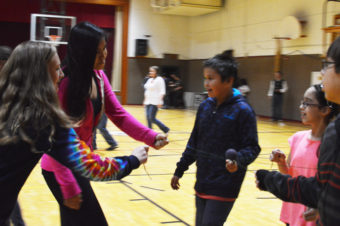
Hoonah students balance a small ball on two strings as a part of a team building exercise. (Photo by Lakeidra Chavis/ KTOO)

Last Friday morning, more than 50 students tossed hoops, dribbled basketballs and hustled feet in the Hoonah High School gymnasium. But this wasn’t a gym exercise. It was a part of a three-day anti-bullying awareness program.

“It takes different kinds of forms. It can be very subtle; it can be very physical and upfront in your face. It can happen on the playground, it can happen in the home,” according to coach Andy Lee.

In the last 10 years, Lee has been to more than 30 villages in Southeast and the Northwest Arctic to raise awareness about bullying and substance abuse.

School started last Wednesday, and Lee spent the first three days of the school year teaching the students about teamwork, career-building and anti-bullying awareness. He uses basketball to teach these fundamentals.

Coach Andy Lee poses with Hoonah kindergartners during their lunch house. (Photo by Lakeidra Chavis/KTOO)

“Kids need to be resilient enough to resist bullies, and people have to allow them to stand up and say ‘no’ to it, and I think it’s important to address it from both ends of the spectrum,” Lee said.

Hoonah High School is the 13th school he’s visited in the past 15 weeks. Friday evening he returned home to Sitka, where he is the basketball coach at the local high school.

“Well, I think the key thing is that I come and go, but the issues remain,” Lee said.

According to results from the 2013 Youth Risk Behavior Survey, ninth graders were most likely to report being bullied within the past year, regardless of ethnicity. Female students were more likely than male students to experience bullying.

Two of the students at first wanted to talk about how one of them had been bullied, but after our conversation she returned to ask her experience not be shared for fear that someone might recognize her voice.

(right to left) Hoonah School District Principal Lorrie Scoles discusses Coach Lee's program with Teacher Assistant Bob Barton and Counselor Nung Dinh.
Hoonah School District Principal Lorrie Scoles, right, discusses Coach Lee’s program with teacher assistant Bob Barton and counselor Nung Dinh. (Photo by Lakeidra Chavis/KTOO)

Hoonah School Principal Lorrie Scoles thought the program was a good way to start off the year.

“We have several new teachers here with us this year. We wanted to do some community building and let the kids build some leadership skills,” Scoles said.

This year, Hoonah’s enrollment is high at 120 students. There are about 13 new students and eight new teachers out of a staff of 13. Scoles says that in a school this small, bullying may take on the form of teasing and if it’s been normalized, students might be hesitant to speak up.

Nung Dinh is one of the new hires.  She’s the school’s new counselor and art teacher. Dinh says she enjoyed the program.

“I believe it was a powerful program to get the kids thinking about their future, and thinking about why are they here at school and putting a since of purpose in that,” Dinh said.

Bob Barton, a seasoned parent-teacher assistant for the special education department, agrees.

“I liked the way he didn’t pull any punches or try to sugarcoat anything, but tried to give the students of the real world, and what’s it’s going to be like to try to reach whatever goals they set,” Barton said.

All the students agreed that they enjoyed the program, but when asked about their experiences with bullying and how it was dealt with in the school?

When asked they experience bullying or if the teachers intervene, the students didn’t respond.

The Mayor’s Awards for the Arts honors seven

The certificates for the 2015 Mayor's Awards  for the Arts feature Timi Johnson's "Reflections on Sailing." It won the a 2015 Best in Show award through a the Juneau Arts and Humanities Council.
The certificates for the 2015 Mayor’s Awards for the Arts feature Timi Johnson’s “Reflections on Sailing.” It won the 2015 Best in Show award at a juried art show through the Juneau Arts and Humanities Council.

Seven artists and organizations will be recognized on Friday for their contribution to Juneau’s art scene. This year’s Mayor’s Awards for the Arts takes place at the Juneau Arts and Culture Center.

When the awards started in 2007, Bruce Botelho was mayor. Botelho said it was Nancy DeCherney’s idea. She was the newly-appointed executive director of the Juneau Arts and Humanities Council.

“And I think largely to emulate what has been a long standing practice in the state by the State Arts Council with the Governor’s Awards for the Arts,” he said.

Bruce Botelho was mayor when he helped conceive the Mayor’s Awards for the Arts in 2007. (Photo courtesy CBJ)

DeCherney remembers it differently.

“The arts council was in the basement up on Franklin Street and Mayor Botelho came in and just wanted to chat and suggested that one of the things that might be really nice would be if we did a Mayor’s Awards for the Arts to sort of highlight all the wonderful things that go on in the community. So we did,” said DeCherney.

I told her Botelho’s version, and she laughed out loud.

“OK, memory fades. You know how it is,” she said.

Nancy DeCherney began as the Juneau Arts and Humanities Council's Executive Director in 2006 and helped begin the Mayor Awards for the Arts. (Photo courtesy Nancy DeCherney)
Nancy DeCherney began as the Juneau Arts and Humanities Council’s Executive Director in 2006 and helped start the Mayor’s Awards for the Arts. (Photo courtesy of Nancy DeCherney)

The Arts Council chooses the awardees based on nominations from the community. Since 2007, it’s given 48 awards. Photographer Ron Gile will receive this year’s innovation award. He says he might have been chosen because of a Facebook page he helped develop to alert fellow photographers when Romeo the wolf was out and about. Or maybe it’s because of the themed competitions the Juneau Photography Group hosts.

“One of the things about photography is that people get into a niche; they’ll get into a rut is a better way of looking at it,” said Gile. “They’ll shoot one thing and one thing only. Like they’ll go shoot airplanes or they’ll just shoot landscapes. We started a challenge, a bi-weekly challenge, there’s no awards given other than you get to be the next judge for the following challenge.”

The latest challenge is called “Tales from the Jungle.” It urges participants to “capture stories and players in the forests of Southeast.”

“But is was to try and get people to go out of their comfort box, and to try and find new ways of looking at things around us. To break that mold, and to expand and grow as a photographer,” said Gile.

The other six other awards are going to:
• Dancer and teacher Pat Belec,
• arts educator Heather Ridgway
• Juneau Lyric Opera
• Annie Kaill’s for business leadership
• ConocoPhillips Alaska for being a patron of the arts, and
• Juneau Jazz and Classics Executive Director Linda Rosenthal for lifetime achievement.

The free event is casual, begins at the JACC at 5:30. Assemblywoman Debbie White will present the awards in lieu of Mayor Merrill Sanford.

Flying Karamazovs and friends bring Chautauqua spirit to Juneau

A selfie shot while the New Old Time Chautauqua band  marches through a Wrangell supermarket, June 25, 2015. (Photo by Eben Sprinsock/New Old Time Chautauqua)
A selfie shot while the New Old Time Chautauqua band marches through a Wrangell supermarket, June 25, 2015. (Photo courtesy Eben Sprinsock/New Old Time Chautauqua)

When the New Old Time Chautauqua marched into a TEDx talk in Seattle in 2012, there were jugglers, marching band musicians with mismatched uniforms, a saxophonist with a fez and a mustachioed ringmaster in a kilt.

Now, the motley troupe of almost 60 performers and educators is in Juneau for three days of workshops, shows and activities that start Thursday.

The traveling Chautauqua movement began on Lake Chautauqua in New York in the late 1800s. They brought lectures, theater and music to rural communities but it mostly died out after the rise of radio and motion pictures.

"School Children’s 'Chautauqua' Demonstration" in Juneau, Sept. 21, 1921.  (Alaska State Library, David & Mary Waggoner Photographs & Papers, 1900-1940, Winter & Pond, ASL-PCA-492)
“School Children’s ‘Chautauqua’ Demonstration” in Juneau, Sept. 21, 1921. (Alaska State Library, David & Mary Waggoner Photographs & Papers, 1900-1940, Winter & Pond, ASL-PCA-492)

In 1981, Patch Adams — yup, the one Robin Williams played — and the Flying Karamazov Brothers revived the movement. Natalee Rothaus was with the Juneau Arts and Humanities Council in 1992 when the New Old Time Chautauqua first visited Juneau.

“It’s so much fun and it’s so much goodwill, spirited. You know, you’re working with people who are doing this for the love of it. They’re not coming in just to do a show. It’s not just a gig, it’s a Chautauquan family,” Rothaus says.

A New Old Time Chautauqua performer in the streets of Wrangell, June 26, 2015. (Photo by Zachary "Skip" Waddell/New Old Time Chautauqua)
A New Old Time Chautauqua performer in the streets of Wrangell, June 26.
(Photo courtesy Zachary “Skip” Waddell/New Old Time Chautauqua)

The New Old Time Chautauqua is a nonprofit whose members volunteer their time and fund their own travel during their month-long tour each summer. It’s Chautauquan tradition to share knowledge, partner with local organizations and build community through laughter, entertainment and education.

“The last time we did do a parade, it was quite wonderful. I myself wanted to run away with the circus,” says Rothaus.

One Juneauite actually did. Valerie Snyder, owner of Douglas’ BrownBoots Costume Company, joined the Chautauqua in Bellingham last month for a crammed week of rehearsals before they hopped the ferry up to Ketchikan. During their parades, Snyder says, “People are genuinely surprised and we get community members to march with us. In Ketchikan, I ran up the sidewalk and I did a little face painting to all the little kids waiting on the side of the street. ”

A New Old Time Chautauqua performer juggling in the streets of Wrangell, June 26, 2015. (Photo by Zachary "Skip" Waddell/New Old Time Chautauqua)
A New Old Time Chautauqua performer in the streets of Wrangell, June 26.
(Photo courtesy Zachary “Skip” Waddell/New Old Time Chautauqua)

So far on this jaunt, the group has performed in Ketchikan, Wrangell and Petersburg.

Snyder is the only Alaskan from Southeast in the troupe. She plays violin, juggles, hula hoops, and contributes a little singing and dancing.

“Just expect fun and warmth and friendship. We’re just here to entertain and put a smile on your face,” Snyder says.

For a full list of events, click here.

Their three-day routine begins with an open potluck Thursday at the Douglas library. Think of it as a Chautauqua launch party with a chalk drawing competition and community music jam.

Friday is the workshop day at Centennial Hall, where the Chautauquans and community members will teach circus skills, how to build a fire using friction, the Chinese meditative art of Qigong, how to fold a fitted sheet, and lecture on health.

There will also be pop-up performances downtown. The only ticketed part of their visit is their headlining vaudeville show Friday evening, which features music, aerialists, the Flying Karamazov Brothers and lots of shtick.

New Old Time Chautauqua jugglers in a rainy teaser show in Wrangell on June 26, 2015. (Photo by Zachary "Skip" Waddell/New Old Time Chautauqua)
New Old Time Chautauqua jugglers in a rainy teaser show in Wrangell on June 26. (Photo courtesy Zachary “Skip” Waddell/New Old Time Chautauqua)

On the Fourth of July, they’ll march in both the downtown Juneau and Douglas parades.

New Old Time Chautauqua founder and original Flying Karamazov Brother Paul Magid hopes to inspire change person to person. The troupe will perform at the Johnson Youth Center and the Juneau Pioneer Home, too, as part of their service mission.

Magid describes the spirit behind their group in his 2012 TEDx talk:

“And it’s a our love of music, play, laughter and for each other that bridges all religious and political differences whether it’s on a baseball field, in a grocery store, or at a maximum security prison.”

After Juneau, they’re headed to Hoonah, Haines and Sitka.

Full disclosure: All proceeds from Friday’s ticket sales benefit KTOO. 

Video: MacNaughton portrays the seldom seen

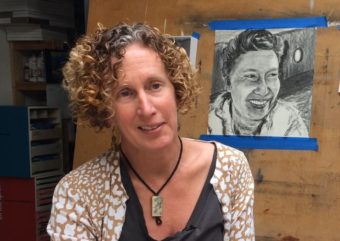
On Friday, Juneau artist MK MacNaughton is hanging portrait number 26 of her project “Grit.” MacNaughton hung the first portrait in early January and says she picks her subjects not for how they look, but for what they do. So far, she’s drawn and hung portraits of electricians, fishermen, firefighters, bus drivers, heavy equipment operators, carpenters and more.
Portrait number 26 of 52 goes up at 4:30 on Friday at the Juneau Arts and Culture Center. It’s of chef and restaurant owner Beau Schooler.

Listen to MacNaughton describe the project see her portraits to date in this video:

Red Carpet Concert with Liz Snyder

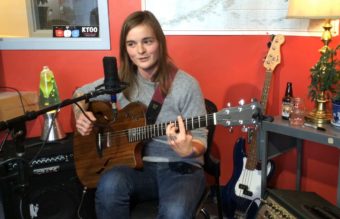
Juneau songwriter Liz Snyder brought her enchanting original music and incredible whistling to KTOO’s red carpet for her first live solo performance in two years. Snyder is well known in Southeast Alaska as a member of folk rock duo The Wool Pullers. She pulled out two new songs along with crowd favorite “Garbo Has No Say in This.”

Set List:
“Garbo Has No Say in This”
“Verse by Verse”
“Stop”

The concert was recorded June 12 in the KTOO arts, culture and music office.

Site notifications
Update notification options
Subscribe to notifications