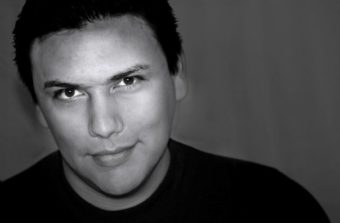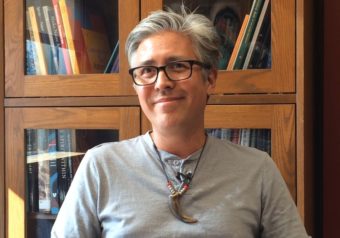
C Scott Fry is the voice behind KRNN’s “Fry’s the Limit” on Saturdays. (Photo by Scott Burton/KRNN)
The Juneau Police Department confirmed in a press release Thursday that an arrest has been made in the assault of a 50 year-old Juneau man.
The victim, C Scott Fry, was found unconscious and badly beaten on Front Street on Saturday morning. Fry is a musician and employee at the Alaskan Hotel & Bar. He was discovered by a JPD officer bleeding from the face and didn’t appear to have a pulse.
CPR was administered by the officer. He was transported to Bartlett Regional Hospital and later, Harborview Medical Center in Seattle. The hospital described his condition as “stable.”
Darrin D. Austin, 31, was charged with second degree assault. JPD describes the investigation as “ongoing.”
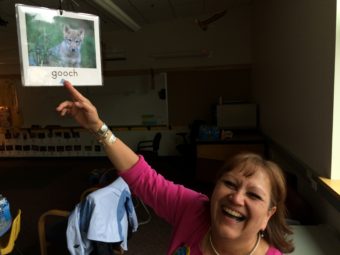
It’s the last day of class in Eddy’s combined kindergarten and first grade classroom. You’d think it’d be hard to gather the students, but it just takes counting down from five — in Tlingit.
Kitty Eddy and students from the Tlingit Culture, Language and Learning Program. (Photo by Scott Burton/KTOO)
“Keijín. Daax’oon. Nás’k. Déiý. Tléix’!” Eddy says in a patient yet stern manner as the students move to the front of the class to sing and dance.
The program, which began in 2000 with help from a federal grant, is a collaboration between Sealaska Heritage Institute and the Juneau School District. The two founding teachers were Eddy and Nancy Douglas.
“That first year was lot of work,” says Eddy who is Tlingit, Yanyeidi (clan). “We worked every single day to try and pull together a classroom that was different than the normal classroom that was based on our culture.”
The program has since grown to include all the elementary grades at Harborview. While the majority of the students in the program are Alaska Native, any student interested in Tlingit culture and language is welcome.
The immersion classrooms are similar to other classrooms in that they do required math and reading, but there is a difference.
“We really build a family unit so that you have a group of children who come in and want to be here and that they belong,” Eddy says.
Eddy engenders the family approach with help from elder Selina Everson and language specialist Jessica Chester, among others. Chester was born and raised in Juneau and is grateful for what the program is doing.
Jessica Chester (left) is a Tlingit language specialist that works in Eddy’s classroom. Shgen George has been with the program since 2002 and teaches a combination fourth- and fifth-grade class. (Photo by Scott Burton/KTOO)
“I never had teachers like Ms. Kitty or Ms. Nancy,” Chester says with tears in her eyes. “So my first year here, the way I saw them work with our children was so much different from the way I was treated and my brother and my sister were treated when we were kids. I just saw that, and something inside me grew and it made me a better person, it made our community better and I am forever grateful for the work they did.”
Eddy knew the program was on the right track by the end of the first year. The kids and their families gathered for a party. All the students’ grandmothers were in tears.
“It was the very first time in their lives that they had heard our language spoken in a public school. And I really think for all of us it really brought to light, ‘Wow, we are doing something incredible and impacting not only the kids, but families,’” Eddy says.
Student test scores have had good and bad years, just like any other classroom, Eddy says.
“When you think about success it’s more than just what the data tells us,” Eddy says. “When you have kids happy to walk in the door in the morning, and they are engaged in what you’re doing, they figure out who they are as a person.”
Eddy says she hopes staff will be able to come together to continue the program without basing it on mandated curriculum. She says new administrations and changing mandates have sometimes put the program in flux.
“I think that they are amazing people who really are going to need to have fight in them to make changes that need to be made,” says Eddy.
And if they need help, Eddy says not to worry. She’ll come back occasionally as a substitute teacher or just to check on the family.
Katasse is known to many as an actor. Here he plays Amos Hart in Perseverance’s production of “Chicago.” (Photo courtesy of Perseverance Theatre)
Urban life has long drawn young people out of rural Alaska. Now art is imitating Alaska life in a first-time Juneau playwright’s new play “They Don’t Talk Back.” The debut work has caught the eye of a well-known Native American theater company, and drawn the homegrown playwright to Los Angeles.
Frank Katasse says his writings often explore the sometimes confusing differences between his Tlingit heritage and contemporary society. When inspiration hits he will compose a monologue, a soliloquy or a poem; this is his first full-length play and is composed of several years of these writings that ride on a central theme.
Katasse is an actor, director, producer and playwright. (Photo courtesy of Frank Katasse)
Not expecting much, Katasse submitted his play to a leading Native American theater company Native Voices at the Autry in Los Angeles. The theater chose Katasse’s play amid numerous submissions as one of three major works to present at this year’s 17th Annual Festival of New Plays.
“He’s an amazing first-time playwright,” says Native Voices Producing Executive Director Jean Bruce Scott. “The fact that this is his first full-length play is telling in terms of his natural talent.”
Scott says the play is unique: “He’s using what we’re currently calling interludes that bracket the individual scenes that are happening in the play. And the interludes, each one of them is different. One may be Tlingit drumming and singing. One may be a poem. He’s using spoken word.”
He’s also using what Scott calls a beatbox-like rhythmic language.
“And then he’s telling a very important story in Indian country, and that is the connection between culture and history, and the present day, and how do Native people hang onto their children.”
Katasse will be in Los Angeles through the end of May for the Playwrights’ Retreat. A full company of nationally recognized directors, dramaturges, producers, designers and Native American actors will read and critique “They Don’t Talk Back.”
Katasse is excited, but says playwriting is different from his usual role as an actor.
“It hasn’t even started yet and I’m nervous, which is very odd,” Katasse says. “I don’t get nervous very often going on stage. But already I’m feeling like it’s something that is out of my control and I just have to trust the ensemble which other playwrights have obviously done with me.”
It’s ironic that Katasse is leaving Juneau himself, but that irony is not lost on him. He plans to bring back all that he learns and share it with aspiring playwrights in Juneau.
Cousin Curtiss played for us in the KRNN/KTOO/KXLL/360 North arts, culture and music office on May 15th, 2015. Check out his three tunes and hear about his new CD and upcoming tour.
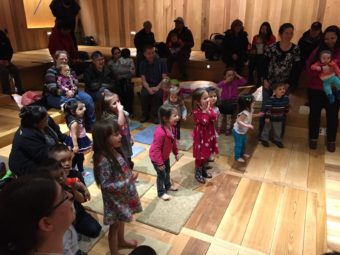
Betty Ann Samato reads a book with her grandson Bryson Stepetin at a Baby Raven Reads family night. (Photo by Brian Wallace/Courtesy Sealaska Heritage Institute)
Families and young children mill around tables in the lobby of the Walter Soboleff Building. There’s a station for coloring, one for science. Margaret Katzeek and her 2-year-old niece Elayna are at the snack table.
Margaret Katzeek brought her niece Elayna Katzeek to the Baby Raven Reads family night. (Photo by Lisa Phu/KTOO)
“Do you want some water?” Katzeek asks Elayna. “Do you remember what it’s called? Heen. Let’s say heen.”
This is their second Baby Raven Reads family night. The free early childhood program run by Sealaska Heritage Institute builds on the strengths of Alaska Native culture in teaching early literacy. Katzeek says they’re a fun way to learn the Tlingit language, for her niece and herself.
“They say the best way to learn something and get to know something is trying to teach it,” she says, “so I definitely work on the words that I do know, I work with her on it lot.”
But Katzeek says Elayna picks up songs better and, lucky for her, there are several that evening with language learner and teacher Mary Folletti.
Inside the clan house, about 30 children, infants to 5-year-olds, start off sitting on small rugs or on the laps of family members. Moments later, many of them are on their feet, singing, laughing and dancing along. About 40 adults sitting on the periphery watch their children, smiling. Some join in the singing.
Inside the clan house at the Walter Soboleff Building, Mary Folletti sings familiar sounding songs with Tlingit lyrics. (Photo by Lisa Phu/KTOO)
Folletti leads the group in Tlingit songs to the tunes of “If You’re Happy and You Know It” and “The Hokey Pokey.” She helped translate these songs several years ago.
“Those songs are great because the kids are already familiar with them and they are the same idea. We do things different, like, ‘Dance like a Tlingit,’ but it is like, ‘Turn yourself around,’ so it’s got a lot of the same ideas,” she says.
Folletti says exposing children to the sounds of the Tlingit language is important for development.
“I know people who learn the Tlingit language when they were older and because they had never tried to make those sounds before, they’d never heard those sounds before, they physically could not make the sounds, so I think it’s important for them to hear it,” Folletti says.
(Photo by Brian Wallace/Courtesy Sealaska Heritage Institute)
Early education specialist Karen Larson is working with Sealaska Heritage Institute. She says the Baby Raven Reads program emulates other successful early learning practices. It gives out a free children’s book at each session, like the Dolly Parton Imagination Library. It brings families together, like events organized by the Association for the Education of Young Children. And it’s all done in ways relevant to Alaska Native families.
“People are really craving cultural experiences for their children and language exposure. And then people bring their own culture to it and it grows from there,” Larson says.
Pamela Craig and her son, Kee Night Gun Cole. (Photo by Lisa Phu/KTOO)
Parent Pamela Craig is one of those people. She’s with her 2-year-old son.
“This is exactly the kind of thing that I think he needs, to be able to meet up with his Native peers from an early age and be able to work with them and have people to talk to, especially learning language,” Craig says.
The Baby Raven Reads events are good for her as well.
“Just looking around, I have family here, my relatives and other people I’ve met through the years going to different Native events, and so it’s a good opportunity for me,” Craig says.
That’s part of the early childhood program – creating community.
Jackie Kookesh is the education director for Sealaska Heritage Institute. She hopes people like Mary Folletti will be an inspiration to parents and relatives.
“To sing along with Mary and their children and try to pronounce the Tlingit words that are in the song, that takes a lot of courage,” Kookesh says. “And so if that’s an outcome we come away with, I say that’s phenomenal, creating those safe places for the language to be in the air and to be heard and for everybody to do it together.”
Kookesh hopes the program will make more parents comfortable singing “Twinkle, Twinkle, Little Star” in Tlingit with their children.
Sealaska Heritage Institute is hosting another Baby Raven Reads family night for Alaska Native families this Saturday, May 23. For more information, contact Jackie Kookesh at 586-9229.
Tlingit glass artist Preston Singletary was chosen as one of three people to contribute monumental art to Sealaska Heritage Institute‘s new Walter Soboleff Building. In this video he explains the inspiration for his glass screen and his take on contemporary indigenous art.
Close
Update notification options
Subscribe to notifications
Subscribe
Get notifications about news related to the topics you care about. You can unsubscribe anytime.