In the Community

Juneau-raised rope jumper attempts 3 world records

Peter Nestler has been hooked on jumping rope since second grade, when he saw an exhibition at Glacier Valley Elementary School.

In third grade, he joined the Juneau Jumpers. By the time he finished high school, he had helped his team win seven world championships.

Now 33 and living in Tulsa, Oklahoma, Nestler has come full circle. He’ll perform his world class rope and unicycle skills for a new generation at Glacier Valley on Friday.

“It’s where I learned to jump rope,” he said. “I was on the team there, pretty much my entire learning curve was at Glacier Valley. So it’s kind of neat, and I was thinking about where to do these records. And I was like, you know, it would be kind of cool to have one where I actually started.”

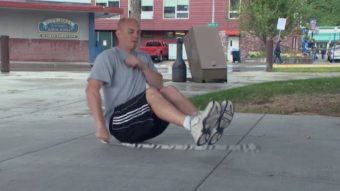
During the show, the Ketchikan native hopes to set a new world record for most bum skips in 30 seconds.

That’s right, bum skips. Nestler explains:

“Basically, you’re seated with your feet out in front of you, and you’re jumping while you’re sitting down,” he said. “For this particular record … you hold both handles in one hand, so the rope’s basically cut in half. And then you spin the rope so it’s making kind of like a helicopter motion, but it’s going, it’s staying on the ground and you’re jumping over that with every jump.”

The current record is 82, according to the Guinness World Records press office.

He already holds the record for most rope skips on a unicycle in one minute: 237. Nestler hopes to set a total of 11 new world records this year, three of them in Juneau in the next six days.

Unicycle Skipping World Record from Peter Nestler on Vimeo.

And yes, this is his day job. He’s been professionally unicycling, jumping rope, and spreading a kid friendly motivational message around the world since 2002.

A lot of people look at people like me that are professional or really good at something and they just think, ‘Oh, you know, he’s just born that way,'” Nestler said. “And I’m like, ‘Well, no.’ I’m definitely one of the people, I don’t pick stuff up quickly, but I work very, very hard, and the reason I’m good at stuff is I practice more than anybody else at something.”

Separately, he performs for churches and youth ministries with a faith-based message. He said his faith and relationship with God has helped him get where he is today.

He’ll perform next Wednesday at the Hub, an after school program at the Juneau Christian Center. There, he hopes to beat the record for the most rope skips while juggling a soccer ball in one minute. That’s 31.

He’ll also try to for the speed record for running a mile on one foot while jumping rope. The time to beat is 34 minutes, 1 second.

Constant conditioning and performing hundreds of shows a year inevitably leads to aches and pains. Add the grueling travel schedule, and he’s questioned his career.

“You definitely have those moments where you’re thinking, ‘Well, is this really the kind of job you want?'”

So far, the answer has been yes.

“But at the end, when you get out and you’re performing, you just kind of see the look on these kids’ faces,” he said. “They see me out there jumpin’, and you kind of see sometimes, those light bulbs kick off behind their heads. It’s like, you know, this really is what I like to do and I love the opportunity to do it,” he said.

Check back Friday for the latest on Peter Nestler’s world record attempt.

Stiff competition at Gold Rush Days

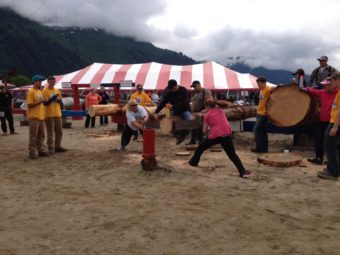
Thousands of people attended Juneau’s 23rd Annual Gold Rush Days at Savikko Park in Douglas, including some of the best logging competitors in Southeast, Alaska.
Alea Oien has been competing in Gold Rush Days for 17 years. Haines-resident Ashley Sage has been competing in logging competitions for 30 years. Together they make up the seventh pair in the women’s team hand bucking contest on Sunday morning.

This contest involves a two-man cross-cut M-tooth saw, otherwise known as a racing saw. This isn’t an ordinary saw. Most of these types come from a company in New Zealand. They cost over one-thousand dollars and, once you order one, it will take up to a year to get. People don’t buy this saw for logging.

“There are some people who are just die hard competitors in this and the best way to keep an edge on everybody is practice, practice, practice,” says Jesse Hay. He’s off to the side watching, waiting for his turn to compete later on. Hay owns three saws but doesn’t have an M-tooth race saw yet. He says it’s in the budget. “Both me and the wife are competing so it’s an investment”

Hay has been helping out with Gold Rush Days since 1992 and started competing ten years ago. His wife Anna has been competing for four. Together they’ve racked up substantial prize money in the past and they’re hoping for the same this year.

“You never know who’s going to show up. Some years it’s a little lean on competitors. Other years, there’s a bunch of them. It’s the luck of the draw and a lot of skill and a little bit of preparation,” says Hay.

According to Gold Rush Commission member Jerry Harmon, this year’s competition is stiff.

We have guys here that compete on the national circuit. They’re around. They’re here today. They come and go. They’ll compete for a while. Prize money is pretty good this year so they’re probably over here trying to get some of that and they will.”

But Gold Rush Days isn’t just about the money. It’s a celebration of mining and logging and of the people who do this work. “We let people know we have families, we drive cars, we fish, we cry, we laugh. We’re just like anybody else and it’s our job to mine and log,” Harmon explains.

Back at the women’s team hand bucking contest, Oien and Sage cut through a 13-inch log in 23 seconds. They get first place. Their secret, says Oien, is “experience.”

Sage says it’s about getting the right rhythm. “Back and forth, and back and forth, and faster, faster, faster and hopefully it’s done real soon.”

As first place winners in this event, Oein and Sage will share a prize of $150. That’s just one contest. There are six more logging events in the day and Oein is competing in all of them.

If Gold Rush Days doesn’t fulfill everyone’s thirst for winning, there’s always next month’s logging competition in Haines.

Main Street improvements making progress

Paving on Main Street will begin Tuesday.
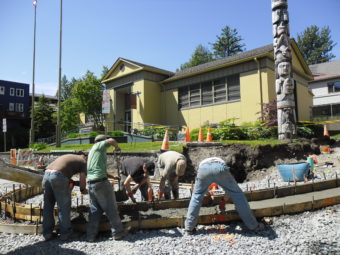
Improvements on the busy street began mid-April shutting down two blocks of downtown Juneau. Originally, the road was scheduled to be open Saturday, but the cold spring weather caused some delays.

Superintendent with Arete Construction Travis Seibel says Main Street will open for traffic as soon as this week.

“The buses are going to start around the 24th and we’ll have one way traffic downhill as soon as they’re done paving.”

This current phase of Main Street improvements includes replacement of the water, sewer, and storm drainage systems between 2nd and 5th streets, as well as the addition of new traffic islands, landscaping, and a sidewalk canopy.

“All the underground utilities are in. Once pavement’s in, we’ll start working on the sidewalks, canopy, traffic islands.”

Seibel says the project has been going well overall and the finish date is still set for August 15th.

June First Friday featuring Ron Klein

Ron Klein Photo
Ron Klein Photo

KTOO will be hosting a photography exhibition this Friday from 4:30 to 6:30 p.m. featuring the work of Ron Klein.

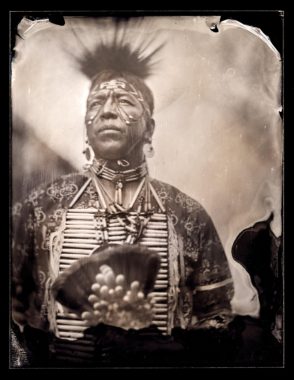
The exhibition of photography is presented using two unique styles. Both were created with antique cameras.  Images of the Oregon Pendleton Roundup, Alaskan Native people, and local characters are only the tip of the iceberg to this show.

Known for years as the “long skinny picture guy” Ron is featuring four panoramic images that offer a marked difference to the collodion wet plate photography that is his current interest.  The 1920 “Cirkut” panoramic camera is not dead yet, and can still out perform digital cameras in many ways. Totally opposite the panoramic views, Klein is presenting a series of portraits made with the wet plate process.

Invented in 1851 by Frederick Scott Archer, wet plate camera work rapidly replaced the Daguerreotype as the mainstay of photography because of lower costs and the ability to make multiple copies from a glass plate negative.

The drawback to this method is that the photographer must prepare, expose, and develop the plates while the coating remains wet or the chemical reaction will not work.  In the field, this means a portable darkroom must be constructed with careful attention to the collection of waste chemistry for proper disposal.

The final product is an image that cannot compare to today’s modern digital photography perfection.  The charm of the ancient process is perhaps the slowness of film speed and tonal ranges that are unlike what we are accustomed to seeing in new imagery.

“My photos are by no means perfect, not because of the process, but the fact that I haven’t mastered the craft yet.  In one sense it proves perfection is not needed.  On the other hand there is still more work to do.”

It will be interesting to see if viewers find the link between the long panoramas and the collodion images.

May First Friday at KTOO

©Hauser Photography
©Hauser Photography

An exhibit featuring the work of over two dozen photographers will open this First Friday in the hallways of the KTOO Building. The artists, members of the Alaska Photographic Arts Association, are well-known in the capital city for their variety of styles, from abstract to landscape. The show will open on Friday, May 3rd, from 4:30 to 6:30 and will continue to be on display during business hours during the month of  May.

Site notifications
Update notification options
Subscribe to notifications