
Since 2010, Juneau poets have been taking the stage at open mics and poetry slams hosted by the Woosh Kinaadeiyi arts non-profit organization. Here’s an audio postcard from this year’s grand slam event on Friday, Oct. 18th. Among a multitude of volunteers and talented performers, we’ll hear voices from poets Ziggy, Jacqueline Boucher, Nathan Block, Woosh Kinaadeiyi president and co-founder Christy Namee Eriksen, and co-host Dee Jay Derego.
Open mics and poetry slams happen every third Friday at 6:30 p.m. Locations vary.
Juneau is buying bike racks that double as public art with locally inspired motifs.
The city is paying Minneapolis-based Dero Bike Rack Co. $20,883 for the custom order.
Renderings of custom, two-tone bike racks Juneau is buying that will double as public art. (Courtesy Dero Bike Rack Co.)
“When these racks are installed – this is just going to be glorious,” said Bob Aldrich, who’s in sales at Dero. “These are the coolest racks that we are fabricating this year, without a question.”
Dero makes thousands of racks a year. Juneau is buying 15.
“Every one of which is a one-of-a-kind, unique design that will be present nowhere else in the universe as presently constituted,” Aldrich said.
The designs include a Tlingit-style raven, a boat, waves, mining tools, an umbrella, and of course, rain boots. Each rack will accommodate at least two bicycles.
Juneau Engineering Director Rorie Watt says the racks are in keeping with a 2009 urban plan that encourages accommodations for cyclists and pedestrians.
“We thought it would be nice to have some bike racks that, you know, had a little flair to them,” Watt said.
Aldrich said they hope to ship out the racks in mid-November.
Project manager Skye Stekoll says some of these racks will replace old ones, some will displace racks in good shape to lower profile locations, and some are going to spots with no racks at all. They’ll be installed next spring.
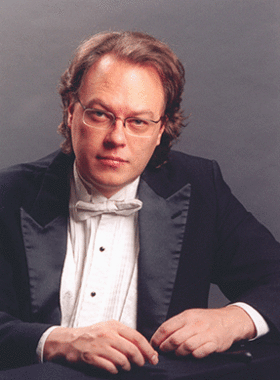
KTOO’s Scott Burton sat down with Juneau Symphony Resident Conductor William Todd Hunt. Hunt spoke about the symphony, his background, life in Juneau, how he spends his free time, what’s on his iPod, and the future.
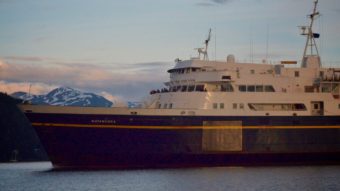
Beginning Wednesday at 8 p.m. (repeating Sundays at 7 p.m.) 360 North-TV will broadcast a four-part documentary series on the Marine Highway’s 50 years of operation.
It’s clear the Alaska Marine Highway is an integral part of coastal Alaskans lives. In this series, people share their stories, like artist and Ketchikan resident Ray Troll, who came up on the ferry to help his sister open a fish shop.
“I think I came by myself, but I came just for the summer, of 1983, and 30 years later, I’m still here.”
Stories of people like retired Boatswain, John Kanarr, who met his wife while working aboard the Malaspina.
“My wife likes to say this, I don’t, but she does, that the Alaska state ferry system was the original Love Boats.”
Petersburg Track coach, Brad Taylor, says the ferry system is the only economical way to get athletic teams around Southeast.
“We would love to be able to travel, you know, by air, just because the time out of school would be less, but there’s no way we would be able to afford that.”
Stephanie Hoag, from Juneau, weaves the ferry into the seasons of her life and thanks the Taku for her life.
The other really significant thing about the ferries for me is the fact that, they saved my life.
You’ll have to watch the series to find out how.
Series Broadcast Schedule:
Alaska’s Marine Highway
Wednesday, Sept. 25th at 8 p.m. (Sunday, Sept. 29th at 7 p.m.)
From Bellingham to the Aleutians, the “flagship program” of the series is an overview of the 35 hundred miles the 11 ships travel. It’s also a historical sketch of it’s first 50 years. This show was released to a national PBS audience earlier this year and has aired in more than half of the states.
Alaska’s Marine Highway: The Golden Voyage
Wednesday, Oct. 2nd at 8 p.m. (Sunday, Oct. 6th at 7 p.m.)
The second documentary showcases the culture, history and change in Southeast Alaska ports as the Malaspina takes it’s Golden Voyage up the inside passage.
The third and fourth shows are long-form, oral histories.
Alaska’s Marine Highway: Life on Board
Wednesday, Oct. 9th at 8 p.m. (Sunday, Oct. 13th at 7 p.m.)
Life on Board, focuses on the challenges and rewards crew members face while working and living on the ships.
Alaska’s Marine Highway: Connections
Wednesday, Oct. 16th at 8 p.m. (Sunday, Oct. 20th at 7 p.m.)
Connections, explores how the ferries have linked people in the villages and towns of coastal Alaska to the road system and to each other.
When Filipinos hear “Alaska,” often the first two things that come to mind are milk and basketball.
(Composited from photos by @Doug88888 and Ion Botezatu via Flickr Creative Commons)
That’s according to the Philippines’ recently appointed honorary consul to Alaska, Jenny Gomez Strickler.
It turns out, the Philippines-based Alaska Milk Corporation sells milk in the country and sponsors the Alaska Aces — not Anchorage’s minor league hockey team, but a professional basketball team in the Philippines. Neither the milk nor the basketball team have a meaningful connection to the 49th state.
That means if Alaska wants to make inroads in trade with the Philippines, the state has a lot of work to do. In 2012, less than 1 percent of Alaska’s exports ended up in the Philippines, according to census data.
Jenny Gomez Strickler, Philippines honorary consul to Alaska
But Strickler says connections are being forged that could help build a market for Alaska seafood, and even liquefied natural gas.
The Juneau resident and retired Alaska Department of Commerce and Economic Development worker spoke to the Juneau World Affairs Council on Wednesday. In her new honorary role for the government of the Philippines, she’s part bureaucrat, and part international trade facilitator.
She’s trying to make the case that “Alaska” should mean “seafood” in the Philippines.
“The Philippines is a fish-eating country,” she said. “Yet its fish is imported from other countries. And its imported salmon is farmed salmon.”
Strickler, Juneau Rep. Cathy Munoz and the governor’s office are trying to put together a seafood festival in Manila next year to show the country what Alaska has to offer.
Strickler shared an anecdote about a missed connection that networking at the festival might fix. A former Juneau resident brought some Alaska seafood to Manila for his friends to try. One of samplers happened to be a hotel owner.
“The business owner enjoyed it so much, he said, ‘If I get this from you, can you guarantee me X amount throughout the year, or a portion of the year?’ He looked him straight in the eye and said, ‘I can’t, cause I’m not a fisherman.’”
She said they’re working on a pitch to get support from the Alaska Seafood Marketing Institute.
Strickler also said she was on a recent conference call between Philippines Ambassador Jose Cuisia Jr. and state officials. The ambassador said he’s putting together a team to visit Alaska and investigate opportunities to import liquefied natural gas.
Finally, Strickler said Aklan State University in the Philippines is interested in sending instructors to the University of Alaska Southeast through an exchange program. They want to learn about saltwater fisheries.
Strickler said she expects that arrangement to come together after the Juneau Assembly adopts a sister city proclamation linking Juneau and Kalibo, the capital city of the Philippine province Aklan.
For Juneau Runners, September means some seriously crazy running. For the past 31 years, teams of runners run, walk or crawl–whatever means necessary–through a relay-style, ten-leg race that begins in Skagway and ends nearly 110 miles later in Whitehorse (most of it in the middle of the night).
The length of the ten legs vary from just over 5 miles up to 16 miles. The terrain is quite hilly (especially for leg 2) and can be quite challenging. This year it rained on and off for the first five legs, and was very foggy for most of legs 2 and 3.
There were 1,396 runners making up 146 teams from all over Alaska and parts of Canada. Some runners are in it strictly for the fun, others are mildly competitive, and some teams are downright determined to win.
It was a good year for Juneau runners, placing within the top three in three categories: Open, Mixed and Women’s only.
In the Open category, the C.C. Striders took second place with a total time of 14.29.34.
In the Women’s Only category, Hard Women are Good to Find, took third place with a total time of 16:44:16.
And in the Mixed category, Team 8 took first place with a total time of 12:22:46.
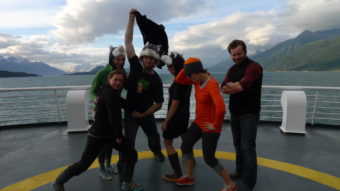
Juneau teams on the ferry riding to and from the Klondike this weekend share their thoughts on the race:
[youtube https://www.youtube.com/watch?v=RYzoag5RkCw]
Enjoy the Klondike Road Relay – 2013 slideshow.
Many teams enjoy the tradition of decorating their support cars before the race begins. Here the Twisted Blistered Sisters have a little pre-party paint time. Photo by Kelli Burkinshaw/KTOO News
Buckwheat Donahue lines up runners at the Klondike starting line and also entertains the masses gathered to watch. Photo by Kelli Burkinshaw/KTOO News
Along the route team members have fun while supporting their team members. Here the Twisted Blistered Sisters create a tunnel of love for their runner, Jessica Schmitz, on leg 1. Photo by Kelli Burkinshaw/KTOO News
Much of the Klondike is run in darkness, this year runners ran legs two and three in the cover of fog too. Photo by Kelli Burkinshaw/KTOO News
Volunteers at each of the ten check points make sure runners are safe and that their transitions go smoothly. And at check point three, volunteers usually create a theme their for their station. Photo by Kelli Burkinshaw/KTOO News
At check point four, volunteers created a Wizard of Oz theme to welcome in runners from leg-three, the princess leg, and get leg-four runners off to a good start. Photo by Kelli Burkinshaw/KTOO News
The Red Dress Runners and Twisted Blistered Sisters enjoy a little friendly competition as the sun rises on the subtle fall Yukon colours. Photo by Kelli Burkinshaw/KTOO News
After a long night of running and partying in their RV, the team of Red Dress Runners enjoys a well deserved rest on the grass before the heading off to the after party. Photo by Kelli Burkinshaw/KTOO News
The entire 109.5 mile Klondike Road Relay route is stunningly beautiful. The thing is, most of it is run in the darkness of night. Most runners appreciate the silence and beauty that night brings, but are also happy to check out their leg the following day as they return from Whitehorse. This was the splendor many Juneau runners were treated to on their return trip. (Photo by Kelli Burkinshaw/KTOO)
After the relay and after the after party, several teams kept the party going on the ferry ride home. Photo by Kelli Burkinshaw/KTOO News
Close
Update notification options
Subscribe to notifications
Subscribe
Get notifications about news related to the topics you care about. You can unsubscribe anytime.