National News

‘Arsenal’ Found At Newtown Shooter’s Home; Read The Police Reports

Dec. 18, 2012: Crime scene tape stretches across the property outside the home of Adam Lanza and his mother, Nancy Lanza. Inside, police found more weapons and other evidence. Lucas Jackson /Reuters /Landov

Police found hundreds of rounds of ammunition, guns, three photos of “what appears to be a deceased human covered with plastic” and other evidence when they searched the Newtown, Conn., home of killer Adam Lanza, according to records released Thursday.

Five search warrants, which include lists of what detectives discovered in the first few days after the Dec. 14, 2012, mass shooting that left 20 school children and six educators dead, were made public. We’ll embed them below. Though not overly graphic, they do include some details about what investigators saw when they discovered the body of Nancy Lanza, the gunman’s mother, at the home.

There isn’t anything else said about the photos of what appear to be a dead person, but it is noted that Lanza had saved a New York Times article about a shooting at Northern Illinois University. It’s also reported that investigators found “one handwritten note pad with what appears to be to do lists for Nancy Lanza from December 14 through December 20.” And, they came upon an “Adam Lanza National Rifle Association certificate.” While some computers, gaming consoles and other electronic devices were recovered, there was “a smashed hard drive on top of a desk in what is believed to be Adam Lanza’s bedroom.” He had a gun same in the room as well. A witness, whose name was redacted, told investigators that Adam Lanza “rarely leaves his home.”

The Hartford Courant begins its report on the warrants this way: “Newtown shooter Adam Lanza kept an arsenal of guns, more than 1,000 rounds of ammunition, swords and knives at his home, search warrants released Thursday indicate.”

The Stamford Advocate leads with this: “Investigators found a trove of evidence … seven journals and drawings, three photos of dead people covered in plastic and possibly blood, and a huge cache of ammunition scattered through the home. … A gun safe and a military-style uniform were in his bedroom. Among other items in the home: three samuarai swords with blades ranging from 13 to 28 inches, 10 other knives, both X-box 360 and Sony Playstation game consoles and handwritten notes with locations of various gun shops.”

Also Thursday, as NBC Connecticut reports, Danbury State’s Attorney Stephen Sedensky said that Lanza’s attack on those inside Sandy Hook Elementary School was over within about five minutes. It ended when the 20-year-old killed himself.

Sedensky released a long statement with more details about what authorities have determined happened on Dec. 14. It begins with this account:

“On the morning of December 14, 2012, Adam Lanza, the shooter, age 20, of 36 Yogananda St., Newtown, shot his mother, Nancy Lanza, age 52, in her bed with a .22 caliber rifle. There was no indication of a struggle.

“Later the shooter went to Sandy Hook Elementary school where he shot his way into the building and killed 20 children and 6 adults with a Bushmaster .223 caliber model XM15 rifle. The Bushmaster was loaded with a 30-round capacity magazine. Fourteen rounds were in the magazine when the Bushmaster was recovered by police. There was one round in the chamber.

“The shooter took his own life with a single shot from a Glock 10 mm handgun. He also had a loaded 9mm Sig Sauer P226 handgun on his person. Recovered from the person of the shooter, in addition to more ammunition for the handguns, were three, 30-round magazines for the Bushmaster, each containing 30 rounds. Located in the area of the shootings were six additional 30-round magazines containing 0, 0, 0, 10, 11, and 13 live rounds respectively. One-hundred-and-fifty-four spent .223 casings were recovered from the scene.

“It is currently estimated that the time from when the shooter shot his way into the school until he took his own life was less than five minutes.”

Sedensky adds that “the guns used in the shootings were apparently all purchased by the shooter’s mother. There is currently no indication that the shooter attempted to purchase the guns and was denied. The gun locker at 36 Yogananda St. was open when the police arrived. It was unlocked and there was no indication that it had been broken into.”

Sedensky also notes that some of the statements in the warrants have after further investigation found to be incorrect:

“The released search warrants were obtained on December 14, 15, 16, 2012, within a short time of the shootings. Subsequent investigation revealed that shootings took place in two of the classrooms, not three, and that the shooter was not wearing a bullet-proof vest, nor was he a teenager. Paragraph 5 of the December 16, 2012, warrant contains excess verbiage that was the result of incorporating information from prior search warrants. Finally, page numbers on returns do not necessarily follow the page listed before them as the returns are prepared after the warrant has been executed. The officer filling out the return may have used different equipment for the form which may result in discrepancies in the page numbering for the returns.”


Read original article

‘Arsenal’ Found At Newtown Shooter’s Home; Read The Police Reports
In Chicago, Dozens Arrested As They Protest School Closures

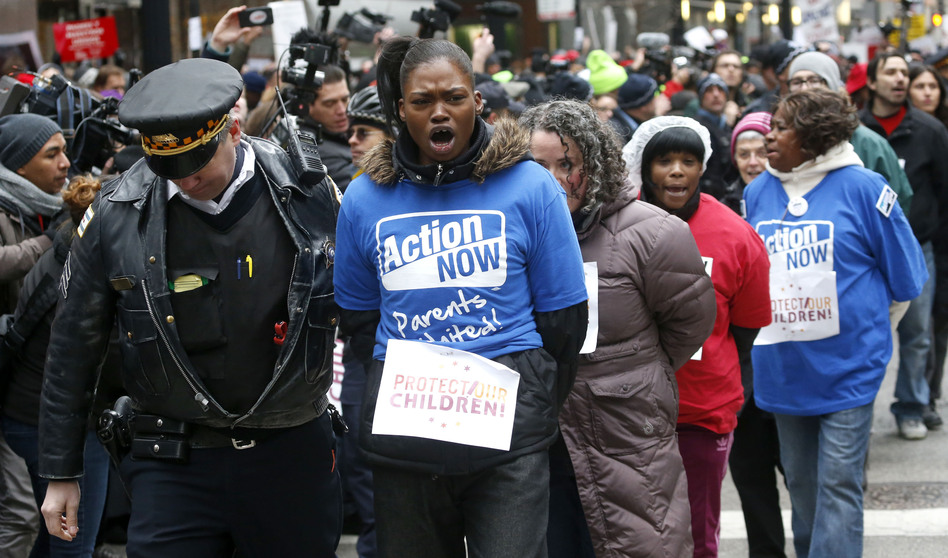
A Chicago police officer takes several protesters into custody on Wednesday, during an act of civil disobedience during a march and demonstration of opponents to a plan to close 54 Chicago Public Schools. Charles Rex Arbogast/AP

Hundreds of demonstrators, along with the Chicago Teachers Union, marched through the city today demanding that City Hall walk back its plan to close 53 elementary schools and one high school in response to a $1 billion budget deficit.

The Chicago Tribune reports:

” ‘People have a right to the neighborhoods in which they live,’ [Chicago Teachers Union President Karen Lewis] said. ‘Children have the right to a safe, nurturing, loving environment.’

“During the sit-in, crowds of people on the sidewalk and on northbound LaSalle continued to wave signs and chant ‘save our schools’ as some of the crowd sat down. The sit-in, including the plan for potential arrests, was part of an itinerary put out by CTU before the rally began.

“Police soon began making arrests, leading more than 50 people away one by one to a holding area outside a building just south of Washington Street. Those in the holding area stood with their hands behind their backs chanting, ‘Hey, hey, ho, ho, Rahm Emanuel’s got to go.’ ”

Emanuel is mayor of Chicago and a former chief of staff for President Obama.

As NPR’s Claudio Sanchez reported over the weekend, school closures across the country, which used to be a local issue, have “morphed into a politically charged” national campaign. As Claudio explained, the closures have pitted race and poverty against budgets.

The rise of public charter schools has led to empty public schools and that in turn has led to closures, which inevitably affects communities.

That was on display in Chicago today. The Sun Times reports:

“Elementary education expert and professor Bill Ayers — who has sparked controversy on the national political scene with his ties to President Obama — was in the crowd in support of teachers.

” ‘The assault on public education and abandonment of these communities has to be resisted,’ Ayers said.”

The Washington Post reports the under-enrolled schools are scheduled to be closed by this fall.

“It is the largest mass district closing of schools ever in the United States, and it is fiercely opposed by many teachers, parents and education activists,” the Post reports. “The vast majority of students affected are African American and Hispanic …”


Read original article

In Chicago, Dozens Arrested As They Protest School Closures

Residents Wait To Return Home After Landslide On Puget Sound Island

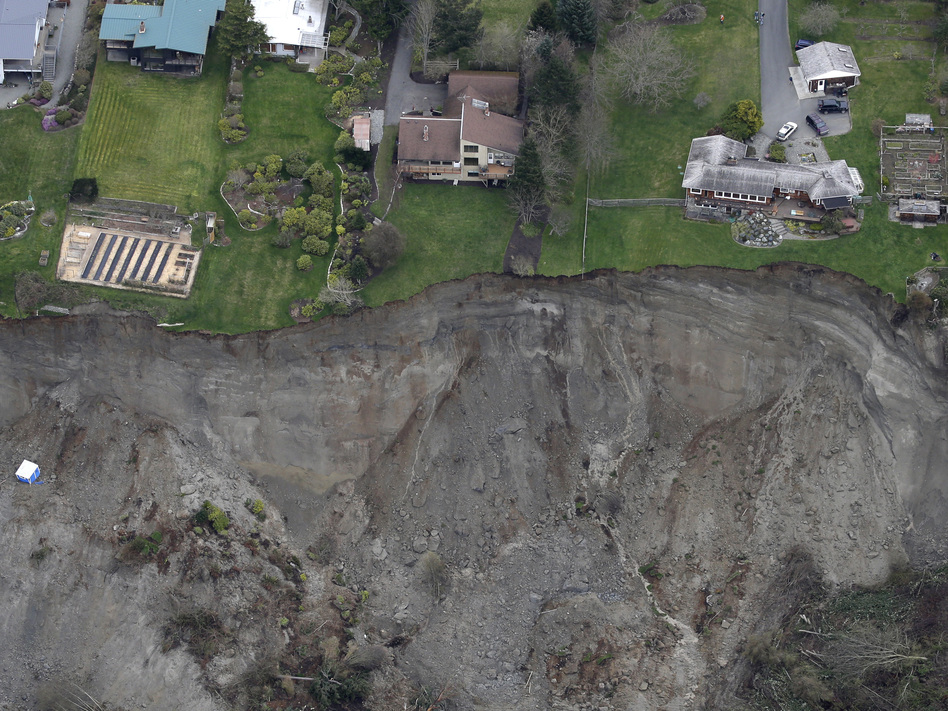
Houses sit near the edge of a landslide on Whidbey Island on Wednesday. Ted S. Warren/Associated Press
Houses sit near the edge of a landslide on Whidbey Island on Wednesday.
Ted S. Warren/Associated Press

Residents evacuated from their homes on Puget Sound’s scenic Whidbey Island are waiting for a green light from geologists and engineers after a large landslide knocked a house off its foundation and threatened to damage several others.

No one was injured in the collapse early Wednesday in the Ledgewood community on the island, about 50 miles north of Seattle, but one home sustained heavy damage and 33 others were ordered evacuated, according to The Associated Press.

The landslide, near the town of Coupeville, measured about a quarter-mile wide and a half-mile deep, according to NBC News.

“It’s possible more homes could be lost. We’re trying to ensure the safety and awareness of people,” Central Whidbey Fire and Rescue Chief Ed Hartin told KOMO-TV in Seattle. There’s not anything we can do to stop the movement of the ground.”

Resident Ralph Young, who was forced to evacuate with his wife, Cheryl, told NBC that the landslide sounded like “rolling thunder.”

Geologists took an initial look and said residents could return to about 15 homes higher up the hillside Wednesday evening, Hartin said. Seventeen homes were evacuated along that road, and officials were still concerned about two, he said.

Eleven people from 16 homes along a road close to the water were evacuated by boat because the road was blocked by the landslide, Hartin said, according to the AP.


Read original article

Residents Wait To Return Home After Landslide On Puget Sound Island

A Hot Topic: Climate Change Coming To Classrooms

Satellite image of Hurricane Sandy
For the first time, new federal science standards recommend teaching K-12 students about climate change.

By the time today’s K-12 students grow up, the challenges posed by climate change are expected to be severe and sweeping. Now, for the first time, new federal science standards due out this month will recommend that U.S. public school students learn about this climatic shift taking place.

Mark McCaffrey of the National Center for Science Education says the lessons will fill a big gap.

“Only 1 in 5 [students] feel like they’ve got a good handle on climate change from what they’ve learned in school,” he says, adding that surveys show two-thirds of students say they’re not learning much at all about it. “So the state of climate change education in the U.S. is abysmal.”

We all learn the water cycle. But how many can draw a picture of the carbon cycle? It would include plants taking in carbon to grow, then dying, and eventually turning into fossil fuels like coal and oil, which then put carbon back into the atmosphere when burned.

Even when this is taught, McCaffrey says, climate is often sidelined. Why take Earth science, when what you need to get into college is biology and chemistry? A recent report on climate literacy recommends sweeping changes to address such issues.

Political Pressure

On top of this, there’s the political battle over how climate change is taught. Last month, Colorado became the 18th state in recent years — including seven this year — to consider an “Academic Freedom Act.”

“The bill will go toward creating an atmosphere of open inquiry,” Joshua Youngkin of the Discovery Institute told state lawmakers. The institute is the same group that’s long questioned evolution and the way it’s taught. Now it has crafted suggested legislation that also targets global warming, although Youngkin testified that the aim is not to ban teaching about climate change.

“It just gives teachers a simple right,” he told lawmakers, “to know that they can teach both sides of a controversy objectively, and in a scientific manner, in order to induce critical thinking in their student body.”

But critics point out there is no controversy within science: Climate change is happening, and it’s largely driven by humans. So far, only Tennessee and Louisiana have passed legislation meant to protect teachers who question this.

Still, educators say the politicization of climate change has led many teachers to avoid the topic altogether. Or, they say some do teach it as a controversy, showing Al Gore’s An Inconvenient Truth one day, and the British documentary The Great Global Warming Swindle the next. The end result for students? Confusion.

The new science guidelines could provoke more push back.

“To the extent that these standards do paint a picture that I think runs counter to the scientific evidence, we’re going to make sure that we point that out,” says James Taylor, a senior fellow with the Heartland Institute. The free-market think tank is working on its own curriculum questioning humans’ role in global warming.

Raising Difficult Issues

The new science standards are voluntary, but 26 states helped develop them, and about 40 say they’re likely to adopt them.

“There was never a debate about whether climate change would be in there,” says Heidi Schweingruber of the National Research Council, which created the framework for the standards. “It is a fundamental part of science, and so that’s what our work is based on, the scientific consensus.”

Schweingruber says a lot of thought did go into how to deliver what can be crushingly depressing information, without freaking kids out. For instance, while students will learn that humans cause global warming, they’ll also be taught what kinds of actions can have a positive impact in helping to reduce it.

McCaffrey, of the National Center for Science Education, says many teachers will need training themselves on climate science. He’d also like to see them prepared for the pressures that come with teaching it.

“We’ve heard stories of students who learn about climate change,” he says. “Then they go home and tell their parents, and everybody’s upset because the parents are driving their kids to the soccer game, and the kids are feeling guilty about being in the car and contributing to this global problem.”

McCaffrey says this raises all kinds of psychological and social issues that are difficult to grapple with, yet essential for this generation of students to take on.


See Original Story

A Hot Topic: Climate Change Coming To Classrooms

DOMA Challenge Tests Federal Definition Of Marriage

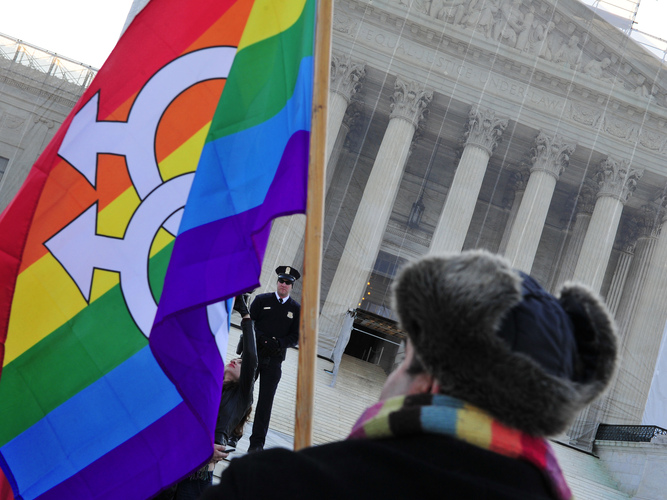
A pro-gay-marriage protester stands in front of the Supreme Court on Tuesday, the first of two days of oral arguments on challenges to laws that limit the definition of marriage to unions of a man and a woman. Karen Bleier/AFP/Getty Images

After weeks and months of public debate and speculation about the legal fate of same-sex marriage, the second round of arguments takes place at the U.S. Supreme Court on Wednesday.

After hearing a challenge on Tuesday to California’s ban on same-sex marriage, the justices move Wednesday to the 1996 Defense of Marriage Act, known as DOMA. The law bars federal recognition and benefits for same-sex couples married in any of the states — and there are nine currently — where such unions are legal.

There are more than 1,000 federal laws that confer benefits of one sort or another on married couples — everything from tax savings to Social Security benefits, but DOMA excludes those benefits for legally married same-sex couples.

The test case involves a couple from New York, Edith Windsor and Thea Spyer, who had been together for 42 years prior to their marriage in 2007. When Spyer died, however, the federal government, acting under DOMA, required Windsor to pay $363,000 in estate taxes that she would not have owed if her spouse had been of the opposite sex.

“If Thea had been Theo, I would not have had to pay those taxes,” says Windsor. “It’s just a terrible injustice and I don’t expect that from my country. I think it’s a mistake that has to get corrected.”

At the Supreme Court on Wednesday, Windsor’s lawyer, Roberta Kaplan, will tell the justices that the federal government, throughout the nation’s history, has always deferred to state definitions of marriage, because regulating marriage is a state function. But because of DOMA, that traditional deference to the states doesn’t exist for same-sex couples. Edie Windsor’s marriage, recognized as legally valid by the state of New York, is not recognized by the federal government.

And that, Kaplan argues, creates a “second-class citizenship, or at least second-class marriages, that the Equal Protection Clause of the Constitution forbids.”

The 14th Amendment guarantees all citizens equal protection of the law, and Kaplan will argue that the government has to have “a good reason” for distinguishing between gay and straight couples. Contending that DOMA supporters have been unable to justify treating legally married gay couples differently, she argues that it is unconstitutional to “allow straight married couples to have all the benefits of federal law and gay couples to have none.”

Normally, the federal government defends all acts of Congress, but the Obama administration, in a rare move, has declined to defend DOMA in court and instead is siding with those challenging the law.

The House Republican leadership has stepped in to defend the statute, hiring former Bush administration Solicitor General Paul Clement to do the job. About half of the oral argument will focus on whether Congress has legal standing to defend the law in court. And because the administration agrees with Congress that it does have standing, the Supreme Court has appointed a private lawyer to argue that Congress does not.

Those defending DOMA have been strangely unwilling to make their arguments outside of the court. House Speaker John Boehner, R-Ohio, declined to be interviewed for this article, as did Clement and leading House members who voted for the law. Even Sen. Orrin Hatch, R-Utah, who filed a friend of the court brief supporting DOMA, was unavailable for an interview. The primary sponsor of the bill, former Rep. Bob Barr, R-Ga., now retired, has changed his mind and now opposes the law. President Clinton, who signed DOMA into law, has also reversed course.

Rep. Steve King, R-Iowa, however, is an outspoken DOMA supporter. Equal protection, he says, means “equal protection for a man and woman to be able to get married to each other,” because “that’s been the definition of marriage for thousands of years.”

And as for Edie Windsor: She simply “wasn’t married in the eyes of the United States Congress, according to DOMA.” Under our system of federal and state shared power, King says, states are free to recognize same-sex marriages, and the federal government is free to not to recognize those marriages.

Brigham Young University Law School professor Lynn Wardle puts it this way: “Since the Constitution was drafted in 1787, it’s been the federal government that has had the authority to define who is eligible for federal programs and benefits.”

Wardle, who testified in support of DOMA in 1996, notes that at the time, Hawaii seemed poised to become the first state to legalize same-sex marriage, “and Congress said nope, there’s a very clear consensus on what marriage is. … It’s the union of a man and a woman.”

The House leadership, in its legal brief, makes similar arguments in support of DOMA. In the face of state and public debate over same-sex marriage rights, the brief says, the federal government had good reason to “retain the traditional definition” of marriage as “the uniform rule for federal-law purposes.”

Like proponents of California’s ban on same-sex marriage, the brief also highlights the reproductive ability of opposite-sex couples, arguing that “the core purpose and defining characteristic of the institution of marriage always has been the creation of a social structure to deal with the inherently procreative nature of the male-female relationship.” This inherent difference between same-sex and opposite-sex couples is just one of the rational justifications for their unequal treatment under federal law, according to the brief.


See Original Story

DOMA Challenge Tests Federal Definition Of Marriage

North Korea Cuts Hotline, Warns Of ‘Simmering Nuclear War’

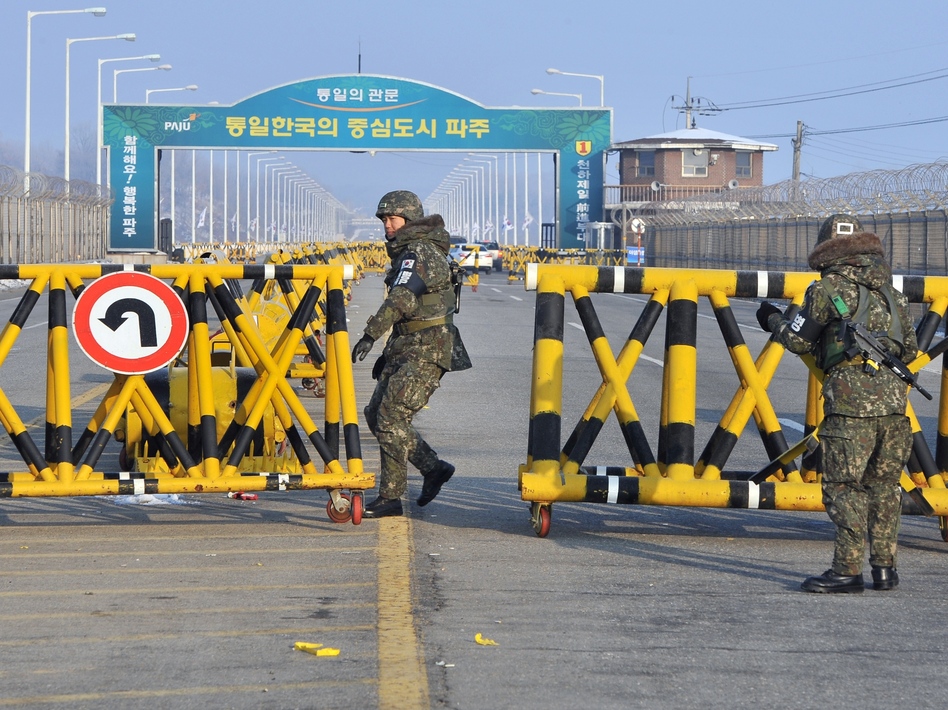
South Korean soldiers set up barricades across the road linking North Korea's Kaesong Industrial Complex last month. Jung Yeon-je/AFP/Getty Images
South Korean soldiers set up barricades across the road linking North Korea’s Kaesong Industrial Complex last month. Jung Yeon-je/AFP/Getty Images

North Korea on Wednesday cut a hotline with the South and told the United Nations that conditions were ripe for a “simmering nuclear war” on the peninsula.

“Upon authorization of the Foreign Ministry, the DPRK [North Korea] openly informs the U.N. Security Council that the Korean Peninsula now has the conditions for a simmering nuclear war,” a statement read. “This is because of [provocative] moves by the U.S. and South Korean puppets.”

Meanwhile, the North unplugged a key hotline with its arch rival after cutting another earlier this month. Wednesday’s announcement means the North will sever the link used to operate Kaesong, an industrial complex run jointly between the two countries as part of a nascent effort to foster cooperation.

The harsh rhetoric is barely a half-octave above what has become daily fare emanating from Pyongyang in recent weeks. It comes at a time when both Pyongyang and Seoul have untried leaders.

Writing in Foreign Policy, David Kang, professor of international relations and business at the University of Southern California, and Victor Cha of the Center for Strategic and International Studies warn:

“North Korea has a penchant for testing new South Korean presidents. A new one was just inaugurated in February, and since 1992, the North has welcomed these five new leaders by disturbing the peace. Whether in the form of missile launches, submarine incursions or naval clashes, these North Korean provocations were met by each newly elected South Korean president with patience rather than pique.”


Read original article

North Korea Cuts Hotline, Warns Of ‘Simmering Nuclear War’

Site notifications
Update notification options
Subscribe to notifications