National News

Happening Now: Supreme Court Hears First Of Two Gay-Marriage Cases

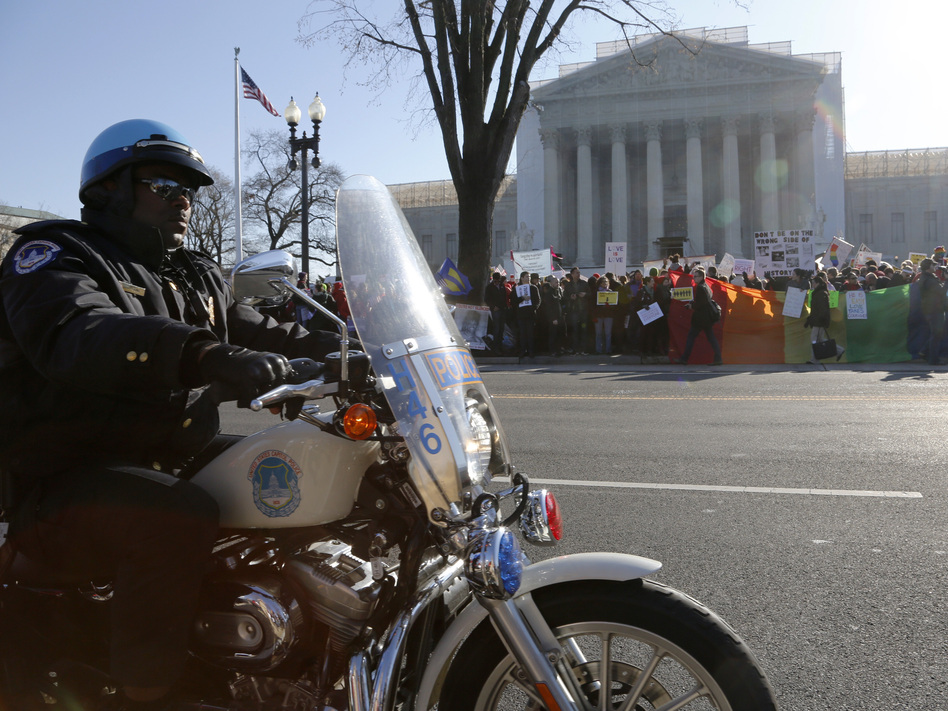
A Washington D.C. motorcycle police officer kept watch on demonstrators outside the Supreme Court Tuesday morning. Jonathan Ernst /Reuters /Landov

The Supreme Court on Tuesday held the first of two high-profile hearings on laws concerning same-sex marriage (today’s focuses on California’s Proposition 8 ban on gay marriage; Wednesday’s focuses on the Defense of Marriage Act).

We’re watching for news from inside the court and posting updates.

If you’re not up to speed on the cases and the issues, our post from earlier in the day is one place to start.

Update at 11:28 a.m. ET. Arguments Are Over:

According to Reuters, “oral arguments in #Prop8 just concluded …”

Update at 11:25 a.m. ET. Gone Into Overtime:

The oral argument has gone longer than scheduled, according to reports from the court. It should be over soon (if it hasn’t finished already; it’s impossible for us to know precisely what’s happening inside the courtroom).

Update at 11:14 a.m. ET. Votes Aren’t There To Recognize Right?

Fresh analysis from SCOTUSblog: “There are not 5 votes to strike down #prop8 and recognize equal right to #ssm at this time.”

Update at 11:10 a.m. ET. Kennedy Uncomfortable; Prefers Dismissal?

SCOTUSblog update: “Breaking: key vote Kennedy VERY uncomfortable striking down #prop8. Suggests dismissing case. Would leave in place 9th Cir pro-#ssm ruling.”

Update at 10:57 a.m. ET. Justice Kennedy On Children Of Same-Sex Couples:

According to Reuters, Justice Anthony Kennedy (often the “swing” vote in close cases) expressed the thought that children of same-sex couples “want their parents to have full recognition and legal status.”

The New York Times‘ live blog adds that “the justices, particularly Anthony Kennedy and Antonin Scalia, appear to be debating the effect of the gay marriage ban on the children of gay couples.”

Update at 10:41 a.m. ET. Word Begins To Emerge; No “Standing?”

SCOTUSblog and Reuters are beginning to post some bits of information about what’s been said during this morning’s oral arguments and what the justices’ comments may mean. According to Reuters, Chief Justice John Roberts’ questions hint that he thinks the sponsors of Prop 8 may not have the legal standing to challenge a lower court’s ruling that invalidated the law. NPR’s Nina Totenberg reported for Morning Edition that “standing” would be the threshold question. If that’s the case, then the court may not rule on the constitutionality of the ban on gay marriage.

Update at 10:30 a.m. ET. Filling Time:

We’re likely at least 10 minutes or so away from getting our first word about what’s been said during Tuesday’s oral arguments. Meanwhile, the live blogs from other organizations, such as The New York Times and Reuters, are filling the time with word of celebrity sightings — actor/director Rob Reiner, for instance, is at the court.

From our original post, at 10:05 a.m. ET:

The justices came to the bench at 10 a.m. ET. Tuesday’s argument should be over by 11 a.m. ET. SCOTUSblog is promising updates on its Twitter page. We’ll be monitoring that and watching what others have to say — including the discussion hosted by NPR’s Frank James and Andy Carvin on the NPRPolitics Twitter account. Right after the hearing, we’re scheduled to speak with NPR’s Nina Totenberg.

Outside the court this morning, NPR’s Craig Windham said the crowd was so large “you can’t even move through it.”

There were demonstrators on both sides of the issue, Craig added earlier, and an hour or so before the hearing, “clearly the majority … favor gay marriage and they’re hoping the court will make a broad ruling.” That changed as the court session began, Craig later told our Newscast Desk — hundreds of opponents of gay marriage came to the site to make their voices heard.


Read original article

Happening Now: Supreme Court Hears First Of Two Gay-Marriage Cases
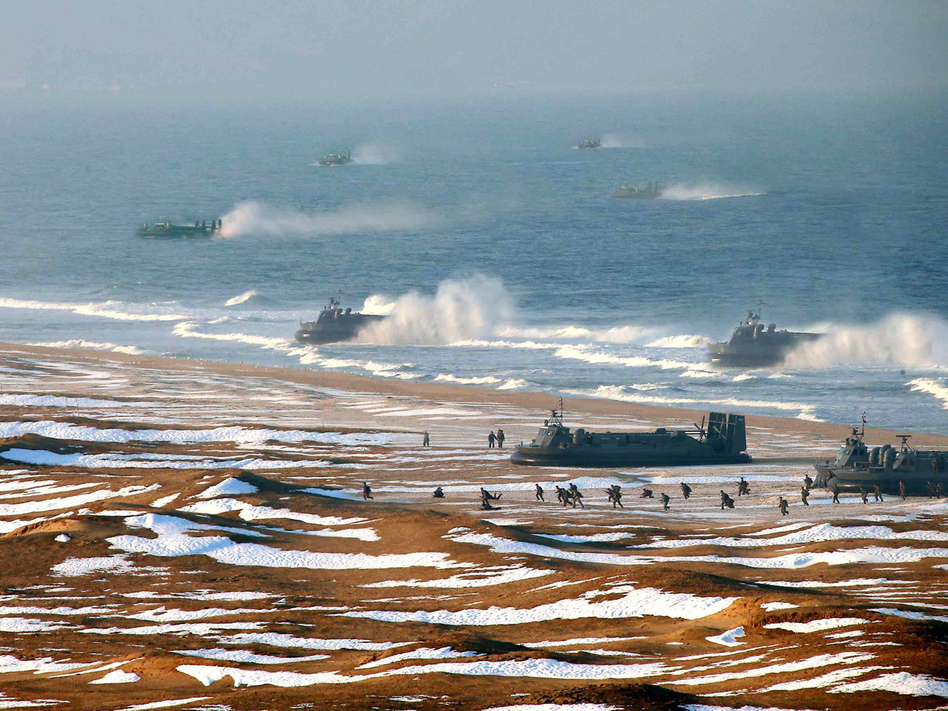
North Korea Threatens To Attack U.S., South Korean Bases

North Korean "landing and anti-landing drills" are shown in a photo released Tuesday. KCNA/AFP/Getty Images
North Korean “landing and anti-landing drills” are shown in a photo released Tuesday. KCNA/AFP/Getty Images

North Korea says it has moved its artillery and ballistic missiles into “combat posture” for possible use against targets in South Korea, Guam, Hawaii and the U.S. mainland.

“From this moment, the Supreme Command of the Korean People’s Army will be putting in combat duty posture No. 1 all field artillery units including long-range artillery units [and] strategic rocket units that will target all enemy object in U.S. invasionary bases,” the official KCNA news agency said.

KCNA said Pyongyang’s forces had been “assigned to strike bases of the U.S. imperialist aggressor troops in the U.S. mainland and on Hawaii and Guam and other operational zones in the Pacific as well as all the enemy targets in South Korea and its vicinity.”

The statement, which cited the participation of nuclear-capable B-52 bombers in South Korea-U.S. drills, came on the third anniversary of a North Korean torpedo attack on a South Korean ship that killed 46 sailors.

The Associated Press quotes Seoul’s Defense Ministry as saying it hasn’t seen any suspicious North Korean military activity and that officials were analyzing the North’s warning.

Analysts say a direct North Korean attack is extremely unlikely, especially during joint U.S.-South Korean military drills that end April 30, though there’s some worry about a provocation after the training wraps up.


Read original article

North Korea Threatens To Attack U.S., South Korean Bases

China Reportedly To Buy Russian Subs, Fighter Jets

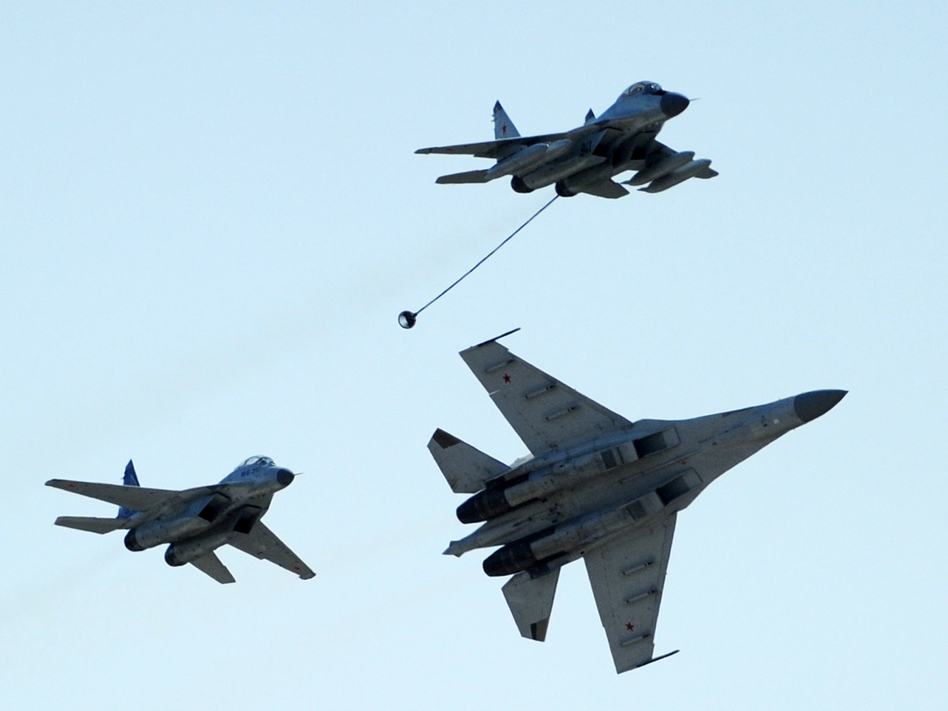
Russian MiG-29 (top), MiG-35 (left) and Su-35 (right) perform at an air show outside Moscow, in 2011. Dmitry Kostyukov/AFP/Getty Images

China has reportedly signed a deal to buy new submarines and Sukhoi Su-35 fighter jets from Russia, the first such arms deal in nearly a decade.

The agreement, long in the works, was inked during last week’s visit of Chinese President Xi Jinping’s visit to Moscow, according to China Central Television CCTV. But, somewhat oddly, Russia’s ITAR-TASS has denied the reports.

According to Chinese media, the agreement was for four Amur-1650 class diesel-electric submarines and 24 Su-35s, one of Russia’s most advanced fighters.

The submarines would supplement China’s existing fleet of about 65 subsurface vessels, including indigenously built nuclear and ballistic missile submarines.

China has also produced several of its own variants of Russia’s Sukhoi Su-27, Su-30 and Su-33 warplanes and is in the process of developing its own stealth fighters. The BBC quotes China’s People’s Daily as saying the advanced Su-35s from Russia would “effectively reduce pressure on China’s air defense” as China moved ahead with its stealth planes.

Last year, IHS Jane’s, quoting the Moscow daily Kommersant, reported that Moscow was leery of a deal with China because it was afraid Beijing would illegally copy the weapons.

Kommersant said:

“[Moscow] is requiring that Beijing provide a legally binding guarantee that it will refrain from making reverse-engineered copies of the Russian fighter — largely so that this does not create a potential competitor in the market to sell the aircraft to other countries. China is [in] no hurry to provide this guarantee.”

The reports come as Beijing and Moscow have moved closer in an apparent desire to counterbalance U.S. interests in Asia and Europe and The China Daily described Xi’s visit to Russia as a “well-deserved riposte to Washington for America’s military ‘pivot’ to Asia. Xi is executing China’s own ‘pivot’ — the visit to Moscow to cement ties with” Russian President Vladimir Putin, according to the BBC.


Read original article

China Reportedly To Buy Russian Subs, Fighter Jets

Rebels Rain Down Mortars On Damascus

Rebels from the Free Syrian Army walk on a street in Damascus in this picture provided by Shaam News Network and taken March 23.
Rebels from the Free Syrian Army walk on a street in Damascus in this picture provided by Shaam News Network and taken March 23. The Syrian capital came under mortar fire on Sunday and Monday. Ward Al-Keswani/Shaam News Network/Reuters /Landov

The author is a Syrian citizen living in Damascus who is not being further identified out of safety concerns.

Syrian rebels carried out mortar and rocket attacks on Sunday and Monday in what appeared to mark a new escalation in the fighting over the Syrian capital.

At least two people were killed and dozens injured, according to the state-run media in Syria. The United Nations announced it was relocating about half of the 100 members of its international staff in the city for security reasons.

The rebels have periodically attacked Damascus with mortar shells before, but the magnitude of Monday’s attack, felt in every city neighborhood, was much more intense than before and left many Damascenes feeling caught in the crossfire.

The two sides exchanged fire all night, which included sporadic shelling from the government batteries placed in the hills around the capital. Damascenes are now used to those sounds and accustomed to interrupted sleep punctured by blasts and thuds. On a bad night, it sounds like continuous loud thunder.

An Early Morning Blast

But Monday morning, a loud boom jolted me from bed. It was louder and closer than usual.

We heard similar blasts on Sunday evening too, when rebels fired a rocket and mortar shells at state television headquarters.

The early morning blast Monday was just the beginning. More explosions roared, one after the next. Two dozen, maybe more. I lost count.
Then, countershelling from government missile batteries began. Everyone in Damascus can recognize that sound. But Monday, even those sounded different more sustained and angry than usual.

Activists later said the government had fired from a huge missile battery in the city, and not just ones in the hills that surround Damascus. This would seem to explain why Damascenes throughout the city heard and felt each retaliatory missile fired from Damascus onto the rebel-held areas on the outskirts.The attacks and counterattacks went on for several hours.

I had been through similar shooting exchanges two or three times before, the most recent being just last Tuesday, when rebels fired onto the neighborhood of Malki, an affluent residential areas where President Bashar Assad lives. But there was a widespread belief that this was the heaviest such shooting yet in the capital.

Rebel Warnings

Every now and then, Damascus is abuzz with the latest statements from rebels claiming that the “final battle” for Damascus has arrived.

“The shaking of fortresses has begun,” a rebel brigade, Liwa al Islam, said in a statement referring to regime targets in the capital.

“Government installations shall be targeted, including presidential, military and intelligence. They will be pounded with surface-to-surface missiles,” it added. “We advise our fellow citizen who live near such government targets to hurriedly leave to a more secure location. As God is our witness, you have been forewarned.”


Read original article

Rebels Rain Down Mortars On Damascus

President’s Pen Establishes New National Monuments

Kayak at Sunset San Juan Islands.
Kayak at Sunset San Juan Islands. Mark B. Gardner/San Juan Islands Visitor Bureau

President Obama on Monday designated five new national monuments, including one in Maryland dedicated to anti-slavery activist Harriet Tubman and another setting aside Washington state’s San Juan Islands.

“These sites honor the pioneering heroes, spectacular landscapes and rich history that have shaped our extraordinary country,” President Obama said in a statement. “By designating these national monuments today, we will ensure they will continue to inspire and be enjoyed by generations of Americans to come.”

Here’s a list of the new dedications:

— First State National Monument in Delaware and Pennsylvania:

Includes 1,100 acres of land in the Brandywine Valley along the Delaware-Pennsylvania border that National Parks Traveler says was originally acquired by William Penn from the Duke of York in 1682:

“Woodlawn property lies on the banks of the Brandywine River, primarily in Delaware and extending north into Pennsylvania. Nearby, in 1777, General George Washington’s troops defended against British forces in the largest battle of the American Revolution. Since then, the Brandywine Valley’s natural beauty has inspired generations of artists, including acclaimed painter Andrew Wyeth. Today, however, rapid development is squeezing the pristine open spaces that remain.”

Vice President Joe Biden says the monument tells “the story of the essential role my state played in the history of the United States.”

According to The Philadelphia Inquirer, there is still legislation pending to turn the area into a full-fledged national park, which “has had wide support from conservationists, community and civic groups, elected officials and the Lenni-Lenape tribe.”

Harriet Tubman Underground Railroad National Monument, Maryland:

The African-American abolitionist who directed a secret network of safe houses to move slaves to freedom in the North will be honored with a national monument on land in Dorchester County, Md., on the Eastern Shore of the Chesapeake Bay, a key stop on the Underground Railroad.

The Baltimore Sun reports:

“Members of Maryland’s congressional delegation have for years sought to approve funding to honor Tubman on the Eastern Shore. The monument designation coincides with this year’s commemoration of the 100th anniversary of Tubman’s death March 10.”

According to The Auburn Citizen:

“The national monument designation won’t affect legislation in Congress that would create national historical parks in Auburn and on Maryland’s Eastern Shore, where the monument will be located. … The national historical park in Maryland would include several significant sites from the first half of Tubman’s life. In Auburn, the national historical park would consist of Tubman’s home and the Home for the Aged on South Street. The Thompson AME Zion Church and Fort Hill Cemetery, where Tubman’s grave site is located, would also be part of the park.”

Rio Grande del Norte National Monument, New Mexico:

The Albuquerque Journal describes this area, 28 miles north of Taos near the Colorado border, as:

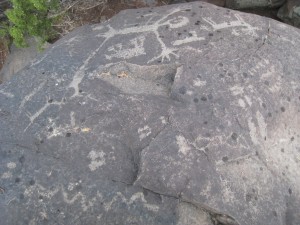
” … a swath of unspoiled country that may appear just modestly attractive compared to the neighboring Sangre de Cristo range and the likes of Bandelier. But in reality, the northern reaches of the Rio Grande house a treasure trove of scenery and natural resources, including wildlife, and historical remnants ranging from petroglyphs to parts of El Camino Real. The river gorge alone, from its mouth near Pilar all the way to the Colorado border, is truly a wonder.”

Some of the petroglyphs date back 11,000 years.

The Journal notes:

“The whole area, extending from the site of the first Spanish settlements north of Española all the way into the San Luis Valley of Colorado is a human heartland … wintering ground to the Utes in ancient times, then home to Spanish settlers and, later, homesteaders. Preserving this heritage is part of the plan for the monument: Supporters have made sure that traditional wildland uses, including hunting, firewood and piñon harvesting, will continue.”

National Park Traveler says Rio Grande del Norte “is popular with kayakers, birders, anglers, hikers and equestrians.”

Charles Young Buffalo Soldier National Monument, Ohio:

According to The Dayton Daily News:

“Col. Charles Young, a distinguished officer in the United States Army, was the third black to graduate from West Point and first to achieve a colonel ranking. He later became a professor of military science at Wilberforce University.

“Young’s fraternity, Omega Psi Phi, made the site of his former home available to the federal government to establish a monument dedicated to him.

“Young served as an army superintendent of Sequoia and General Grant National Parks before the National Parks Service establishment in 1916.”

San Juan Islands National Monument, Washington:

The official travel guide for this area is inviting, advertising, “Deep green forests. Sparkling blue waters. Silence broken only by birdsong.”

Brian J. Cantwell, a blogger for The Seattle Times, is just as effusive, saying the San Juan Islands include:

” … soul-soothing scenery such as San Juan Island’s Cattle Point lighthouse, a lonely sentry at the windswept edge of the Strait of Juan de Fuca, and the Lopez Island landmark of Chadwick Hill, where I’ve counted dozens of turkey vultures soaring on updrafts above gorgeous little Watmough Bight, a favorite saltwater hidey-hole for boaters with a hermit gene.”

(If you’re confused about the difference between a national park and a national monument, you might want to read this. In short, it takes an act of Congress to establish a national park, while the president can unilaterally create a national monument.)

Copyright 2013 NPR. To see more, visit http://www.npr.org/.image

Read original article

President’s Pen Establishes New National Monuments

Secretary Of State Kerry In Baghdad, With Concern Over Syria

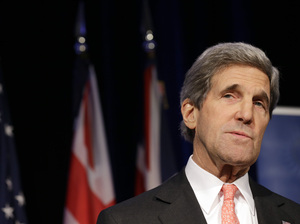
Secretary of State John Kerry is in Baghdad Sunday on an unannounced visit following President Obama's Mideast tour. Alex Brandon/AP
Secretary of State John Kerry is in Baghdad Sunday on an unannounced visit following President Obama’s Mideast tour. Alex Brandon/AP

Secretary of State John Kerry is on an unannounced trip to Baghdad Sunday, and according to an official, the buzzword of the trip is “engagement.”

NPR’s Michele Kelemen, who’s traveling with Kerry, tells our Newscast Desk that Syria is on his agenda:

“He’s … pressing [Iraqi Prime Minister Nouri al-Maliki] to crack down on, as one official put it, ‘the nearly daily Iranian flights over Iraqi territory to Syria.’ The U.S. accuses Iran of shipping weapons to Bashar al-Assad’s regime and is warning Iraq that these shipments are fueling the conflict and are dangerous to the region.”

The Associated Press reports the overflights “have long been a source of contention between the U.S. and Iraq.” Iraq promised to inspect the flights last year, the AP says, but an official says only two have been checked since then.

The New York Times has more on the Iran-Syria relationship:

“The air corridor over Iraq has emerged as a main supply route for weapons, including rockets, antitank missiles, rocket-propelled grenades and mortars, as well as Iranian personnel, according to American intelligence officials. There are supply lines on the ground as well.

“Iran has as an enormous stake in Syria, which is its staunchest Arab ally and has provided a channel for Iran’s support to the Lebanese Islamist movement Hezbollah.”

The conflict in Syria rages on: Refugees are pouring into neighboring countries, and the United Nations is investigating the possible use of chemical weapons in the conflict.

Kerry’s trip comes 10 years after the war in Iraq began. With Iraqi provincial elections in April, having the Shiite government work with Sunnis and Kurds is also a concern for the U.S., Kelemen says.

Kerry’s trip follows President Obama’s Mideast tour, including his first trip to Israel as president.


Read original article

Secretary Of State Kerry In Baghdad, With Concern Over Syria

Site notifications
Update notification options
Subscribe to notifications