A snow-covered cherry blossoms at the Yuyuantan Park in Beijing, China. Li Xin /Xinhua /Landov
Don’t tell Chicago, Buffalo or Minneapolis — which will see high temperatures just in the 20s, today — but at 7:02 a.m. ET., the Earth’s axis was neither tilted from nor toward the sun, marking the beginning of spring in the northern hemisphere.
“On the equinox, night and day are nearly exactly the same length – 12 hours – all over the world. This is the reason it’s called an “equinox”, derived from Latin, meaning “equal night”. However, even if this is widely accepted, it isn’t entirely true. In reality equinoxes don’t have exactly 12 hours of daylight.
“The March equinox occurs the moment the sun crosses the celestial equator – the imaginary line in the sky above the Earth’s equator – from south to north. This happens either on March 19, 20 or 21 every year. On any other day of the year, the Earth’s axis tilts a little away from or towards the Sun. But on the two equinoxes, the Earth’s axis tilts neither away from nor towards the Sun.”
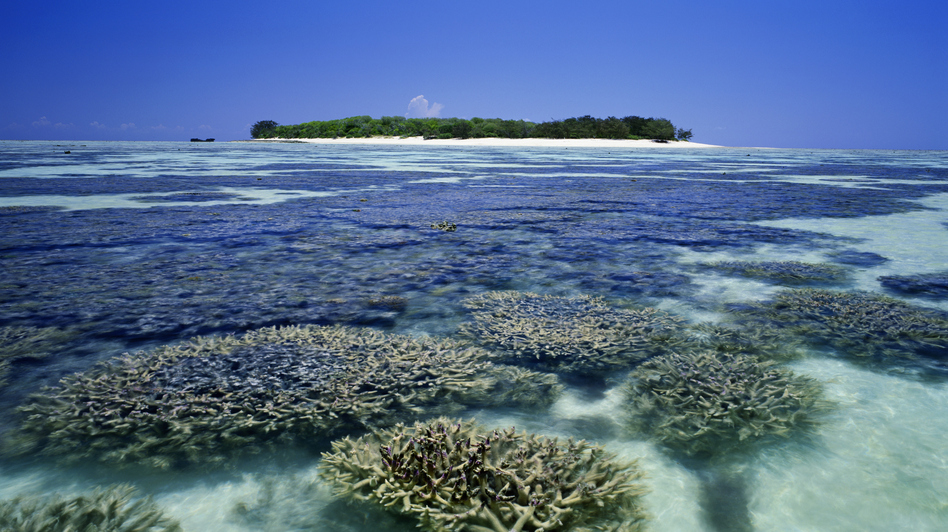
Heron Island is located on the southern end of the Great Barrier Reef, about 25 miles off the northeast coast of Australia. Ted Mead/Getty Images
NPR Science Correspondent Richard Harris traveled to Australia’s Great Barrier Reef to find out how the coral reefs are coping with increased water temperature and increasing ocean acidity, brought about by our burning of fossil fuels. Day 1: Richard gets a hefty dose of bad news.
I’ve seen the future, and it isn’t pretty.
That’s a tough sentence to write because the setting for this unhappy discovery is spectacular. Heron Island sits in tropical turquoise waters about 25 miles off the northeast coast of Australia. It’s an island on the far southern end of the Great Barrier Reef — one of our planet’s most dramatic natural features, akin to the tropical rain forests, only submerged.
The low vegetation is filled with fearless and noisy sea birds. Snorkelers watch as graceful turtles swim toward the coral sand beaches — it’s egg-laying time for them.
Within earshot of the lapping waves is a modern scientific laboratory, the Heron Island Research Station. And that’s where the topic turns from tropical relaxation to a nagging anxiety about the future of the world’s coral reefs.
Sophie Dove, from the University of Queensland in St. Lucia, has spent the past couple of years crafting an experiment to see what will happen to coral reefs as the ocean absorbs ever more of the carbon dioxide and heat we’ve added to our planet’s thin skin. She’s gathered a variety of coral species from the island’s nearby reef and placed them in tanks that look like a cross between a kettle drum and an oversized plant pot.
Into one set of these pots, she has put seawater at the reef’s current temperature and carbon dioxide concentration. A second set circulates water that’s somewhat cooler and has less carbon dioxide — conditions the reef experienced 100 years ago, before we started burning fossil fuels and pouring huge amounts of carbon dioxide into the atmosphere.
Two final sets of tanks hold water that’s warmer and contains far more carbon dioxide than the oceans absorb today. These are glimpses into our perhaps not-so-distant future.
Carbon dioxide matters to coral because when it soaks into sea water, it turns into carbonic acid. We’ve put so much carbon dioxide into the atmosphere that the oceans are already 30 percent more acidic now than they were before the Industrial Revolution. And as acidity increases, it becomes harder and harder for corals to build their calcium structures. Eventually, corals will need to expend a lot of energy just to prevent their skeletons from dissolving into seawater.
Heat is also a problem. Most of the additional heat that Earth has absorbed as a result of the enhanced greenhouse effect has in fact been soaked up by the world’s oceans. In fact, we’re really experiencing ocean warming more than global warming.
The result?
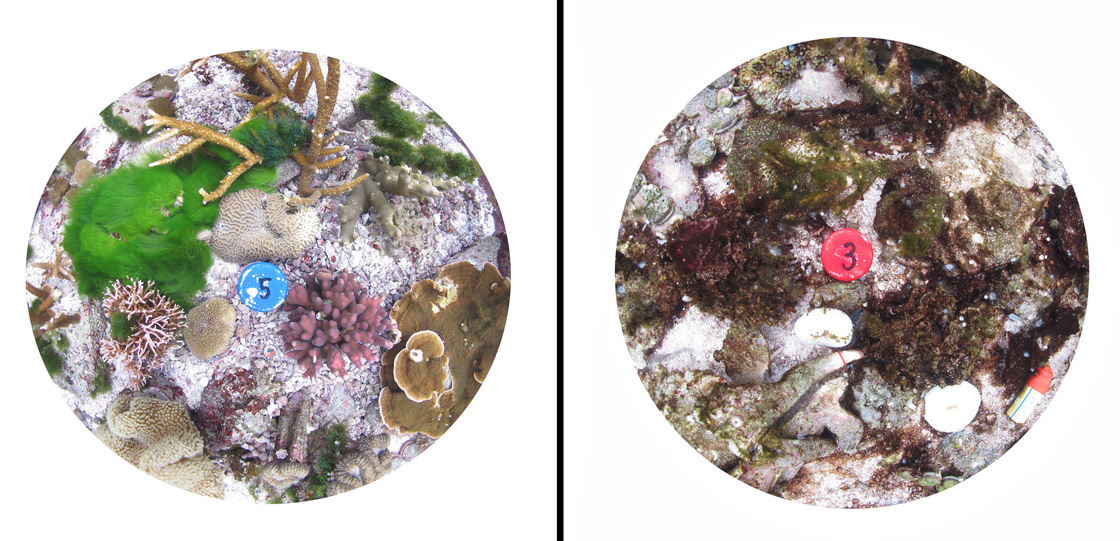
Dove opens up the first of these tanks — present-day conditions. The corals look like they came from a picture book of life on the reef. The second tank, pre-industrial, looks about the same, though Dove says those corals are actually growing faster and are healthier than those growing in modern-day seawater.
This composite image of pots used in the experiment shows how healthy coral (left) is dramatically affected by higher carbon dioxide levels and sea temperatures (right). Courtesy of Sophie Dove
The third and fourth tanks are the shockers. Most of the corals have died in this “future” world. A gelatinous black slime floats across the top of one tank. Corals still hanging in there have lost the colorful organisms that live inside those calcium skeletons, so they are bleached white.
Scientists have been worrying about this for well over a decade. It’s taking some time for the experimental evidence to catch up with the basic chemistry, which strongly suggests that many marine animals that build shells from calcium are going to have it rough as carbon dioxide builds up in the water. Add heat, and the situation for these corals is grim.
That’s not the end of the story, thankfully. This experiment offers a glimpse at our most likely future, but it’s not the only possible path. Carbon dioxide levels and sea temperatures depend on what humanity does over the coming decades.
At least seven Marines are dead and another seven are injured after an accident Monday night in Nevada in which a mortar round exploded inside an artillery tube, military officials tell NPR’s Tom Bowman.
The Marines were taking part in a live-fire exercise, those officials say. “Shell fragments, I’m told, killed almost three [Marines] immediately,” Tom says. The others died before they could be evacuated to a hospital.
The Reno Gazette-Journal says the accident happened at the Hawthorne Army Depot, “about 135 miles southeast of Reno.” Those killed, officials tell Tom, were from the 9th Marine Regiment out of Camp Lejeune, N.C.
Update at 9:40 a.m. ET. More Information From The Marine Corps.
In a statement emailed to reporters, Marine Corps. Lt. Col. Neil Murphy says, in part:
“A fatal incident occurred during a training exercise shortly before 10 p.m. [local time] Monday at Hawthorne Army Depot, Nev., killing seven service members and injuring several others with 2nd Marine Division. …
“The identities of those killed will be provided 24 hours after primary next of kin notification. The status of those injured will be provided as it becomes available.
” ‘We send our prayers and condolences to the families of Marines involved in this tragic incident. We remain focused on ensuring that they are supported through this difficult time,’ said Maj. Gen. Raymond C. Fox, II MEF commanding general. ‘We mourn their loss, and it is with heavy hearts we remember their courage and sacrifice.’ ”
While state-controlled media in Syria are claiming that opposition forces are responsible for what may have been a chemical weapon attack Tuesday in the city of Aleppo, rebel spokesman Qassim Saadeddine is telling Reuters that the opposition was “not behind this attack.”
As often happens when news such as this breaks, it’s not possible at this point to confirm just what — if anything — has happened. Syrian state media are claiming that at least 15 people were killed in Aleppo by some sort of rocket. The watchdog Syrian Observatory for Human Rights is telling Reuters that as many as 26 people were killed.
American officials have said that President Bashar Assad’s regime has prepared chemical weapons for use, and President Obama has warned the Syrian leader that “if you [Assad] make the tragic mistake of using these weapons, there will be consequences and you will be held accountable.”
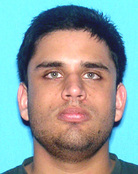
Former University of Central Florida student James Seevakumaran, who police say was planning to attack others in one of the school’s dormitories. He killed himself instead. Red Huber/Orlando Sentinel /MCT /Landov
“It could have been a very bad day for everyone here.”
That’s University of Central Florida Police Chief Richard Beary’s conclusion after seeing the evidence that a former student at the school “drafted plans to kill others in his dormitory but changed his mind early Monday and took only his own life,” The Orlando Sentinel writes.
Our colleagues at WMFE report that police say 30-year-old James Oliver Seevakumaran apparently left behind not only weapons and at least four improvised explosive devices, but also evidence of his plans.
“We found some notes and some writings that indicated this was a planned attack. This individual had laid out a timeline,” Beary told reporters.
As we reported, the incident began just as Sunday turned to Monday morning when someone — apparently Seevakumaran — pulled a fire alarm in the university’s Tower I dormitory.
What we’ve learned since then, is that police believe Seevakumaran “first pulled a gun on one of his roommates, who then escaped to a bathroom and called 911,” the Sentinel says. “The sound of police arriving may have prompted Seevakumaran to alter his plans.”
According to WMFE:
“Officials say Seevakumaran had been a business major through fall last year, but he had not paid for this semester and was in the process of being removed from his dorm in tower one. Seevakumaran is from Lake Mary, and was a graduate of Seminole High School. He was never seen by UCF Counseling and Psychological Services and had no student conduct record.
“From initial investigations it appears he was acting alone in his plans to attack the campus.”
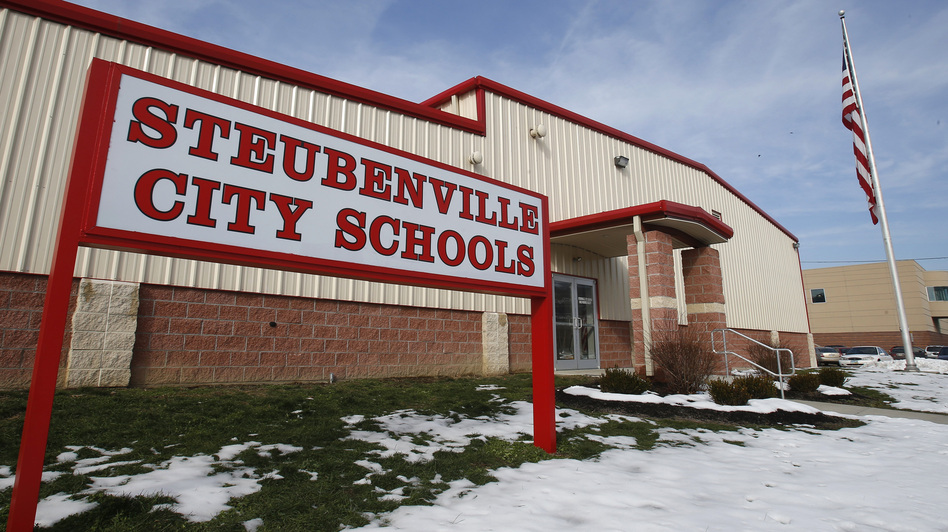
The 16-year-old girl raped by two Ohio high school football players in a crime that has attracted wide attention has also been the victim of online harassment, the state’s top prosecutor said late Monday.
Attorney General Mike DeWine announced that two Steubenville, Ohio, girls have been arrested and charged with threatening the other girl. Cleveland’s Plain Dealer writes that the alleged harassers are 15- and 16-years-old, and:
“The 16-year-old is charged with one misdemeanor count of aggravated menacing for threatening the life of the victim on Twitter. The 15-year-old is charged with one misdemeanor count of menacing for threatening bodily harm to the victim on Facebook.”
“Let me be clear,” DeWine says in a statement on his official website. “Threatening a teenage rape victim will not be tolerated. If anyone makes a threat verbally or via the internet, we will take it seriously, we will find you, and we will arrest you.”
According to Steubenville’s Herald Star, police are also “pursing information about a juvenile male” who may have harassed the victim.
As we reported Monday, DeWine plans to have a grand jury consider whether other teens should be charged in connection with the rape, which happened last summer. The two teenage boys were convicted over the weekend.
The arrest of the two girls for allegedly harassing the victim online continues the crime’s connection to the world of social media. Images of the victim and texts about her, posted by the boys who were eventually convicted of the crime and some of their friends, outraged many people around the nation and the world — and prompted an online movement to publicize the crime and push authorities to investigate.