This video is not for those who are squeamish about seeing others in danger. So think before you click play.
The good news is that 47-year-old Mark Roberts is OK after a terrifying slide last month down an icy cliff in Snowdonia, a region in north Wales. He’s “annoyingly immobile and bruised, but mentally fine,” Roberts tells the British Mountaineering Council, which has put his helmet-cam video online and posted an interview with the mountain climber “to help others understand just how accidents can happen.”
In this case, a climber above Roberts dislodged some ice. Chunks fell toward Roberts, who lost his grip and slid at least 100 feet over rocks, ice and snow.
Asked what he was thinking as he slid, Roberts uses a familiar expletive and then goes on to tell the mountaineering council that:
“There was no feeling of panic, more a concerted effort to protect my head and neck and be aware of what was below me, where I was heading and what I could do to slow and stop myself before I got to the more serious rocky outcrops.”
Fair warning: Don’t click play if scary situations aren’t your thing.
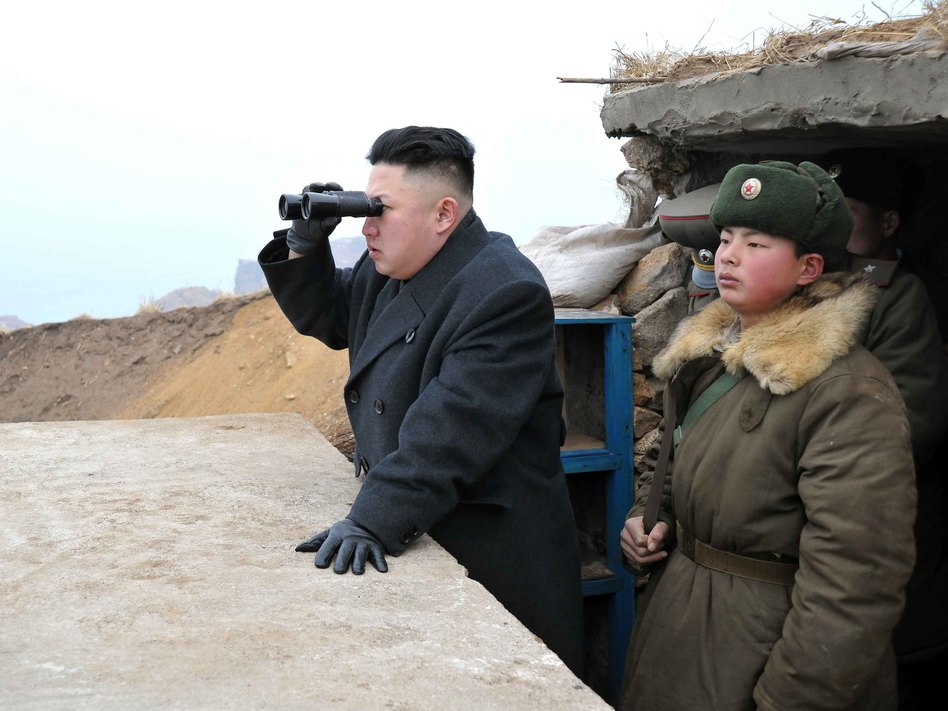
In this image released by North Korea’s Central News Agency, leader Kim Jong Un is said to be using a pair of binoculars to look south during an inspection of a front-line army unit. Xinhua /Landov
As NPR’s Louisa Lim reported Monday on Morning Edition, a week of inflamed rhetoric from North Korea — including talk of a preemptive nuclear strike on the U.S. — is being followed by word that the North has carried through on its threat to annul the 1953 armistice that ended open warfare on the peninsula and has stopped answering calls on the telephone hotline to the South.
Meanwhile, the U.S. and South Korean militaries have begun their annual joint military drills — exercises that the North views as provocative. Tensions, always high on the Korean peninsula, have been ratcheted up even further.
Here’s more from Louisa’s report:
South Korean news is headlining Operation Key Resolve: war games involving 13,000 U.S. and South Korean soldiers. Every year, it’s a time of tension. But this year, the North seems to be acting on its threats. A hotline between the South and North rang unanswered today. And Pyongyang’s state mouthpiece is warning the ceasefire that ended the Korean war is now invalid.
A South Korean official reportedly told parliament that unilateral cancellation isn’t legally binding. Pyongyang has made that threat half-a-dozen times before. But this time the context is different.
As Brian Myers, an expert on North Korean propaganda at Dongseo University in South Korea, says, “the rhetoric is always bellicose. What we’re hearing is a change of degree and not kind.” He believes the North’s new young leader, Kim Jong Un, is more military-focused than his father, Kim Jong Il.
“The problem, of course, is [that] the more Pyongyang threatens the United States and South Korea, the more it puts itself under pressure to do something,” Myers says. “So I think it’s very likely that North Korea will engage in some significant disruption of peace this year, as it does every year.”
Speaking to ABC News’ George Stephanopoulous, Rodman relayed a message from the North Korean leader.
“He wants Obama to do one thing – call him,” Rodman said.
But Kim’s bellicosity is putting limits on how the U.S. and other nations can respond to the North. South Korea just inaugurated a new conservative president, Park Geun-hye. Her cabinet meets for the very first time today. She campaigned on a platform of leaving the door open to dialogue with the North, but that position is no longer tenable. Hahm Chai-bong, the president of the Asan Institute in Seoul, says North Korea has made that very clear: “It has very quickly and very assuredly slapped President Park Geun-hye’s outreached hand.”
Elsewhere, North Korea’s traditional ally, China, is also undergoing a leadership transition. As its new leaders gather in the Great Hall of the People, Beijing seems to be recalibrating its position. The Chinese supported tougher U.N. sanctions against Pyongyang after its most recent nuclear test. Ian Bremmer, the president of the Eurasia Group has been in Beijing; he says Chinese officials are increasingly frustrated:
“The Chinese government has not developed working relations with Kim Jong Un. We’ve seen some reports from party officials in the international media that maybe China should cut off North Korea — I don’t believe that’s intended for Chinese consumption. I think it’s because formal North Korean channels aren’t working and they’re trying to get North Korea’s attention. They’re very unsettled.”
Meanwhile, on North Korean television, the bombast continues… with footage of Kim Jong Un visiting the frontline army unit that shelled the South three years ago, killing four people. Now many observers are bracing themselves for the next North Korean provocation. The big question is just how serious will it be this time.
Related headlines:
— “North Korea Says It Has Scrapped Armistice That Ended Korean War.” (The Washington Post)
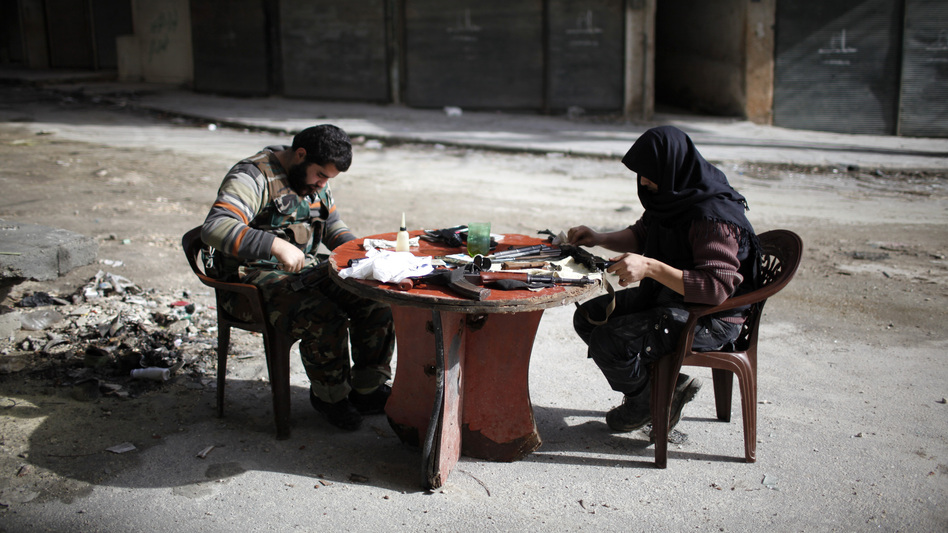
Members of Jabhat al-Nusra clean their weapons, in Aleppo in December. The Islamist rebel group has become an increasingly powerful force in Syria’s civil war. Ahmed Jadallah/Reuters /Landov
The Islamist rebel group Jabhat al-Nusra has been secretive, keeping to itself and refusing to meet Western journalists. The group has been designated a terrorist organization by the Obama administration and was thought to be made up mostly of foreign fighters, working alongside Syrian rebels.
But lately, members are starting to open up as more Syrians join the group and they make more gains on the ground in the fight against the Syrian government.
In the northwest Syrian town of Kafr Nabel we met a 21-year-old fighter from the group. He said he came from Libya six months ago and goes by the name Brother Huthaifa. He says he is a “sheikh,” or leader.
He agreed to meet on the condition that he could “invite us to Islam,” though he refused to have his photo taken.
Here are highlights of the conversation:
On labeling the group
Brother Huthaifa: I object to anyone calling us extremists.
NPR: So what word would you use?
BH: Mujahedeen (fighter for God).
NPR: What is your vision for Syria?
BH: We Muslims have a certainty, there is talk of the prophet who preached that the best place on earth is the Levant. He also said that God chooses whom he wishes to be his best followers to be from here. I hope God chooses me and this is why I came to here, too.
NPR: What did you do before you came to Syria?
BH: I was a teacher of Quran and a sharia [Islamic law] student, fourth year in Benghazi, Libya. [During the uprising against Moammar Gadhafi], I was fighting in Sirte.
NPR: What is the goal of Jabhat al-Nusra in Syria?
BH: There are orders from the general command of the group that it is not allowed to conduct suicide operations inside residential neighborhoods.
On the group’s attitude toward women
NPR: Will women be required to wear hijab [if the current regime is ousted]?
BH: Let me explain it this way. If I gave someone two lollipops … one is covered and the other is not. Where will the germs and the bacteria go? To the uncovered one. And the same with the woman; if she is uncovered, the rotten one, who will the men chase? While if the woman is covered, even the most beautiful one, they will not chase her.
NPR: That brings us to the wider question of an Islamic state, and what does that mean for the non-Muslims?
BH: Preserving the Muslim society, that is the general rule. Prevention is the best treatment. What makes people commit sin is viewing porn films, listening to songs that provoke desire.
NPR: You are also in a way not respecting the minds of men. You immediately think that they will chase a woman who is unveiled.
BH: Prevention is the best treatment. Men mostly look at face and the body. Then he will be following women and Satan will be whispering into his ears.NPR: So why don’t you put on a veil, too? There are women who chase men?
BH: Are you really asking to get an answer or to argue?
NPR: To get an answer.BH: Islam is a great religion. There is a verse that says: “Tell the believers to lower their gaze and guard their modesty. That is better for them, as God is aware of what they are doing. And tell the woman [believers] to lower their gaze and guard their modesty.”
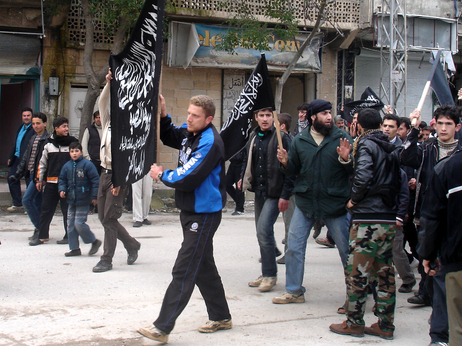
Islamists from Jabhat al-Nusra stage a protest in the Syrian town of Kfar Nabel. Until recently, the group has been reluctant to appear in public. Caroline Neil/NPR
On why the group is becoming more public
BH: There are no guidelines regarding this matter. Because people want to come to Jabhat al-Nusra on their own. If you want to know about us, you can follow us on Twitter.
NPR: But today you were a bit upset that the media didn’t publicize your demonstration.
BH: The problem is that the media has lost its credibility. The media’s role is to convey what is happening on the ground without exaggeration. And it isn’t the case. It’s opposite. Especially when Jabhat al-Nusra was classified as a terrorist organization. It did not commit any terrorist acts outside Syria, and it doesn’t have any links to al-Qaida, but it was classified as a terrorist organization. Why? Because it resisted [Syrian president] Bashar al Assad.
NPR: In Syria, people have different beliefs than you. So the question is, how can you come from a different country and tell Syrians how to live their lives as Muslims?
BH: In our religion, the believers are brothers and sisters. … There is no such thing as Libyan, Syrian, Tunisian. We are all Muslims.
On Islamic law
BH: We believe in the prophecy of implementing an Islamic state.
NPR: So once there is an Islamic state, there will be the cutting off the hands of thieves and the death penalty [for worse crimes]?
BH: I decline to answer.
NPR: The people of Syria deserve an answer.
BH: Al-Hudud [the Islamic punishments for serious crimes] cannot be implemented except in a Muslim country with power and force. With cutting off hands, we would have to implement the several conditions necessary for an Islamic state before we could do that.
NPR: We saw how your organization helped with bread distribution in Aleppo. Is it an important phase for you right now to earn the trust of the people?
BH: Yes, Sheikh Abu Mohammad al-Joulani, who is the emir of Jabhat al-Nusra in Syria, wrote a letter titled, “People of Sham we sacrifice our souls for you.” In it he said that Jabhat al-Nusa is not a political organization but a group that cares in the matters of all Muslims.
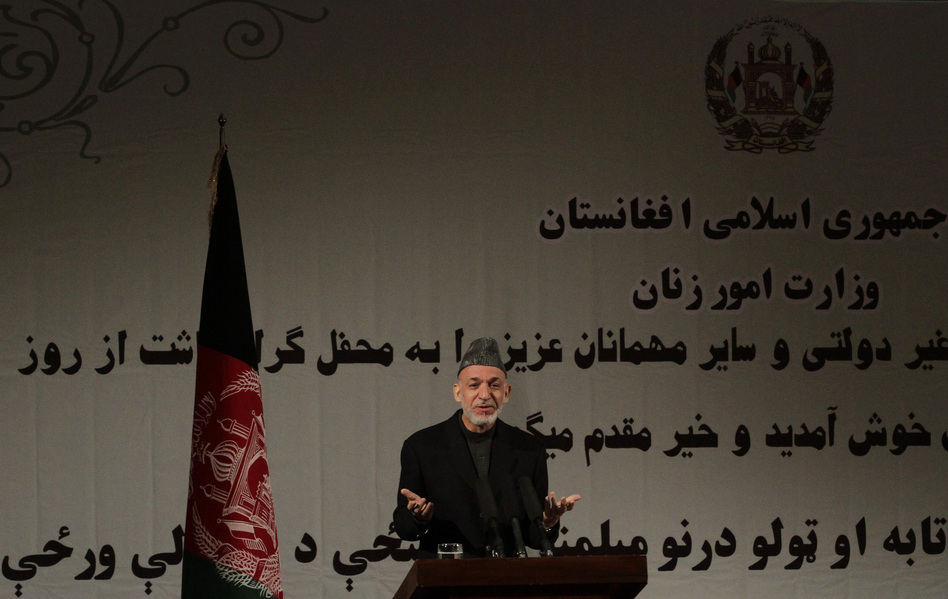
Afghan President Hamid Karzai said in a nationally televised speech on Sunday that the U.S. and the Taliban are holding talks. Ahmad Jamshid/AP
Afghanistan President Hamid Karzai claims the U.S. is holding talks outside Afghanistan with the Afghan Taliban.
The allegations come as Defense Secretary Chuck Hagel continues his first visit to the nation as Pentagon Chief – and after a deadly explosion in Kabul on Saturday that the Taliban called a message to the new defense secretary.
Karzai made his claims in a nationally broadcast address just hours before he was to meet with Hagel, reports NPR’s David Welna, who is traveling with Hagel.
“Karzai claimed the U.S. has been meeting daily elsewhere with the Taliban,” Welna reports. “He also accused the U.S. of collaborating with the Taliban to stoke fears about coalition forces pulling out of Afghanistan next year.”
The Taliban claimed responsibility for a blast outside the Afghan Defense Ministry on Saturday that killed nine people. A second bombing in eastern Khost Province, also on Saturday, killed two police officers and eight children.
“The explosions in Kabul and Khost yesterday showed that they are at the service of America and at the service of this phrase: 2014,” Karzai said. “They are trying to frighten us into thinking that if the foreigners are not in Afghanistan, we would be facing these sorts of incidents.”
American Gen. Joseph Dunford, who commands those forces, denied the charges, Welna says.
“President Karzai has never said to me that the United States was colluding with the Taliban, so I don’t know what caused him to say that today,” Dunford said. “All I can do is speak for the Coalition and tell you that it’s categorically false.”
Security concerns caused the cancellation of a joint news conference with both Karzai and Hagel on Sunday, a U.S. official said. Instead, the two men are scheduled to have dinner together, Welna reports — their first meeting of this trip.
“Ram Singh, who is accused of driving the bus on which a 23-year-old student was raped and fatally assaulted by a group of six men in December, hung himself with his own clothes, said G. Sudhakar, the top police official at Tihar jail.
Singh, along with four other men on trial with him on rape, murder and abduction charges, had been under a suicide watch, another jail official said on condition of anonymity because he was not authorized to speak publicly on the matter. He said the five were being held in separate cells in separate buildings at the jail.”
The remaining suspects could face the death penalty if convicted. A sixth accused is being jailed and on trial separately because he is a juvenile.
The brutal Dec. 16 attack, in which the woman and her male friend were attacked after boarding the bus, sparked nationwide protests and turned the world’s attention to India’s treatment of women and its laws to protect them.
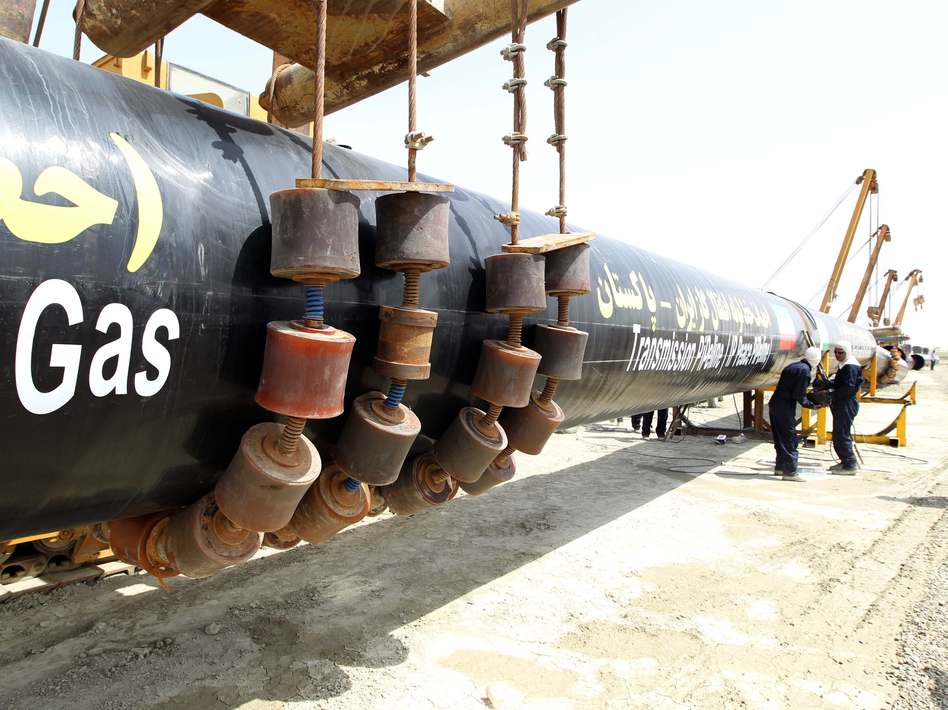
Iranians work on a section of the pipeline on Monday. Atta Kenare/AFP/Getty Images
Iran and Pakistan are moving closer to completion of a nearly 1,000-mile natural gas pipeline linking the two countries, despite U.S. objections that it could become a source of hard currency for Tehran in defiance of international sanctions.
Monday marks the beginning of construction on Pakistan’s part of the pipeline, which will consist of a 485-mile run. Iran has already completed most of its 760-miles of the link, which will stretch from Assaluyeh along Iran’s Persian Gulf coast to Nawabshah in Pakistan’s Sindh Provence.
The pipeline is meant to help alleviate shortfalls in energy demand in Pakistan, where brownouts and blackouts occur daily.
In a live television broadcast Monday, Iran’s Mahmoud Ahmadinejad stood side-by-side with his Pakistani counterpart, Asif Ali Zardari just inside the Iranian border.
Iran reportedly gave Pakistan a $500 million loan for the project, which is expected to cost Islamabad $1.5 billion.
“Today is a historic day. The gas pipeline project is the beginning of a great work,” Ahmadinejad told assembled dignitaries from both countries.
“The Westerners have no right to make any obstacles in the way of the project,” he added.
The U.S. has strenuously objected to the project, which Iran and Pakistan agreed to in 1995. According to the Pakistani media, U.S. Consul General Michael Dodman said in January that the U.S. would impose sanctions on Islamabad if the pipeline went ahead.
“If this deal is finalized for a proposed Iran-Pakistan pipeline, it would raise serious concerns under our Iran Sanctions Act. We’ve made that absolutely clear to our Pakistani counterparts,” State Department spokeswoman Victoria Nuland said during a Washington news conference last week.
Pakistan’s Dawn newspaper reports Pakistani presidential spokesman Farhatullah Babar “brushed aside” U.S. concerns and pressures.
Babar was quoted as saying the project was only about energy requirements.
“The project will bring economic prosperity, provide better opportunities to the people and help defeat militancy,” he told Dawn.
The pipeline was scheduled to begin operations in 2014, but delays have caused construction to fall behind.

9(MDEwMjQ0ODM1MDEzNDk4MTEzNjU3NTRhYg001))
9(MDEwMjQ0ODM1MDEzNDk4MTEzNjU3NTRhYg001))
9(MDEwMjQ0ODM1MDEzNDk4MTEzNjU3NTRhYg001))
9(MDEwMjQ0ODM1MDEzNDk4MTEzNjU3NTRhYg001))
9(MDEwMjQ0ODM1MDEzNDk4MTEzNjU3NTRhYg001))