The scene at a job fair in New York City on Feb. 28. Lucas Jackson /Reuters /Landov
There were 198,000 jobs added to private employers’ payrolls in February, according to the latest ADP National Employment Report — a privately produced snapshot of the employment picture that’s sometimes a signal of what the Bureau of Labor Statistics will say when it releases its data from the same month.
ADP didn’t only report there was solid, if not spectacular, growth last month. It also revised up its estimate of the growth in January. It now says private employers added 215,000 jobs that month — 23,000 more than previously though.
In the ADP report, Moody’s Analytics chief economist Mark Zandi says that “the job market remains sturdy in the face of significant fiscal headwinds. Businesses are adding to payrolls more strongly at the start of 2013 with gains across all industries and business sizes. Tax increases and government spending cuts don’t appear to be affecting the job market.”
The BLS data on February’s employment and unemployment figures are due Friday at 8:30 a.m. ET. In its last report, BLS said the nation’s unemployment rate edged up to 7.9 percent in January from 7.8 percent a month before, and that there were 157,000 jobs added to public and private payrolls in the first month of the year. According to Reuters, economists expect to hear that there were 160,000 jobs added to payrolls last month and that the jobless rate stayed at 7.9 percent.
A U.S. Marine taking part in a winter drill in South Korea last month. Jung Yeon-je/AFP/Getty Images
South Korea upped the ante on Wednesday after Pyongyang threatened to scrap the armistice that ended a brutal war between the rival neighbors in 1953, promising retaliation for any North Korean attack.
“If North Korea carries out provocations that threaten the lives and safety of South Koreans, our military will carry out strong and resolute retaliations,” South Korea’s Gen Kim Yong-hyun told reporters in Seoul.
Gen. Kim’s remarks came in direct response to a North Korea threat to attack South Korea and the United States if the two countries continue joint military exercises in the region that began on March 1.
North Korea’s Military Command announced Tuesday that it would “launch surgical strikes at any time and any target without being bounded by the armistice accord”.
The two sides have remained technically at war for the past 60 years because the agreement in 1953 to end hostilities in the Korean War was a simple armistice and not a formal peace treaty.
But tensions have risen even further in the past year following a change in leadership in North Korea that ushered in Kim Jong Un, 30, to replace his late father, Kim Jong Il. Since then, Pyongyang has moved ahead with a series of provocative nuclear weapon and ballistic missile tests that have drawn international condemnation.
The U.S. has led the effort to clamp down on the North’s nuclear ambitions and on Tuesday, Washington introduced a U.N. Security Council resolution to target the North’s cash transfers. China, which until recently has stood by long-time ally Pyongyang, has agreed to sign on to the new resolution. The resolution is expected to be formally adopted later this week.
Meanwhile, Reuters, quoting South Korea’s Yonhap news agency, reports that the North appears to be preparing its own military exercises or a possible ballistic missile test:
“North Korea has set no-fly and no-sail zones off its east and west coasts that indicates it will conduct major military drills, but test firing of short-to-medium-range missiles cannot be ruled out, South Korea’s Yonhap news agency, quoting South Korean government officials, said on Wednesday.”
An unmanned drone patrols the U.S.-Canadian border. Attorney General Eric Holder, in a letter to Sen. Rand Paul, R-Ky., said the president could in an “extraordinary circumstance” order a drone strike inside the country. U.S. Customs and Border Protection /AP
Attorney General Eric Holder has said in a letter to Sen. Rand Paul that the president could in an “entirely hypothetical” situation authorize the military to use lethal force within U.S. territory.
The letter to Paul came in response to three inquiries the Kentucky Republican sent to John Brennan, President Obama’s nominee for CIA director. Paul’s letters asked if it was legal for the U.S. government to use lethal force, including in the form of drone strikes, on Americans inside the country.
“As members of this Administration have previously indicated, the U.S. government has not carried out drone strikes in the United States and has no intention of doing so. As a policy matter, moreover, we reject the use of military force where well-established law enforcement authorities in this country provide the best means for incapacitating a terrorist threat. We have a long history of using the criminal justice system to incapacitate individuals located in our country who pose a threat to the United States and its interests abroad. Hundreds of individuals have been arrested and convicted of terrorism-related offenses in our federal courts.
“The question you have posed is therefore entirely hypothetical, unlikely to occur, and one we hope no President will ever have to confront. It is possible, I suppose, to imagine an extraordinary circumstance in which it would be necessary and appropriate for the President to authorize the military to use lethal force within the territory of the United States. For example, the President could conceivably have no choice but to authorize the military to use such force if necessary to protect the homeland in the circumstances of a catastrophic attack like the ones suffered on December 7, 1941, and September 11, 2001.
“Were such an emergency to arise, I would examine the particular facts and circumstances before advising the President on the scope of his authority.”
In a separate response, Brennan told Paul that the “CIA does not conduct lethal operations inside the United States — nor does it have any authority to do so.”
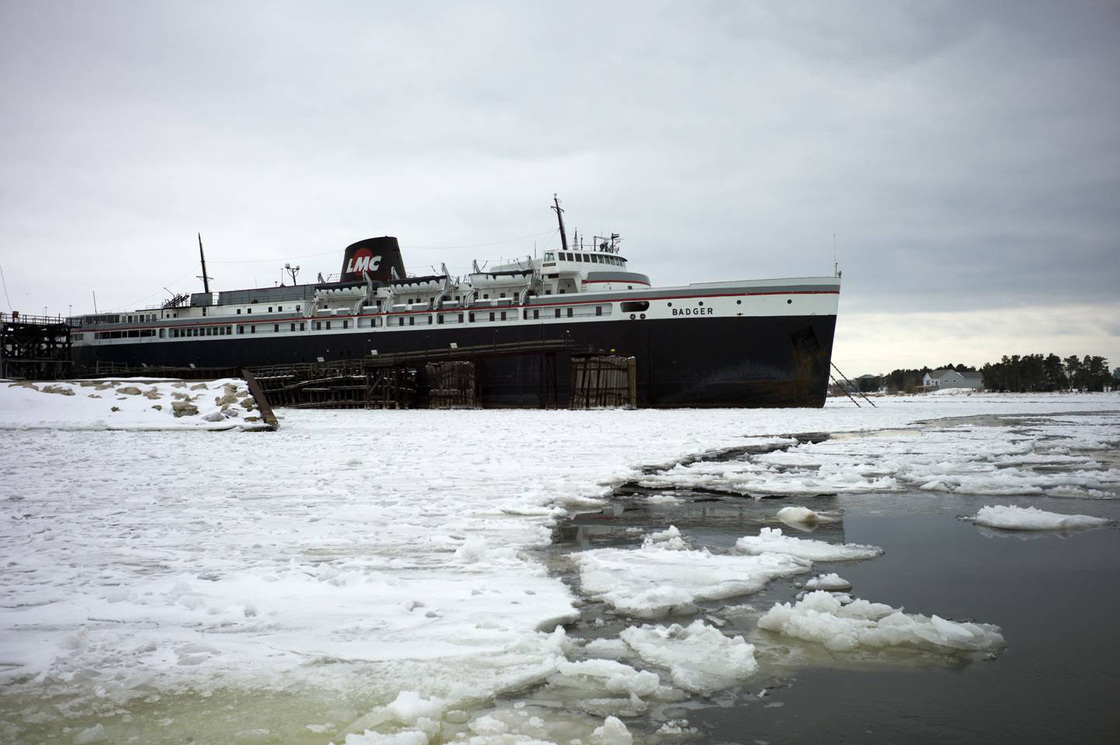
The nation’s last coal-burning ferry, the SS Badger, sits on Lake Michigan in the port town of Ludington, Mich. The EPA permit that has long allowed the ship to dump coal ash into the lake is now under review. Courtesy photo for NPR
On the shores of Lake Michigan, the tiny town of Ludington, Mich., is home port to the last coal-fired ferry in the U.S. The SS Badger has been making trips across the lake to Manitowoc, Wis., during the good-weather months since 1953. And as it runs, the 411-foot ferry discharges coal ash slurry directly into the lake.
An Environmental Protection Agency permit allows the Badger to dump four tons of ash into the lake daily. But now, the agency has put the permit under review — and that means the Badger could stop sailing.
Locals say the ship is a fundamental part of Ludington life — and brings $20 million into the local economy each year via jobs, motels, B&Bs, restaurants, gas stations, galleries and the bike shop.
People in this town of 8,000 had a lot to say about all this, including Chris Hinkle.
“I like the Badger. It’s good for tourism and things like that. I don’t feel that we should put any of my federal dollars into it, though,” Hinkle says, referring to a one-time idea of using stimulus funds to help modernize the ferry. “It’s got to support itself.”
A Piece Of Living History
Down at the waterside, the SS Badger — that’s SS for steamship — is at the dock all winter. Sixty years old, she’s almost frozen in ice and time. The hull is black and the upper decks white with a black smokestack. The ship is longer, by far, than a football field.
From May into October, the Badger runs four hours each way to Manitowoc, Wis., and back daily, with two trips a day in deep summer. It can carry 600 passengers and 180 cars, buses, trucks — even those long white blades for wind farm turbines.
Kari Karr, who used to work for the Badger, is out in the snowy wind with me. We lean back to see the ship’s pilot house towering five stories above us.
“It’s so hard to picture, when you’re standing here on a day like this … what it’s like to be up there, looking out,” Karr says. “And then the ship pulls out and heads down the channel, and you’re into the open water. I’ve loved doing it my whole life, and still do.”
A meeting with some of the current employees while in Ludington was impossible because the company — LMC, or Lake Michigan Carferry — told them not to talk to reporters. LMC is concerned about the EPA’s review of the Badger’s permit — and the change that is likely to come.
The presence of the ferry is a real part of why people say they like this town. In season, people love to hear the Badger’s steam whistle echoing out from the harbor. From her nearby antiques store, Sally Cole has been watching the ferry sail off and return for 27 seasons.
“We can see it right from our front window,” Cole says. “During the season, coming closer to April, [customers] look out that way and say, ‘Oh, the car ferry! Oh, look, the smokestacks going — they’re running, they’re getting ready to sail!’ It’s a big deal around here.”
Cole likes to brag on the ship’s crew. One day, a Wisconsin customer called the store to say, “That cupboard we were in looking at the other day — could we buy that, and you could send it to us over on the Badger?”
The shop blanketed and covered the cupboard, Cole says, “and we took it over, and they strapped it to the side of the ship, and it took a trip all by itself over to the owners who were waiting on the Wisconsin side.”
Each Year, 500 Tons Of Coal Ash
A few blocks away, Bill Fay, a retired mental health worker, collects maritime artifacts. Fay likes to take his grandkids on the Badger. His dad was a chief engineer on one of the big boats, but started out shoveling coal.
“When I grew up in the ’60s, you couldn’t look out on that lake and not see a boat out there, whether it’d be a lower laker or one of our car ferries or whatever,” Fay says. “They were all dumping the coal ash at that time, all through the ’40s and ’50s. I don’t remember a fish die-off, or I don’t remember any ecological disaster that came of that.
“Now, we got one little boat dumping a little bit of ash,” Fay adds. “I think it’s ridiculous.”
Fay may have said “a little bit of ash,” but it adds up. Every sailing season, 500 tons of coal ash slurry go into Lake Michigan. Arsenic, lead and mercury are all part of that waste mix.
During halftime at a high school girls basketball game, Mark Willis, a high school science teacher, shares what he would tell a student about the ash going into Lake Michigan.
“Obviously that’s got to be corrected. Because the lake is our first priority,” he says. “That’s what Ludington is centered around, is the lake … We chose to live in this area because of how good the environment is. There’s many other things that do damage as well. I guess I’d be hypocritical just to say it’s just because of the Badger.”
Willis’ wife, Joanie, says she, her husband and their three children go down to the water several times a week “just to watch [the ferry] come in, watch it go out … It’s part of growing up in Ludington. It’s part of being here.”
‘Ludington Will Manage To Survive’
As for the negotiations over the ship’s permit, here’s what they might bring: The Badger could be switched over to diesel or natural gas. Or a way could be found to keep the coal ash onboard, then take it to a landfill.
But if the day ever comes when the ferry is retired — left at the dock — what would that mean?
“Ludington will manage to survive,” says Brandy Henderson, who runs the town’s convention and visitor’s bureau. “We obviously have great beaches, [the] top state park in Michigan, many other assets of why people are coming here. But certainly the car ferry is the icon of our community, and without it, I think we’ll be missing a large part of our identity.”
The EPA says it expects a draft ruling later in March, followed by a period of public review, before anything is final. So the SS Badger will indeed open this 2013 sailing season the first week in May.
Outside the office of Utah Gov. Herbert Friday, Betsy Ogden lays paper chains on a pile symbolizing uninsured state residents who would be covered by a Medicaid expansion. Rick Bowmer/AP
Poor adults who live in states that don’t go along with the federal health overhaul’s expansion of Medicaid expansion face a double whammy.
They can’t take advantage of the law’s widened eligibility standards allowing individuals with incomes up to 138 percent of the federal poverty level ($15,856 in 2013) to sign up for Medicaid. But they’re also not likely to qualify for subsidized coverage on the new state-based health insurance exchanges set to open in January because, ironically, they’re too poor.
Premium tax credits will be limited to individuals with incomes between 100 and 400 percent of the poverty level ($11,490 to $45,960 in 2013).
Without financial help, coverage is likely to be unaffordable for many people living below the poverty level, says Edwin Park, vice president for health policy at the Center on Budget and Policy Priorities.
More than 11 million uninsured adults could fall into this neither/nor category, according to an estimate published by the Urban Institute last year.
To date, about half the governors have announced that they want to move ahead with Medicaid expansion.
Many people assume that state Medicaid programs typically cover people up to the poverty level, says Park. Although that’s true for children, he says, for their parents and other adults that isn’t the case.
Medicaid eligibility levels vary widely by state, but typically only very poor adults qualify for coverage. Last year, for example, the median eligibility threshold for working parents was 63 percent of the federal poverty level and 37 percent of poverty for jobless parents, according research by the Kaiser Family Foundation. (KHN is an editorially independent program of the foundation.)
Under current Medicaid rules, childless adults are in the toughest spot.
“In a large majority of states, an adult without children who’s not disabled isn’t eligible at all for Medicaid,” says Park.
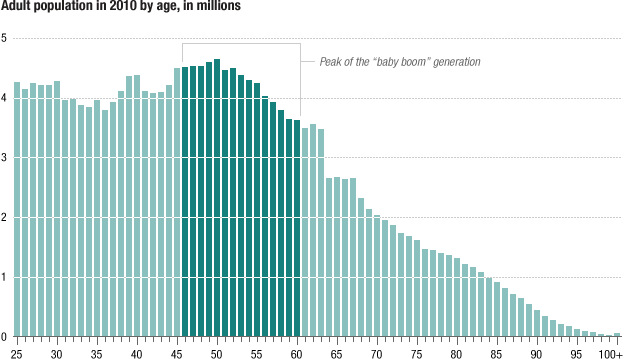
The oldest of the baby boomers came of age in the 1960s and are beginning to retire. Their younger cohorts are still putting kids through college and building careers. Baby boomers are a giant portion of the population — 78 million people, by one estimate.
They grew up in an era of rising living standards, but the Great Recession destroyed any sense of financial security — and many nest eggs. Financial planner Tim Maurer outlines a variety of issues boomers face.
Who is a baby boomer, and what defines their financial situations?
“The age range is vast — anyone from 48 to 67 — so we’re really talking about a couple of generations within the baby boomer generation. Some of them are now in retirement. Their kids are out of the house. And some of them are still in the thick of getting kids through college in their peak expense years, but also their peak income-earning years. And obviously this is all taking place within one of the most confounding periods of time in financial history. There’s an awful lot of confusion, a lot of market volatility and economic uncertainty, so a lot of questions on that front.”
How much income can be generated in retirement?
“We’re really looking at three different sources [of income]. If they’re one of the few who still have a pension, that would be a great benefit. Then they will also have some sort of Social Security. The baby boomer generation is expecting quite a deal from Social Security, actually. Some of them will be getting up to $2,400 per month of income from Social Security. And then they have their retirement savings.
“An easy way of getting an idea of how much income your retirement savings can generate is that you add it all up and you multiply it by .04. That is the equivalent of 4 percent, which would be a reasonable rate of return that you can expect to take out of your investment dollars. If you take the pensions, add the Social Security and add 4 percent of the retirement savings that they currently have, that will give them a good idea of what they can reasonably generate in terms of income today.”
Adult population, 25 and older. Highlighted bars show the ages of the people born during the peak years of the baby boom. Source: 2010 Census. Credit: Alyson Hurt / NPR
What are their immediate financial issues?
“The baby boomers truly are our first sandwich generation, where they have concerns of their parents, who are still living, possibly having to help fund them in their old age. We’re also talking about the expectation of baby boomers: This is the first generation that was expected to put their kids through school. … Many of them did take on the financial obligations for their children’s education.”
What kinds of investments should boomers be in?
“Boomers have really [ridden] the roller coaster of the market because they grew up professionally in the 1980s; 1982 to 2000 was the longest bull market stretch that we’ve ever seen in this country. And so they grew up basically believing that if they just plowed money into the market, it was going to make all of their dreams come true. From 2000, 2001, 2002 — the three-year stretch where the bubble burst in the tech market and 9/11 hit — I think that they were all scared. If they were scared in those three years, 2008 really scared them into a cocoon, and they never wanted to come out again. And just over the course of the last several weeks was the [Dow Jones industrial average] reaching 14,000. So if they just did hang on for the ride throughout all of that volatility, now is the time when I’m saying to them, ‘It is time to put together a truly diversified, more conservative, balanced portfolio that will be able to provide you with income throughout your retirement.’ ”
Is this a generation on top of estate planning?
“The generation is not, but I think few generations are. I think what’s important about estate planning for baby boomers is now they are actually glimpsing needing to utilize these documents with a higher degree of probability. In other words, baby boomers are possibly glimpsing down the road when they will be leaving this Earth, and it makes the will that much more important, but because they have assets, because they have concerns about health care. It also makes the powers of attorney and the advanced directive, the living will document and the health care power of attorney all the more important as well. They should also be thinking of their parents, who are still alive, and that imminent need for their estate planning documents to be completed.”


9(MDEwMjQ0ODM1MDEzNDk4MTEzNjU3NTRhYg001))