Former Republican presidential candidate Mitt Romney and wife, Ann, at the MGM Grand Garden Arena on Dec. 8, 2012, in Las Vegas. Al Bello/Getty Images
It was not the outcome they had hoped for, but in his first interview since losing the presidential election, Mitt Romney said he and his wife are moving on.
Speaking to host Chris Wallace on Fox News Sunday, Romney described last year’s presidential race, his second attempt at serving in the White House, as a “great, thrilling experience of a lifetime.”
“It didn’t end the way we wanted it to, but the experience itself was magnificent,” Romney said.
Both he and his wife, Ann, said they did not expect to lose to President Obama last November.
“I think we were convinced that we would win. We saw that the polls were very close, but we knew that the energy and passion was with our voters,” Romney said. “And my heart said we were going to win.”
The former GOP presidential candidate described to Wallace the “slow recognition” on election night that he was losing, especially as Ohio’s election results started coming in.
“By 8 or 9 o’clock, it was pretty clear that we were not going to win,” Romney said.
Ann Romney told Wallace the disappointment she felt was beyond any personal hopes she had of living in the White House.
“It was that crushing disappointment, not for us, our lives are going to be fine,” she said. “It’s for the country.”
Romney says while he knows his defeat means he will not be “the leader of the Republican Party,” he would still like to have a means of influencing the GOP’s tactics, and addressing national problems.
“It kills me not to be there, not to be in the White House doing what needs to be done,” he said referring to the “gridlock” over the sequester, the across-the-board cuts that went into effect Friday.
“No one can think that that’s been a success for the president. He didn’t think the sequester would happen. It is happening.”
During the interview, the Romneys also described their post-campaign life, which included an offer for Ann Romney to compete in Dancing With The Stars.
Mrs. Romney said she declined the invitation.
“I’m not really as flexible as I should be,” she said.
Romney said he and his wife are now looking to the future.
“Of course, you rehearse all the mistakes that you made. And I went through a number of my mistakes, I’m sure. And then you think about the things that were out of our control,” Romney said. “But you move on. I mean, I don’t spend my life looking back.”
Shakes on a plane aren’t all that funny to the Federal Aviation Administration. Colorado College’s ultimate frisbee team last month convinced the crew aboard a Frontier Airlines fight to let them do the “Harlem Shake.”But now that the video of their funhas gone sort-of viral, the FAA is looking into whether some safety rules may have been violated.As the college’s student-run newssite — The Catalyst — puts it:
“Something aboard a Frontier Airlines flight across the Rocky Mountain West caught the attention of federal investigators last week. Perhaps it was the passengers banging on the ceiling, walls and floor of the cabin, or maybe how most of the passengers were out of their seats, jumping up and down.
“The Federal Aviation Administration is investigating a group of Colorado College students and a Frontier flight crew for a video that was shot in the air during Flight 157 of a Airbus A320 on Feb. 15, an airline spokesperson and federal officials confirmed this week.”
According to The Associated Press, “FAA spokesman Allen Kenitzer said Thursday they’re looking at what phase the flight was in during the dance in the aisles. Frontier Airlines says the seatbelt sign was off and safety measures were followed.” The flight was headed to San Diego.
The sophomore who recorded the performance, Matt Zelin, tells The Catalyst that “obviously I hope that this whole situation is solved with the FAA. … I don’t see there being any reason why this should cause any trouble. We asked the staff and they said it was safe.”
The team says it not only asked the cabin crew for permission to do the shake, but also asked the other passengers — many of whom obviously decided to get in on the fun.
If you’re not up on the Harlem Shake, the AP describes the trend this way: “In the suddenly popular YouTube videos, one person starts dancing, then the video cuts to a large group of people dancing, many in costume.”
Former Chairman and CEO of Massey Energy Don Blankenship in 2010. Alex Wong/Getty Images
A relatively routine plea hearing in Beckley, W.Va, Thursday, took an unexpected and dramatic turn when a former Massey Energy executive implicated former CEO Don Blankenship in a criminal conspiracy.
It’s the first time Blankenship has been publicly named as an alleged conspirator in the ongoing federal criminal investigation of the 2010 explosion at Massey’s Upper Big Branch coal mine.
The accusation is also the first public indication that Blankenship specifically is in the sights of federal prosecutors.
Blankenship’s name was not uttered by former Massey executive David Hughart as he pleaded guilty to two conspiracy counts for his role in providing advance warnings to miners underground when federal inspectors arrived on the surface for surprise safety inspections.
Ken Ward of the Charleston Gazette was in the courtroom when U.S. District Judge Irene Berger asked Hughart “to name his co-conspirators,” as Ward reports.
“Hughart said ‘the chief executive officer,'” Ward writes, which was Blankenship at the time of Hughart’s crimes.
“Finally there is a witness to Blankenship’s misdeeds who will step forward and tell what he knows,” says Cecil Roberts, president of the United Mine Workers of America. “Hopefully more will follow suit.”
Hughart, 54, ran a Massey subsidiary that did not include the Upper Big Branch mine but prosecutors seem to be trying to build conspiracy cases against former executives aware of allegedly illegal practices.
“Don Blankenship didn’t conspire with anybody to do anything illegal or improper,” says William Taylor, Blankenship’s attorney, in an interview with NPR. “It’s not unusual but always a little strange to see what people will say when they’re trying to get a shorter prison sentence.”
Hughart is scheduled for sentencing in June and continues to cooperate with prosecutors.
Assistant U.S. Attorney Steve Ruby declined to respond when asked by NPR whether Blankenship is a formal target of the federal investigation.
Prosecutors claim in court documents that Hughart participated in a conspiracy to violate mine safety laws, resulting in the kind of dangerous conditions that preceded the explosion at the Upper Big Branch mine.
Four investigations of the tragedy concluded that the corporate culture at Massey Energy put production before safety. Investigators in this and an earlier mine disaster found evidence that Blankenship kept very close tabs on coal production and delays in all of the company’s mines.
Blankenship left Massey in December, 2010, shortly before the company was sold to Alpha Natural Resources. He received a departure package worth $86.2 million according to an analysis of company records conducted for an attorney for some of the families who sued Massey for wrongful death.
After much handwringing from GOP House members, the Democratic minority and some Republicans joined forces to reauthorize the Violence Against Women Act.
The vote was 286 to 138. Eighty-seven Republicans voted in favor of the bill; no Democrats voted against it.
According to The Hill, the bill authorizes a “program meant to protect women from domestic violence.” In previous years, the bill was not controversial. But this year, Republicans had issues with provisions that provided protection for native women and protection offered to lesbian, gay, bisexual and transgender people.
The bill, which was earlier passed by the Senate, will now head to President Obama for his signature.
“Republicans generally agree the law is needed, but many in the GOP oppose a sweeping expansion. Before taking up the broad-ranging bill approved by the Senate two weeks ago, the House will vote on a more limited GOP version. But with Democrats solidly behind the Senate bill and Republicans split over their own alternative, that version was likely to be rejected.
“In contrast to the partisan divide in the House, the Senate passed the measure on a 78-22 vote, with all Democrats, all women senators and 23 of 45 Republicans supporting it. The Senate bill goes further than some Republicans like in significantly broadening the scope of the law’s coverage.”
Right before the House voted on the Senate version of the bill, a Republican version was voted down. The Hill reports that conservatives are worried that more and more the House is simply signing on to Senate bills.
The same thing happened, for example, with the bill that averted the fiscal cliff. That time, the bill sailed through the Senate with vast bipartisan support, but passed in the House with a vote of 257 to 161 with only 85 Republicans voting with the majority.
The real issue here is that during Congress’ last term Speaker John Boehner had only brought issues to the floor that a majority of his caucus agreed with. That has changed.
The Hill explains:
“The issue underscores the difficulty Speaker John Boehner (R-Ohio) has had in navigating between pressure from conservatives on his right and the White House and Senate Democrats on his left.
“He has recommitted to the regular order process in the new Congress, but he has also told Republicans that the party must pick its battles with the ‘Democratic majority’ in Washington. Democrats have been hammering Republicans for months over the bill after Obama won big with women voters in the November election.”
China’s answer to accusations of cyber-espionage against the U.S.? The Americans are doing it to us, too.
Barely a week after a report from security firm Mandiant that an arm of the People’s Liberation Army was behind the theft of “hundreds of terabytes” of data from U.S. companies, China’s Defense Ministry said Thursday that U.S. hackers were penetrating Chinese military websites.
“The Defense Ministry and China Military Online websites have faced a serious threat from hacking attacks since they were established,” Defense Ministry spokesman Geng Yansheng is quoted by Reuters news agency as saying at a monthly press conference.
“Like other countries, China faces a serious threat from hacking and is one of the primary victims of hacking in the world,” Geng said. “Numbers of attacks have been on the rise in recent years.”
Geng said that 144,000 such attacks occurred each month last year and that an analysis of the IP addresses showed that 62.9 percent of them came from the U.S.
“We hope that the U.S. side can explain and clarify this,” he said.
According to The Associated Press:
“Geng attacked the Mandiant report … as ‘unprofessional and not in accordance with the facts.’ He also criticized the U.S. military’s cyber command for impeding international efforts at controlling hacking.
The Mandiant report was widely praised by cybersecurity professionals interviewed by The Associated Press, who said it provided the most detailed picture yet of China’s state-sponsored hacking efforts.”
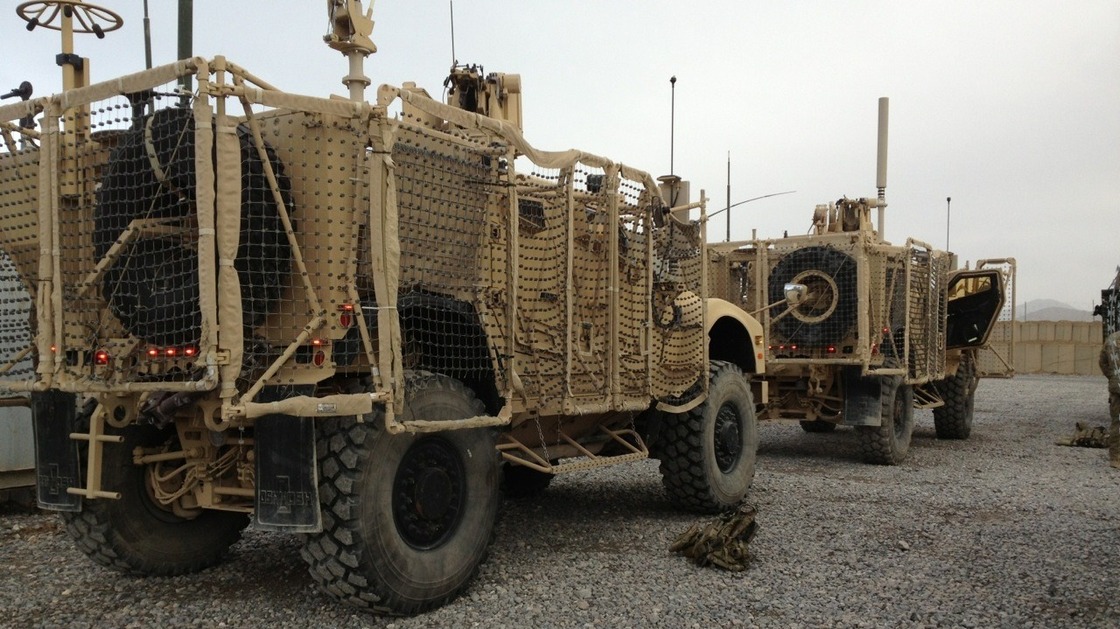
A pair of mine-resistant, ambush-protected vehicles are lined up for a convoy to Kandahar Airfield. One of the trucks broke down before leaving Forward Operating Base Frontenac. The unit has to move out 50 vehicles from the compound. Sean Carberry/NPR
In addition to training and equipping Afghan soldiers, U.S. forces in Afghanistan have another critical mission: packing up more than 11 years worth of equipment and sending it home. The number of containers to move out is in the six figures, and some question whether everything can be shipped out by the end of 2014.
Forward Operating Base Frontenac sits amid jagged mountains in the Shah Wali Kot district of Kandahar province. It’s an area that saw a lot of action during the U.S. troop surge, but more and more of the action now is about sending stuff back to the U.S., a mission the military calls retrograde. The 2-3 Field Artillery arrived here in January, and they now spend half their time on missions and half their time on retrograde. They have to clear out 25 percent of their containers, their excess ammo and nonessential equipment by April, when the fighting season begins.
“What we’re doing here is we’re working on retrograde of over 50 vehicles from our task force,” says Capt. Michael Williams, the logistics officer. “These vehicles aren’t being used in any of our missions, so we’re working on pushing them out of the country. We’ve already sent quite a few down to KAF.”
That’s Kandahar Airfield, the main base and staging area in the province. From there, vehicles and containers are shipped out of the country, some by air, but most overland through Pakistan. That’s one thing that makes the exit from Afghanistan so difficult.
When the U.S. military left Iraq, it had what it called a “catcher’s mitt” — in other words, U.S. bases in Kuwait. They could store equipment there and move it out at a leisurely pace. But Pakistan isn’t about to provide storage services, so everything has to ship out as quickly as possible.
All the vehicles here have to go through an inspection process that’s overseen by Staff Sgt. Christopher Risiska.
“Me and my guy, Spc. Ramos, go through bumper to bumper on the vehicle, look for anything missing, anything damaged, any leaks,” he says. “Pretty much a full workup of the whole entire vehicle, every operating system.”
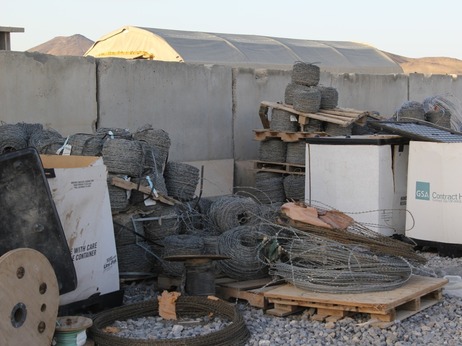
Surplus razor wire is seen at the scrap yard on the base. For years units dumped trash and surplus construction materials there, and now the 2-3 Field Artillery has to clear it out. Sean Carberry /NPR
He says they give each vehicle a code on a scale of whether it’s in perfect condition or pure junk. Most of the ones he has inspected can be reused with some minor repairs. He says one did have a ruined engine because the troops driving it were fleeing an area and drove into deep water that flooded the engine.
After the inspection, Williams says, they drive or tow the vehicles out.
“Our role is basically just getting it to the Kandahar Airfield so we can get it turned in and off our books,” he says.
Williams says they have come across a few surprises and oddities in their two months of cleaning up the base.
“For example, one of these vehicles we have to either tow it or head it to KAF because it has no seat belts, so it’s a safety issue to drive it down there,” he says, laughing.
He says his unit never used the vehicle, nor did the prior unit. He says he’s not sure how long it’s been sitting on the base.
And, considering that for years units came and went with no pressure to clear out surplus equipment, it’s now falling in the lap of units like his.
“We have, across most of Afghanistan, over 10 years of building these places up, and so many units have accumulated so much,” Williams says.
We walk along the base, and he points out that there are hundreds of containers sitting around.
“When you actually go through these containers and look at them, there’s junk in them,” he says. “There’s torn tents, there’s one container full of busted bed frames.”
We head over to a couple of containers lined up in the staging area.
“There’s nothing of value in them for the most part,” Williams says. “This one has some old dunnage — it’s just empty ammo containers.”
He moves to the next one over. “Let’s go in this mystery container,” he says. It clanks open and there’s nothing but reverberation inside — it’s empty.
They will fill it up with broken generators, bullet-riddled glass panels from armored vehicles and any other junk shipped from smaller bases that are closing. Then they will send it down the line to Kandahar. And once they meet their quota for this quarter, they will get new orders on what to clear out next.
Getting these containers and vehicles down to Kandahar is no easy task. It’s a two- to four-hour drive, and that’s assuming nothing breaks down along the way. Plus, IEDs and insurgent attacks are still a threat.
On a chilly morning, a cavalry troop assembles to deliver two vehicles and a truckload of equipment to Kandahar. But the convoy didn’t even make it off the base before one of the vehicles to be turned in broke down.
They set off without it. Once they get to Kandahar, it can take several days to complete the paperwork before they can return to their base and prepare the next load.