People grieve outside New Zealand’s Muriwai Surf Lifesaving Club after the fatal shark attack at Muriwai Beach on Wednesday. Phil Walter/Getty Images
Authorities think it was a great white shark that was responsible for a fatal attack on a swimmer Wednesday off a beach near Auckland, New Zealand — the first such incident in at least four years.
Adam Strange, a 46-year-old filmmaker, was swimming about 650 feet off Muriwai Beach on Wednesday afternoon when witnesses on shore saw the attack by what authorities estimate was a 12- to 14-foot great white.
New Zealand news website stuff.co.nz quotes fisherman Pio Mose as saying that he saw Strange swimming nearby when “all of a sudden … we saw the shark fin, and next minute, boom, attack him then blood everywhere on the water.”
Mose says he called emergency services while his friend ran to get help.
The swimmer “was still alive, he put his head up, we called him to swim over the rock to where we were,” Mose said. “He raised his hand up, and then while he was rising his hand up, we saw another attack pull him in the water.”
Police were dispatched to the scene and fired on the shark from an inflatable boat, authorities said.
The shark “rolled over and disappeared,” police inspector Shawn Rutene said.
Strange was a filmmaker and The New Zealand Herald, quoting a bio on his website, says one of his short films had been in 10 international film festivals and had won an award for Best Short Film at the Berlin Film Festival.
In the bio, Strange described his love of the outdoors, saying, “When I get a spare five minutes, I like to make a fruit smoothy [and] surf some big waves out on the West Coast …”
There have been only 14 known fatal shark attacks in New Zealand since records began around 1937, says Clinton Duffy, a shark expert at the country’s Department of Conservation.
“In the last 20 years we have been averaging two shark incidents, where the shark actually bites someone, a year.”
“Those are generally on swimmers and generally result in fairly superficial flesh wounds,” Duffy said.
Duffy said the last death was in 2009, when a kayaker was mauled by a great white, but it’s not clear whether he had drowned prior to the attack. Before that, the last death was in 1976.
People walk past the Apple logo at the Apple Store at Grand Central Terminal in New York. Timothy A. Clary /AFP/Getty Images
Apple has agreed to give out more than $100 million in iTunes store credits to settle a lawsuit that alleged it was allowing children to make in-app purchases without the consent of their parents.
“The lawsuit, which was filed by five parents two years ago, alleged that Apple did not create parental controls to keep children from buying extra features sold within a video games app. The parents who filed the lawsuit said they didn’t realize their children were charging their accounts until they were billed. Some of the games were designed for children as young as 4 years old.
“‘Apple failed to adequately disclose that third-party game apps, largely available for free and rated as containing content suitable for children, contained the ability to make in-app purchases,’ the lawsuit alleged, according to a report by Reuters.
“In the settlement, Apple agreed to give $5 of iTunes store credit to about 23 million affected customers. Apple will also pay cash refunds to customers seeking $30 or more from the company, according to the Associated Press.”
The New York Times reports that Apple has already made in-app purchases more difficult. Before, children or adults could make in-app purchases without entering a password up to 15 minutes after the app was purchased.
Now, a password is required even if someone just bought the app.
New Defense Secretary Chuck Hagel, left, as he was sworn in Wednesday morning at the Pentagon. His wife, Lilibet, held the Bible. Michael L. Rhodes, the Pentagon’s director of administration and management, administered the oath. MC1 Chad J. McNeeley/Office of the Secretary of Defense
Hagel took the oath of office in a private ceremony. His wife, Lilibet, held the Bible on which Hagel placed his hand. The oath was administered by Pentagon Director of Administration and Management Michael L. Rhodes.
The new Pentagon chief is due to address military and civilian personnel at 10:30 a.m. ET. We’ll monitor his remarks and update with any news.
Hagel replaces Leon Panetta, who is among several cabinet members who decided to retire at the start of President Obama’s second term.
Update at 11:20 a.m. ET. Hagel’s Message:
“Newly minted Defense Secretary Chuck Hagel is vowing to continue to build strong relations around world and engage with allies,” The Associated Press reports. And it adds that “Hagel is telling the Pentagon workforce that he is committed to ensuring that the troops and department civilians are treated fairly and equally.”
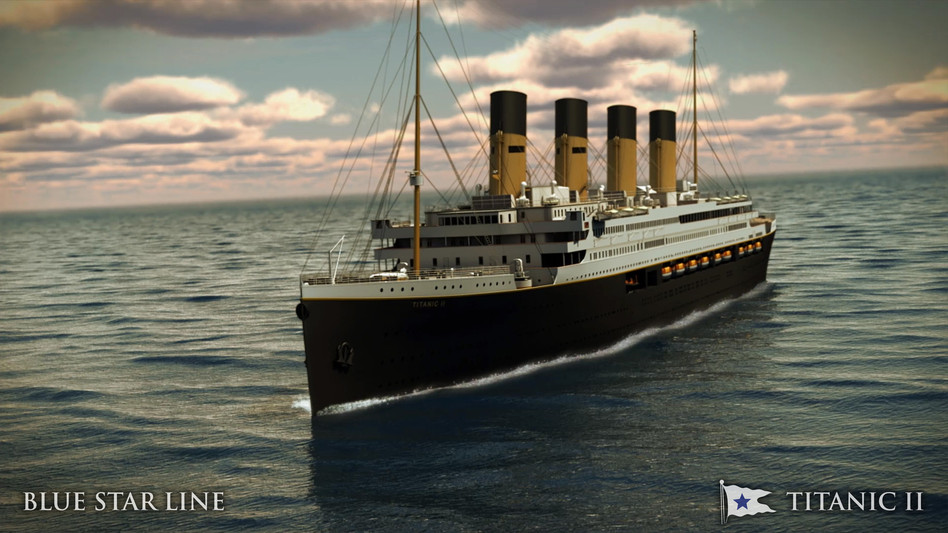
An artist’s image of the Titanic II. Blue Star Line/UPI /Landov
Declaring it will be the safest cruise ship in the world and will have more than enough lifeboats just in case something goes wrong, the designer of what’s supposed to be a replica of the Titanic has unveiled images of what the Titanic II will look like, inside and out.
It was almost a year ago, some Two-Way readers will recall, when we passed along word that Australian billionaire Clive Palmer had contracted with a Chinese shipbuilder to build such a ship.
This week, as the Daily Mail reports, Palmer and designer Markku Kanerva released artists’ images of what the new Titanic will look like and details about how it will and won’t be like the original:
— “There will be capacity for 2,435 passengers and 900 crew. There will also be lifeboats that can carry 2,700 and a life rafts with an additional capacity of 800. The original Titanic had just 16 wooden lifeboats that accommodated 1,178 people, one third of the total capacity. Some 1,502 people died when it sank on April 15 1912. …
— “Just like in 1912 there will be three classes of passenger and those with different tickets will not be able to move between the classes, though there will be more toilets for the lower decks than the original. Everyone on board will however be provided with early-20th-century-style clothes and undergarments in their cabins to get them in the mood. Whilst there will be air conditioning there will be no TVs and no Internet in a bid to get back to the ‘romance’ of a bygone age.”
The Daily Mail has put together a video with the artists’ images. It’s hoped the ship will sail in 2016.
We asked last year whether “if the cost wasn’t an issue, would you want to be on the Titanic II’s first voyage?” About 63 percent of those who responded said yes. Now that more is known about about the ship, we’ll ask again.
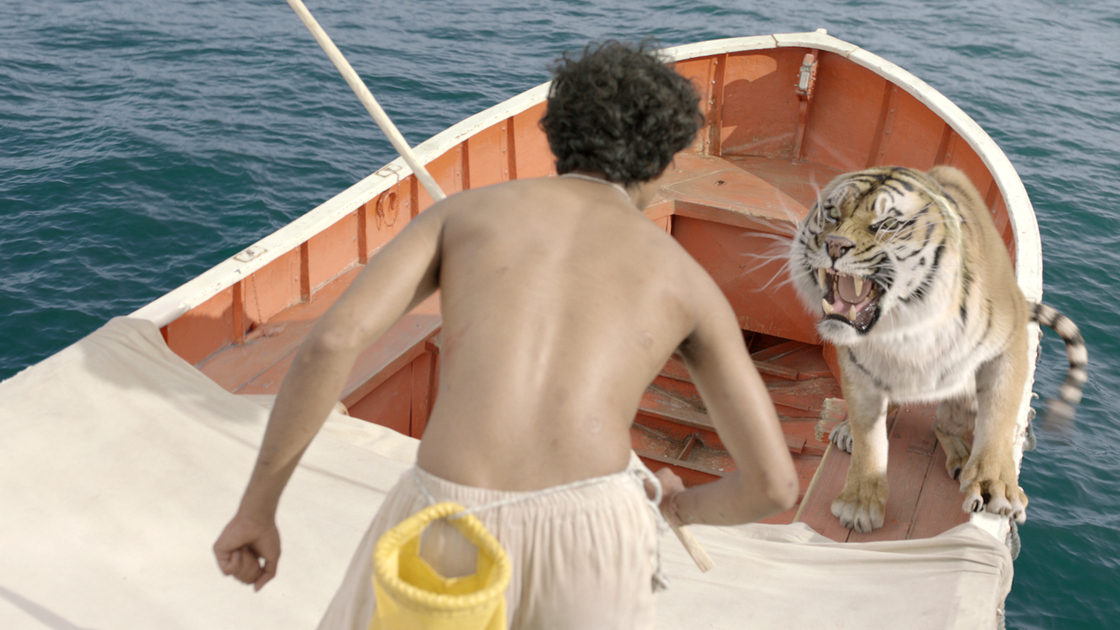
Life of Pi won an Oscar for Best Visual Effects, but the studio that helped bring to life the tiger Richard Parker is now facing bankruptcy in a increasingly volatile industry. AP via Twentieth Century Fox
In a business where effects-laden movies helped Hollywood make a record-setting $10.8 billion last year, many of the studios that create those effects are barely staying afloat.
Visual effects have been a part of the movie industry ever since Georges Melies went on his famous Trip to the Moon in 1902. These days, VFX studios do everything from putting a tiger in a lifeboat on an ocean voyage to choreographing the destruction of a New York City being defended by Earth’s mightiest heroes.
If you watched the Academy Awards on Sunday night, you might recall the ominous theme from the movie Jaws being used to usher off the stage visual effects supervisor Bill Westenhofer, whose team won an Oscar for Best Visual Effects for the movie Life of Pi. What you might not know is that Westenhofer was cut off before he could address an issue in Hollywood that many moviegoers might not know about.
“We have to figure out a way to fix the business model,” Westenhofer later said backstage.
The studio Westenhofer mentioned in his speech before that booming, cello overture interrupted him was Rhythm & Hues, an L.A.-based VFX house that worked on Life of Pi, which has gone on to make more than $500 million in worldwide ticket sales. Despite that, Rhythm & Hues filed for Chapter 11 bankruptcy earlier this month and was forced to lay off hundreds of workers.
Many of those workers and their supporters protested outside the Dolby Theatre where the Oscars were being held. Many had signs with slogans like “Foreign Subsidies = No LA VFX Jobs” and “End The Subsidies War.”
“It’s obvious these subsidies are really harming the industry and perverting it,” said Scott Ross, a founder of Digital Domain and a former general manager for Industrial Light & Magic, in a Los Angeles Times article. Digital Domain filed for Chapter 11 last September.
Those subsidies are just one of the many complex issues facing the industry, along with the outsourcing of a lot of work with cheaper labor in other countries. Others have called for the VFX industry, one of the few non-union trades in the movie business, to unionize under the banner of the International Alliance of Theatrical Stage Employees.
“A lot of VFX studios are accepting work at insanely lower costs, not making a profit and barely breaking even to complete work for the movies,” says Suzanne Cipolletti, a visual effects artist working in L.A. “There are a lot of studios filing for bankruptcy and artists are losing their jobs … in some cases not being paid for the work [and] hours they’ve already put in.”
“The problem is that you have 6 studios dishing out work to hundreds of companies. Imagine if you lived in a remote town of 100 people, where there were only 6 available women. The competition would be beyond fierce. The studios can’t turn down the allure of tax credits, or cheap labor overseas, because even if you do understand the VFX process, everyone’s boss has a boss, and they want you to spend less and get more.”
Coupled with Westenhofer getting his message cut short, many in the VFX community were angered that director Ang Lee didn’t thank the visual effects people that worked on Life of Pi during his acceptance speech for winning Best Director.
Cinematographer Claudio Miranda didn’t mention the VFX firms onstage either when receiving his Oscar for the film, but backstage he said that he’s sympathetic to the problems facing the industry. “I would hope that we could really support our effects companies, so we’re not just riding the hairy edge of profit,” Miranda said. “These guys did an amazing job … I really think we should support these people if we can.”
It’s unclear how Hollywood and the studio system will address the ongoing issue with VFX houses, but a movement has started among artists in the industry to call for change.
Supporters of that movement are changing their Facebook and Twitter icons to a solid, green screen, what many say “90 percent of movies would look like without their work.”
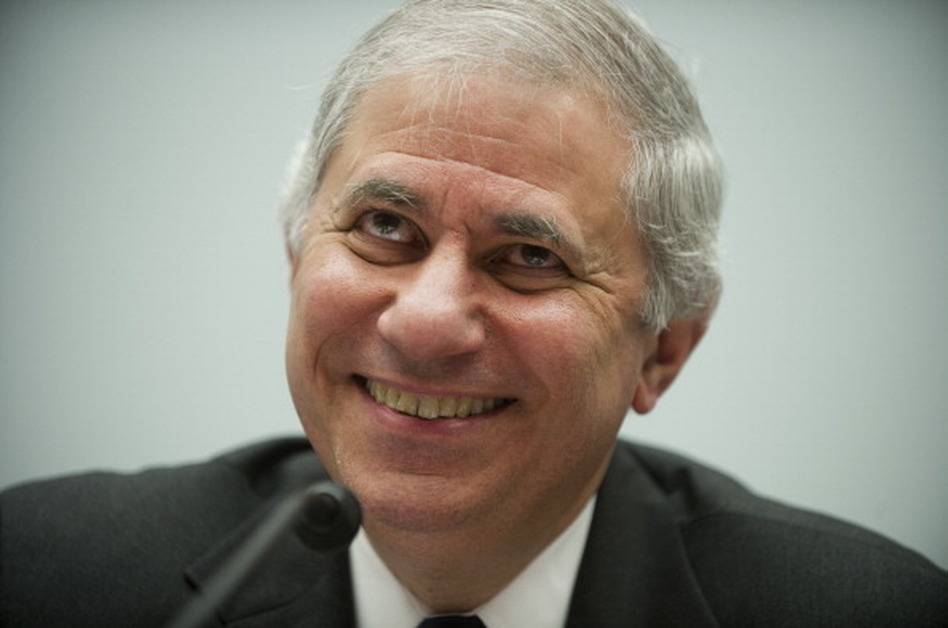
Martin Gruenberg, Acting Chairman of the Federal Deposit Insurance Corporation (FDIC), testifies during a U.S. House Financial Services Committee hearing on Capitol Hill on June 19, 2012. Saul Loeb /AFP/Getty Images
Profits for U.S. banks skyrocketed in 2012, a report from the Federal Deposit Insurance Corp. finds today.
According to Bloomberg, U.S. banks made $141.3 billion in net income last year. That is the “second-best earnings on record.” The best year was 2006, when banks reported $145.2 billion in earnings.
The AP explains:
“‘The improving trend that began more than three years ago gained further ground in the fourth quarter,’ FDIC Chairman Martin Gruenberg said in a statement. Still, ‘troubled loans, problem banks and bank failures remain at elevated levels, while growth in lending and revenue remains sluggish.’
“Banks with assets exceeding $10 billion drove the bulk of the earnings growth in the October-December period. While they make up just 1.5 percent of U.S. banks, they accounted for about 82 percent of the industry earnings.
“Those banks include Bank of America Corp., Citigroup Inc., JPMorgan Chase & Co. and Wells Fargo & Co. Most of them have recovered with help from federal bailout money and record-low borrowing rates.”
Bloomberg reports that the profits were broad with “60 percent of banks reporting increases from the previous year even as interest-income margins tightened.”