Recent News

Kids learn chemistry through cooking

What makes dough rise? How do you preserve milk? Twenty-seven young chefs are learning the answers to those questions and more this week at a Juneau Economic Development Council summer camp designed to teach kids the science of cooking. Casey Kelly has more.

Young chefs learn about the science of cooking at the Juneau Economic Development Council's Kitchen Chemistry camp. (Photo by Casey Kelly/KTOO)

Its day three of the Kitchen Chemistry camp and students are making mozzarella cheese in the culinary classroom at Thunder Mountain High School. Working in groups of four or five, they start by warming a gallon of milk and just over a teaspoon of lime juice – a substitute for citric acid – in a large pot on the stove. But most of the kids are a little unsure about the next step.

“After I think we cook it, we just gotta wait awhile or bake it or something,” says Hunter Hill, a fifth grader at Gastineau Elementary School. He says he signed up for the camp because he really likes cooking at home – mostly desserts.

“I like making crepes for my family that I get from a library book. And yeah, other than that, I like making cookies, brownies and cake, stuff like that,” Hill says.

JEDC Education Specialist Bob Vieth says the purpose of the cheese making exercise is to teach kids one way to preserve milk. During the week they also learn how to preserve cucumbers by pickling them, about leavening agents by making pizza dough, and about sweeteners by making fudge.

Making mozzarella cheese at JEDC's Kitchen Chemistry science camp. (Photo by Casey Kelly/KTOO)

“And along the way we’ve been trying to emphasize the science aspects and the chemistry aspects of the various cooking techniques that they’re using,” says Vieth.

Simon Smith learned what happens when you use baking soda instead of baking powder to make scones.

“The whole class tasted them and wasn’t so good,” Smith says.

Vieth admits there have been a fair number of failures. All the kids are going into either fourth or fifth grade, but he says some of them are pretty good chefs already, and they’re learning advanced science years before they would in school.

Budding chefs at JEDC's Kitchen Chemistry science camp. (Photo by Casey Kelly/KTOO)

“They’re learning concepts and vocabulary terms here that they normally wouldn’t be exposed to until high school chemistry,” Vieth says. “So when they do get them in chemistry, they’ll say ‘Oh yeah, I remember that from the cooking class.'”

Sophia Harvey says there’s another benefit of going to a cooking summer camp.

“I like eating the stuff after,” Harvey says.

Kitchen Chemistry is the last of this year’s JEDC Summer Camps. Previous camps include building underwater gliders, rocketry, and LEGO robotics. All the camps are part of JEDC’s STEM education program, which stands for Science, Technology, Engineering and Math. In Juneau, I’m Casey Kelly.

Cold case closed of Wasilla abduction and assault

Alaska State Troopers are reporting a big break in a cold case of a child kidnapping and sexual assault.

Brooks E. Jackson of Wasilla has been linked to the crime, twenty years after it occurred.

Sketch courtesy of Alaska Department of Public Safety

The eight-year girl was abducted by a stranger from a bus stop near Wasilla in February, 1991. She was taken to a home and raped, then released a few hours later. After an investigation and a search, no suspect was ever identified.

Jackson was arrested and convicted in 2005 for a marijuana grow operation in his home. He was required to submit a DNA sample as part of his conviction. But Troopers say that Brooks committed suicide just before the sample could be analyzed.

Sketch courtesy of Alaska Department of Public Safety

The sample that Brooks provided was one of nearly ten million in the federal DNA database, but Troopers says it was a perfect match to a sample collected after the Wasilla abduction. After the DNA connection was made last September, Troopers say they began investigating Brooks, what he was doing in February in 1991 and what vehicles he was driving. Troopers say they were not able to locate the vehicle or home with a porch described by the girl during the abduction. But the DNA sample is an explicit tie to the case and they consider it closed.

Sketch courtesy of Alaska Department of Public Safety

There is no statute of limitations for such a crime in Alaska. But with the main suspect dead, Troopers say there will be no prosecution or conviction.

The girl is now 28-years old. The woman and her family were informed of the break in the case last week. She was not specifically named in an announcement on Tuesday and Troopers, Palmer District Attorney’s office, and the Alaska Scientific Crime Detection Laboratory are asking everyone to respect her privacy.

Fairweather ends sailing, repairs expected soon

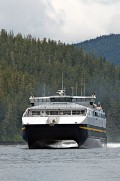
The FVF Fairweather. (Photo courtesy Alaska Marine Highway System)

The fast ferry Fairweather ended its Sitka sailing today (Wednesday) due to problems with its automated engineering system.

The ship left Juneau for Sitka in the morning, but turned around before entering Sergius Narrows, which can have strong currents. It returned to Juneau for repairs.

The ferry’s engine room is un-staffed, and the equipment is controlled and monitored via computer. Ferry chief Mike Neussl says the problem is with that system, not the engines.

He expects the Fairweather to be ready in time for its Thursday sailing to and from Sitka.

Heating oil theft on the rise

At least $10,000 worth of heating oil has been stolen from Juneau homes so far this year. Since January, Juneau police say there’s been nearly twice the number of thefts than were reported for all of 2010.

The latest was for $200 in oil stolen from a tank at the back of a Lemon Creek area home. It’s prompted police to ask Juneau residents for help.

Spokeswoman Cindee Brown-Mills says police have no leads in any of the cases.

“We have in 2011 so far 19 cases and I wonder how many have not been reported or never discovered,” Brown-Mills says. “There’s not anyone area of town that’s been more affected than others so we don’t really have a whole lot to go on. This is really something we need the public’s help on if we’re going to catch people doing it.”

Local fuel-delivery companies say they’ve been getting their fair share of complaints about oil thieves, especially now that prices are more than $4 a gallon. Reliable Fuel says calls come in spurts, and have averaged two a month this year.

The best deterrents? Lock the tank, put it behind an enclosure, or install a video camera. Police say be a nosey neighbor and pay attention to what’s happening in your neighborhood.

Taku Oil’s Tim Hansen says locking caps will help, but a determined thief can still get your oil.

“Those plug-type caps seem to work better. They’ll go inside the hole in the tank there, rather than being up on a spout where someone can tip off the fill spout with a pipe wrench,” Hansen says. “Definitely the more obstacles you can put in people’s way, the less likely people are going to try to get some (oil) from you. Below ground tanks are pretty hard to get to.”

Juneau police say anyone with information on stolen oil should call JPD at 586-0600, or remain anonymous and leave a tip at www.juneaucrimeline.com.

NTSB investigators review recent crash data

The wreckage of a single-engine plane that crashed July 24th on Douglas Island rests in a Juneau hangar. A National Transportation Safety Board crew is piecing the aircraft together for the investigation into the accident that killed Charles Luck and his wife Liping Tang-Luck.

The NTSB preliminary report indicates the plane crashed very shortly after Luck communicated with the Juneau tower. So soon, says investigator Clint Johnson, that in interviews the air traffic specialist used the term “moments.”

“Mr. Luck called in, indicated that he was about 10 miles to the southeast, landing Juneau, and right after that, we’re not sure exactly how long it was, just moments after that, they received a very faint ELT signal,” Johnson says.

That Emergency Locator Transmitter signal led searchers to an aircraft debris field, at about the 31-hundred foot level of Mount Ben Stewart, near the Eaglecrest Ski Area. The fuselage and bodies were not found until the following day. It was six days before skies cleared enough to recover the bodies.

Johnson has been conducting interviews and expects to review Juneau Air Traffic Control Tower tapes later this week. He’s also awaiting autopsy results.

“What we’re doing is gathering information on the pilot, as far as past history, experience level,” Johnson says. “Obviously there was an autopsy and toxicology screen, which is very, very standard for anybody who’s killed in an airplane accident.”

Charles Luck was a physician assistant at the SEARHC health care clinic in Hoonah. According to Johnson, Luck had not filed a flight plan for his early morning trip to Juneau.

Johnson says the Cessna was being operated on visual flight rules. While weather conditions at the accident site aren’t known, the Juneau airport tower reported marginal conditions that morning.

Johnson says local pilots tell him that when the cloud ceiling is low in Juneau, it’s often even lower over the area where the plane crashed.

Sanford wants CBJ to withdraw support for Tongass Roundtable

Juneau Deputy Mayor Merrill Sanford wants the city to pull its support for the Tongass Futures Roundtable.

Sanford believes the roundtable has changed direction since the assembly passed a resolution backing its work in 2007. Most logging advocates left the group earlier this year, and Sanford says he’s no longer comfortable giving it the city’s blanket support.

Deputy Mayor Merrill Sanford wants to withdraw Juneau’s support for the Tongass Futures Roundtable. (Photo courtesy City and Borough of Juneau)

“If they wish to come before us and ask for approval on some topic, that’s fine with me. But I can’t sit here as an assembly member any longer and let this move forward in a different direction than what we thought it was going to be,” said Sanford.

The Tongass roundtable is a group of stakeholders that came together five years ago in an attempt to find consensus in the often contentious public policy debates surrounding the nation’s largest national forest. It includes the US Forest Service, conservation groups, and Native organizations, including regional Native Corporation Sealaska. Juneau Mayor Bruce Botelho is the group’s facilitator.

At this week’s assembly meeting Sanford made a motion directing the city attorney to draft a resolution rescinding the assembly’s earlier declaration of support. Botelho recused himself from discussion, because he felt his role as facilitator presented a conflict of interest. Reached by telephone Tuesday while out of town on business, Botelho declined to comment.

Sanford’s motion passed unanimously. But Assembly member Karen Crane expressed concern that the city not ditch its support for the roundtable without a thorough review.

“I don’t know enough about it to say yay or nay at this point,” Crane said.

The assembly’s 2007 resolution supporting the roundtable was approved unanimously, and signed by Sanford, who was deputy mayor at the time. The largely symbolic declaration talks about the effort to create a “steady, reliable, and predictable” timber supply to “support an integrated manufacturing industry.” It also discusses protecting “watersheds with important values” and “maintaining the natural values and ecological integrity of the forest.”

Earlier this year the State of Alaska and timber industry representatives quit the roundtable, citing its inability to increase logging in Southeast Alaska. Representatives of Petersburg, Wrangell, Craig and Coffman Cove also pulled out of the organization. In its place the Parnell administration formed a state Timber Jobs Task Force that includes no representatives from the conservation community.

Site notifications
Update notification options
Subscribe to notifications