Syndicated

Article 32 hearing underway in Juneau

NOTE: This is a developing story. Check back for updates.

A hearing is now underway in Juneau for a Coast Guard officer facing charges related to the deaths of two of his crewmates during a crash off the coast of Washington last year.

Lieutenant Lance Leone was the co-pilot of a Coast Guard H-60 helicopter being flown to its new assigned station in Sitka in July 2010. It crashed after striking power lines near La Push, Washington. Leone was the only survivor. Lieutenant Sean Krueger — the pilot — and Aviation Maintenance Technicians Adam Hoke and Brett Banks were killed.

In testimony today (Wednesday), a civilian helicopter pilot who witnessed the H-60 flying near Long Beach said it appeared to be flying about 150-feet off the ground and as fast as 150-knots on the day of the crash. Under cross examination she admitted she had sent an email to a Coast Guard officer days after the crash that indicated the chopper wasn’t flying quite that low or fast.

A Coast Guard mishap investigator testified that Leone’s helicopter traveled at an altitude that was too low and violated regulations for flight through two wildlife refuges. He also said the chopper was traveling at about 125-knots for most of the flight. That’s considered the normal maximum operational airspeed for preservation of the aircraft’s mechanics.

At this hour (noon), Leone’s defense counsel, government counsel, and the hearing’s investigating officer are listening to cockpit voice recorder tapes behind closed doors. The Article 32 hearing will reconvene afterward. The hearing is much like a grand jury proceeding or preliminary hearing in civilian criminal court, but the accused has the right to refute the government’s evidence or cross- examine witnesses.

Proceedings are now expected to last into Friday before the hearing’s investigating officer drafts a set of recommendations. He could call for dismissal of the charges, administrative or internal discipline, or a general court martial on the charges.

Today’s proceedings are being observed by Leone’s wife, father, stepmother, friends from Sitka, and other Coast Guardsmen who served with him. Kyla Krueger, widow of pilot Sean Krueger, has come from Florida to attend the hearing and support Leone.

‘Tis the season

(Photos by Ty Scales)

Governor Sean Parnell and First Lady Sandy Parnell held the 99th annual holiday open house at the governor’s mansion on Tuesday. It’s among the most popular holiday events in the Capital City, with eager citizens lining up around the block to get a picture taken with the Governor and First Lady. KTOO’s Danny Peterson has more.

Report says sea otters hitting dive fisheries hard

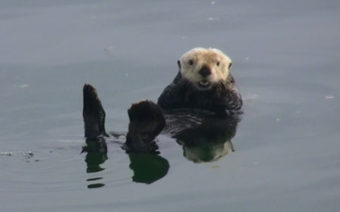
Sea otter in Glacier Bay. Photo by Riley Woodford.

The Allen Marine catamaran St. Tatiana heads along the outer coast south of Sitka near the end of this year’s tour season. It’s on one of the company’s Sea Otter Quests, and it’s having some success.

Several dozen cruise-ship tourists watch from an open deck as otters swim, dive, roll and float on their backs.

“You saw a few of them have their hind feet out of the water. That’s because there’s not so much fur around there so they don’t want to lose that heat through their body to the water because they don’t have a lot of fur around their feet,” says Naturalist Ryan Dunn.

He goes on to explain that otters have incredibly thick fur instead of blubber. Their pelts are valuable, and they were hunted to near-extinction by the early 1900s.

Otters were reintroduced to Southeast in the 1960s, and for decades, they were a rare sight. But recently, their population has boomed, mostly along the outer coast and in southern Southeast.

That means the voracious eaters are consuming more and more sea cucumbers, sea urchins and the giant clam called geoducks.

A resting sea otter. U.S. Fish and Wildlife Service digital archives.

A new report says Southeast Alaska’s sea otter boom has cost the region’s commercial divers and fishermen close to $30 million. Most is income lost as otters consume shellfish and crabs that otherwise would be harvested.

“We don’t know what’s going to happen with the dive fisheries in the long run. It doesn’t look very promising, though,” says Phil Doherty, executive director of the Ketchikan-based Southeast Alaska Regional Dive Fisheries Association.

The association recently released an economic report from the McDowell Group, a Juneau-based research firm.

The report estimates regional otter numbers will soon hit 20,000, more than double the population about eight years ago. And by 2015, it will more than triple.

“We don’t see a real management plan out there that would even slow down the growth, let alone trying to keep otters out of areas where they aren’t in yet,” Doherty says.

The report estimates otters have taken about $22.5 million dollars in the species divers harvest, plus Dungeness crab, using the wholesale value. Add in businesses that support the dive and crab industries and the figure grows to just over $28 million dollars.

That includes $9 million dollars of sea cucumbers, just over $4 million dollars in geoducks, almost $4 and a half million dollars in sea urchins, and around $5.3 million of Dungeness crab.

“That’s a very narrow way of looking at sea otters’ role in the ecosystem,” says California activist Jim Curland, who lobbies Congress to continue protecting sea otters.


He says their return to an area where they were virtually extinct is good for the marine ecosystem.

“When you have large colonies of sea urchins, which occurs when you don’t have sea otters, they can destroy kelp forests. And sea otter predation on sea urchins actually enhances the productivity of kelp forests. Scientists have documented this effect in Southeast Alaska and elsewhere over decades of studying this,” Curland says.

The Marine Mammal Protection Act bans most hunting. Alaska Natives can harvest otters for subsistence use. But they can only give or sell whole pelts to other tribal members. Other sales are allowed if the pelt is substantially altered, such as being turned into handicrafts or clothing.

Alaska’s Congressional delegation is pushing legislation that would allow Natives to sell whole pelts to anyone.

Doherty, of the dive fisheries association, says it’s unlikely to pass. But even if it does, it won’t solve the problem.

“If the Natives could sell them as a pelt, that would increase the harvest. But we feel it’s doubtful that even that new legislation would make a significant dent in the population and slow the growth down in the areas where they are most affecting our dive fishery,” he says.

A group of environmental organizations are campaigning against the legislation. Otter activist Curland says it could do a lot of damage to a species that’s recovering.

“You would open up a larger market outside of the Native subsistence hunters in Alaska. You’d start seeing pelts sold to China. They’d show up on Craigslist or eBay or whatever. And I think that demand would create a greater pressure on the hunting of sea otters,” he says.

Doherty says the dive fisheries association funded the recent report to share its concerns.

“We need to make sure everyone is fully aware of what’s going to happen with our shellfish fisheries in Southeast Alaska. And if at the end of the day, people still don’t want to react to it, and they will allow the sea otter population to wipe out the shellfish fisheries in Southeast Alaska, that’s the decision that our divers need to know so they can make a decision as to what their future is going to be,” he says.

A separate U.S. Fish and Wildlife service research effort is trying to determine the extent of sea otter population growth.

It’s shown a 13 percent boost in southern Southeast. Additional research, due out soon, will provide numbers for the northern part of the region.

Read a report from the U.S. Fish and wildlife service.

Hear a report on sea otter harvest legislation.

Juneau stuck in the middle of garbage fight

City officials are frustrated by stalled changes to Juneau’s solid waste system. City Manager Rod Swope says Juneau can’t make any improvements until two private companies work out their issues over the collection and disposal of garbage.

The Regulatory Commission of Alaska recently rejected an Alaska Pacific Environmental Services proposal to barge Juneau’s trash to the Lower 48 instead of putting it in the landfill. The company also wanted to implement a curbside recycling program. APES operates Juneau’s garbage collection company Arrow Refuse.

When APES announced the plan in September, it caught city officials and landfill operator Waste Management by surprise. With news of the regulatory commission’s rejection of the APES application, Swope hopes Waste Management will be able to rekindle a city-backed effort to expand recycling services at the dump.

“I’m very hopeful they’ll be able to work things out at least to the point where they’re willing to extend the contract at least for another year to give everybody more time to try to figure some of this stuff out. The city’s pretty much caught in the middle right now,” says Swope.

Arrow’s contract with Waste Management expires in December 2012. Landfill Manager Eric Vance says the two companies are talking, but declined comment since he’s not involved in the negotiations.

In denying Alaska Pacific Environmental Services’ application to barge trash and provide curbside recycling, the Regulatory Commission of Alaska’s staff wrote that the “proposed revisions collectively… represent a rate redesign,” which requires a cost of service study. No such study was included in the company’s application.

Officials from APES did not return calls seeking comment.

Ketchikan man faces APOC campaign fine

A Ketchikan House candidate faces a sizable penalty for campaigning without registering.

An Alaska Public Offices Commission attorney recommends fining David Scott $2,357. That’s because he sent out emails announcing his election plans without filing the proper paperwork with the state.

Scott is a former chief of staff for the incumbent in the seat, Representative Kyle Johansen. The Republican, now chief of staff for Nome Democratic Senator Donny Olson, announced his candidacy on Alaska Day.

He sent emails to the media, plus another Ketchikan Republican,

David Scott

who forwarded it to party members. At the time, he said he planned to work the upcoming legislative session, which meant he would not file until after the legislature adjourns. That’s because legislative staff have to quit before running for office.

In a report to the commission, APOC attorney Martha Tansik recommends he be charged a $700 fine, plus$1,657 in staff costs. That adds up to $2,357 in civil penalties.

Calls for comment were referred to APOC Executive Director Paul Dauphinais, who said staff concluded Scott violated state statute.

“For Mister Scott, it appears that he had an expenditure in announcing his campaign and did so before he filed either a letter of intent of candidate registration or put his name in nomination,” Dauphinais said.

Question: “Does the commission have a rule or the state have a rule that says sending an email is an expenditure?”

Dauphinais: “Yes, the commission has set a precedent where sending an email is considered an expenditure, even if it is de minimis (a legal term for minimal).”

The full commission will decide whether to levy the entire recommended fine.

Scott also could not be reached via phone and email. But in an earlier interview with KRBD, he said he did his best to follow the rules.

“I had no intent to try to skirt any ethical barriers or campaign laws, which is why I was in contact with the ethics committee before hand, before I did the press release. So I used my own private time. I did it after 5 o’clock. That’s why I used my own private computer. And I released the press release on a state holiday,” Scott said.

His written response to APOC’s complaint notes that he sent another email, rescinding his candidacy announcement, after agency staff told him he was in violation of campaign laws.

He also said he realizes he should have contacted APOC before sending out the first announcement.

The APOC report also questions whether Scott has actually ended his campaign. It cites a KRBD report where he indicates he still intends to run for the House.

Incumbent Johansen is seeking election to a reconfigured Ketchikan-based House district. Wrangell Representative Peggy Wilson and Ketchikan Visitors Bureau Director Patty Mackey have also filed for the Republican primary.

Ketchikan City Council Member Matt Olsen will run as a Democrat.

Guide’s client charged with hunting violation

A client of a Juneau guide is the latest to be implicated in possible poaching activities in the area.

Bradley Deffenbaugh, 51, of Honolulu, Hawaii has been charged with a single count of negligently falsifying information required on a sealing certificate or temporary sealing form. That’s a class ‘A’ misdemeanor.

A ‘not guilty’ plea was entered during an arraignment on Tuesday. A jury trial is tentatively planned for late February.

Alaska Fish and Wildlife investigators allege that Deffenbaugh killed a black bear near the end of the Juneau road system, traveling by vehicle with guide Michael Duby on June 4, 2009. According to charging documents, Deffenbaugh “signed a sealing form certifying that the bear was taken south of Lyn (sic) Canal with the use of a boat on June 3, 2009”.

When interviewed by investigators, Deffenbaugh admitted to signing the sealing certificate, but he did not know why it stated that the bear was killed on the previous day with a boat.

The charge against Deffenbaugh was filed by the Attorney General’s Office of Special Prosecutions which has also filed charges against Michael Duby’s brothers, Jason W. Duby and Joel M. Duby, both of Washington state, for alleged bear hunting and sport fishing violations. Their father, Michael W. Duby, is also being charged with providing guide services without a license.

Michael Patrick Duby is currently awaiting sentencing on a federal charge for selling migratory bird parts over the internet for use as fly-tying supplies. But no charges related to the bear hunting have been filed against him yet by the State of Alaska.

Michael Patrick Duby and Michael W. Duby were already sentenced in September for five years of poaching elk, deer, and antelope in Montana.

According to the Bozeman Daily Chronicle newspaper, Michael Patrick Duby received a 20-year suspended prison sentence and was ordered to pay $15,500 in restitution. Michael W. Duby was sentenced to two six-month suspended jail sentences and three years probation for unlawful possession of game animals.

Site notifications
Update notification options
Subscribe to notifications