Interior

Young amendment blocks ANWR wilderness plan

Pond on ANWR coastal plain. (Photo: USFWS)
Pond on ANWR coastal plain. (Photo courtesy of the U.S. Fish and Wildlife Service)

Alaska Congressman Don Young has added an amendment to a bill that would block the federal government from spending any money on a plan that calls for more wilderness in the Arctic National Wildlife Refuge.

Young’s amendment to the Interior Department spending bill passed the House Tuesday by voice vote after a brief debate.

President Obama announced the update to the comprehensive plan for the Arctic refuge in January, with great fanfare. The planning document calls for designating more than half of the refuge wilderness – the highest level of protection in federal law. Including the areas that are already wilderness, there’d hardly be any part of the refuge that’s not under the designation.

Alaska’s congressional delegation and the governor hit the roof, and they’ve stayed mad. They, like a majority of Alaskans in many polls, want the coastal plain of the refuge opened to oil and gas exploration.

Young says the president’s actions are illegal, because only Congress can declare a wilderness area. He also referred to the “no more” clause in ANILCA, the Alaska National Interest Lands Conservation Act of 1980.

“This is an example of what I think of the whole Department of Interior. Between the EPA and Department of Interior, they’re trying to cripple this nation and cripple my state,” Young said.

The president’s defenders say he’s not breaking the law because he’s only asking Congress to declare the new wilderness areas. Congresswoman Betty McCollum, a Minnesota Democrat, stood to oppose Young’s amendment on the House floor.

“ I understand there’s differences of opinion how to manage this land, and that legislation designated in this area as wilderness — may not get very far in this Congress, but I want to commend the president for his leadership on this issue and I would hope that the legislative process could play out,” McCollum said.

The House is expected to vote on the full bill this week. The Fish and Wildlife Service says it’s concerned about Young’s amendment, but they haven’t done a thorough review. The service has repeatedly acknowledged it can’t fully carry out its new comprehensive plan anyway, unless Congress passes a bill declaring the new wilderness areas.

The planning document itself says it would take an act of Congress to implement. And the Arctic Refuge manager has said he’s still treating the areas in question as they’ve been treated since 1988, under a management regime called “minimal management.” The differences between that and actual wilderness management are administrative and subtle.


Infected salmon just another problem for Yukon subsistence fishermen

A severe case of ichthyophonus in a Yukon Chinook filet. (Photo courtesy of RapidResearch.com)

As Yukon salmon continue their summer runs, subsistence fishermen are expressing frustration about gear restrictions, closures, and now potentially infected fish.

When managers and fishermen met for their weekly teleconference Tuesday, they heard reports of discoloration and pus in chum salmon from callers in Pilot Station, Russian Mission and Fairbanks.

Stephanie Schmidt, summer season area management biologist for the Yukon for the Alaska Depart of Fish and Game, says the parasite ichthyophonus could be the culprit

“Folks here complaining about summer chums having white patches and pus sacs … A lot of these fish have pus in the meat, so that’s a bummer … Kind of little pockets of pus when you fillet the fish. That’ll be about the size of a pea or maybe a little smaller. And I know that in warm water, which is what we have right now, that ichthyophonus really grows rapidly if the fish is infected.”

Fish and Game says the pathogen is not harmful to humans, and Schmidt invites fishermen to submit samples for testing if they’re concerned.

The summer chum run is now estimated at 1.3 to 1.5 million fish, which is average but below Fish and Game’s preseason predictions. The first pulses are passing through Tanana, Koyukuk, and Kaltag, but many stragglers are still lingering in the lower river. Schmidt says that’s led to record numbers for commercial fishermen.

“There have been record catches of summer chum salmon with dipnets this year in district one and district two. To date, the dip net and beach seine commercial fishery in these lower districts have caught 185,700 summer chum salmon and they’ve released just over 8,000 Chinook salmon,” Schmidt says.

Meanwhile, subsistence fishing has been a mixed bag. Abundant chums on the lower Yukon have helped fishermen in Nunam Iqua to fill his racks. But fishermen upriver have struggled to meet their subsistence needs, citing plenty of activity but little production.

Fish and Game is continuing efforts to protect the kings through strategic closures, but Chinook numbers are still weak. More than 80,000 kings passed through Pilot Station by the end of June — about 20-thousand fish fewer than the historical average.

The possibility for incidental harvest of Chinook has been discussed and even allowed for short periods in areas with strong passages of chum. But the general call for immediate release, coupled with gear restrictions, hasn’t allowed for much.

Schmidt says it’s possible that king escapement goals will be reached this year, but conservative management strategies will continue to ensure that happens.

Water fountains in the tundra

Wilderness guide Garrett Jones takes a photo of water fountaining from the tundra near the middle fork of the Chandalar River.  (Photo by Ned Rozell)
Wilderness guide Garrett Jones takes a photo of water fountaining from the tundra near the middle fork of the Chandalar River. (Photo by Ned Rozell)

While tightroping on tussock heads in a bog off the Chandalar River, two companions and I heard a waterfall. Strange.

Looking through binoculars, we saw a knee-high fountain of clear water in the tundra. The flow was as thick as your leg. We squished over to investigate.

The three of us had never seen water spewing from the ground in such a way. The clear water was so cold it burned, forcing us to pull our hands back after a second or two.

A few days later, on our flight out of the bush, pilot Dirk Nickisch said yes, he had seen tundra “hydrants” in a few arctic valleys. When I got back, local experts watched this video:

They theorized that we had seen the effect of high-pressure groundwater finding a way through permafrost.

Dan White is a hydrologist by trade who wears his Xtratuf boots less often now as the University of Alaska’s vice president of academic affairs and research. He thinks the hydrant may be an artesian well pressurized by a permafrost barrier.

“Looks like water entering the subsurface from higher on the mountain,” he wrote in an email. “That is just the place it found to get out through the frozen ground. My guess is that water is channeling though a thawed ice wedge or something.”

The gusher is about 75 miles north of the Arctic Circle, on the south slope of the Brooks Range. That part of northern Alaska has remained cold enough to preserve permafrost — ground that remains frozen through the heat of at least two summers (it often has endured thousands of summers). The area featured other permafrost-related landforms, such as a house-size pingo. We ate lunch on top of the mound one day, noticing the birch trees that grew on it were rare in the surrounding spruce forest.

Permafrost researcher Kenji Yoshikawa said sometimes pingos and frost blisters generate fountains. He thinks what we saw might be related to a frost blister, a pimple caused when freezing ground in early winter blocks groundwater already restricted from beneath by permafrost. The fountain we saw might be what happened when the pimple popped.

Water held under pressure by permafrost can be a problem if we try to use it. In 1946, workers for the Army Corps of Engineers drilled a well near the eastern end of Farmers Loop in Fairbanks. They penetrated a permafrost layer and the non-frozen layer beneath it. At about 100 feet, they hit water. It was under so much pressure a four-foot gusher erupted from the drill hole.

Water flowed around the well casing in what engineers called an “uncontrolled artesian well.” Corps workers pumped cement down the casing to seal the well. They topped it with a 10-foot square of concrete that was one foot thick.

“In August 1948 the final loss of control occurred,” wrote geologist Troy Péwé in the chilling publication, Geologic Hazards of the Fairbanks Area. “Water began escaping from beneath the 10-foot square, and during the summer of 1949 the slab collapsed into an enormous, water-filled thermokarst cavity. Eventually the slab sank as much as 50 feet below the surface.”

Two years later, engineers injected refrigerant brine in the ground and installed freeze probes around the wellhead. That refroze the well shaft and reestablished the permafrost seal.

Thirty years later, a drilling company sunk a well in the same area. It flowed out of control all winter, covering a portion of Farmers Loop with two feet of ice and inspiring lawsuits from local homeowners whose houses and cars became glaciated.

Since the late 1970s, the University of Alaska Fairbanks’ Geophysical Institute has provided this column free in cooperation with the UAF research community. Ned Rozell is a science writer for the Geophysical Institute.

Surveyors climb Denali to recalcuate its height

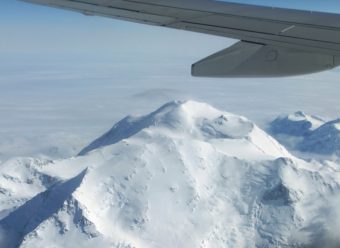
Denali. (Photo courtesy of  the National Park Service)
Denali. (Photo courtesy of the National Park Service)

A dispute over the height of North America’s tallest mountain may soon be resolved as surveyors climb to the top of Mount McKinley.

McKinley – recognized throughout Alaska by its Koyukon Athabascan name, Denali – has long been thought to stand at 20,320 feet, a measurement recorded in 1953. That number was contested in 2013 when the United States Geological Survey used radar technology to re-calculate the mountain’s height. The result was a mere 20,237 feet — 83 feet lower than the previously recognized elevation.

Dave Moune is senior project manager with Dewberry Geospatial Products and Services – a company contracted by USGS to perform the 2013 survey.

“Oh, people didn’t like the lower number,” Moune says. “And I was bothered by it myself. I mean I had people say, ‘It’s still over 20,000 feet, I hope?’ And I said, ‘yes it’s still over 20,000 feet, but I don’t know how much over 20,000 feet.’”

Moune says the “new” elevation, in addition to being controversial, may not be entirely accurate.

He says the measurement was taken from the air using radar frequencies, to create 3D images as part of an ongoing mapping project around the state. And while that technique is great for mapping complex terrain in 3D, Moune says its single-point elevation measurements could be off by several meters.

He adds the most accurate way to measure height for a specific peak is to use GPS. But for that, you need old-fashioned boots on the ground.

Blaine Horden is leading those boots – and a team of three surveyors – to the summit of Denali this week. Their mission: to set the record straight.

As of Monday night, the team had settled in at 14,000 feet, with plans to push for the summit as early as Wednesday. Moune says the task of measuring a mountain isn’t an easy one.

“These guys are not just taking themselves to the top of the mountain. They are carrying a lot of equipment with them that all has weight associated with it. Some of it is stuff they have to keep inside their coat so their bodies will help keep it warmer. That all adds to the complexity of the climb,” Moune says.

The expedition could take as long as three weeks to complete, but Moune reports that the surveyors are currently ahead of schedule – and could begin their descent by the end of this week.

And the height of the continent’s tallest mountain isn’t the only thing up for debate. The name of the famous Alaskan peak has long been a point of contention – both in and out of state.

Alaskans have filed several federal bills since 1975 to change the name from Mount McKinley – after former president William McKinley – to Denali, a traditional Koyukon Athabascan term meaning “high one” or “great one.”

That effort has been largely opposed by representatives from McKinley’s home state of Ohio – with Rep. Bob Gibbs filing a bill that would stop the U.S. board of Geographic Names from changing the mountain’s title as recently as March 2015.

Last month, Sen. Lisa Murkowski introduced yet another bill to change the name to Denali in honor of the region’s Native heritage. It remains unclear whether either legislator will succeed in pushing their bill through the House or the Senate.


Sled dogs safe, but musher stays to protect fire-threatened homestead

Silver, the lone dog left with Brent Sass in Eureka. (Photo courtesy of Brent Sass/Wild and Free Mushing)

The Sockeye Fire caused evacuation of hundreds of sled dogs from Willow area kennels earlier this month, and now new fires have forced movement of huskies from a remote kennel north of Fairbanks.

Yukon Quest champion Brent Sass remains at his wildfire-threatened compound in Eureka, but his dogs are safe in Fairbanks. The Baker and North Fork wildfires are burning in the Eureka area, west of the Elliot Highway between mileposts 131 and 137.

Dog handler Tim Muto says Sass was away working Tuesday as flames began advancing, and he had to scramble to get dog boxes on trucks and move the animals.

Muto says the group of dogs trucked to a property Sass has in the Goldstream Valley includes several young puppies.

Muto says he’s impressed with how all the dogs handled the hectic trip. He says he has no phone connection with Sass in Eureka, but suspects he’s working to fire prep the property, Muto says the Eureka property has a creek and pond on site that can aid in firefighting. He adds that as of yesterday, neighbors and fellow mushers Rick and Kelly Swenson planned to stay put in Eureka with about 20 dogs.

Ongoing gear restrictions, wildland fires lead to empty fishracks along the Yukon

 smokehouse and fish rack in Emmonak. (Photo courtesy of Alaska Department of Fish and Game)
smokehouse and fish rack in Emmonak. (Photo courtesy of Alaska Department of Fish and Game)

King and chum salmon are still slowly building a run up the Yukon this summer — and fishermen are contending with everything from gear restrictions to wildland fires in their efforts to fill their racks.

During the weekly teleconference with fishermen and managers from the state and federal level in U.S. and Canada — organized by the nonprofit Yukon River Drainage Fisheries Association — fisherman all along the river say Alaska’s intense fire season is definitely hampering their season, turning an afternoon boating on the river into a day choking in a smoke-filled oven.

Norma in Marshall said the local “firefighters are still out at the Card Street Fire (near the Kenai Peninsula community of Sterling), so a lot of our subsistence activities were lower than in previous weeks.”

Fred Huntington in Galena said “lots of forest fires” were likewise impacting fishing in his community.

While the fires may have hindered fishing, they haven’t stopped the fish. The first pulse of Chinook entered the river in early June, and is now as far upriver as Koyukuk, but overall the numbers remain low: roughly 13,000 fewer kings have passed the Pilot Station Sonar project near the river’s mouth when compared to this time last year.

It’s a different story for summer chums: they also began running just a week into June, and now two pulses have made it as far upriver as Holy Cross. Compared to last year, there are nearly 20,000 more chums in the water now.

Even with hundreds of thousands of chums swimming alongside thousands of Chinook, runs are still just average, and that means gear is still limited to dipnets, beach seines, and the occasional live-release fish wheel. An unfamiliar tool for many on the Yukon, dipnets have been for the most part ineffective—and many fishermen hoping to user smaller 4-inch mesh nets say they simply can’t get that gear in their communities. That’s turned what should be a busy summer along the river into a slow and frustrating season with little fishing.

Sven in St. Mary’s said, “reports are people haven’t been able to get most of their, or a lot of their, subsistence needs done.”

Martin in Pilot Station said “very little subsistence activity (is happening in the community). Most racks along the riverfront have a few salmon hanging; we should be usually hanging and drying salmon in Pilot.”

Ken Chase in Anvik said, “subsistence fishing for salmon right now is just about nil, there’s no one out fishing.”

Bill Alstrom in St. Mary’s added that the “dipnet fishing, for subsistence … it just ain’t workin’ out.”

While subsistence has been slow, commercial chum fishing was open in the lower river with dipnets and beach seine gear. As of Sunday, commercial fishermen harvested almost 62,000 chums and released over 3,000 Chinooks.

Sven in St. Mary’s told Fisheries Managers the gear limits—and overlap with commercial fishing—should be reason enough to allow for a ‘round-the-clock opening for subsistence.

“Since we are doing subsistence and commercial at the same time, what are the chances having subsistence going 24/7?” he asked. “With the little amount of fish in the river, and people still have to meet their subsistence needs, I imagine it should give them more chance for subsistence opportunities, for these fishermen here, just to give folks a chance to have their subsistence needs taken care of.”

Alaska Department of Fish and Game managers said that’s not likely, as they already hold subsistence-only openings in the mornings prior to the subsistence and commercial openings in the afternoon and evening. They said openings might happen for subsistence-only fishing in the lower river, but for now, limited chum salmon openings continue.

But what does the goal of protecting kings really mean for people living along the river?

For Janet in Rampart, the spiritual connection to the Chinook is what’s being lost with the king closures, and it’s something she fears will be lost to new generations if they can’t harvest the sacred fish.

“We’ve been doing due diligence of trying to preserve the king salmon,” she began. “And we keep saying ‘for our grandchildren,’ but when you think about it, our grandchildren are not even getting … or we’re depriving them of eating king salmon … of the taste of such a wonderful food … then how are they even going to know?”

If the tight conservation on kings continues, Schmidt said they’d be on track to meet escapement goals for Chinook this year. That could mean very limited openings for incidental take of kings. That’ll help fishermen meet subsistence needs without a significant impact to the Chinook population, Schmidt said, but she emphasized no final decisions have been made.

Site notifications
Update notification options
Subscribe to notifications