Interior

As Alaska’s boreal forest warms, land managers face tough questions about how, or whether, to respond

A glimpse of the boreal forest between Cantwell and Fairbanks, Alaska. (Lois Parshley)

Northern ecosystems are seeing some of the planet’s most sweeping changes from climate warming. For some animals and plants, that has posed a threat to their very existence and, for humans, a couple complicated questions: Can we — and should we — do anything to save them?

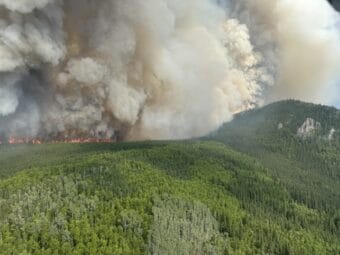
In Alaska, one area where land managers and ecologists are wrestling with those questions is the boreal forest, home to spruce and birch trees, wetlands and many species of animals. But the boreal is warming more rapidly than anywhere on Earth and seeing more intense wildfires, invasive beetles decimating wide swaths and changing rainfall patterns that’ve caused some parts to shift to grasslands.

A story in the spring issue of the Virginia Quarterly Review by reporter Lois Parshley, in collaboration with the climate-focused magazine Grist, explores these issues of whether and when humans should accept, resist or direct climate change’s impacts.

And, Parshley says, there’s a lot at stake in the boreal forest.

Listen:

This interview has been lightly edited for length and clarity.

Lois Parshley: The boreal forest is one of the world’s largest biomes. And it is filled with both trees and birds and many other different kinds of species that you can think about like pieces of a biological puzzle. The forest itself encompasses about a third of the world’s forests, but it also holds a lot of freshwater. When trees draw water up from the soil and into their needles, it can billow out as vapor when the needle pores open in the sun. And this is a process called transpiration. And it actually helps the boreal forest make its own rain. And collectively, these kinds of exhalations also make the boreal a really important worldwide source of oxygen. Some scientists even think it might change the planet’s air circulation.

Casey Grove: As climate change progresses and the planet gets warmer and warmer, what are we seeing happen to the boreal forest in Alaska?

Lois Parshley: So spruce trees are, in a lot of ways, made to burn. Their seeds are released after wildfires. But we’re seeing fires come back too quickly, while trees are too young to produce cones. And in many places, black spruce is now being replaced by trees like aspen and birch. And all of these trees are simultaneously confronting insects and new diseases. So in some places, trees aren’t re-growing at all. The landscape is actually in the process of converting to grassland. You might have seen these changes if you’ve driven the Parks Highway recently, around Cantwell, many spruce trees have died off and you can see them now standing dead on on either side of the highway.

Casey Grove: One thing I thought was interesting about your story, I got a sense that it was less about, you know, maybe we need to change what we’re doing to stop it and more about just kind of acknowledging what’s actually happening out there. Am I on the right track there?

Lois Parshley: Yeah, so wildlife managers are increasingly acknowledging that we’ve reached a point where, in some places, there’s simply no way to keep conditions as they were. And they’re now asking some pretty big questions about how much we should intervene. You know, it sounds deceptively simple, but is climate change something to be resisted, accepted, or directed? And these are terms that the National Park Service, for example, are using to try to make more realistic conservation goals. So accepting climate change in this instance might mean that we’re accepting that spruce trees might not regrow after wildfires. Or directing that kind of change might mean introducing bison to the Kenai National Wildlife Refuge to try and help make new grasslands healthier. So across the country, scientists are now asking these kinds of questions and considering introducing species to new habitats where they’d never been previously, in order to help them try to avoid extinction.

Casey Grove: I mean, if if we lose the boreal forest or it’s significantly reduced, what’s at stake there?

Lois Parshley: Yeah, I think one of the most helpful answers I heard to that question in my interviews was talking to Jill Johnstone. She is a researcher who’s been working with the boreal forest for many years. And she told me that she sees its recent transformations like a big ship changing its course. It happens very gradually at first, and then you never really see the consequences further as time goes on. And her perspective was that there’s very little that can truly devastate an ecosystem. But those changes might not always be in a direction that we like. The forest itself maybe will just convert to grassland, and that’s something that will just happen. The value judgment about whether that’s a good or a bad thing comes from from us.

Casey Grove: Yeah, I think that was the thing that resonated for me in that story was it was like, “climate change beyond good and evil” or something like that, you know, that, like you said, like the value judgment placed on that change or what you get after that change is sort of on us.

Lois Parshley: Yeah, I think it’s important to distinguish there what we’re saying when we say “value judgment,” because, certainly to species that are depending on those ecosystems being spruce trees, those species aren’t going to do well. Humans have always had a significant impact on the environments they inhabit. But that has looked different ways throughout the course of human history. And in this moment, where we’re seeing rapid change, seems like a really good time to be asking questions about the landscapes we live in and their relationships and our impact on both of those things.

Eielson looking into cause of F-16’s in-flight emergency

A May 28 problem with an F-16 Fighting Falcon like this alerted the pilot of the jet fighter from Eielson Air Force Base’s 18th Fighter Interceptor Squadron to declare in in-flight emergency and return to base. (Eielson Air Force Base)

Eielson Air Force Base investigators are looking into the cause of an in-flight emergency that required an F-16 fighter pilot to jettison the plane’s fuel tanks shortly after taking off from the base last month. Meanwhile Eielson officials also are also preparing to remove contaminated soil from the off-base area where the tanks hit the ground.

Soon after the F-16 returned to base on May 28, Eielson officials began what’s likely to be a six-month process of determining what caused the pilot to declare an in-flight emergency. And to ensure the problem doesn’t happen again.

“The main point of conducting a safety investigation is to prevent future mishaps,” says Master Sgt. Daniel Douglas, the 354th Fighter Wing’s Flight Safety noncommissioned officer.

Douglas said in an interview last week that he can’t comment on the ongoing investigation into the mishap. But he says it’s an exhaustive process that includes interviewing those involved, examining the aircraft and double-checking initial findings with a second set of experts.

“Safety investigations are very thorough,” he said. “We don’t want to overlook anything and so we give every piece of information, every point of evidence its due diligence.”

An Eielson news release says the F-16 pilot declared an in-flight emergency just after takeoff and then jettisoned the plane’s two fuel tanks, before returning to base. Douglas says that’s done to reduce the weight of the aircraft and reduce risk of fuel further endangering the pilot and emergency personnel on the ground. No injuries were reported. The fuel tanks hit the ground in an uninhabited area about a mile and a half west of the base and east of the Tanana River.

Jettisoned fuel tanks fell on Mental Health Trust Authority land

The site is on land administered by the Alaska Mental Health Trust Authority, says Lt. Col. Christopher Higgins, who commands Eielson’s 354th Civil Engineer Squadron.

“It is densely wooded,” he said, “and so, we’ve kind of cordoned-off that entire area.”

Eielson officials asked that the exact location remain confidential, to ensure the safety at the site. Higgins says the 1.5-square-mile area includes the spots where the tanks were found and surrounding land that also may have been contaminated by JP-8 jet fuel that leaked from the two ruptured 370-gallon tanks after impact.

“We want to ensure that we’ve captured all of that fuel,” he said, “so we’ve given ourselves a little bit of a buffer to make sure that there’s enough space there.”

The base’s civil engineers will work with a contractor to clear the site and excavate all the contaminated soil, he said. It’ll then be loaded onto trucks that’ll take it to a facility that treats contaminated materials. That’ll probably be the one in Moose Creek, but that’s still not yet decided.

Higgins says the cleanup will comply with all state and federal regulations, which also mandate long-term monitoring of the site.

“I would expect that we will be required to continue to do follow-on testing for multiple years,” he said.

Eielson spokesperson Capt. Faith Hirschmann says base officials take their responsibility to protect the environment seriously.

“We’re really just committed to keeping our airmen and the community and everybody safe, while we do our mission and our training,” she said.

Douglas, the Flight Safety NCO, says it’ll probably take about six months to complete the investigation and issue a final report.

Fort Wainwright opens the Army’s biggest child care center

Fort Wainwright Child and Youth Services Coordinator Jessica Spittle explains the age-appropriate and child-safe design of one of the new CDC’s classrooms. (Tim Ellis/KUAC)

Fort Wainwright celebrated the opening of its new Child Development Center Tuesday with a ribbon-cutting ceremony. The $3.5 million facility is the Army’s newest and largest child-care center.

Active-duty military personnel and qualifying federal employees who work at Fort Wainwright now have access to a new spacious and colorful, on-post child-care option for infants through kindergarten-age kids.

“It’s a really great facility” says Post spokesperson Eve Baker. “And it’s the only facility of that type among the Army child development centers.”

Baker says the 42,930-square-foot child-care center is the Army’s largest. And it’s designed to be used for both child care and early childhood education. That’s why 22 of the rooms for kids are referred to as classrooms.

“The center will have room for 284 children, from infants through age 5 – for preschool children and kindergartners,” she said.

Baker says the Child Development Center, or CDC, will make child care available for kids whose parents have been waiting for a space to open up.

“It will clear the waiting list for the other two facilities that we have,” she said, “and there will still be plenty of room for additional children to come in.”

The brightly lit CDC’s classrooms are furnished with age-appropriate chairs and desks and fixtures to accommodate the different age groups. It also has all the necessary grown-up amenities for staff and parents, like administrative offices, break room and a laundry.

“As well as a nursing room for staff or for parents who may want to visit their infants during the day,” Baker added.

And there’s also a 3,000-square-foot multipurpose room.

“Small groups can come in and use it, they can do sports, they can run around,” she said, “It can be an evacuation space in the event of an emergency.”

And throughout the CDC, there’s beautiful artwork that celebrates Alaska history and culture.

“Our new facility is named the Denegee Child Development Center, and that is a Tanana word for moose,” she said. “We worked closely with our Alaska Native tribal partners to come up with an appropriate name for the center.”

Baker says kids will be surrounded by artwork, much of which was created by members of the local arts community.

She says child-care providers interested in working in the new CDC can contact Fort Wainwright’s Morale, Welfare and Recreation office.

An Alaska wildlife refuge is changing its wildfire strategy to limit carbon emissions

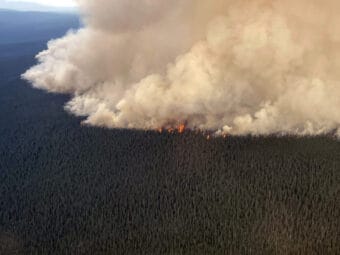
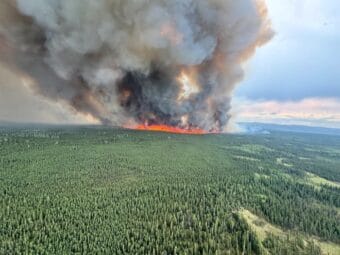
The Goose Fire (#395) is burning in the Yukon Flats in northeast Alaska about 41 miles east of Fort Yukon on Aug. 4, 2022. Smokejumpers are protecting two Native allotments from this and the Belle Fire. The two fires merged on Aug. 4, 2022. (Photo by John Lyons, BLM Alaska Fire Service air attack)

Baked with the around-the-clock summer sunlight and regularly peppered with lightning strikes, the Yukon Flats region in eastern Interior Alaska is regularly set ablaze with fires that are considered part of the natural forest cycle. Standard practice is to let them burn out on their own, unless they threaten people, their homes or other economically valuable property.

That is set to change this summer.

At the Yukon Flats National Wildlife Refuge, managers are experimenting with a fire plan aimed at protecting the sequestered carbon on the boreal forest floor and in the frozen soil below. In the 8-million-acre refuge, 1.6 million acres are now moved from the “limited” protection category, the lowest priority firefighting priority and usually applied to fires that are merely monitored, to the “modified” category, the next-higher priority.

The point of the limited firefighting is to put the brakes on what has been a troubling trend in the world’s boreal forests: a transition from their function as sinks that absorb atmospheric carbon into sources that pump more climate-warming gases into the air.

If carried out, the practice of fighting fires to prevent carbon emissions would be a first not just for Alaska but likely for the world’s boreal forests, said Jimmy Fox, the refuge’s superintendent.

“There’s not been any land manager or land management agency that has made the decision that I’ve made,” Fox said. “It’s deemed a pretty radical idea. It’s controversial.”

Even if it is radical, the plan is also modest.

If a wildfire breaks out on any of those newly designated “modified” response areas of the refuge, the plan calls for smokejumpers to be dispatched to try to limit the spread. It will not be the large-scale effort that is typically mounted in areas assigned higher priorities for firefighting, Fox said. Rather than stay as part of a big firefighting army, smokejumpers would be given 72 hours to contain the fire, and then they would be pulled out to work at higher-priority sites. The plan would be in effect only through early July, depending on the way events unfold, Fox said.

The plan, created with the help of Fairbanks-based permafrost expert Torre Jorgensen, emphasizes the areas of the refuge with the most thaw-vulnerable sites: those with yedoma, the term for permafrost that is at least 50% ice. It would have been used last year, Fox said, but there were no applicable refuge fires in 2023.

Fox has been among those pushing for firefighting to prevent carbon releases from the boreal forest, and he admits that he has “a bee in my bonnet for climate change.” The Yukon Flats suppression plan is justified by new scientific findings about boreal wildfires, he said.

The Yukon Flats National Wildlife Refuge is seen from the air on Sept. 1, 2006. The refuge sprawls over 8 million acres. (Photo provided by U.S. Fish and Wildlife Service)

“There’s more and more research coming out making it so clear that there’s so much at stake here,” he said.


Vast stores of carbon

The world’s boreal forests are estimated to hold about a third of the world’s terrestrial carbon. While fires have been part of the boreal forest cycle for millennia, increased frequency and intensity means that wildfires that used to be considered normal and even beneficial can now cause harm. The most intense fires are burning duff, the soft mat of vegetative material on the forest floor, and — more worryingly — expose and thaw the permafrost the duff would have protected.

“The thicker it is, the more it’s insulating the permafrost,” he said. But when the duff burns, the insulation is gone.

Fire experts will be paying a lot of attention to what happens with this pilot project in the Yukon Flats, said Randi Jandt, an ecologist with the Alaska Wildfire Science Consortium.

The standard practice up to now, Jandt said, is for wildland firefighting to be focused on protecting resources of local and regional value. In the Lower 48, that includes timber, with a goal of protecting local or regional economic values, she said. The Yukon Flats firefighting goal represents a significant shift, she said.

“It’s a new concept for managers to even think of carbon as a value at risk,” she said. For the most part, preventing carbon emissions is about addressing global values, not local or regional values, she said. “They would be doing it to help the whole planet, and that’s different.”

A big question concerns cost. Is it worthwhile to deploy firefighting resources in areas where people and property are not at risk?

Researchers from the Woodwell Climate Research Center, who helped craft the Yukon Flats pilot project, say it is. They have penciled out the added fire-response costs and, for comparison, the costs of other actions that would reduce carbon emissions.

In a 2022 study published in the journal Science Advances, the Woodwell researchers used data from Alaska firefighting efforts mounted between 2007 and 2015 in calculations that found that increasing expenditures in Alaska by 1% reduced boreal fire size by 0.21% and that the direct firefighting cost of avoiding release of a metric ton of carbon dioxide was $12.63.

That compares favorably to the costs of reducing carbon emissions through solar arrays and offshore wind energy, the study found. Not taking the extra fire-suppression action, in contrast, would make it more difficult for the world to keep global warming to no more than 1.5 degrees Celsius above pre-industrial levels, the scientists found.

Boosting suppression to limit Alaska boreal wildfires to their historic levels would avoid the release of 0.89 gigatons to 3.87 gigatons of carbon dioxide through 2050, at an average annual response cost of $696 million per year, on average, according to the Woodwell scientists’ calculations.

A related study, by some of the same Woodwell scientists and colleagues from Tufts University, uses Alaska data to project boreal firefighting needs through the end of the century. To prevent massive carbon emission from boreal forests, spending on firefighting might have to be five to 10 times as much as it is now, said the study, published in 2022 in the journal Environmental Research Letters. The cost may be worthwhile, said the study: “When the alternative is skyrocketing carbon emissions with a social cost of billions of dollars per year, increased fire management may be a prudent and essential investment in the years to come.”

For now, Alaska gets considerably less wildfire funding than what the scientists consider necessary to control carbon emissions.

Gwich’in International Council chair Ed Alexander listens to a fellow panelist speak on April 12, 2024, at the Arctic Encounter Symposium in Anchorage. Alexander believes cultural burning can help manage boreal wildfires and prevent excessive carbon emissions. (Photo by Yereth Rosen/Alaska Beacon)

Despite holding a fifth of the nation’s land mass and producing about half of the nation’s wildfire emissions, Alaska gets only a tiny sliver of annual federal wildfire funding, scientists and fire managers say.

Annual federal firefighting costs averaged over $2.8 billion from 2018 to 2022, according to the National Interagency Fire Center. In comparison, in 2019 – a year with the long-burning Swan Lake Fire on the Kenai Peninsula and other serious wildfires – about $300 million was provided from both the state and federal government for firefighting, according to experts at the University of Alaska Fairbanks.

While the refuge is gearing up for a new type of fire management to stem climate change, Gwich’in tribal members want to achieve the same goal by reviving a tradition.

The Gwich’in Council International, which represents Gwich’in Athabascan people in Alaska and Canada, and the Yukon Flats-based Council of Athabascan Tribal Governments are promoting cultural burning, a practice that is, in various forms, part of Indigenous traditions around North America.

The Gwich’in practice involves controlled fires lit in open meadows areas during the spring, when exposed plants are dry but the ground below them remains snowy and frozen, said Ed Alexander of Fort Yukon, the Gwich’in Council International’s chair.  As carried out in the past, the practice created breaks that limited the spread of big summer fires once they arrived.

Full-out suppression, which is costly, is not desirable because it interferes with the natural cycle and is “not great for forest health,” Alexander said. But the early season mitigation, as the Gwich’in International Council is advocating, is seen as a low-cost, low-risk way to keep wildfires at manageable levels once the summer heat and lightning strikes arrive, he said.

“In order to have that situation here, humans need to be involved in our landscape like we have for thousands of years,” Alexander said. Keeping wildfires at manageable levels will do more than protect permafrost and avoid excessive carbon emissions, he said. It might also protect human health by keeping the air cleaner, he said. The hope is that “we don’t get late-season fires where you end up with smoke filling up Fairbanks from July through the end of August,” he said.

Wildfires have yet to arrive this summer in the Yukon Flats region. They usually break out there in late June, Fox said.

So far, the biggest Alaska wildfire this season is a tundra burn in the Yukon-Kuskokwim Delta of Western Alaska. That fire was estimated at 1,890 acres as of Sunday.

In Canada, which had a record wildfire season last year, several fires are burning in the boreal region. One fire in northern British Columbia prompted evacuations last month.

This story originally appeared in the Alaska Beacon and is republished here with permission.

Rescue teams attempting to reach 2 hypothermic climbers stranded near Denali’s summit

The Denali Park Road curls around a mountainside near the Polychrome Overlook on Sunday, May 3, 2020. (Nat Herz/Alaska Public Media)

Update, 8:15 a.m. Thursday:

Cloud cover around Denali prevented further flights to rescue two climbers stranded near the mountain’s summit since early Tuesday.

Denali National Park and Preserve spokesman Paul Ollig said crews were still awaiting a break in the clouds Thursday morning to launch another flight to the climbers just below the mountain’s summit.

Original story:

Multiple rescue agencies were working Wednesday to reach two climbers stranded for more than a day near Denali’s summit, after rescuing three other climbers suffering from severe frostbite.

Denali National Park and Preserve spokesman Paul Ollig said Wednesday afternoon that the two climbers were at a flat spot on the mountain called the “Football Field,” at an elevation of 19,600 feet.

According to a statement from the park, a team of three climbers atop the 20,310-foot peak sent an SOS signal from an InReach satellite device at about 1 a.m. Tuesday saying they were hypothermic and unable to descend.

“Rangers maintained two-way communications with the team until approximately 3:30 a.m., when the team texted that they planned to descend to the ‘Football Field,’” park officials said in the statement. “Rangers did not hear back from the team after that transmission, nor did the location of the device change.”

The Alaska Air National Guard was called in to help with the search Tuesday morning, due to cloud cover that kept the park’s high-altitude helicopter from reaching the mountain. An HC-130 search plane crew spotted two of the climbers between 19,000 and 20,000 feet, with a guide on the mountain finding the third climber near Zebra Rocks at 18,600 feet.

According to the park, a separate pair of climbers suffering from frostbite were being treated by Park Service patrol members at the mountain’s 14,200-foot camp. The helicopter crew tried to reach the summiters at about 5 p.m. Tuesday, but instead landed at the camp and rescued the two climbers there. Both were flown to Talkeetna, with one transferred to a LifeMed air ambulance for further care.

The Park Service helicopter made a second attempt to reach the summiters at 9 p.m. Tuesday, but was again unsuccessful.

“By that point, one of the three climbers had made their way down to the 17,200-foot high camp with severe frostbite and hypothermia,” park officials said. “A guided party initially assisted the patient until transferring care to an NPS ground team who had ascended to high camp from 14,200-feet to support the rescue effort.”

That climber was helicoptered to Talkeetna at about 10:15 p.m. Tuesday night and also transferred to LifeMed, according to the statement.

“Meanwhile, an experienced expedition guide on the upper mountain had diverted significant time to assist and provide care to the two non-ambulatory climbers at the Football Field (19,600 feet),” park officials wrote. “However, when the clouds moved back in late Tuesday night, the guide was forced to return to the 17,200-foot high camp for his own safety and for the safety of his team.”

Crews have been waiting for another break in the weather Wednesday to make another attempt at reaching the stranded climbers.

Ollig said Wednesday afternoon that details were still coming in about how both groups of climbers ended up in distress, as well as what condition the stranded climbers were in when the guide left them Tuesday.

He also said that high-altitude flight issues further hampered Tuesday’s rescue efforts for the summiters, noting that the helicopter was fitted with a short-haul rescue basket when it tried to reach the “Football Field.”

“Due to weight restrictions, we can’t do a short haul at that high of an elevation with either a spotter or an attendant ranger on the end of the line,” he said. “So the patients need to be either ambulatory or have assistance on the ground.”

This is a developing story. Check back for updates.

Organization awards home in Fairbanks to combat-wounded Army veteran


Andy Armstrong prepares to get the keys to his news house from representatives of the organization and business that awarded the home to him. From left, Ken Eakes, Military Warriors Support Foundation executive director; Armstrong; Adam Little, regional Bank of America/Merrill Wealth Management marketing executive; Tyann Hollis, BofA/Merrill Wealth Management vice president. (Tim Ellis/KUAC)

An Army veteran has been given a home in Fairbanks, courtesy of a program that helps wounded combat vets rebuild their lives.

Memorial Day usually is a solemn occasion for Americans to remember and thank U.S. military personnel who lost their lives in combat.

But there was no sorrow during a ceremony held last week near Fairbanks to honor a veteran who survived a brush with death.

Spec. Andy Armstrong, a military police officer, deployed to Iraq in 2009-10 and Afghanistan in 2010-11. He and three fellow soldiers were seriously injured in August 2011 when the truck they were in detonated a roadside bomb. (Andy Armstrong)

And the only tears shed at Thursday’s gathering to honor Andy Armstrong’s service came from his wife, Elise, after one of the sponsors of the event gave her the keys to the cabin.

“So please join me and welcoming the Armstrong family to their new home!” said Adam Little, a regional Bank of America/Merrill Wealth Management marketing executive.

Elise also gushed when Little said his company and the Texas-based Military Warriors Support Foundation, which organized the event, also want to ensure the home is furnished.

“This is a gift card for you to choose your furnishings for this home,” he said. “We took care of all that for your home.”

“Thank you for doing this for all the veterans that are out there, and for their families,” she said, “because, like you said, there’s a lot of sacrifices that veterans go through and that much of the country doesn’t quite understand.”

Armstrong struggled to find the words to express his appreciation.

“I can’t thank you guys enough,” he said. “What you do is absolutely phenomenal.”

Armstrong and his wife, Elise, and infant daughter, Andi, talk with visitors about their new home just before organizers of Thursday’s event handed over the keys. (Tim Ellis/KUAC)

Armstrong was medically retired in 2012 after he and three other soldiers he was with sustained serious injuries when the truck he was driving hit an explosive device buried along a road in Afghanistan. He was awarded a Purple Heart, and after rehab returned home to upstate New York, where began working as logger.

Then late last year he got a job that brought him to Alaska, driving fuel trucks up the Dalton Highway from Fairbanks to Deadhorse.

“It’s challenging,” he said. “With truck driving, it’s very monotonous — in the Lower 48. Here, that road changes, by the hour. And it’s never the same. It keeps you kinda sorta on your toes.”

Armstrong says he and his wife have long dreamed of living in Alaska. And now that he’s got a job and a home in Fairbanks, Elise and their 1-and-a-half-year-old daughter, Andi, can both join him.

“When I was in the Army, me and my wife had actually wanted to get stationed up here,” he said. “And we tried and tried, because Alaska’s kind of always been our end goal. She had never been up here, I had never been up here. We just kind of knew that we wanted to come up here and see what it’s all about.”

Elise exclaims in appreciation about the toybox that Andi found as soon as the family walked into their new home. (Tim Ellis/KUAC)

Military Warriors Support Foundation Executive Director Ken Eakes says the organization is dedicated to helping veterans injured in combat to heal and achieve their dreams.

“We’ve awarded nearly a thousand houses that are mortgage-free to our combat wounded veterans and Gold Star families over all 50 states,” he said. The house given away Thursday is the third to be awarded in Alaska.

Eakes says Bank of America donates homes to his organization, often repairs and renovates them with locally hired workers, then awards them to deserving veterans. The program also teaches budgeting and other skills to help veterans build a new life in their new home and offers other services to help wounded vets recover.

Site notifications
Update notification options
Subscribe to notifications