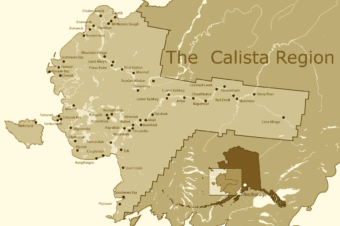
Arctic Fibre plans to route its 10,000-mile-long cable linking Great Britain to Japan along the coast of northern Canada and Alaska. (Image courtesy of Arctic Fibre)
This story is the first of a two-part series from KUAC.
Dial-up Internet access is a distant memory for most of us. But slow connections to the web are still a fact of life in much of the far north, says Madaleine d’Argencourt, who heads up a municipal-government organization in the Canadian territory of Nunavut.
“It’s a serious issue, all across the board here in Nunavut,” d’Argencourt said.
Most of northern Canada lacks access to broadband Internet connections. D’Argencourt says that limits residents’ ability to conduct business online. She cites studies that show broadband in the three northern territories would create jobs and dramatically boost the economy.
“This has huge economic impact,” she said.
The lack of broadband also contributes to a fragmentation of the communities, because residents must go elsewhere for training and education.
“Most people in Nunavut have to leave their own community to get the training they need because online training is impossible to do in the north, without the right broadband. And they’re paying $8,000 to $10,000, to go south.”
An ambitious project proposed by a Toronto-based company could change all that. Arctic Fibre proposes to lay a 10,000-mile-long cable on the ocean floor from the United Kingdom to Japan.
“It’s an immense undertaking — 17,000 kilometers from Asia through to Europe,” d’Argencourt said.
Company spokeswoman Madeleine Redfern says it also would enable much faster and reliable connections than the satellite-based systems now in use.
“We’re the only region in Canada that does not have fiber-optic connections to the outside world,” Redfern said. “And so we’re completely dependent on satellite. It’s very slow, and it’s extremely expensive.”
Arctic Fibre proposed the $700 million backbone as a faster link for financial institutions, and a backup for other cables. Redfern says Arctic Fibre has offered to link up with local Internet service providers in several communities along its route, which would provide broadband to about half of Nunavut’s 30,000 residents.
Next week: Alaska fiber-optic cable project would bring broadband to villages.
Wade Hampton was a Confederate general and senator from South Carolina. HIs son-in-law was a territorial judge in Western Alaska and named the census district for him. (Photo courtesy of the Library of Congress)
The Western Alaska census district named for a confederate slave owner and Civil War general has a new name. Gov. Bill Walker wrote Wednesday to the Census Bureau to begin the process of changing the name from the Wade Hampton Census District to Kusilvak Census District.
The city and tribe of the largest community in the area, Hooper Bay, passed a resolution in support of a change and came up with the new local name. A recent Alaska Dispatch News article brought the history to the forefront. Local and state politicians voiced their support for shedding the name of a Confederate general whose rise to political power was in tandem with terror campaign by a violent white power group, the Red Shirts.
“Everyone knows in the early times, that man was a slaver and never had stepped into Alaska. Why should our area be named after a man we don’t even know about,” says Edgar Hoelscher, the tribal chief for the Native Village of Hooper Bay.
Hoelscher says having a local Yup’ik name honors the region’s people.
“It shows that our elders and forefather were there, and we’re still living on the ground where they were,” Hoelscher says.
Wade Hampton’s son-in-law was a territorial judge and named a nearby mining district after the South Carolina politician. The name first showed up in census data in 1920 and it stuck.
Myron Naneng leads the Association of Village Council Presidents and Sea Lion Corporation of Hooper Bay. He’s been organizing behind the scenes to get a new name.
“Kusilvak means the high one. It’s the mountain located between Scammon Bay and Mountain Village. It’s highest mountain in the area and there’s a lot of history associated with it,” Naneng says.
The name is used for statistical record keeping. There’s no regional government with the name, but it shows up in countless publications for borough-level information. That will change going forward.
The Chuathbaluk fire was active Friday afternoon. (Photo by Patrica Yaska)
Aniak and Chuathbaluk were receiving favorable winds Friday, cutting down on the smoke and fire danger. The fire across the river from Aniak has grown to 27,000 acres. Bill Wilson is Aniak’s Mayor.
“The fire is paralleling on the opposite side of the river of where the runway and town is here. It’s worked its way about halfway down the runway at this point. You can see it, Most is further off the shore, it’s touched down in a few places at the shoreline. The smoke is thick; it’s blowing toward the Russian Mountains and towards the north more.
Two crews are in Aniak to do point protection in the off chance that the fire moves across the river.
“With the winds the way they are, there’s no chance of it jumping across unless we had another thunderstorm at this point.”
Three flights of at-risk people were evacuated to Bethel Thursday to stay out of the thick smoke. Near Chuathbaluk, the approximately 5,000-acre Mission Creek Fire was 1.3 miles from the old airport and is visible from town. Two hotshot crews are also doing site protection in Chuathbaluk. There had been discussion of moving a large amount of people to Aniak from Chuathbaluk, but Wilson says there’s no need to at the moment.
“We’re still prepared; we have a plan ready, places for people to come. We have food and boats to run there. Until there’s a more imminent threat, they’re going to stay put and hold their homes.”
Francis Mitchell is with the state Division of Forestry. He says farther upriver, the Red Devil fire has been threatened the community.
“Late yesterday, the fire got within 1,000 feet of the village; there were a couple air tanker drops of retardant drops in that knocked it down pretty well. There are fire fighters in there, two crews.”
Forty-eight people are working to protect Red Devil. Three crews’ members are in Crooked Creek, which has been prepared for site protection. Others crews are making a fire line around Lime Village.
Closer to Bethel, a 1,000 acre fire is burning southeast of Kwethluk, but officials say nothing is at risk now. This weekend, firefighters might get a little break from the weather.
“At least swaths of rain, not big rain, not putting out fire rain, but dampening down fire type of rain, maybe in that lime village and middle Kuskokwim area. Rain will help in several places, but it’s probably not going to last long, as far as we’re being told.”
More than 230,000 acres have burned in Southwest Alaska. There are 78 active fires in the region and 317 statewide.
Nome City Council Chambers. (Photo by Matthew F. Smith/KNOM)
The city of Nome has passed a budget for the next year, and even dropped property taxes, but at Monday’s city council meeting residents came out to ask the city to find more room in the budget to support community nonprofits.
Earlier this month the Nome City Council passed an $11.3 million budget for operations, and saw fit to also drop the property tax rate from 12 to 11 mills.
But what wasn’t in that budget was any mention of funding for various nonprofits and other charities in Nome, some of which have relied on thousands of dollars of funding from the city in the past. Even the annual Community Benefit Share, given each year by Norton Sound Economic Development Corporation for public projects, remained earmark-free in the city’s budget.
That caused many community members to speak at the meeting to ask not just for a piece of the benefit share pie, but also for some kind of dedicated city funding.
Danielle Slingsby, executive director of the Nome Community Center, said nine out of every 10 dollars her group spends comes from state grants. Now, with state budget deficits in the billions, Slingsby pushed for a permanent place on the city’s ledger.
“We’re running programs even when we get funding pulled, and we try to make sure it works just to fill in the gaps in the community,” she said to the council.
“We’ve got the Boys and Girls Club (and) funding was pulled, we still made it work. We pulled some strings, we’re keeping it together to still run with one staff, 50 kids … it’s still running, but its something we could use constant and continued support for.”
Several members of NEST, the community’s emergency shelter, made a similar appeal to the council. Lance Johnson spoke to the role the shelter plays in preserving lives, reducing homelessness, and keeping police from responding to calls better served by the shelter’s services.
“We can’t afford to see NEST go away in this community, or we’re going to see some really bad numbers,” Johnson said. “I hate to put things in numbers but that’s what it is, it’s numbers from (a) financial standpoint, it’s numbers from casualties, it’s numbers in substance use increasing greatly because of … homelessness.”
Johnson added, “Joblessness and homelessness are things that are going to contribute” to those issues the most, concluding that the community “can do something about one of those two things.”
Council member Stan Andersen invited the nonprofits to find a supportive council member and have them introduce an amendment to the budget, or otherwise wait for the community benefit share to be divvied up early next year.
smokehouse and fish rack in Emmonak. (Photo courtesy of Alaska Department of Fish and Game)
King and chum salmon are still slowly building a run up the Yukon this summer — and fishermen are contending with everything from gear restrictions to wildland fires in their efforts to fill their racks.
During the weekly teleconference with fishermen and managers from the state and federal level in U.S. and Canada — organized by the nonprofit Yukon River Drainage Fisheries Association — fisherman all along the river say Alaska’s intense fire season is definitely hampering their season, turning an afternoon boating on the river into a day choking in a smoke-filled oven.
Norma in Marshall said the local “firefighters are still out at the Card Street Fire (near the Kenai Peninsula community of Sterling), so a lot of our subsistence activities were lower than in previous weeks.”
Fred Huntington in Galena said “lots of forest fires” were likewise impacting fishing in his community.
While the fires may have hindered fishing, they haven’t stopped the fish. The first pulse of Chinook entered the river in early June, and is now as far upriver as Koyukuk, but overall the numbers remain low: roughly 13,000 fewer kings have passed the Pilot Station Sonar project near the river’s mouth when compared to this time last year.
It’s a different story for summer chums: they also began running just a week into June, and now two pulses have made it as far upriver as Holy Cross. Compared to last year, there are nearly 20,000 more chums in the water now.
Even with hundreds of thousands of chums swimming alongside thousands of Chinook, runs are still just average, and that means gear is still limited to dipnets, beach seines, and the occasional live-release fish wheel. An unfamiliar tool for many on the Yukon, dipnets have been for the most part ineffective—and many fishermen hoping to user smaller 4-inch mesh nets say they simply can’t get that gear in their communities. That’s turned what should be a busy summer along the river into a slow and frustrating season with little fishing.
Sven in St. Mary’s said, “reports are people haven’t been able to get most of their, or a lot of their, subsistence needs done.”
Martin in Pilot Station said “very little subsistence activity (is happening in the community). Most racks along the riverfront have a few salmon hanging; we should be usually hanging and drying salmon in Pilot.”
Ken Chase in Anvik said, “subsistence fishing for salmon right now is just about nil, there’s no one out fishing.”
Bill Alstrom in St. Mary’s added that the “dipnet fishing, for subsistence … it just ain’t workin’ out.”
While subsistence has been slow, commercial chum fishing was open in the lower river with dipnets and beach seine gear. As of Sunday, commercial fishermen harvested almost 62,000 chums and released over 3,000 Chinooks.
Sven in St. Mary’s told Fisheries Managers the gear limits—and overlap with commercial fishing—should be reason enough to allow for a ‘round-the-clock opening for subsistence.
“Since we are doing subsistence and commercial at the same time, what are the chances having subsistence going 24/7?” he asked. “With the little amount of fish in the river, and people still have to meet their subsistence needs, I imagine it should give them more chance for subsistence opportunities, for these fishermen here, just to give folks a chance to have their subsistence needs taken care of.”
Alaska Department of Fish and Game managers said that’s not likely, as they already hold subsistence-only openings in the mornings prior to the subsistence and commercial openings in the afternoon and evening. They said openings might happen for subsistence-only fishing in the lower river, but for now, limited chum salmon openings continue.
But what does the goal of protecting kings really mean for people living along the river?
For Janet in Rampart, the spiritual connection to the Chinook is what’s being lost with the king closures, and it’s something she fears will be lost to new generations if they can’t harvest the sacred fish.
“We’ve been doing due diligence of trying to preserve the king salmon,” she began. “And we keep saying ‘for our grandchildren,’ but when you think about it, our grandchildren are not even getting … or we’re depriving them of eating king salmon … of the taste of such a wonderful food … then how are they even going to know?”
If the tight conservation on kings continues, Schmidt said they’d be on track to meet escapement goals for Chinook this year. That could mean very limited openings for incidental take of kings. That’ll help fishermen meet subsistence needs without a significant impact to the Chinook population, Schmidt said, but she emphasized no final decisions have been made.
Arctic waters seen from the U.S. Coast Guard Cutter Healy. (Photo courtesy NASA Goddard Center)
The U.S. Arctic Research Commission will be visiting Nome in August looking for feedback on local Arctic research—what’s needed, what’s funded, and what needs more support.
While the commission itself does not fund research, it makes recommendations to Congress and the Office of the President on where funding goes and what research gaps in the Arctic need to be filled. They’re holding their 104th meeting in Nome to solicit ideas about what research people in our region want to see, and to increase awareness of current research that could impact the Bering Strait.
“A good example of that would be the renewable energy session,” said Dr. Cheryl Rosa, deputy director of the commission.
She says they’re looking for Bering Strait region speakers to discuss renewable energy planning, and coordinating brainstorming sessions with the Alaska Energy Authority and the Alaska Center for Energy and Power through UAF.
“The Arctic Research Commission—we don’t fund research, but we support and do coordination efforts, and one of the things we’re moving towards is trying to figure out how we fit in to the renewable energy approach in Alaska and the Arctic in general,” said Rosa.
The U.S. Arctic Research Commission is looking for feedback on any type of research being done in the Arctic—from behavioral health or indigenous languages, to climate change and marine mammals—so they can make funding recommendations to the federal government.
Already signed up to present in August are organizations including Kawerak and Alaska Climate Science Center, and Lisa Wexler, a behavioral health researcher at the University of Massachusetts who lives in Kotzebue.
“The most important part of these presentations is telling us, how are things going with research—are you happy with what’s being done? What do you see as gaps or needs? That’s really where we have the opportunity to assist in a really strong way, because that obviously goes into our reports and then we’re able to follow up from there,” said Rosa.
The commission’s visit to Alaska kicks off in Anchorage on August 24 with a day of presentations on behavioral and mental health. Meetings continue in Nome on the 25, when commission will also tour the Sikuliaq research vessel, which will be docked in our port.
Close
Update notification options
Subscribe to notifications
Subscribe
Get notifications about news related to the topics you care about. You can unsubscribe anytime.