Calista is the regional Native corporation for much of Western Alaska. (Image courtesy of Calista Corp.)
Thousands of so-called afterborns will be eligible for shares of Calista Corporation after shareholders voted Saturday. The preliminary results from the annual meeting in Kasigluk dramatically reshapes the ownership of the YK Delta’s regional Alaska Native Corporation.
It extends the shareholder base beyond people born before a cutoff date of December 18th 1971. Prior to passage of the binding resolution, younger people could only receive shares through inheritance or gifting.
The company estimates that the number of shareholders could initially increase from 13,000 to between 38,000 and 43,000. With a tripling of shares, each individual shareholder would, on average, receive one-third of the value of shareholder dividends relative to the company prior to expansion. Last year’s dividend averaged $380 dollars.
The company takes on additional administrative overhead with the growth. Establishing a quorum also becomes more complicated. While more than 60% of shareholders live in the YK Delta region, that figure could drop to 55% with the descendant enrollment.
The corporation in a Saturday news release did not indicate the breakdown of votes for descendant enrollment. The certified tally will available in the next few days. Just fewer than 58% of the company’s shares voted this year, many through online proxy votes.
Calista says they will spend the next 18-24 months developing a plan for enrollment. The actual enrollment would begin between January and June of 2017. One-hundred Class C shares are issued to descendants of original shareholders, while Class D shares will be created for Alaska Natives who did not receive original shares in 1971 with the passage of the Alaska Native Claims Settlement Act.
Board Chair Willie Kasayulie in a statement said the company has for years heard from shareholders about their interest in enrolling descendants.
“With this binding vote, Calista’s shareholder base will grow tremendously, and we directors and the administration will step up to meet the increased challenges,” said Kasayulie.
Calista joins other Alaska Native corporations like the Arctic Slope Regional Corporation, Doyon, and Sealaska that have issued shares to descendants.
Calista is the regional Native corporation for much of Western Alaska. (Image courtesy of Calista Corp.)
Calista shareholders will decide this weekend whether to issue shares to thousands of so-called “afterborns” – those born after December 18, 1971, the year Alaska Native Corporations were formed. The final vote happens Saturday corporation’s annual regional meeting in Kasigluk.
Shareholders will be able to vote in-person at the meeting, but they’ve also been voting online and through the mail. Thom Leonard is communications manager for Calista. He says the corporation first offered online voting last year, however, less than 3 percent of the proxy votes were submitted online.
“The final numbers aren’t in for this year, but it’s looking to be many, many more times that. The number of shareholders participating in online voting has grown tremendously, which is very exciting,” Leonard said.
If shareholders approve opening up enrollment, descendants and those who could have but didn’t enroll in 1971 will be able to enroll. An estimated 25,000 new shareholders would triple the number of shares that make up the corporation. A three-fold increase in shares means per-share dividends would drop to a third of their previous value. This year’s annual dividend averaged about $380.
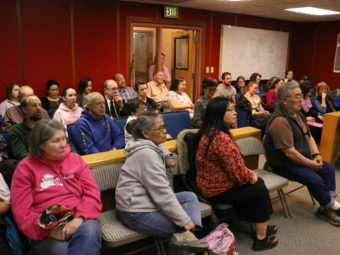
Leading up to the vote, the company met in person with shareholders in 15 communities and Anchorage. Leonard says they wanted to make sure shareholders know how including descendants would change the geographic makeup of shareholders.
“Right now about 61 percent of shareholders live in the Calista region. If this passes, we anticipate that that percentage will drop to about 55 percent,” Leonard said.
If more shareholders are added, holding annual meetings could also get more complicated.
“If the number of shareholders increases dramatically, that certainly could be a challenge to make sure the 50 percent plus quorum requirement is met,” Leonard said.
If enrollment is opened up, Calista would join other corporations such as the Arctic Slope Regional Corporation, Doyon and Sealaska — all regional corporations that issue shares to descendants. There are currently about 13,000 Calista shareholders.
Chum salmon numbers are well below average. (Photo by Shane Iverson / KYUK)
The Kuskokwim River is experiencing a poor chum salmon run, according to state managers, and with it, a restrictive fishing schedule.
The Department of Fish and Game plans to eventually move to a 24/7, 6-inch mesh gillnet fishing schedule, but they’re still moving with caution and have not yet set a date. Gillnet restrictions on the lower river last year were relaxed June 30th.
On Wednesday at a meeting of the Kuskokwim River Salmon Management Working Group — an advisory body for fish management — fishermen supported a cautious approach.
“I talked to several fishermen over here; they were concerned about the very low numbers of chums showing up. Some said they hardly caught any. The majority catch is always chums and a few small chinook,” said John Andrew from Kwethluk. “We could recommend they be cautious for the next two weeks until the silvers pick up.”
Biweekly subsistence fishing periods are underway now. State officials are not considering a chum salmon commercial fishing period.
The working group wanted state officials to allow other opportunities to put away fish. They passed a motion recommending state managers lift the ban on 4-inch mesh set nets. Mike Williams of Akiak said he and other dog mushers rely on whitefish during the summer to feed their teams. The nets can still catch salmon species.
They also asked for longer fishing periods upriver, noting that there are far fewer fish and fishermen in the river. They passed a motion asking that the next fishing above the Holitna be at least 24 hours. The state then announced after the meeting that 50 fathom gillnet fishing above the Holitna opens Wednesday night until further notice.
Members noted that more people downriver are done fishing compared to the middle and upper river, where many are just starting. Red salmon will be the mainstay of the middle and upper river and many are also planning on taking advantage of the silver salmon run as the summer progresses.
Alutiiq Pride Shellfish Hatchery in Seward. (Photo courtesy of Wiley Evans/NOAA)
New research paints an unsettling picture of the future of shellfish in coastal Alaska. The effects of ocean acidification are worsening and could mean the end of hatcheries in the next 25 years if costly mitigation efforts aren’t put in place.
2040: that’s the date put forward by researchers in the ongoing study.
“It is dire,” says Wiley Evans, research associate at the NOAA Pacific Marine Environment Lab in Seattle and the University of Alaska Fairbanks Ocean Acidification Research Center.
He led the project, based at the Alutiiq Pride Hatchery on the Kenai Peninsula. Right now, the hatchery has only a 5-month window where ocean conditions are right for production.
“You know, I have young children and when I’m talking to the public about this, I typically will say that my kids are going to be graduating college when this optimal growth window potentially closes for the Alutiiq Pride Shellfish Hatchery,” says Evans.
“It was very, very alarming. Not knowing much about ocean chemistry, I know a lot more now than when we started, that’s for sure,” says Jeff Hetrick, owner of Alutiiq Pride, which is situated at the head of Resurrection Bay in Seward. “Right now we have blue and red king crab, roughly 6 million sea cucumbers, 2 million cockles, 7 million little neck clams, 100,000 butter clams, roughly 300,000 purple-hinge rock scallops, abalone as well, and we have oysters and geoducks, too.”
It’s currently the only full-time commercial shellfish hatchery in the state, with on-site personnel, which made it a logical choice for data collection.
“We had the opportunity last year to install a state-of-the-art system that could monitor the water chemistry of the seawater that they were pumping in to the hatchery on a continuous basis and it would report out to us in what we call real-time,” says Jeremy Mathis, a NOAA oceanographer who helped choose the site.
Ocean acidification is the name for certain changes in the ocean’s chemistry due to higher levels of carbon dioxide. When seawater absorbs CO2, there’s an increase in hydrogen ions, leading to more acidic water, and lower levels of carbonate ions.
Carbonate ions are crucial for organisms like clams and mussels to develop hard shells. And, without shells, they aren’t protected and can’t survive.
Mathis says Resurrection Bay is in a particularly vulnerable position because of certain environmental factors.
“It gets a lot of freshwater input from not only the streams and little freshwater runoffs that come through there but also quite a bit of meltwater from glaciers. And that unique water chemistry can actually exacerbate or worsen the ocean acidification effect,” says Mathis.
Cold water, which is quicker to absorb CO2, combined with the presence CO2-rich glacial melt put Alaska as a whole at particular risk. Evans says those factors are natural and it’s a delicate balance. But as for the levels we’re seeing here now-
“It’s not natural and it’s a large problem,” says Evans.
Humans and their carbon footprint have added serious amounts of CO2 to the atmosphere very quickly.
“And that little bit of additional carbon dioxide can just push the system past thresholds to where you can’t produce shellfish perhaps anymore without very serious mitigation strategies,” says Evans.
That’s what worries Hetrick when he thinks about the future and the 5-month production window at his hatchery that’s on track to close completely in 25 years.
“We don’t really know what the full costs are going to be. There’s going to be some. There’s going to be capital costs and there’s going to be some operational costs. It’s just going to be another thing we’re going to have to do to produce shellfish.”
Figuring out exactly what to do next is tricky but Mathis says Alaska has to put in the effort, immediately.
“Unfortunately, Alaska is the canary in the coal mine for ocean acidification. We’re seeing changes in water chemistry faster in Alaska than really any other place around the world. So, it’s our job now in the next few years to figure out what the magnitude and impact of those changes are going to be.”
And he says find a way to protect our fisheries before it’s too late.
The B-25 Mitchell bomber recovered in Nome in June 2015. The plane, destined for the Russia front, still bears the red star of the Soviet Air Force. Photos: Warbirds of Glory Museum.
A B-25 J Mitchell bomber left to rust in Nome after World War II is being stripped for parts and may one day be refurbished thanks to efforts from a Michigan war planes museum and help from students across the Bering Strait.
The B-25 was a U.S. military bomber of the same class that went to Russia through the lend-lease program leading up to World War II, and planes of its kind later dropped bombs on Japan after Pearl Harbor. It flew with the U.S. Army Air Force, the British Royal Air Force, and the Soviet Air Force.
In June, Patrick Mihalek with the nonprofit Warbirds Of Glory Museum in Brighton, Michigan, came to Nome to rescue an unusual B-25. “We came up to Nome to recover a World War II B-25 that was sitting out on the tundra for the last 70 years,” Mihalek said, knowing that the distinctly American aircraft had a uniquely Soviet twist.
“We went through the whole wreckage of the aircraft and disassembled it,” Mihalek said. “Many pieces that we need currently for the ongoing restoration we shipped home.”
That “ongoing restoration” is of a different B-25 known as Sandbar Mitchell, another bomber during the war that went on to become a plane for pilots in training, and eventually dumped water on Alaska wildfires near Fairbanks through the 1960s. It crashed in 1969, and after 44 years spent rusting on a Tanana River sandbar, the museum recovered that plane. Mihalek said the museum will use parts of Nome’s B-25 to get Sandbar Mitchell in the air once again.
“We’re going to continue our main project, which is restore Sandbar Mitchell to flying status,” he said. “There’s a few parts from this [Nome B-25] that are airworthy that we’ll put in Sandbar Mitchell, and then vice versa, the parts that are not airworthy from Sandbar Mitchell, because of damage, we’ll put on the Nome [B-25], so in that way, the [Nome plane] could resemble a B-25 once again.”
Just how the B-25 first came to the Seward Peninsula goes back to 1944. After being assembled in Kansas, the bomber was part of a group of planes allocated to Russia through Franklin Roosevelt’s “lend-lease program” prior to and during the U.S. entering World War II. The plane was officially handed over to Russian pilots in Fairbanks, who were set to fly it to Nome and onward to the Russian front. The Nome B-25, however, never crossed the dateline; a rough landing in Nome left it un-flyable, and facilities in Nome at the time left it irreparable.
But the Russian pilots of the Voyenno-Vozdushnye Sily—the Soviet Air Force—didn’t let the plane go to waste.
“The Russians stripped it of all the parts and things they could use as repair parts, or replacement parts, that they felt they could use on their other B-25s,” said museum trustee Todd Trainor during his visit to Nome. “Then it was just left there for vandals and scoundrels to take parts and shoot holes in it with guns.”
In the 1980s, former state House Representative Richard Foster visited Skagway and told then-Skagway resident and aviation enthusiast Mitch Erickson about the bomber. Erickson moved to Nome in 1991, and less than a year later, he found the B-25: axed, chopped, and shot up over years of impromptu target practice. He got the plane loaded on a flatbed and hauled away for safekeeping, but one wing still bearing the red star of Soviet Russia remained trapped in the mud.
“We actually had the NACTEC kids there when we pulled the old wing out of the mud,” said Nathan Pitt, the program coordinator for NACTEC, the Northwestern Alaska Career and Technical Center in Nome. “We had to have every hand available to flip that old wing over. And there on the other side you could see the Russian star still on there, barely visible, but it was still there.”
Recovering Nome’s B-25 was built in to NACTEC’s summer aviation program, and students from Nome and across the Bering Strait worked to recover the plane and disassemble its components.
Pitt said it was an application of the skills students learned working on NACTEC’s own ongoing restoration of another plane, a 1962 Piper Colt. The coordination linked the historic plane to their work in the classroom.
“The 1962 Piper Colt is NACTEC’s project that we’re restoring, so the kids were putting rivets in and also taking rivets out [of the Piper Colt], and then they went over to see the B-25 project, where they were taking all the rivets out in order to disassemble the plane,” Pitt said of the multi-day project.
“They could see where this work was done, and they had a little bit of knowledge about the process and the parts that, you know, keep a plane together.”
The Nome bomber now sits in a shipping container within Nome’s Satellite Field T-hangar—itself a relic from World War II—not far from where the wing was dragged from the mud. “Hopefully within the next year, we’ll be able to raise some money to have the shipping container shipped back to Michigan,” Mihalek said.
The ultimate goal would be to get the Nome bomber flying again, but the wing’s spars are corroded and a “substantial donation” would be needed to make that happen. Failing that, Mihalek said it could be assembled as a static airplane, offering a distinctly Russian display piece for the Michigan museum to tell the unique story of the B-25.
After facing a slew of charges alleging professional misconduct, Nome Superior Court Judge Timothy Dooley has responded to the allegations, denying any wrongdoing or a pattern of inappropriate behavior.
In late May, the state body charged with oversight of judges and courts cited Judge Dooley for six incidents the commission said may have violated codes of professional conduct.
The Alaska Commission on Judicial Conduct highlighted statements made by the judge during court hearings that the commission said potentially violates state law, and the state’s code of conduct for judges, by showing “insensitivity” to victims, witnesses and others in both criminal and civil cases.
The complaint was based on multiple anonymous reports submitted in May of 2013 through September of last year.
In a formal response filed last month, attorney William Satterberg, representing Judge Dooley, acknowledged the judge did indeed make the statements in court. The response goes on to say Judge Dooley “specifically denies” he engaged in a “pattern of conduct” that violates state laws or behavior standards for judges.
In the filing Judge Dooley asked, “the complaint be denied in its entirety” and requested the issue be subject to a hearing in Nome. Further, the judge asserted the hearing be held before an “independent panel,” calling the “existing panel” of the commission “predisposed” and “no longer … impartial.”
The commission apparently rejected Judge Dooley’s request for a Nome hearing. In late June, the group ordered a December hearing in Anchorage where the judge will confront the complaints before the nine members of the commission.
If the complaints prove valid, commission director Marla Greenstein said Judge Dooley could face three possible punishments: a formal and public admission of wrongful conduct, a suspension from office, or, most severely, removal from office.
The decision will ultimately be heard, and enforced, by the Alaska Supreme Court.
Close
Update notification options
Subscribe to notifications
Subscribe
Get notifications about news related to the topics you care about. You can unsubscribe anytime.