Juneau elections

Two weeks before Juneau’s election, Will Muldoon says it’s not too late to run

Juneau resident Will Muldoon serves on six boards and commissions for the city of Juneau and the state of Alaska. In 2021, he won as a write-in candidate for school board after entering the race less than two weeks before the election. (Photo by Paige Sparks/KTOO)

In the fall of 2021, Juneau schools still had a district-wide mask mandate in place when seven candidates for school board participated in a forum ahead of the local election.

Watching at home, Will Muldoon realized that at least two candidates were running just to overturn the mask mandate. He knew he had to do something.

He said 25 people called him — some he didn’t even know — encouraging him to run.

“So that kind of felt like critical mass for me,” he said.

He launched a write-in campaign less than two weeks before the election. And he won. It was the first time someone in Juneau had won any election as a write-in in almost 30 years.
Muldoon works as a data analyst for the state of Alaska. He doesn’t have kids. But he is passionate about civic engagement. He serves on six boards and commissions for the city and the state. The school board takes the most time and energy, though.

“The one thing I really didn’t fully consider was just how much of your life it takes over,” he said.

There are the meetings, of course, but there’s also homework between the meetings. And hours and hours of reading emails each week from constituents. People don’t usually write in to tell board members they are doing a good job. The tone is often less than civil.

In his first year, the board has taken public feedback on COVID-19 policies, bathroom use for trans students and reaction to the school district’s food vendor serving floor sealant to students instead of milk.

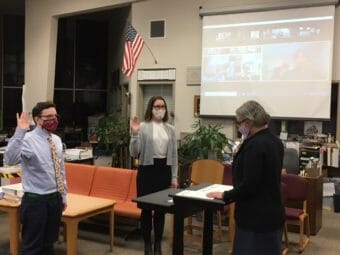
New Juneau Board of Education Members, Will Muldoon (left) and Elizabeth Siddon (center) in person and Amber Frommherz online, took the oath of office on Tuesday, October 19, 2021. (Juneau Board of Education photo)

“It’s tough, because I think with schools in particular, I feel personally that it’s not my job to tell people how to raise their kids, or even really have an opinion on that item,” he said.

But it is his job to make policies informed by the public on the schools’ role in their kids’ lives.

Muldoon says people often ask him if he enjoys serving on the school board.

“‘Enjoy’ is never the word I’m going to use in my top five adjectives,” he said. “I think the work is valid. I think it’s important. It’s also impactful to me on an individual level — like, it’s tough.”

But he’s still enthusiastic about recommending people run for local office.

There are no contested seats on the school board this year. But Muldoon says it’s not too late to “pull a Will Muldoon” and enter the race as a write-in candidate.

“It’s tough to win a write-in campaign,” he said. “I’m aware of that, obviously, and the chances aren’t always the best.”

He ran for school board twice before last year — the first time, when he was only 18 years old.

“I tend to just be a born loser,” he said. “But I don’t mind losing. It’s okay to lose. It’s okay to make mistakes, because that is what really helps us get better.”

He recognizes that the last few years have been hard on everyone. The pandemic has left us burned out on work and on life, which includes our volunteer work and our civic engagement. But he also recognizes that we can’t make life easier for each other if people don’t step up.

“Do I want to be on six boards next year? Probably not,” he said. “Do I want a couple of more folks in our community to be on at least one or two? Yeah, I think so.”

Juneau’s election is by mail again this year and ballots have already hit most people’s mailboxes. But voters have until 8:00 p.m. on Oct. 4 to cast their votes.

There are also dozens of vacancies on Juneau’s boards and commissions.

Muldoon’s advice is always going to be to go for it.

“I wish that people would run and not be afraid to lose with that in mind,” he said. “And if your end goal is to be engaging, and advocating for the things that you believe in, losing is a real good door opener for that.”

This story is part of KTOO’s participation in the America Amplified initiative to use community engagement to inform and strengthen our journalism. America Amplified is a public media initiative funded by the Corporation for Public Broadcasting.

Watch: 2022 Juneau Virtual Candidate Forum

Ballots are in the mail for Juneau’s 2022 municipal election on Oct. 4. This is the third year the city has held the election largely by mail. Early voting opens on Sept. 19. A sample ballot is available on the city clerk’s election web page.

There are no new challengers this year, so barring write-in candidates, all five incumbents seeking reelection to the Juneau Assembly and Juneau Board of Education are running unopposed.

On the Assembly, that means Carole Triem, Greg Smith and Wade Bryson are all headed into their second terms after the October election. On the school board, Deedie Sorensen is headed into her second term and Emil Mackey is headed into his third term.

Get to know the candidates during the League of Women Voters of Juneau Virtual Candidate Forum hosted by KTOO, KINY and the Juneau Empire on Sept. 14 at 7:00 p.m. Watch here or tune in to KTOO 104.3 FM, KAUK 91.7 FM, KINY 94.9 FM or 800 AM.
Juneau’s new ballot processing center is up and running

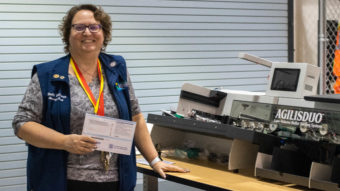
Beth McEwen, Municupal Clerk, leads visitors on a tour of Juneau’s new ballot counting center on Sept. 12, 2022. (Photo by Paige Sparks/KTOO)

For the past two municipal elections, Juneau’s city clerk had to fly to Anchorage with all of the city’s ballots to use the vote-counting equipment there. 

Now, just in time for the local election on Oct. 4, Juneau has opened its own ballot processing center. Ballots were mailed on Tuesday.

“It’s all being done in house versus having to have our staff travel up there and the expense of sending everything,” said Jessica DeBartolow, who works in the clerk’s office. “So it’s a little easier just to do it here.”

On Monday, City Clerk Beth McEwen gave tours of the facility off Thane Road, near the Rock Dump. 

Now that the ballots have been sent out, visitors will have to put their phones or other recording equipment into a locker. There are security cameras trained on everything in the room. And in the waiting room, there’s a screen with all the feeds from those cameras. 

Deputy Clerk Diane Cathcart escorts visitors on a tour of Juneau’s new ballot counting center on Sept. 12, 2022. (Photo by Paige Sparks/KTOO)

Every part of the process, from envelope opening to counting the vote, is recorded so the public can watch.

“Anybody who is coming to observe the process, if they’re sitting out here, they can watch the security cameras and what all the election workers are doing inside,” McEwen said. 

The cameras serve the same purpose as in-person poll monitors in traditional elections.  

The center will have a screen dedicated to the adjudication process, which happens when there is an issue with a ballot that needs human eyes — like if someone filled in two bubbles and crossed out one. 

“We’re going to be having a really big screen TV so that anyone sitting out in our entry area here can actually see that adjudication taking place in real time,” McEwen said. 

Juneau’s first by-mail election, in 2020, had record turnout. Eleven thousand ballots were returned, which was more than 40% of registered voters. The city decided then that it would be worth opening its own ballot processing center. 

Early voting starts on Sept. 19. Once the ballot processing starts, anyone interested in observing can contact the city clerk’s office. The city is still looking for election workers, as well

What to know about Juneau’s 2022 municipal election

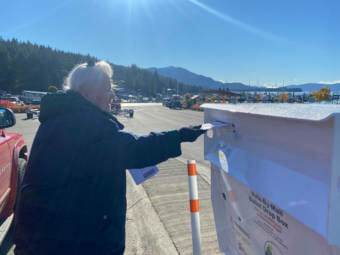
A Juneau woman drops off her ballot at the Auke Bay-Statter Harbor drop box on election day in 2021. The drop boxes at Douglas Library and Statter Harbor are just one of three ways voters can return their ballots this year. (Photo by Claire Stremple/KTOO)

Juneau’s municipal election is on Oct. 4 this year. It will be the city’s third since switching to a mostly by-mail format.

There have been some changes since last year. For one, there are new voter precincts.

City Clerk Beth McEwen is the local election official. She told the Juneau Assembly on Monday that complications from the state’s redistricting process meant city staff didn’t have enough time to integrate the new precinct maps with the city’s systems. That means results won’t be broken down by precinct.

“You will see area-wide results and not at that granular level,” she said.

McEwen says the new precincts will be squared away in time for the next local election.

Another change is that a new ballot counting center is opening right here in Juneau. For the first two by-mail elections, McEwen flew to Anchorage to use a secure facility there to process Juneau’s ballots.

New voters must register by Sept. 4 to be able to participate in the election. If you are already registered but your address has changed, you should update your mailing address by Sunday to get a ballot by mail.

Ballots will be mailed on Sept. 13. A sample ballot is available on the city clerk’s election web page.

After voting, there are three ways to get those ballots back to election officials.

Voters can return them by mail with postage. The city encourages getting the post office to hand-cancel that postage with a legible date on the postmark. Hundreds of ballots in last year’s election were rejected because of postmarking issues.

Ballots can also be placed in secure drop boxes that will be available 24 hours a day, beginning Sept. 19. There will be one drop box available at the Douglas Library/Fire Hall Community Building and one at Statter Harbor.

Finally, ballots can be delivered in person to vote centers at City Hall and the Mendenhall Valley Public Library during business hours.

Barring write-in candidates, all five incumbents seeking reelection to the Juneau Assembly and Juneau Board of Education were unopposed as of Aug. 30. For write-in candidates to be valid, they must file paperwork by Sept. 27.

But the ballot will have four local ballot questions. Voters will be asked to:

  • Repeal a mandate to disclose real estate sales prices;
  • Authorize the city to borrow up to $35 million to build a new city hall;
  • Authorize the city to borrow up to $6.6 million for parks projects; and
  • Renew 1% of the city’s sales tax rate for five more years, with the revenue earmarked for city infrastructure and special projects.

Juneau Assembly votes to keep city neutral on October ballot questions

Protect Juneau Homeowners' Privacy July 2022
The group Protect Juneau Homeowners’ Privacy had this entry in Juneau’s 2022 Fourth of July parade. The group wants local voters to repeal a city mandate to disclose real estate sales prices. The Juneau Assembly recently debated if the city government should publicly oppose the repeal, or stay neutral. (Photo courtesy of Ann Sparks)

Is it OK for the City and Borough of Juneau to publicly take sides on local ballot questions? The Juneau Assembly wrestled with two versions of that question on Monday night before deciding “no” on both. Which means that in their official duties, city staff must stay neutral on the ballot questions in the October local election.

State law generally bars state agencies and local governments from using their resources to influence the outcome of elections. A 2018 Alaska Supreme Court opinion maintained that even using a city government’s email system can be a violation.

But using city resources to inform and educate the public is OK, City Attorney Rob Palmer explained.

Deputy Mayor Maria Gladziszewski asked, where is the line between informing the public and influencing the public?

“So it’s not ‘facts’ that are probably the most operative issue,” Palmer said. “It’s how those facts are stitched together and tell a story. So the legal standard is, have we spent money to influence the outcome of election?”

City Manager Rorie Watt explained what that means practically.

“It’s likely that we would have a very muted public involvement, and very limited. I would not want to put my staff in a position of making an APOC violation,” he said.

APOC is the Alaska Public Offices Commission, a state body that receives campaign finance complaints and issues fines for violations.

“It would be a fine line to walk on providing information,” Watt said. “Where and how you cross the line in a debate from providing factual information to expressing an opinion can be challenging.”

For example, there are some commonsense reasons why city officials want to consolidate current city offices spread across multiple buildings into a single, new city hall building. One upcoming ballot question, which the Assembly approved on Monday in a 7-2 vote, will ask voters to authorize the city to borrow up to $35 million to pay for a new city hall. Assembly members Greg Smith and Maria Gladziszewski voted no.

“In making the business case for city hall, some of those arguments are subjective arguments,” Watt said. “So saying things like, ‘Having all the offices in one place would be more convenient and more efficient.’ Are those facts or are those suppositions? I think it’s actually quite tricky.”

State law does leave a pathway for state agencies and local governments to legally campaign on ballot questions — on the condition that state lawmakers or local elected officials pass legislation that sets aside money specifically to influence the outcome of a ballot question.

That’s what prompted the Assembly’s debate on Monday. Watt had asked the Assembly to consider letting him and his staff support the city hall question and oppose a question to repeal a mandate to disclose real estate sales prices.

“To me, it doesn’t seem right that government would get involved in taking an advocacy position in an election, in a political matter like this,” said David Ignell of West Juneau during public testimony. “I think it sets very bad precedent.”

Assembly member Carole Triem was sympathetic to the point but struggled with how to vote on the real estate disclosure advocacy question.

Real estate professionals and developers are leading the repeal effort, which began with the citizen petition process. They say the policy is an invasion of privacy. The Juneau Assembly created the mandate in 2020 and added fines this past February. Most members think mandatory disclosure will lead to more accurate property assessments and more fairness in property taxes between different kinds of property owners.

“The benefits of mandatory disclosure are a lot more diffuse across Juneau, so it’s really unlikely that there’s going to be a competing advocacy group that organizes for the election to support mandatory disclosure,” Triem said.

Even though Assembly member Alicia Hughes-Skandijs called the pro-repeal side a “special interest,” she couldn’t get behind the city stepping in to oppose it.

“When I picture myself in the shoes of a citizen who got together with other citizens and gathered enough signatures, and knew I was getting something on the ballot, I ask myself how I would feel if then the government was spending my funds to work against me,” Hughes-Skandijs said.

The Assembly voted unanimously against having the city staff oppose the real estate disclosure repeal.

Of course, the Assembly members themselves can advocate for their positions on ballot questions without using city resources.

“I think it’s much more appropriate for Assembly members to do that job,” Assembly member Michelle Hale said. “I think that is our job to do. And it’s tricky, because we have a citizens’ ballot initiative. But I think that is our responsibility.”

The vote on having city staff support the city hall question also failed, but with three yes votes. Mayor Beth Weldon, Wade Bryson, and Alicia Hughes-Skandijs voted yes.

Deputy Mayor Maria Gladziszewski said she went around and around on her first vote but felt decisive about her city hall vote.

“This is the exact same thing,” she said. “The first was to defend our decision that we made. And this is also to defend our decision that we made. And I was on the fence on it, but once I finally worked through it, if we’re going to vote no on that one, we have to vote no on this one.”

To Hughes-Skandijs, opposing a citizens’ referendum was a big distinction from supporting the Assembly’s own city hall question.

“That to me is totally different than us saying, ‘We’re going to put this thing on the ballot, we think it’s a good idea,’” Hughes-Skandijs said.

Other ballot questions

Earlier that night, the Assembly held public hearings and final votes to approve two additional ballot questions.

The Assembly voted unanimously to ask voters to renew 1% of the city’s sales tax rate for five more years. The revenue is earmarked for city infrastructure and special projects.

And the Assembly voted 6-3 to ask voters to authorize the city to borrow up to $6.6 million to pay for parks projects. Christine Woll, Alicia Hughes-Skandijs and Michelle Hale voted no.

Monday is the public’s last chance to weigh in on several Juneau ballot questions, including a new City Hall

New City Hall on Whittier Street rendering
During a public forum in May, the City and Borough of Juneau’s design team shared this rendering of what a new City Hall building could look like on Whittier Street.

On Monday, the Juneau Assembly plans to take public comment and hold its final vote on measures to put questions on the October local election ballot focused on new infrastructure and how to pay for it.

There are three ordinances for three separate questions.

First, an ordinance to ask voters to extend a temporary portion of the city’s sales tax. Without action, 1% of the city’s overall 5% sales tax rate will expire in September 2023. If it is extended another five years, it’s forecast to raise $60 million. As with past renewals, the money is earmarked for several specific infrastructure projects. Here’s the list this time:

  • Deferred maintenance of city and Juneau School District facilities
  • Replacement of public safety equipment for the Juneau Police Department and Capital City Fire/Rescue
  • Redevelopment of Gastineau Avenue, Telephone Hill, and north State Office Building parking garage
  • Harbor expansion and maintenance
  • Lemon Creek multiuse path
  • Relocating the Juneau-Douglas City Museum

Unlike past 1% asks, this year’s list also includes funding for items that aren’t traditional brick-and-mortar infrastructure:

  • Contributions to the city’s budget reserve
  • Support for expanding childcare availability
  • Support for affordable housing and ongoing development of Pederson Hill
  • Information technology upgrades

A second item would ask voters to authorize $35 million in debt to build a new city hall on Whittier Street. The new facility would let the city centralize its office workers and public-facing services, which are currently spread across four different buildings downtown. Of those four buildings, the city only owns the current City Hall. Watt said the city pays more than $800,000 a year in rent for the extra office space.

“When your business plan is to be in business FOREVER, you should own your own building — it just makes economic sense,” Watt told the Greater Juneau Chamber of Commerce recently.

Watt said he knows that asking the public to OK so much new spending is a big ask.

“I want people to be firmly aware that there is a cost of doing nothing,” Watt said. “And that’s a cost of not deciding. That cost is, we’re going to keep paying that rent forever. You know, we probably could’ve bought several of those buildings — or probably, we bought several buildings for those owners already, by being such a good tenant.”

The existing City Hall building dates back to the 1950s and needs significant repairs. Public Works and Engineering Director Katie Koester said it needs about $12 million of work over the next several years to stay viable.

“Some of it is near term, like painting the facade,” she said. “But you can’t paint the facade without repairing the plaster. You can’t repair the plaster without fixing the windows. Then you need to replace the windows — so it escalates very quickly.”

The city’s design team held a public forum about the new city hall proposal in May.

A third ordinance would ask voters to authorize $6.6 million in debt for park improvements:

  • Turf and track surfacing for sports facilities at Adair-Kennedy Park
  • A new public use cabin
  • Areawide trail maintenance

The Assembly is also taking up two other ballot question-related ordinances to let the city manager campaign for the new city hall question, and against a petition-driven referendum to repeal a local mandate to disclose the price of real estate sales to the city assessor’s office. The city manager is asking for $25,000 for each of those campaigns.

The Juneau Assembly meeting begins at 7 p.m. Monday. Members of the public can participate in person or remotely through Zoom. The remote option requires advance notice by 4 p.m. the day of the meeting with the city clerk’s office at 907-586-5278. The Assembly also takes written comments by emailing BoroughAssembly@juneau.org.

KTOO also broadcasts Assembly meetings live at 104.3 FM.

Site notifications
Update notification options
Subscribe to notifications