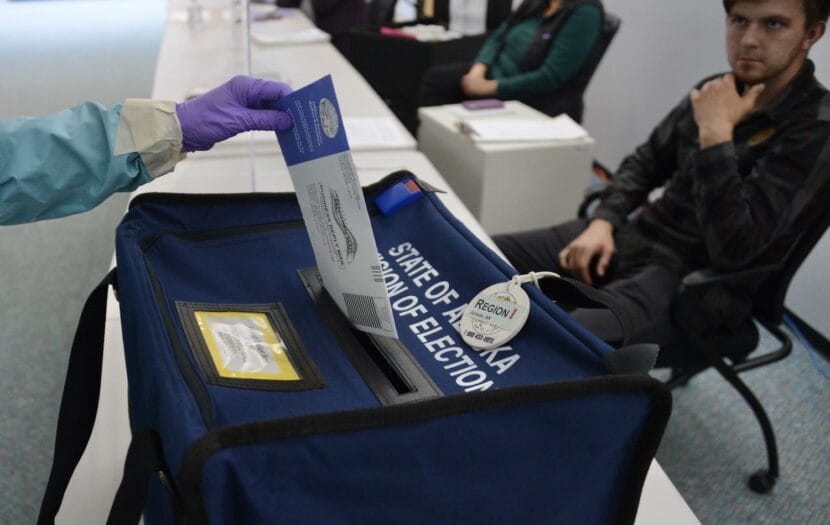
A voter in Alaska’s special U.S. House primary election drops their ballot into a box on Saturday, June 11, 2022 as a poll worker observes. (Photo by James Brooks/Alaska Beacon)
Twelve candidates are vying to reach the final four in the race for Alaska’s U.S. House seat, and each has a different view of the state’s biggest need.
Early and absentee voting is underway for the state’s Aug. 20 primary, and the four top vote-getters, regardless of political party, will advance to the November general election.
Responding to a questionnaire from the Alaska Beacon, 10 of the 12 candidates offered their views of Alaska’s biggest need, with most focusing on economic issues.
Incumbent Democrat Mary Peltola said she views “affordable and reliable energy” as the state’s top need but believes the state can be energy independent if it intensifies oil and gas drilling while also upgrading the electrical transmission infrastructure along the Railbelt.
During her first term in office, Peltola backed development of the Willow oil project on the North Slope and encouraged the federal government to direct millions toward electrical upgrades.
Peltola said it would be “unacceptable” if Cook Inlet utilities are required to import liquefied natural gas, and said she is advocating additional energy legislation to address the problem.
Republican challenger and Lt. Gov. Nancy Dahlstrom likewise said she would “advocate for responsible legislation that unleashes Alaska’s energy and natural resource potential while maintaining our natural order.”
She went a step further, saying Alaska’s economy as a whole needs help, adding that she believes Alaska needs “to get our economy out of the rut we’ve been in under Mary Peltola and Joe Biden.”
Alaska has the sixth-worst unemployment rate in the country and ranks 26th in job growth, according to figures published by the Alaska Department of Labor and Workforce Development. This spring, it became the last state in the country to erase job losses caused by the COVID-19 pandemic emergency in 2020. Employment in the state remains lower than it was in 2014.
Fellow Republican challenger Nick Begich said Alaska’s “most pressing need is to address the high cost of living that affects all residents, particularly those in rural areas.”
He, like Dahlstrom and Begich, suggested that energy development is needed and offered multiple other solutions, including the elimination of the Jones Act for Alaska. That federal law requires shipping companies to use American-flagged ships to carry cargo between American ports.
Repealing that law could lower costs for Alaskans, he said.
Begich said the state needs expanded road and rail infrastructure and that more federal land should be opened for development.
Nonpartisan candidate Samuel Claesson, who lists an Iowa address as his home, said housing is the state’s biggest need, writing, “we have some of the highest costs of rent in the nation because of a lack of housing.”
Republican Jerry Heikes and Alaskan Independence Party candidate John Wayne Howe each suggested that the state’s biggest need is to have less federal government presence.
Howe, repeating a long-held tenet of his party, said the state’s 1957 statehood vote was flawed and that the federal government “is not a properly authorized governing body for Alaska.”
David Ambrose of Fairbanks also suggested that the state needs “a separation of powers from the federal government over Alaska’s ability to be independent from bureaucratic overreach.”
Lady Donna Dutchess, a nonpartisan candidate from Anchorage, said “awareness” is Alaska’s biggest need, and that she believes “there is corruption so widespread, that the citizen’s only recourse is to repent of past compliancy and call on the Most High God for guidance.”
Richard Grayson, representing the No Labels Party from an address in Arizona, said Alaska’s biggest need is “A designated day for moose to stay off the roads. I would ask Congress to designate a holiday called ‘Moosemas.’”
An early voting station is set up in the atrium of the State Office Building in Juneau, Alaska on Monday, Aug. 5, 2024, the first day of early voting for the 2024 Alaska primary election. (Photo by James Brooks/Alaska Beacon)
Early voting for Alaska’s Aug. 20 primary election opened Monday at polling stations across the state.
If a voter wants to download and print out an absentee ballot, the deadline to apply for that procedure is Aug. 19.
Either kind of ballot must be postmarked before or on Election Day. Because most Alaska mail is postmarked in Juneau or Anchorage, ballots cast within 10 days of Election Day should be hand-postmarked at a local post office.
Ballots must reach the Alaska Division of Elections no later than 10 days after Election Day in order to be counted.
If you haven’t registered to vote, it’s too late to participate in the primary — the deadline was July 21. You can still register for the November general election; the deadline for that is Oct. 6.
Under Alaska’s primary election system, all candidates for a particular office run together. A voter picks one of those candidates to advance. The top four vote-getters for the office, regardless of political party, advance to the November election.
In any race with four or fewer candidates, all candidates advance to November. In 2022, some candidates withdrew from the general election after viewing the primary results.
Primary elections for the presidency are the responsibility of individual political parties, and those have already taken place, so no presidential candidates appear on the Aug. 20 ballot.
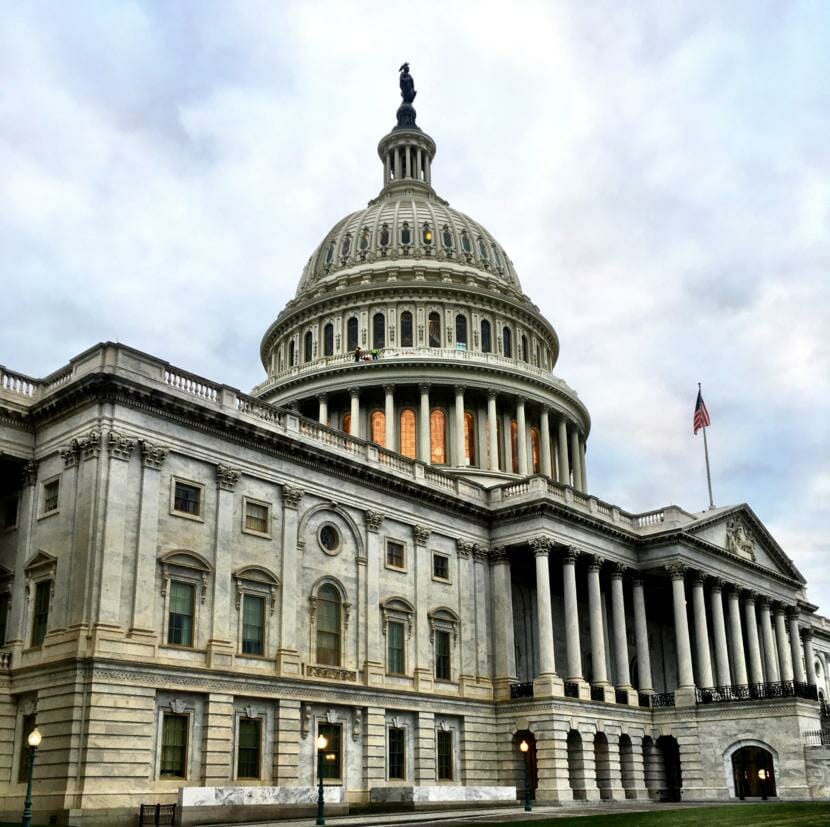
The U.S. Capitol building in Washington, D.C. (Photo by Liz Ruskin/Alaska Public Media)
Seattle has more power in the U.S. House of Representatives than the state of Alaska.
And yet, ahead of this year’s House elections, there’s as much at stake with Alaska’s race than all four of the contests in King County combined.
The vast majority of the 435 seats in the House are firmly Democratic or firmly Republican. Alaska is among a dwindling number of exceptions that could go in any direction.
More than that, it’s one of just five places in the country that voted for Donald Trump as president in 2020 yet elected a Democrat to the House in 2022.
The House is almost equally divided between Republicans and Democrats, and in a series of interviews and speeches throughout this year, current and former candidates for Alaska’s House seat have said the race could help decide which party controls the House.
In turn, that could affect the country’s direction on issues ranging from abortion to oil development to international affairs.
“We are down to the tiniest margins we’ve ever seen, like three or four people in the House and one in the Senate,” said Rep. Mary Peltola, the incumbent Democrat, in a January interview.
Control of the House will impact whoever wins the presidential race. A Republican-controlled House will support Donald Trump or act as a brake on Kamala Harris. The opposite is true if Democrats control the chamber.
“That’s exactly how I see it,” said Lt. Gov. Nancy Dahlstrom, a Republican candidate for House this year.
“I have President Trump’s endorsement. And so what that tells people is that when President Trump needs to talk to a congressperson from Alaska, he wants to call me, and he’s going to pick up the phone and call me, and he knows that we can work together, and we’re going to get things done together. You know, I think that’s important,” she said.
Candidates on the issues
Ahead of the primary, the Alaska Beacon asked all of the House candidates their opinions on 15 different issues suggested by you, our readers, and our reporters. Ten of the 12 candidates responded. See our questionnaire to read how they answered.
The candidates for the House include the Democratic incumbent, four Republicans, three nonpartisan candidates, one who didn’t declare a party, an additional Democrat, a member of the Alaskan Independence Party and a member of the No Labels Party.
Thousands of Alaskans are already voting absentee, and early voting begins Monday.
Election Day, for those who haven’t already voted, is Aug. 20. The four candidates who get the most votes will advance to the November general election.
Republican challenger Nick Begich said he thinks Alaska is at a “pivotal point” in its history.
“There’s really two camps as I see it,” he said in February. “There’s one camp that believes that Alaskans have a role as guardians of the state, that development should be diminished or eliminated. There’s another group of Alaskans who believe that our responsibility in Alaska extends to increasing development and that we have a role to play in our nation … as a source for critical minerals, base metals, energy in the form of oil and gas.”
And what’s at stake extends beyond what’s happening within Alaska itself.
“This time around, they’ve got some major issues they’re facing,” said Santa Claus, a socialist-leaning independent who finished sixth in the 2022 special U.S. House primary election.
He proceeded to rattle off a partial list: Social Security and Medicare; Russia and Ukraine; issues of abortion and contraception; student loans; education and libraries; LGBTQIA-Two Spirit issues, including with sports; wearing masks in schools should the pandemic or some other medical issue arise; gun control; cannabis and hemp; and oil and gas mining, fracking, pipelines and carbon capture.
“Issues like that, I think they’re all important, because this election is going to have a profound impact on how the American people view and deal and cope with those particular issues,” he said.
Democratic incumbent tries to focus on Alaska topics
Peltola is a Democrat who was elected twice in 2022: Once in a special election to fill the remainder of Republican Rep. Don Young’s term after his sudden death, and then again for a two-year term of her own.
Through March, she voted with her fellow Democrats on 88% of the votes in the House, a figure that appears to be high, but is the fourth-lowest among House Democrats.
Since Harris replaced Joe Biden as the Democratic presidential nominee, Peltola has declined to endorse her, in part because the congresswoman isn’t sure that Harris would support oil drilling within the state.
Like her Republican opponents, Peltola has repeatedly voted in favor of measures to allow more drilling here. The support hasn’t been universal — shevoted presentonone high-profile Arctic drilling bill because of a clause she disapproved of — but that was an unusualexception.
Peltola has also bucked her Democratic colleagues by voting against gun control measures and this year became the first Democratic member of Congress since 2020 to be endorsed by the National Rifle Association.
Speaking in January, Peltola said that in places where one member of Congress represents an entire state, “it doesn’t give the one representative for the entire state much latitude to be championing issues that aren’t directly Alaska-related.”
“Alaska is so big and so young that whoever is in the position that I’m in — in Congress — we are up to our eyeballs in issues,” she said.
That’s why, she said, she’s focused on fisheries issues, on energy topics and on consumer issues like her opposition to the grocery-store merger of Albertsons and Kroger.
That has upset some Democratic voters, who want her to take a stand against Israel’s attacks that have killed civilians in Gaza.
A Peltola fundraiser in Juneau was disrupted by a pro-Gaza speaker, and Claus, who previously endorsed Peltola, withdrew his support over the issue.
“I care about international issues of course,” Peltola said. “I want peace and prosperity across the world. But Alaskans sent me to Washington, D.C., to champion Alaska issues.”
Significant differences on reproductive health
Peltola differs from her principal Republican competitors on reproductive issues. Since entering office, she’s co-sponsored bills that would prohibit restrictions on abortion, birth control, and in vitro fertilization.
Some Republicans have expressed interest in using a 19th century law, the Comstock Act, to restrict birth control and abortions, and Republican control of the House or the presidency may cause a significant change in existing federal policy.
Republican Lt. Gov. Nancy Dahlstrom said in an interview that she is “pro life with exceptions of rape, incest and life of the mother,” but that abortion is “best left up to the states.” Republican candidate Nick Begich has said that while he supports the idea of allowing states to restrict abortion at a local level, he also would eliminate Medicaid funding for the practice and stop pharmacies from distributing mifepristone, a drug used in many abortions.
Among the nine lesser-known candidates in the race, Alaskan Independence Party candidate John Wayne Howe referred to abortion as “child murder” but said he doesn’t think Congress will act to restrict abortion.
“The people will not at the current time quit killing their children, as they are oppressed, and see only small value even in their own life,” he wrote.
Republican Gerald Heikes is strongly against abortion rights, saying in June that “there are no Christians in the Democratic Party” because of the party’s stance on abortion.
“When you vote for people that believe in the sacrifice of children, in abortion and abortion bills, you’re responsible for that innocent blood,” he said.
For Republicans, hopes of helping Trump — and oil
Heikes and another Republican candidate, Matthew Salisbury, haven’t received significant amounts of financial donations or support from local or national Republican Party officials.
They could nevertheless advance to the November general election under Alaska’s top-four primary, which winnows the candidate field to four people, regardless of party.
Howe, of the Alaskan Independence Party, could also be one of the four. During a May interview, he said he sees Alaska as a puppet of the federal government and believes the federal income tax system should be replaced with a program that allows people to choose which programs to support.
“Ideally, we would vote with our funds, if we didn’t have this tax structure that we do,” he said. “Ideally, all of the oil money that comes into the state would be given to individuals first, and then the individual would have a chance to state which department the money goes to.”
That isn’t a view shared by the two leading Republican candidates, Begich and Dahlstrom. Both have received substantial support from within and without the state, but each has expressed similar views about the state’s need to be allowed to drill for oil and mine for minerals in order to grow its economy and benefit its residents.
While Peltola may support oil drilling in Alaska, her Democratic counterparts in Congress and the White House generally do not, Begich and Dahlstrom have said, and regardless of Peltola’s views, electing her could result in further restrictions on development here.
“Oil and fossil fuels are and always will be central to Alaska’s economy. We have an abundant supply — very much contrary to the media spin saying otherwise — that we are not tapping into due to leftist policies pushed by Joe Biden and Mary Peltola,” Dahlstrom wrote in response to a question from the Alaska Beacon.
Both Begich and Dahlstrom have expressed hopes that Donald Trump will be reelected as president. During his first term in office, Trump signed the bill that opened parts of the Arctic National Wildlife Refuge to drilling, and he has pledged to renew that program, which was stopped by the Biden administration.
Begich has received support from members of the House Freedom Caucus, a group of more conservative Republicans who are sometimes at odds with the House’s current Republican leadership. Dahlstrom, meanwhile, has received support from the Republican House leadership and has Trump’s endorsement.
At the state Republican convention and in local meetings since, Republican officials within Alaska have thrown their support behind Begich, endorsing him for House even if it puts them at odds with Trump.
Dahlstrom, during an interview in late July, said she doesn’t think those local officials speak for all Republican voters in the state.
Begich, a firm opponent of ranked choice voting, has said that if he finishes behind Dahlstrom in the race, he will drop out in order to consolidate support behind her. Dahlstrom hasn’t made a similar promise.
Correction: The initial version of this article incorrectly described how Peltola voted on an Arctic drilling bill that contained a clause she disapproved of. She voted present on the bill, not against it.
Alaska Congresswoman Mary Peltola in the halls of the Capitol in January. (Liz Ruskin/Alaska Public Media)
Alaska Congresswoman Mary Peltola voted Thursday for a Republican resolution condemning the Biden administration — and specifically Vice President Kamala Harris — for their border security policies.
Peltola was among six Democrats to vote for the non-binding measure. She and other Democrats running for re-election from red districts have repeatedly united with Republicans in statements criticizing the Biden administration for not cracking down on border crossings and not doing more to stop the flow of illegal drugs from Mexico.
Thursday’s resolution takes pointed aim at Harris just days after she became the likely Democratic nominee for president. The resolution calls her the “border czar,” a label USA Today and Politifact, among other fact-checkers, have rated false or mostly false.
Harris is not in charge of border security. President Biden said in 2021 that she would lead diplomatic efforts addressing the root causes of migration from three central American countries.
Peltola said this week that she was not committed to voting for Harris and that she would not endorse any candidate.
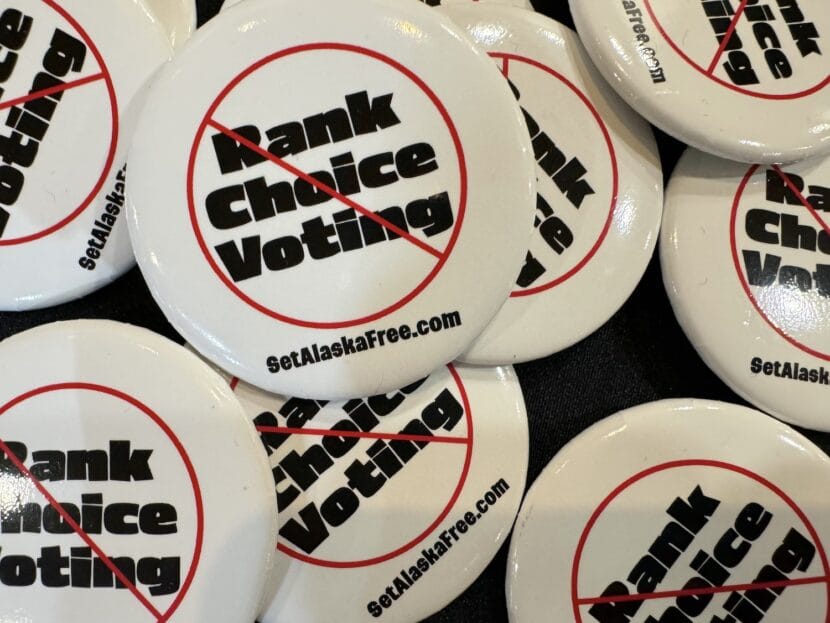
Pins supporting the repeal of ranked choice voting are seen on April 20, 2024, at the Republican state convention in Anchorage. (Photo by James Brooks/Alaska Beacon)
Alaska voters are slated to have an opportunity this year to affirm or repeal the state’s use of ranked choice voting, Division of Elections officials confirmed on Wednesday.
The news comes after Superior Court Judge Christina Rankin disqualified some of the signatures gathered by a repeal effort on Friday because the gathering process was not carried out in accordance with state law.
Whether there would be enough total signatures was not in question, but rather whether there would be enough to meet the requirement for a certain number of signatures from at least 30 of 40 state House districts.
Former Alaska Attorney General Kevin Clarkson represented repeal supporters in the case and predicted the outcome would be favorable for the repeal initiative last Friday.
Attorney Scott Kendall wrote the 2020 ballot measure that led to the use of ranked choice voting and represented the plaintiffs in court. He said he expects to file an appeal with the state’s Supreme Court this week.
Alaskans first used ranked choice voting in the 2022 election. It will be used in the general election this November.
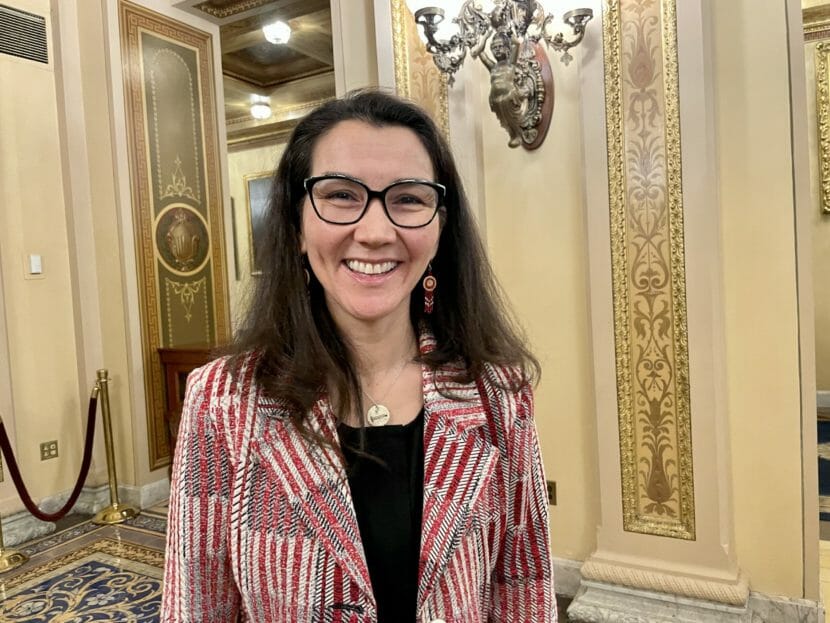
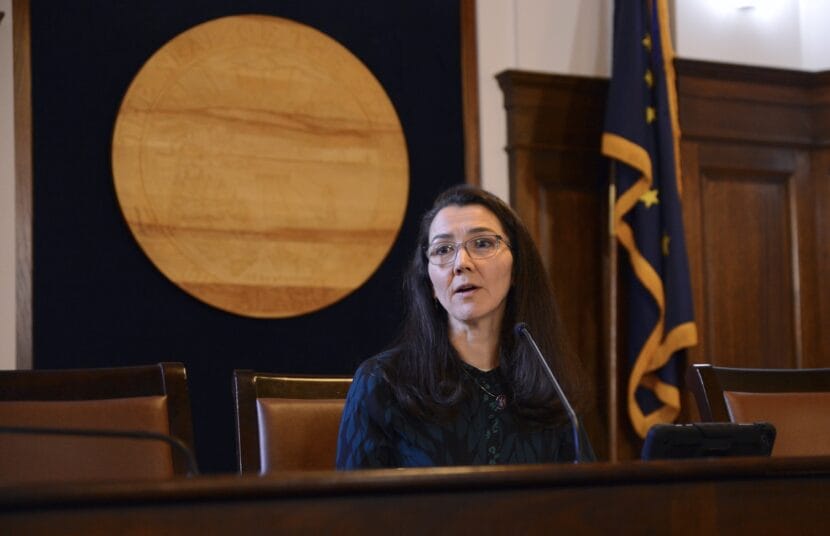
Rep. Mary Sattler Peltola, D-Alaska, speaks to reporters on Monday, Feb. 26, 2024, after her annual address to the Alaska Legislature. (Photo by James Brooks/Alaska Beacon)
Alaska’s House race will be one of the hardest fought races in the country, according to a national group dedicated to getting Republicans elected into the U.S. House of Representatives.
It’s for that reason the National Republican Congressional Committee launched its first television ads in the general election cycle in Alaska before any other state, according to a news release.
The television ad labels incumbent Rep. Mary Peltola, D-Alaska, a “devout Biden enabler” who would “betray Alaskans to back Biden.” It includes Peltola saying: “I think Biden’s mental acuity is very, very on.”
NRCC Spokesperson Ben Petersen criticized her for working with President Biden.
“Republicans are charging full speed ahead to win Alaska’s House seat, stop the liberal attacks on Alaska and ensure conservative leadership in Congress. Instead of standing up to Biden, Mary Peltola has praised him and pandered to the Biden agenda that’s hurting Alaska from economic sanctions to the fentanyl and border crisis,” he said in an email.
Peltola is one of five Democrats representing House districts that voted for Republican Presidential candidate Donald J. Trump in the 2020 election.
In a news conference on Tuesday morning Peltola reiterated her commitment to teamwork rather than attacking opponents.
“I’ll always be committed to having a positive campaign. I think it’s really important. I think the climate that we’re in is very toxic and we’re tired of the toxicity,” she said.
“I am confident that Alaskans and Alaskan voters will see through that baloney, the lies that will be perpetuated in commercials throughout the campaign cycle.”
The 30-second ad does not endorse or mention a Republican candidate. Twelve candidates are vying for the seat, including Lt. Gov. Nancy Dahlstrom and Nick Begich, both Republicans.
So far, reports from the Federal Elections Commission show Peltola’s campaign has raised more money than her Republican challengers.
Peltola said she plans to work with whichever candidate is elected president.
“I’m overtly choosing governing over politicking,” she said. “I still have six months, we all have six months to get as much done as we can.”
She said Biden made some choices that were not in Alaska’s best interest, but praised his lifetime commitment to public service. She said Biden was “very on point” about 10 months ago when they last spoke; Biden called in September to offer his condolences after her husband, Eugene Peltola, Jr., died.
“He does seem a lot older than he was 10 months ago,” she said, adding that the effects of aging can advance quickly and that she was surprised by his recent debate performance.
“It’s a very sad realization when you see elders becoming very, very geriatric,” she said.
Close
Update notification options
Subscribe to notifications
Subscribe
Get notifications about news related to the topics you care about. You can unsubscribe anytime.