Nancy Dahlstrom, Mary Peltola and Nick Begich III are running for U.S. House in 2024. (Alaska Public Media)
Congresswoman Mary Peltola may be in a competitive contest for her re-election, but she’s far ahead of Republican challengers Nancy Dahlstrom and Nick Begich in the race for campaign cash.
In the three months ending June 30, Peltola raised more than $2 million — five times more than any other candidate, according to reports filed Monday with the Federal Election Commission.
Republicans see the Alaska race as an opportunity to flip a seat from blue to red and increase their thin majority, while Democrats have identified Peltola as a seat they need to hold to have any hope of regaining the speaker’s gavel.
Dahlstrom, Alaska’s lieutenant governor, has Donald Trump’s endorsement, and the support of Republican leaders in the U.S. House of Representatives. The GOP congressional support has been a boon for Dahlstrom. About $300,000 of her total comes from Political Action Committees and groups affiliated with the House speaker and majority leader. She raised about $100,000 from individuals.
Peltola raised even more money from Political Action Committees. PACs representing a variety of sectors — including railroads, energy, insurance, Alaska Native Corporations and unions — sent her contributions. But Peltola raised 90% of her total from individuals, mostly through the ActBlue fundraising platform. It allows contributors from around the country to easily give to Democratic candidates.
Republican Nick Begich III has statewide name recognition from his 2022 campaign for the same seat. Begich has been running a largely self-funded campaign but he reports raising $300,000 from individual contributors, his best quarterly showing yet. He also got a $5,000 contribution from a committee affiliated with the hard-right House Freedom Caucus.
Radio infrastructure used by the Juneau Police Department. (Juneau Police Department)
The Juneau Assembly unanimously approved two ballot measures on Monday that could add nearly $23 million to the city’s debt for public health and safety improvements.
If passed by Juneau voters this fall election, the bonds would help fund upgrades to Juneau’s public safety communication system and the Juneau Douglas Wastewater Treatment Plant.
The public safety bond asks to borrow $12.7 million and the wastewater bond asks for $10 million. Following the Assembly’s vote last night, they’ll both be put to voters on the Oct. 1 municipal election ballot.
The $12.7 million bond measure will help cover the cost of replacing the radio system used by the Juneau Police Department and Capital City Fire/Rescue.
Police say the current system is outdated — it was only designed for an eight-year lifespan, and that expired a decade ago. Though it’s still operating, they say it’s causing dead zones and is no longer reliable. In total, the project is expected to cost around $25 million.
The other $10 million bond measure will help cover the cost of replacing the wastewater clarifier building at the Juneau Douglas Wastewater Treatment Plant. That plant services Thane, Downtown and Douglas.
City officials say the replacement is needed due to decades of erosion.
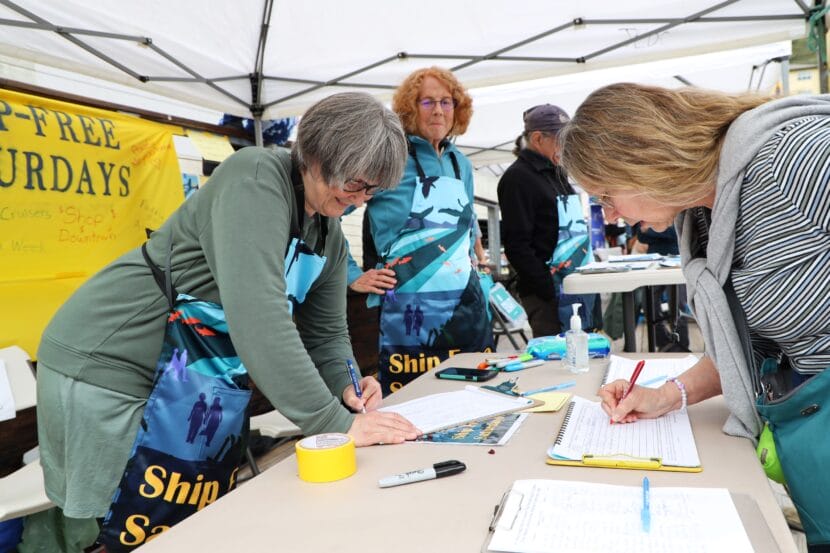
Karla Hart (left) helps a resident sign the “Ship-Free Saturday” ballot initiative at the Maritime Festival in downtown Juneau on May, 4, 2024. (Clarise Larson/KTOO)
An initiative asking voters whether Juneau should ban large cruise ships on Saturdays starting next year has qualified for the local ballot this fall.
The City and Borough of Juneau clerk’s office announced on Monday that the group leading the “Ship-Free Saturday” ballot initiative had secured enough certified signatures to get a spot on Juneau’s Oct. 1 ballot, unless the Juneau Assembly decides to take action on the issue before then.
Karla Hart is one of the activists who led the effort this spring. She said the support the initiative has seen so far goes to show how much people in Juneau want change.
“I think it says that Juneau really seriously wants some hard stops on cruise industry impacts in their lives, and that they haven’t received that from the city Assembly,” she said. “And that they don’t think that those hard stops are coming unless citizens take action.”
If the initiative is passed by voters, it would ban all cruise ships that carry 250 or more passengers from visiting Juneau on Saturdays and on the Fourth of July. But before it appears on the ballot, the Juneau Assembly has until Aug. 15 to decide whether to take its own action on the issue.
Though the initiative gained more than 2,300 signatures in support, plenty of people and businesses in the community oppose it, including Laura Martinson McDonnell.
She owns a gift shop downtown and is on the steering committee for a local advocacy group called Protect Juneau’s Future. The group is behind the orange signs hanging around town that discouraged people from signing the initiative.
“I’m absolutely voting against this initiative,” she said. “That’s because I would like to maintain the right to control my own business and have a say in how my business is operating.”
Martinson McDonnell said she believes the initiative is being led by a small minority of the community. And, she doesn’t think it actually has the support needed to pass in October.
Juneau Visitor Industry Director Alix Pierce said the city will likely share information on its website that explains what the initiative seeks to do and the facts surrounding it. But, she said the city does not plan to take a formal stance on the issue.
“People are always welcome to provide their own interpretation, but our duty as a local government is to provide accurate and factual information to our citizens,” she said.
Local initiatives similar to this one have popped up in recent years in other parts of Southeast and at other ports across the U.S., but many have failed to make it across the finish line because of legal barriers.
Late last month, a group of residents in Sitka submitted a ballot measure to city officials there. It would limit the number of cruise ship passengers that visit there each season. That initiative is currently undergoing legal review. Last season, Sitka city officials there denied a petition seeking a similar goal, saying the proposed legislation would be unenforceable under the Alaska Constitution.
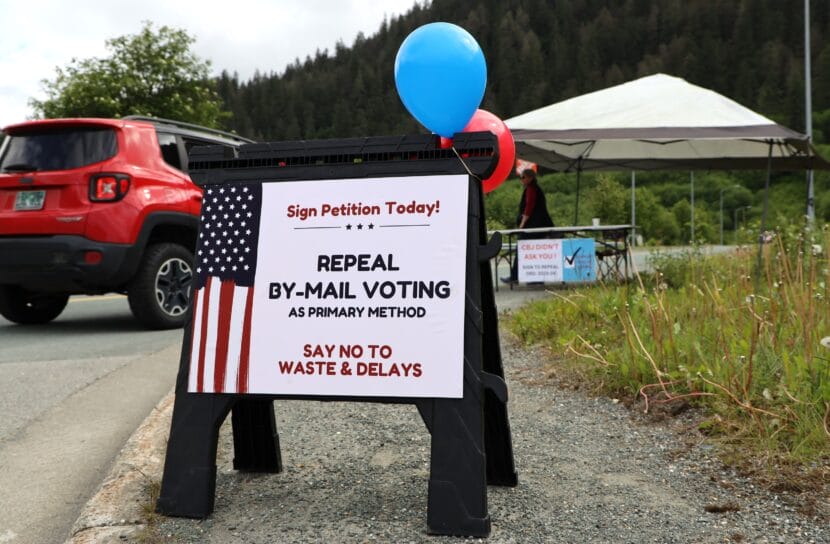
Petitioners gathering signatures to repeal Juneau’s local by-mail voting method collect signatures near Costco on Wednesday, June 12, 2024. (Clarise Larson/KTOO)
An effortto repeal an ordinance that made by-mail voting the default in Juneau has failed to gather enough signatures to get on the local ballot.
The group of residents behind the repeal needed to get nearly 2,400 signatures to put the question to voters this October. During the initial 30-day signature gathering period, they gathered less than 1,000.
The group tried to make up the shortfall during an additional 10-day collection period, setting up tables around Juneau with signs and information about their cause. Multiple petitioners declined to be interviewed by KTOO.
According to documents submitted to the city clerk’s office, the repeal effort took aim at an ordinance the Assembly adopted last year making by-mail voting the default for local elections.
Only five residents spoke against the idea at the meeting when the ordinance passed. They cited voter fraud and questioned whether it would actually improve voter turnout. Widespread voter fraud has been widely debunked by national experts.
By-mail voting has been used by the City and Borough of Juneau for the past four elections, since the start of the COVID-19 pandemic. In-person voting is still available at city vote centers.
Even if the ordinance had been repealed, the Assembly still could have directed the city to conduct a by-mail election.
Ballots will be mailed to registered voters starting on Sept. 12 and must be postmarked or returned by Oct. 1.
Attorney Maeve Kendall, at podium, represents supporters of ranked choice voting. Her co-counsel are on left: Samuel Gottstein and Scott Kendall (no relation). At the other table are Assistant Attorney General Thomas Flynn and attorney Kevin Clarkson, right. (Screen shot of court live stream/ published with court’s permission)
Supporters of Alaska’s ranked choice voting and nonpartisan primaries were in court Monday trying to block a ballot measure that would repeal the election reforms voters adopted in 2020.
On day one of the trial before Superior Court Judge Christina Rankin, witnesses testified that they saw irregularities in how repeal sponsors collected signatures last year. Most said they saw petition booklets left unattended. Attorney Maeve Kendall, representing voters who want to keep ranked choice voting, called a witness who was a regular at Tudor Bingo last year. Dawn Dunbar testified that she saw petition books left out on a table for weeks.
“Did you ever see anyone monitoring the booklets?” the attorney asked.
“No, ma’am,” Dunbar testified. “People were picking up the booklets. People were writing on the booklets.”
Dunbar thought it was so unusual she contacted the Division of Elections.
For a petition to be valid, registered voters need to sign a petition in the presence of a circulator assigned to a particular booklet.
Kendall and other attorneys representing the pro-ranked choice side say the problems with the signature collections were so widespread that entire booklets — and all the booklets that were assigned to certain circulators — need to be thrown out. That, they say, would leave the repeal measure short of the nearly 27,000 signatures needed to be on the November ballot.
Their witnesses spoke of seeing unattended petitions at Tudor and Big Valley bingo halls, Duane’s Antique Market in Anchorage and at a business in Soldotna. Witnesses also said they saw petition booklets at the state fair that did not appear to be in the possession of the circulator they were assigned to.
Some of the witnesses, like Gregory Lee, were paid to gather evidence. He pretended he wanted a job as a signature gatherer and spoke to a contractor for the repeal drive, Mikaela Emswiler. His recording was played in court.
“Am I allowed to leave booklets at places or with family or friends,” he said. “or do I have to … ,”
“The only thing is … I would give you extra books,” Emswiler said. “And then, in order to keep track of them, I just need a name and location address of where to keep track of it. The bingo places are — we’ve got a couple places around town that have welcomed books into their businesses. So just as long as we can keep track of everything, that would be great.”
“Okay, so if I left a book somewhere, I just need to let you know where I left them?” Lee asked.
“Mmm-hmm,” Emswiler said. “We need email — yeah, email, phone number, a point of contact and address, okay?”
Former state Attorney General Kevin Clarkson represents the sponsors of the repeal petition. He contends the exchange shows Emswiler wanted to keep track of who would be responsible for the petition, not just where it might be left.
Clarkson poked holes in the witness accounts and got most to admit that they didn’t see anyone actually signing the petitions that were said to be unattended.
Alaska’s system of a nonpartisan primary and ranked choice voting in the general was narrowly approved in the 2020 election. It is said to favor moderates, mostly because all candidates appear on the same primary ballot, regardless of party. The method is unpopular among Alaska Republicans and conservatives. They especially dislike that the first time it was deployed, in the special U.S. House election of 2022, Democrat Mary Peltola won.
The trial is expected to last into July. It will be decided by Judge Rankin, without a jury.
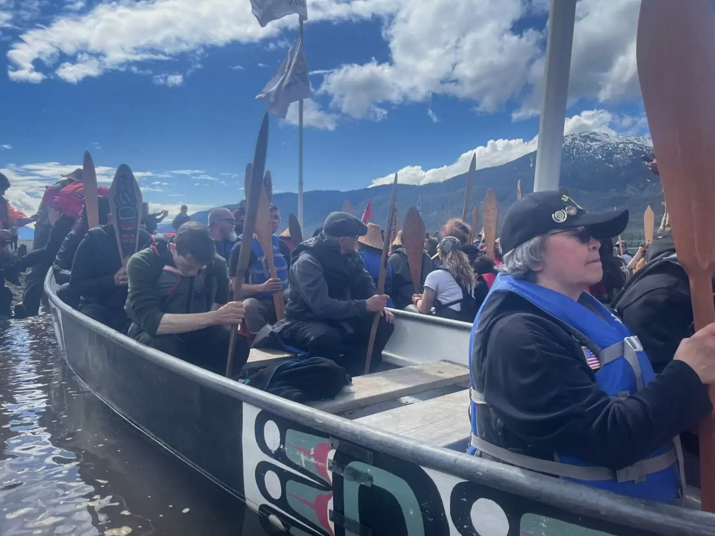
Paddlers in the veterans’ canoe (forefront) wait to land in downtown Juneau on June 4, 2024. (Colette Czarnecki/KSTK)
About 70 people in six canoes paddled north from Wrangell to Juneau last month for Celebration, a biennial cultural gathering that celebrates Southeast Alaska tribes.
The canoe journey to the event took a week, and veterans of war paddled one of the canoes. Many of the vets found solace during the expedition, where they were able to be together.
By Tracy Arm, a fjord about 70 miles north of Petersburg, flames crackled while a large group of paddlers sat around a campfire. People said gunalchéesh and dedicated songs to the veterans, who introduced themselves and briefly spoke about their position in the military.
Dennis Jack, one of the founders and a previous president of Xheighaa Warrior Veteran Canoe Journey Inc., was one of the vets who spoke.He said the organization started back in 2015 when he visited his friend, Doug Chilton, who organizes canoe journeys with the One People Canoe Society.
Jack asked him if there was any representation with the veterans during the journeys, and Chilton replied no. He encouraged him to start an organization.
“It was three months later where I posted on Facebook that we have a veteran canoe journey taking place from Angoon to Juneau, and we’re looking for paddlers,” Jack said. “Maybe 20 minutes later, after it was posted, phone calls started coming in.”
Eight veterans participated during the first canoe journey in 2016. Two years later, there were 27.
“The purpose of the veteran canoe journey was so that we can help other combat veterans cope with PTSD and suicide, because we had been losing one veteran every 22 minutes to suicide,” Jack said.
He said the canoe journey is what they call a healing journey, where participants get in touch with their culture, ancestry and process personal concerns.
This year, 28 veterans paddled.
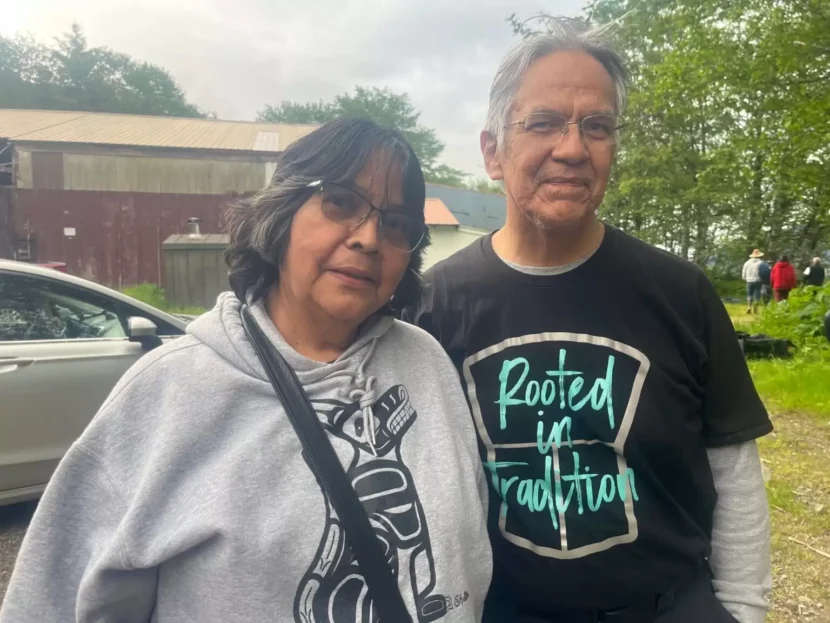
Dennis and Roberta Jack at the soft landing in Thane on June 3, 2024. (Colette Czarnecki/KSTK)
“There are others that are paddling in memory of one of their brothers or sisters or auntie or uncle who were killed in action, either in Iraq, Afghanistan, or even Vietnam,” Jack said.
Jack said that the journey has helped him deal with his own PTSD from when he was deployed to Iraq.
“I have a hard time on July 4 because of all the fireworks, and a lot of the really loud fireworks,” he said. “It sounds like a cannon or a mortar that’s going off.”
To him, it sounds like war. He said there were several times in Iraq where he’d be in the middle of a firefight, and his seven man recon unit would have to split up and meet at a rally point.
“There were times where….I’m sorry,” Jack said as he choked back tears. “There were times where our buddies wouldn’t make it and so we’d pack them out.”
“He would have loved to be on this journey”
His wife, Roberta, has witnessed his PTSD and helps him deal with it. She joined him on this year’s journey.
“He’s been asking me to come, how many years? And I kept telling him no,” she said. “I don’t know what it was about this year. I finally told him okay, I’ll go. This is all pretty amazing.”
Roberta said it won’t be her last — she has two brothers who fought in Vietnam. One lives in Angoon, and they lost the other in 2015. She said he never got the help he needed.
“He just drank and drank and drank,” she said. “His last couple of months or so, he started talking to us about what he went through.”
She said she’s thinking of him while on this journey.
“I know if he was here, he would have been on this. He would,” Roberta said. “He would have loved to be on this journey.”
Paddling with other veterans helps her feel less alone
Another veteran, Bethany Remi Onibokun served in Afghanistan and lives in Juneau. This is Onibokun’s third canoe journey to Celebration. She said paddling with other veterans lets her realize that she’s not alone, and other people are going through tough times like her.
“Things progress, and sometimes healing takes a long time,” she said. “I feel like every time I get on the water is like something gets a little bit better.”
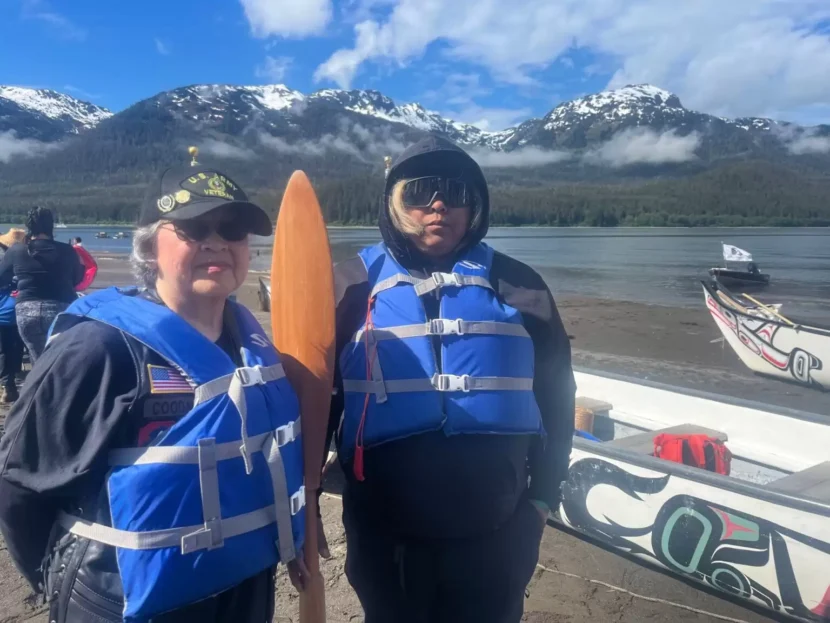
Val Cooday (left) with her daughter, Bethany Remi Onibokun, in downtown Juneau on June 4, 2024 for the canoe landing before Celebration. (Colette Czarnecki/KSTK)
The journey helps her take focus off her troubles. She said her mom, Val Cooday, heard about the journey through Southeast Alaska Native Veterans.
“She thought it might be good for my PTSD and my other issues that I was going through, like my legal problems and my mental health issues and my help with my physical home,” Onibokun said. “They thought that it would be a good way to get me back outdoors.”
“It’s a spiritual, cultural, reawakening back to the culture”
Val Cooday served in Vietnam with the U.S. Army and also lives in Juneau. She joined her daughter on this year’s canoe journey, which is the second one she’s participated in. Her first one was in 2018.
Cooday said it’s inspirational — where the Tlingit, Haida and Tsimshian people are going back to the canoe.
“It’s the culture, the songs, the stories, the people, the humor, everything,” she said. “It’s a spiritual, cultural, reawakening back to the culture.”
As for the weather? It rained for most of the trip, with little spurts of sunshine sprinkled in. But it didn’t discouraged Cooday.
“The weather hasn’t been great, but that’s okay. It’s beautiful,” she said. “The area’s spectacular. The sights are spectacular. So it’s a beautiful journey, really. And for those of us, we grew up here in Southeast. We are used to the rain, so I’m not traumatized by rain.”
Sobriety in the canoe
The captain of the veteran’s canoe, Ketchikan resident Tim Flanery, served three years as an electrical mechanic in the military during peacetime, between 1998 and 2001.
“Gaaná aya yáada yóo duwasáakw. Yeíl naax xat sit.ee, Gaanax.adi xat sit.ee, Teikweidi yadi aya xat, L’awaa kwaani aya xat,” he said. “That means Tim Flanery in Tlingit.”
(I am of the Raven moiety, I belong to the Gaanax.adi clan, my Grandfather was Teikweidi, I am from Klawock.)
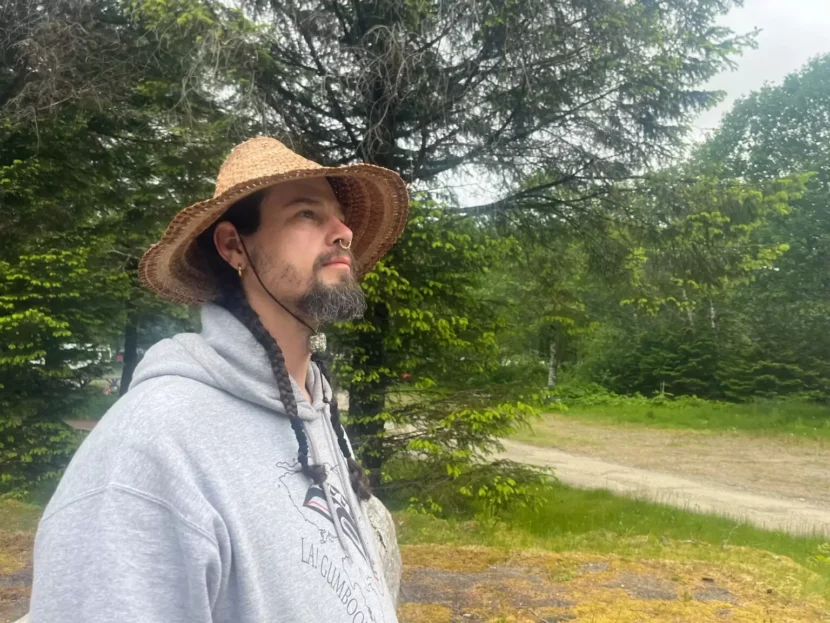
Tim Flanery on June 3, 2024 in Thane, where canoes soft landed. (Colette Czarnecki/KSTK)
This was his fourth Paddle to Celebration as a skipper — or captain. He said he didn’t have a reason — or a purpose — to paddle the first time he was invited to. He wasn’t sober before that first journey, but that changed.
“They said it’s a sobriety event, and I was looking for something different,” Flanery said. “I just really love it. How it brings all the people together — Native, non-Native, people who are interested in a different way of life.
He said his spirits are up and they’ve got a good crew this year.
“It’s an amazing event that brings us together and allows me to feel more connected to my ancestors,” Flanery said. “The way of life that they lived, you know, camping along the side of the beach.”
The group wasn’t able to paddle every day because of rough weather, but Flanery said he loves seeing all the wildlife, like killer whales, seals and eagles anyway.
“It’s a nice break away from civilization,” he said. “But I think I’m missing a shower now.”
He said no one’s complained, so he thinks he’s O.K.
When he and the other veterans got to Celebration in Juneau, they joined each other with song and dance on stage.
Close
Update notification options
Subscribe to notifications
Subscribe
Get notifications about news related to the topics you care about. You can unsubscribe anytime.