Rep. Andi Story, D-Juneau, speaks during a House Education Committee meeting on May 3, 2024. (Eric Stone/Alaska Public Media)
Alaska lawmakers passeda bill last week that adds several Indigenous languages to Alaska’s official list of languages.
A version of the bill, sponsored by Juneau Rep. Andi Story, was approved by the Senate and then OK’d by the House last week. It was originally passed in the House last year. Now it heads to the governor.
Earlier this year, Story, a Democrat, called the changes included in the bill an important step in recognizing all of the 23 distinct Alaska Native languages in the state.
“This reflects the goal of sustaining and reinvigorating Alaska Native languages, a concept that goes beyond preservation,” she said.
The languages that the bill adds to the official list are Cup’ig, Middle Tanana, Lower Tanana and Wetał. Middle and Lower Tanana were previously classified as just one language.
According to a recent report from the council, there are currently no high-proficiency speakers of the Wetał language. It comes from the Portland Canal region of Southeast Alaska and British Columbia.
The bill also expands and renames the Alaska Native Language Preservation and Advisory Council. The council advocates to promote the survival and revitalization of Indigenous languages in the state. It will now be called the Council for Alaska Native Language.
The bill adds two seats to the council and moves it from the Department of Commerce to the Department of Education and Early Development to better emphasize the council’s focus on education.
In testimony earlier this year, the chairman of the council, X̱ʼunei Lance Twitchell, said he supports the bill and argued Indigenous languages need to be a bigger priority for the state. Twichell teaches Alaska Native languages at the University of Alaska Southeast.
“Alaska Native languages are the oldest living resource in Alaska,” he said. “These languages are older than the trees, they’re older than some of the rocks, and none of us are qualified to make the decision that they should not exist anymore.”
He said it’s crucial that these languages are recognized as the valuable and historic resources that they are.
“Every single Alaska Native language is sacred and irreplaceable,” he said. “It contains concepts that cannot be translated, it contains things that cannot be replaced, and that give a sense of fulfillment and wholeness and health to Alaska Natives and to non-natives in Alaska.”
The bill passed unanimously in the Senate. In the House, only Rep. David Eastman, a Wasilla Republican, voted against it. He argued some of the languages proposed, like Wetał, are not spoken regularly and should not be added to the official list.
A spokesperson for Gov. Mike Dunleavy did not directly respond to questions asking whether the governor plans to sign the bill.
A sign welcoming people to town as been changed from saying “Welcome to Haines” to “Welcome to Deishu” on Saturday, April 27, 2024. (Rashah McChesney/Chilkat Valley News)
If you drove into town from the ferry terminal two weeks ago or from up the Chilkat Valley, you may have noticed something odd about the cedar signs welcoming you to Haines.
In fact, the signs wouldn’t have welcomed you to Haines. Instead, they said “Welcome to Deishú.” That’s the original Lingít name of the area — before missionaries established a settlement here near the end of the 19th century.
Sometime in late April, someone replaced the word “Haines” with “Deishú” on the welcome signs at either end of town — one at Picture Point and the other at 1 Mile Haines Highway.
The perpetrator’s identity remains a mystery. But their actions have reinvigorated a long-running discussion about the town’s name and revitalization of the Lingít language.
The alterations, which according to Kreitzer occurred without the borough’s permission, came just a week after an idea popped up at a local Parks and Recreation Advisory Committee meeting to add the word “Deishú” to the signs. Since the incidents, there have been informal calls to go even further: to change the town’s name, or to put the question to a public vote. But no official proposals are on the table.
Borough manager Annette Kreitzer noticed the change at Picture Point as she drove down Lutak Road on her way back from Chilkoot Lake one morning.
“As I drove by I was just in my mind thinking, ‘Is that really what I just saw?’” Kreitzer said.
She asked Mayor Tom Morphet to take a look; he found the original cedar panel with the word “Haines” carved into it lying in the dirt next to the sign — and in its place was a plywood board with “Deishú” spelled out in similar black letters.
At 1 Mile, a plank with “Deishú” was fastened over the original sign rather than in its place.
Kreitzer said the borough’s public facilities crew took down the new signs and reverted them back to “Welcome to Haines” last week.
“As far as I’m aware those are the only two,” she said.
As of last Wednesday, borough staff hadn’t received any official requests for assembly action or petitions for a special election, Kreitzer said.
Borough staff have consulted with CIA on work to incorporate Lingít names on street signs and in the borough’s tourism brochure. At least five streets now have Lingít language signs, and more are planned, Kreitzer said.
James Hart, who is Chilkoot Indian Association’s council president, said he became aware of the “Welcome to Deishú” signs on Facebook and that he appreciated the conversation that they sparked.
Regarding the idea to change the borough’s name, Hart said the council hasn’t had any official discussions on the issue. “This isn’t a CIA position, but I think it is a discussion that needs to be had with the whole community,” he said.
Hart added that he has a sense of pride saying he’s from Haines but that there wasn’t an agreement in the first place to change the name from Deishú and that it would be nice to see the original name restored. He noted, though, that there used to be other Lingít communities in the area that would get lumped in under the name Deishú.
“These are place names that were thousands of years old, that tell a story about this place, this community, and this place of land,” he said. “Changing the name creates erasure of our culture and our ways of life. Reverting back to Deishú would be revitalizing that aspect of this community.”
The word itself — Deishú — means “end of the trail” or “beginning of the trail.” Hart said his understanding is that it signifies the area’s historic position as a trading route with access to both the ocean and the interior.
The “Welcome to Haines” sign at Picture Point was constructed just five or six years ago, while the one at 1 Mile was put up in the 1960s, according to Lee Heinmiller, director of Alaska Indian Arts. Heinmiller and local carver Greg Horner made the Picture Point sign, which is sandwiched between two halves of a 27-foot totem pole that was carved decades ago and had to be sliced in half to be removed from a California home and brought back to Haines.
Heinmiller said he wouldn’t mind adding “Deishú” to the signs but he added: “Having people vandalize the sign with that idea is not exactly the way you should be going about it. Once the decision is to change the wording on the sign, hopefully the work would be done with quality carving.”
He noted that on one of the welcome signs the “Deishú” lettering was etched into a “pretty crummy piece of wood that you wouldn’t even use to patch a hole in the wall of your house.”
Haines Borough Assembly member Gabe Thomas, who’s a member of Chilkoot Indian Association, voiced indifference about the name. “I don’t care if it’s Haines or if it’s Deishú, you can change the name all you want but you didn’t give the land back, did you?”
He added that he thinks the assembly should focus first on more important issues like infrastructure.
Assembly member Kevin Forster said that having signs that acknowledge the traditional area seems appropriate to him but that the issue of the borough’s name “feels like one of those bigger decisions that has to reflect the will of the people here.”
“It would be really important to understand CIA and CIV’s perspective,” he added, referring to Chilkoot Indian Association and Chilkat Indian Village, the two tribal governments in the valley.
If the issue came before the assembly, Forster said that he’d support a referendum.
People dipping with Haa Tooch Lichéesh Coalition at Auke Recreation Area on March 24, 2024. (Photo by Yvonne Krumrey/KTOO)
This is Tongass Voices, a series from KTOO sharing weekly perspectives from the homelands of the Áak’w Kwáan and beyond.
Haa Tooch Lichéesh Coalition is a nonprofit that offers Indigenous-based healing practices and reconciliation with the violent history of colonization and its impacts on Juneau’s community today.
One of these traditional practices is a dip in the ocean, for strength and healing. It’s methodical and intentional — participants walk in up to their knees, then stop, then up to their waists, then stop, and so on until they are as far in as they feel comfortable. Afterward, participants warm themselves by the fire.
We spoke to Ḵáaḵ’utx̱éich Kai Monture and organizer Saan Jeen Jennifer Quinto about the clarity they find in the frigid waves.
This transcript has been edited for length and clarity.
Kai Monture: My names are Ḵáaḵ’utx̱éich and Eeḵ Kahaa Ḵáa. My English name is Kai Monture. I come from Yakutat from Tsísk’w Hít, the Owl House.
My intention for this dip is to introduce my three nephews here who are Teiḵweidí from Yakutat. They just moved back to Lingít Aaní this December, just started to reconnect to their Lingít side. Now this is their very first dip.
Saan Jeen Jennifer Quinto: The coldness of the water is like the overwhelming moments when we’re in our daily lives. And because we’re not taught how to process and confront those overwhelming moments, like in school or other places, and we really don’t have guidance in that way, I use the water to help teach me how to navigate those really overwhelming things.
That overwhelming cold sensation is what I equate to those things that we need to start confronting and learn how to navigate in our daily lives.
Kai Monture: I was very lucky to be raised by my grandparents, Elaine Abraham and George Ramos. And they were very traditional. My grandpa in particular taught me a lot about the training of the X̱’éig̱aa Ḵaa which translates to “a true or authentic person.” And that was the title of our traditional warriors.
Their training began when a boy was six or seven years old. He would go to live with his maternal uncle, who would raise him from that point on. And one of the core parts of their strength training was going into the ocean at sunrise almost every day of their life.
It was always a practice I was really fascinated by but something I actually didn’t start until my adult years. Just from personal experience, it was just like the way my grandparents were describing it to me, as a way to test and build up your toowú latseen, your inner strength.
The cold obviously is so hard on the body. But the strength of your heart and your soul can like do wonders, especially when you test it for yourself.
I think a lot of people that are scared to try and reconnect to this practice would really be surprised by themselves.
I actually was scared Soriano is too small. But he really really insisted he would try it.
Students from Harborview Elementary’s Tlingit Culture, Language and Literacy Program dance on stage during a Ravenstail robe ceremony on Tuesday, April 30, 2024. (Clarise Larson/KTOO)
There’s a story behind every Ravenstail robe.
“Up here we have the northern lights with the Chilkoot mountains,” said fifth-grader Aurora Southerland, describing a robe she was wearing. “And then down here are bear prints and the salmon going upstream.”
She’s in fifth grade and in Harborview Elementary’s Tlingit Culture, Language and Literacy Program. And on Tuesday night, she and her classmates made history.
“You have just witnessed the largest gathering of Ravenstail regalia in history — ever,” master weaver Lily Hope told a full crowd at Centennial Hall.
Adult and youth dancers gather on stage during a Ravenstail robe ceremony on Tuesday, April 30, 2024. (Clarise Larson/KTOO)
They had gathered to learn the history — and future — of Ravenstail weaving, or Yéil Koowú. People say the intricate art form slept for a century before it was brought back to life by master weavers like Cheryl Samuel and Kay Parker.
Both were honored at the event. Weaver Ksm L’x Sg̱a̱a Ruth Hallows commended their dedication to passing their knowledge to others.
“In 2019, there were fewer than a dozen weavers in the world who had woven Ravenstail dancing robe,” she said. “Today there are four times as many, and our numbers are growing.”
At the event, people learned about the stories behind the weaving and the journey that it took to bring it back to life today. And they got the first look at dozens of newly created, child-sized Ravenstail robes, which will soon be on display at the Juneau-Douglas City Museum.
Not only did they get to look at them — they got to watch them come to life.
On stage, dozens of students and adults danced and sang in unison to a drum beat. As they moved and twirled, the white fringes of their robes flew in the air like the tail feathers of a bird.
Memo Contreras, one of the students dancing, said his favorite part of dancing was watching the fringe move.
“Because it looks delightful,” he said.
Harborview Elementary’s Tlingit Culture, Language and Literacy Program students Jaelyn Jackson (left) and Josephine Lindoff (right) help tie each other’s robes at Centennial Hall before a Ravenstail robe ceremony on Tuesday, April 30, 2024. (Clarise Larson/KTOO)
Marie Johnson was one of the adult dancers on stage. She said it gives her so much joy to see people young and old gather to celebrate their culture.
“This is a great honor. You know, to bring something to life, and to be able to just share our culture,” she said. “Because every blanket and every article has a story.”
Adult dancers smile while on stage during a Ravenstail robe ceremony on Tuesday, April 30, 2024. (Clarise Larson/KTOO)
After the event, Hope said the journey to grow the number of Ravenstail weavers is far from over.
“It means we’re doing the good work. It means our communities are strong. It means we have mentors in multiple cities and villages. It means the art form is alive and well,” she said. “And it’s just going to get bigger and better from here.”
Master weaver Lily Hope speaks to a full crowd at Centennial Hall during a Ravenstail robe ceremony on Tuesday, April 30, 2024. (Clarise Larson/KTOO)
On Friday, the robes will go on exhibit at the Juneau-Douglas City Museum. They’ll be on display there through the summer.
Disclosure: KTOO was contracted to produce a broadcast of the event for TV and online. You can watch the recording of Tuesday’s event at ktoo.org and lilyhope.com.
Late weaver Teri Rofkar dancing in a Ravenstail robe. (Photo by Tom Pitch)
Dozens of child-sized Ravenstail robes will be danced for the first time in Juneau on Tuesday. Master weaver Lily Hope said it’s the largest collection of new Ravenstail weaving in decades.
The event at Centennial Hall will teach the history — and future — of Ravenstail weaving, or Yéil Koowú, Hope said on Juneau Afternoon earlier this month.
“This particular history and telling of where we are now and how we got here has never been shared on this scale,” she said.
Weaver Rae Mills joined Hope on Juneau Afternoon. They shared their love of weaving and the community that forms around it.
“Iʼve never felt so whole and so complete, and just so healed, as when I’m able to share something so special,” Mills said. “The fact that these things were done by our ancestors, and we almost lost them, and they were woken back up and we are still able to share this knowledge and happiness and love.”
The day-long event will begin with a weaversʼ gathering thatʼs open to the public. Anyone in Juneau can come see 40 weavers at work and speak with them about what they’re weaving.
Hope says the weavers have been scrambling to put the finishing touches on the robes.
Then, during the evening event, Mills says students from Harborview Elementary’s Tlingit Culture, Language and Literacy Program will dance the robes, bringing them to life.
“These new works are going to dance,” Mills said. “And you know, it’ll be high energy and enthusiastic and I’m just smiling, like — my face is already hurting thinking about these beings coming to life and taking their first steps together.”
The gathering will be open to the public from 11 a.m. to 3 p.m. on Tuesday. Tickets for the evening event starting at 5:30 p.m. are available on the Juneau Arts and Humanities Council website.
On Friday, the robes will go on exhibit at the Juneau-Douglas City Museum.
Disclosure: KTOO 360TV is contracted to broadcast Tuesday’s event. It will airlive on 360TV and stream on ktoo.org and LilyHope.com starting at 5:30 p.m.
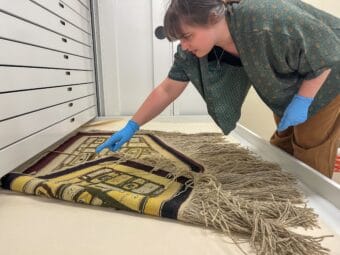
Works on display from the Denver Art Museum’s Northwest Coast and Alaska Native arts collection on April 16, 2024. (Ian Dickson/KTOO)
Earlier this month, the Denver Post reported that Lingít tribal members have been requesting cultural items back from the Denver Art Museum in Colorado for years — to no avail.
The museum holds many Lingít items that may qualify to be returned under federal law.
Investigative reporter Sam Tabachnik says delegates from the Central Council of the Tlingit and Haida Indian Tribes of Alaska sought the return of five items, including a 170-year-old clan house partition featuring the Naanya.aayí clan crest.
One Tlingit and Haida cultural resource officer told Tabachnik that the Denver Art Museum was “probably the worst museum” they had dealt with. And Tabachnik says the museum has a history of denying repatriation requests.
Listen:
This transcript has been edited lightly for clarity.
Sam Tabachnik: With the passage of NAGPRA, the Native American Graves Repatriation Act in 1990, American museums were required to compile inventories of all their Native American objects that may be subject to the act. This includes ancestral human remains. It includes associated funerary objects, objects of cultural patrimony, and a few other categories. And so these museums had to go through their collections and try and figure out what might be subject to the law.
The Lingít tribe had sort-of, off-and-on conversations with the Denver Art Museum over the years. They submitted three formal claims for various objects in the early 2000s. But it was really this meeting in 2017 that kind of, I think, really put the relationship between the tribe and the museum into, kind of, stark focus.
It was a three-day set of meetings here in Denver. There were about a dozen tribal members who came from Alaska to talk with the museum.
It was on this third day, you know, from talking to people who were in this meeting, that the tone really started to shift. Now, the museum says this shift occurred when museum officials were talking about the necessary process that the tribe would have to go to, in order to comply with NAGPRA, in order to file an official claim that might be accepted by the museum.
Tribal members told me that they viewed this meeting in particular, as incredibly, uh — Denver officials were incredibly condescending, insensitive, and seemingly intransigent. Unwilling to really budge.
Yvonne Krumrey: And what has taken place in the last seven years since it’s happened?
Sam Tabachnik: You know, it’s unclear. There has not been a lot of movement here. The museum says the tribe has not submitted formal claims for a couple of the pieces I talked about in the article. And so the museum says, “Hey, you know, we’re just waiting on a formal claim.”
The tribe says, “Well, the museum has been quite clear in their discussions that even if we submitted a formal claim, that they would not return these objects.” So I think the tribe has sort of taken the impression that this is just not gonna happen.
Yvonne Krumrey: And from your reporting, and speaking with tribal members and the museum officials, what are some of the barriers to the process of submitting these formal claims? Is it fairly straightforward? Or are there, kind of, hoops to jump through to do it?
Sam Tabachnik: There are a number of different qualifications or categories that tribes are supposed to fill out, or they’re supposed to show evidence to check off certain boxes.
ProPublica published a really impressive project about NAGPRA in the last year called the Repatriation Project, and it essentially showed how museums — 33 years after the lawʼs passage in 1990 — still half of these funerary objects and human remains are still in some of America’s most prestigious universities and museums.
It is that museums really hold the cards here. They have control of these objects, and they can make it as easy or difficult as they want.
Yvonne Krumrey: And you said that there are still a couple items that there hasn’t been a formal request process for. What has happened with the ones that have been formally requested?
Sam Tabachnik: Yeah, so the museum told me there were three formal claims from the Lingít tribe. Two were rejected for not having enough information — for not checking all the boxes of, you have to prove that a single individual could not give up the rights to an object, that it had to be collective ownership. There are several other categories you have to hit. And the museum said the tribe wasn’t able to prove certain things. And so they rejected them. The third one, they said they didn’t get even enough information from the tribe in the claim. They were unable to initiate a formal evaluation process. So in all essence, they rejected three claims from the tribes.
Yvonne Krumrey: How do Denver Art Museum’s actions compare to other museums that have had this experience or have gone through this process?
Sam Tabachnik: Yeah, so Colorado has generally been viewed as a national leader in complying with NAGPRA, the Denver Museum of Nature and Science has been incredibly proactive. History Colorado has been also cited by some national folks as really leaders in the field. They kind of went above and beyond. A lot of museum folks talk about the difference between complying with the letter of the law and complying with the spirit of the law. And several of these Colorado institutions really wanted to comply with the spirit of the law. And people have spoken about how the Denver Art Museum has not been a part of that. They have not been as proactive as other museums.
Yvonne Krumrey: You’ve reported on Denver art museums ownership of contested items before. Can you tell me a bit about that reporting?
Sam Tabachnik: Sure, I’ve been writing about the Denver Art Museum and repatriation requests or claims for about three years. I spent a long time — wrote a long series about a former now deceased museum consultant and board member named Emma Bunker, who was tied in with the antiquities trafficking and organization essentially. And she helped the museum acquire a host of Southeast Asian antiquities that the Southeast Asian countries — Cambodia, Thailand, Vietnam — said were looted from their ancient temples.
Yvonne Krumrey: In your understanding of this landscape with the Denver Art Museum, how does the story fit into a broader pattern of them holding items that are contested or maybe weren’t acquired in honest means?
Sam Tabachnik: Yeah, what the Lingít tribe reported to me jives with what other countries have told me about the reluctance of the museum to give up objects in their collection. I thought it was telling — the curator of Native American arts who I interviewed I sat down with as part of this latest story said, “We’re not in the business of just giving away our entire collections.” And I thought that quote was an interesting quote and spoke volumes.
Close
Update notification options
Subscribe to notifications
Subscribe
Get notifications about news related to the topics you care about. You can unsubscribe anytime.