Alaska Native Arts & Culture

Stick pulls, seal hops and sportsmanship: Traditional Games bring 260 athletes to Juneau

Anchorage’s Matthew Chagluak performs an Alaskan High Kick during the 2024 Traditional Games in Juneau on Saturday, April 6, 2024. (Clarise Larson/KTOO)

Matthew Quinto stood on an animal skin blanket held taut off the ground by a ring of people. Slowly, they started to pull the blanket out and then in. Quinto got ready to leap. 

As everyone holding the blanket pulled it tight, Quinto jumped frighteningly high in the air, did a backflip, and landed back on the blanket.

“Originally, it was used as a way of lookout over villages in the arctic tundra,” Quinto said later.  

The backflip was just a bonus. 

Last weekend, athletes from across Alaska — and some from the Lower 48 — came to Juneau to compete in the seventh annual Traditional Games, held at Yadaa.at Kalé Juneau Douglas High School. 

The events represent fitness needed for survival and hunting skills in the arctic. But in the gym, the athletes tried to beat their own best scores.

The blanket toss was the first event. Quinto, who coaches for traditional games and Native Youth Olympics, said he only gets to do it a couple of times a year.

“It’s just something we do for fun,” he said. “We can’t really practice it because it takes a whole community to hold the blanket.”

Daanawáaḵ Ezra Elisoff announced the games. He’s an athlete himself. He said each event requires many different skills. 

“There’s agility, there’s explosive strength, there’s flexibility, there’s just a lot of different things. And all the games are different in their own unique way, of course,” Elisoff said.

But his favorite is the Alaskan high kick.

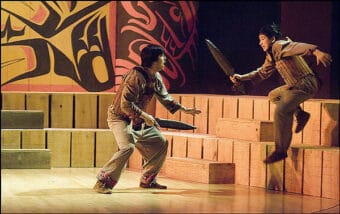
For that event, athletes get into position on the ground with one arm supporting them, grab one foot, and then launch their other foot up to try and reach a ball suspended in the air. If they touch it, officials raise it a bit higher and higher — until the athlete misses.

“That one’s about your technique and how much you can perfect it rather than pure strength and flexibility and whatnot,” Elisof said. “You can out-kick a lot of people once you start going what we call vertical, which is like a one-handed handstand.”

Petersburg’s Andrew Beavers (blue) and Juneau’s Koda Anderson (red) compete in the Dené Stick Pull during the 2024 Traditional Games in Juneau on Saturday, April 6, 2024. (Clarise Larson/KTOO)


Luka Silva officiated some of the events. He said it’s been exciting to see young people push themselves to beat their own records. 

“I’ve heard a lot of like, ‘Wow I can’t believe I just did that. I’m so proud of myself.’”

Mt. Edgecumbe High School in Sitka beat out other high schools for Best Overall Team. They won seven high school events. 

Tessa Anderson won the Overall Athlete title for high school girls. Her favorite event is the scissor broad jump — jumping as far as she can in four steps, as if leaping from ice floe to ice floe.  

“I just like the feeling of the pattern of jumping, I don’t know how to explain it,” Anderson said. 

She won the high school girls scissor broad jump category.

Anderson’s teammate Lennie Brandell said that the camaraderie and support from other athletes is part of what makes Traditional Games so special. 

“Everyone comes together, we’re all nice, no one’s ever talking trash to you. It’s always upbringing,” he said. 

This year, athletes broke 13 records in different categories. About 260 athletes from 31 different schools participated — 200 more than the first Traditional Games in 2018.  

Tongass Voices: Shiggoap Alfie Price on the challenges and rewards of learning endangered languages

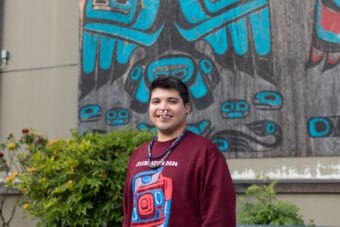
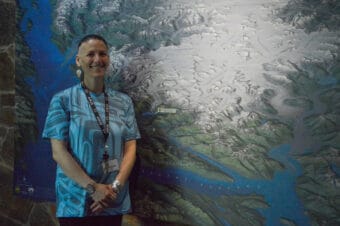
Shiggoap Alfie Price is a student of three Southeast Alaska Native languages and leads Sm’algyax classes online. (Photo by Yvonne Krumrey/KTOO)

This is Tongass Voices, a series from KTOO sharing weekly perspectives from the homelands of the Áak’w Kwáan and beyond.

Shiggoap Alfie Price is Tsimshian, Lingít and Haida, and he was raised in a Tsimshian household. Today, he’s a language learner and teacher who believes in using the power of community to strengthen the language revitalization movement. 

Price has studied all three Southeast Alaska Native languages, starting with Sm’algyax – the Tsimshian language. 

Listen:

This transcript has been lightly edited for clarity.

Listen to: Shiggoap’s Sm’algyax introduction

Shiggoap Alfie Price: There’s a fellow that you probably know, Lyle James who speaks Lingít, X̱aat Kíl, Sm’algyax , among others. And before I started actively learning, he would greet me at the store or what have you, and in Sm’algyax , and I certainly knew what he was saying, but I could not answer him. And I was a little bit embarrassed that this Lingít man was using my language and I couldn’t converse with him. 

Shiggoap dee waayu. My name is Shiggoap which means wave-maker. 

I started learning Sm’algyax because it’s the one I grew up hearing. And I know people, I know family and friends who want to learn. So that’s why I started. 

Also, I had some prompts from my mom, who, in her last few years, she started learning our language and teaching it to children. She was a guidance counselor at elementary school in Metlakatla. And so I felt encouraged. And, you know, I wish I had started earlier when she was still around so I could talk to her on the phone, or what have you or FaceTime.

I was asked to be a moderator or what have you at Celebration to introduce the groups, and I decided that I wanted to be able to introduce myself in all three languages. And so I set out to do that. 

And they’re very different. You would think, here in Southeast Alaska, where we’re so geographically close, that our languages would be similar, but they’re really not. All three are very, very different. Sentence structure is way different. And most of the sounds are different. 

So there’s a couple of years where I was attending classes in all three languages and tried really hard to be able to at least have the basics down where I could greet somebody in these languages, introduce myself, talk about the weather. 

It’s pretty fun, too, when you find crossover. It’s like, in X̱aat Kíl, when we greet each other, we have a word that means like, “hey” or “hi.” We say “Ja!” So whenever I see my fellow X̱aat Kíl speakers, we say “Ja! Hello my friend!”

And then I was in a headstart classroom fixing computers one day, and they had posters on the wall of Lingít words, and one of them was a lady holding your finger up to her mouth, like saying “shhh.” And it said, “Ja!”, and I just, like cracked up because, you know, maybe Lingít speakers would see us X̱aat Kíl telling each other politely to shut up when we see each other. 

I think one of my very favorite phrases in X̱aat Kíl is — it’s parting greeting, “Díi gwíi hl sdíihl.” And it means return to me. And that’s just a really sweet, sweet way to part with a friend. 

Our Sm’algyax group, we met in person every Saturday. And then when the pandemic hit us, we had to stop meeting in person and switch to zoom. So we invited our social media contacts and followers to join us. And suddenly, we had this huge group of people who wanted to learn.

I’m not a trained teacher or linguist. I never thought I’d ever have to learn the difference between transitive and intransitive verbs, but here we are. 

So we all know that our three languages are kind of in trouble. They might be considered endangered. So we definitely need more people to not just study them, but to use them every day at home, at the grocery store or what have you. 

I think the most powerful reason to keep at it for me and a lot of my friends is how healing it is for us as individuals in our spirits to reconnect with these languages because we learn a lot from them. You get an understanding, an insight into the worldview of our ancestors — of the way they view the world, the way they deal with each other. 

And there are a lot of lessons in our languages, that once you start internalizing them, and being able to use them, they can definitely guide your thinking, your priorities. 

And they really restore, they’ve restored my sense of worth, of value. I know who I am today, where before I learned Sm’algyax, I really didn’t. 

Juneau Native Youth Olympics athletes tour Lower 48 to promote Arctic sports

Leif Richards is in the 11th grade and an NYO team captain at Thunder Mountain High School. He is doing the One-Foot High Kick on the Santa Clara Pueblo Indian Reservation. (Courtesy of Kyle Worl)

Now that the North American Indigenous Games Council has approved Arctic sports on a trial basis for its 2027 games in Calgary, fans of Native Youth Olympics believe there’s good chance the games might get a foothold in the Lower 48.

Kyle Worl, the head coach for Juneau’s NYO program, took a team of six athletes on a tour of schools in New Mexico and Kansas to promote Arctic sports. He says the were well received.

Six members of the Juneau Native Youth Olympic program formed the letters, NYO, while visiting the Santa Clara Pueblo Reservation in New Mexico. (Courtesy of Kyle Worl)

“Every school and community we’ve gone to, they’ve been very engaged,” Worl said, “and it’s just been fun.”

The team was in Lawrence, Kansas on Friday at the Haskell Indian Nations University. They demonstrated seven games, including the One-Foot and Two-Foot High Kick, the Alaskan High Kick, Scissor Broad Jump, Seal Hop, and the Inuit and Dene Stick Pulls.

Worl says the students were very interested in the stories behind the games and their connection to Arctic survival.

“I think this sport really resonates with Indigenous people, because it’s an Indigenous sport and it’s about community.” Worl said. “And I think all tribes know that community is really important.”

The Juneau NYO team members demonstrated seven games on their tour. At the Haskell Indian Nation University in Lawrence, Kansas, they added the Wrist Carry, beause one of the school’s Alaskan students was a state champion in that event. (Photo courtesy of Kyle Worl)

Worl says he’s hopeful the sport can take root at Haskell, which has two Alaskan students who can help with the coaching. The team also left behind a kit with equipment that includes a kick stand, a hand-sewn sealskin ball and three types of sticks. Worl says the Calgary games will take place four years from now, which gives new teams plenty of time to train for NYO games.

He says it’s important for teams outside Alaska to compete in the North American Indigenous Games, so Arctic sports can become an official sport.

The Juneau athletes also traveled to the nearby Kickapoo Nation School to plant some seeds among kids who are not yet in college. Worl says the Juneau NYO team gave them a chance to try out the games for themselves, which they seemed to enjoy.

“To be able to be in a space where your Indigenous identity is represented and honored,” he said, “you feel a sense of belonging —and that you don’t have to shy away from who you are.”

Athletes from the Juneau Native Youth Olympics program visit the Kickapoo Nation School. Team members, left to right: Leif Richards, Nate Blake, Alex Beierly, Jordan Bennett, Mila Neely, and Sam Sheakley, Jr. (Courtesy of Kyle Worl)

The Juneau NYO team also traveled to New Mexico to visit the Santa Clara Pueblo Tribal school, the Santa Fe Indian School, and the Institute of American Indian Art. They returned to Juneau on Saturday, where they will jump right into preparations for next month’s Traditional Games.

This is Southeast Alaska’s seventh annual competition, relatively new to the region compared to other parts of the state. But Worl says their popularity has spread quickly, starting first in Juneau and eventually including ten other Southeast communities. Worl says the students from the Haskell Indian Nations University are planning to attend.

The tour was sponsored by Sealaska Heritage Institute and the Central Council of Tlingit and Haida Indians Tribes of Alaska.

In its 75th year, Juneau’s Gold Medal Basketball Tournament transcends the court

Kake and Metlakatla teams face off at a game during the Gold Medal Basketball Tournament on Tuesday, March 19, 2024. (Clarise Larson/KTOO)

Marcelo Quinto was just six years old in 1947, when the first-ever Juneau Lions Club Gold Medal Basketball Tournament took place in Juneau. He’s in his 80s now. On Tuesday, he was one of hundreds in the stands to watch this year’s tournament, which kicked off last weekend. 

Throughout this week, more than 500 people from across Southeast Alaska will attend to watch nearly 50 games. Quinto said he doesn’t remember much about that first tournament — beyond one very clear thing:

“It was jammed. Because there was no TV back then,” he said. 

The location of the tournament has changed since then. Instead of the cramped Capital School, it’s now at the Juneau-Douglas High School: Yadaa.at Kalé gymnasium. He said other things have changed too.

“These kids are faster I think. You know they’re faster and a lot of the rules have changed,” he said.

This year’s tournament is special. It marks 75 years of competitions, disrupted only by the COVID-19 pandemic, which hit the pause button for a few years. For Quinto, the tournament — which is older than the state of Alaska — represents decades of memories. 

“The greatest thing about this tournament really is being able to see all your friends from all of Southeast — from Ketchikan and all the way up,” he said.

The first game kicked off Sunday morning, and games will continue daily throughout the week. Twenty-five regional adult teams will play a total of 48 games, competing for titles in four brackets.

Tim Wilson, a Lion’s Club co-chair for this year’s tournament, said for many, this tournament represents something much greater than the game of basketball. In 1947, it started as a way to raise money for Boy Scouts. But now, Wilson said it transcends the court. 

“For it to be in the 75th year is really special to us — I don’t think when they started 75 years ago, I don’t know if they envisioned it lasting 75 years,” he said. “I always say that the Gold Medal is one big, huge family. I honestly believe that.”

Orion Dybdahl is a player on the Hoonah B-Bracket team this year. He recently graduated from JDHS, where last year he was selected by coaches around the state as a senior all-star. Now, he’s playing basketball at Centralia College in Washington, but he says he couldn’t resist coming home for spring break and playing on his home court again. 

“Probably since birth, I’ve been here at these games, watching my dad play, and just watching all these teams battle,” he said. “It’s kind of a dream come true — been waiting to play for Hoonah for a long time.”

Dybdahl said Gold Medal’s roots run deep — not just for his family, but for Southeast Alaska. His family is from Hoonah. Many teams have players who don’t actually live in the communities they represent. But they still have close connections to them. 

For many, Gold Medal is the one time of year they can connect with loved ones. 

“It means everything just to see family members and friends from other communities,” Dybdahl said. “It just I don’t know, this tournament is more than basketball. It’s kind of like a reunion.”

The tournament’s schedule can be found on the Juneau Lion’s Club’s website. 

‘Now she’s going to teach us’: Southeast Alaska Native leaders welcome historic Chilkat robe home

Sainteen Anna Brown Ehlers wears a 150-year-old Chilkat robe that was recently returned to Southeast Alaska on March 1, 2024. (Photo by Yvonne Krumrey/KTOO)

Southeast Alaska Native leaders and Chilkat weavers welcomed home a very old Chilkat robe on Friday.

A group of donors bought the robe at a Seattle auction and, through the Burke Museum in Washington state, gave it to Sealaska Heritage Institute so weavers could study it. 

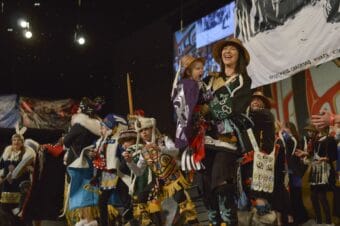
Weavers and elders danced into the Shuká Hít clan house at Sealaska Heritage Institute in Juneau, pausing to greet the robe lying on a table at the front of the room. They sang to welcome it back to Lingít Áaní. 

Later, dancers performed a pair of spirit dances to, as the program says, “breathe life into the robe and welcome the ancestors home.”

Weaver Shgendootaan Shgen George wore a shakee.át, a wooden headdress with a formline face carved on it. She knelt for a bit behind the robe, seemingly overcome, before getting up to dance. 

“Honestly when I got behind it with the shakee.át on my head and I knelt down, I just started crying,” she said. “I don’t know how to explain it, just other than it was really moving and unbelievable that Iʼm right there with this amazing piece that has survived for so long and come home.”

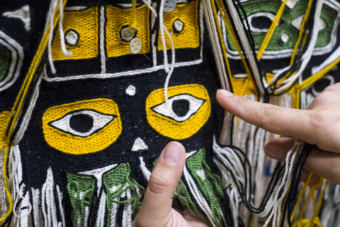
The robe is more than 150 years old. It’s woven in bold black lines with blue and yellow details and killer whales facing out from the middle. This is the first time the robe has been used in a ceremony for at least 60 years. 

George has traveled to museums to study old Chilkat robes. She said she’s never seen one of this design, and it has more to tell weavers about the robeʼs history. 

Weaving instructor Wooshkindein Da.áat Lily Hope was eager to learn from it. 

“Thank you to SHI for being a good place to take care of our things to take care of our ancestors so we can flip them over and look at the backside,” Hope said during the ceremony. 

Dancers enter the Walter Soboleff Building in the Shuká Hít clan house during a Chilkat robe homecoming ceremony on Friday, March. 1, 2024. (Clarise Larson/KTOO)

Hope has taught dozens of Southeast Alaska weavers. Together, they’ve doubled the number of robes that have been woven in recent years in the region. But many historic robes are still in private collections or in museums outside Alaska.

“We have been weaving Chilkat dancing robes long before these institutions existed and we will weave them long after we bring our ancestral work home,” she said. 

Lingít language Professor X̱’unei Lance Twitchell said that weaving, like language, belongs in the future of Lingít peoples, too, not just the past. 

“Our culture is forever, our way of life is forever. We see the footprints of our ancestors extending as a trail right in front of  us. We intend to follow that trail,” he said. “The ways and the wisdom and the strength of our ancestors is woven into the things we wear. These things that become at.oo.”

At.oo are sacred, living objects. 

Members of the Eagle and Raven clans breathed life into a Chilkat robe during its homecoming ceremony at the Walter Soboleff Building in the Shuká Hít clan house on Friday, March. 1, 2024. (Clarise Larson/KTOO)

SHI President Ḵaaháni Rosita Worl said the Lingít word for art — at nané — means that an iconic event was visualized on an object. 

“But then when we brought it through our ceremonies, it then became at.oo,” Worl said. “The sacred art that has sustained us for thousands of years.” 

Kus.een Jackie Pata is Jilḵáat Ḵwáan — the first Lingít people to learn to weave the robes. She said the robes tell clan histories. 

“It tells the story of our lineage, it tells the story of part of our migration, and the story of our fishing grounds,” she said. “So these robes that we wear are not just robes because we wear them for ceremony, but they carry within us.” 

Haida weaver Ilskyaalas Delores Churchhill said she imagines the weaver behind the robe — what she experienced in her life in the year or more it took to weave this robe — and the knowledge she is now passing down to future weavers. 

“Our ancestors are going to be teaching us, because she learned from the ancestors, and now sheʼs going to teach us,” Churchill said.

For the exit dance, prolific Chilkat weaver Sainteen Anna Brown Ehlers wore the robe, carefully standing in one place, as Southeast Alaska Native leaders and weavers danced around the room and out the door.

Weavers will study ‘secrets in the weavings’ of historic Chilkat robe returned to Southeast Alaska

A historic Chilkat robe was purchased at auction late last year by a group of donors and given to Sealaska Heritage Institute. Pictured on Jan. 24, 2024. (Photo by Mircea Brown, courtesy of Sealaska Heritage Institute)

A Chilkat robe that could be hundreds of years old was purchased at auction late last year by a group of donors and given to Sealaska Heritage Institute for Chilkat weavers to study.

Tsimshian basket weaver Mangyepsa Gyipaayg Kandi McGilton said she first found the robe when looking for traditional woven baskets online.

“I just stumbled across the robe in an auction,” McGilton said

McGilton sent a photo of the robe to Haida weaver and historian Kajuulth Evelyn Vanderhoop.

Vanderhoop says the robe at the Seattle auction house has the same pattern as a robe that’s at the Museum of Natural History in New York. Nineteenth century ethnographer George Emmons noted that the latter may have been the first Chilkat robe given to Lingít people by Tsimshian weavers.

The mirrored design features formline faces, in faded blue and yellow, outlined in bold black. The face at the top is upside-down with killer whales facing out.

“It’s an exciting chronological story,” she said. “That whole robe has a wonderful story.”

Tsimshian people wove in the Chilkat style originally. Lingít weavers learned the art form through gifted blankets. They’re called naaxein in Lingít. 

And McGilton, who lives in Metlakatla, felt a personal connection to the pattern’s history too. 

“That trade between the Lingit and Tsimshian with these Chilkat robes — it’s a really fascinating and pretty miraculous thing that has happened throughout our histories,” she said.

She’s had a chance to study old baskets to learn about patterns and techniques, and knew that this robe could offer that opportunity to Chilkat weavers, too.

“There are secrets in the weavings that are just begging someone to look for them,” McGilton said. 

And she said she’s glad that the robe is back in Southeast Alaska, so young people in Metlakatla can visit it. 

“I feel like it’s important for kids in my community particularly to know that we have a connection to Chilkat weaving, because we don’t have weavers like that in our community, so I want that to be an inspirational story to them,” she said. 

McGilton reached out to Kathryn Bunn-Marcuse at the Burke Museum in Seattle to see if the museum could buy the robe and store it. 

Bunn-Marcuse, who’s one of the museum’s curators, said she believes living Indigenous artists should have access to old pieces to learn from.

“The collections are the teachers, right?” she said. “The old belongings, these creations have so much knowledge woven into them.”

And a robe like this one could answer many questions. 

“The mountain goat wool, the cedar bark, the dyes — when do you collect them? What time of year? How do you process them? What are the right plant materials? What are the mordants in a dye? There’s an unbelievable richness to the Indigenous scientific knowledge that is throughout these old pieces,” she said. 

Bunn-Marcuse said the quick time frame wouldn’t have allowed the museum time to review the potential acquisition, so she organized a group of donors to purchase it.

One of the donors, Bob Moore from Seattle, said it’s worth more than the $39,000 the group paid to make sure it doesn’t end up in private hands.

“I know that a full size robe by a contemporary Chilkat Weaver would be $75 [thousand] or $100,000 or more because it takes at least a year, sometimes two years to weave. So we know how much work goes into it,” he said. “So the price for this robe didn’t seem excessive to us at all.”

The Burke Museum connected the donors to Sealaska Heritage Institute and the robe was sent up to Juneau. Local weaver Lily Hope said the robe returning to its homelands helps with revitalizing the art form as a whole. 

“I’m most excited to take my students over to Sealaska Heritage Institute. And look at the backside of this robe,” she said. “That’s where we learn the most from our ancestral pieces.”

And that wasn’t possible before now. This robe had been in private collections for at least 60 years, according to SHI. 

“It matters that this robe is coming back with accessibility, because many robes throughout history are held in families and aren’t visible to artists and makers,” Hope said. 

Hope says it may not be usable in ceremony though. Museums used to use arsenic or mercury as pesticides to preserve old items, making them hazardous now.

The robe is in Sealaska Heritage Institute’s archives and collections department, and next month, weavers will start learning from it.

This story has been updated to clarify how the Burke Museum organized the donation to Sealaska Heritage Institute. 

Site notifications
Update notification options
Subscribe to notifications