Arts

Frosting and fiction: Thunder Mountain students show off their literary knowledge, with cake

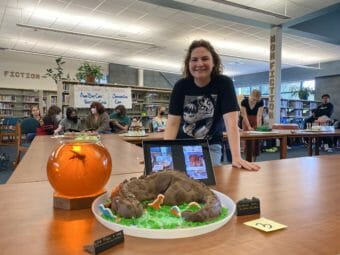
Thunder Mountain High School student Abigail Sparks poses with the cake she made for her final project. The creation was part of the Great Literature Bake-Off in the TMHS library on Tuesday, May 24, 2022.
Thunder Mountain High School student Abigail Sparks poses with the cake she made for her final project. Her creation was part of the school’s Great Literature Bake-Off on Tuesday, May 24, 2022. (Photo by Bridget Dowd/KTOO)

From cake-pop pig heads to edible dinosaur cakes, the Thunder Mountain High School library was sweeter than usual on Tuesday. AP Literature students were presenting their final projects in the Great Literature Bake-Off. 
Thunder Mountain teacher Corrine Marks asked her students to choose a novel they read in high school and to represent one of its scenes, themes or symbols — with cake.

“[The class is] all seniors, and it’s their last semester,” Marks said. “So you know, let’s have a little fun and celebrate with cake.”

One group of students used cake pops to represent pig heads on stakes from "Lord of the Flies."
One group of students used cake pops to represent pig heads on stakes from “Lord of the Flies.” (Photo by Bridget Dowd/KTOO)

Students made mock-up drawings of their cakes explaining their meaning. Then cakes were judged by district staff members.

“It’s been fun to watch their process and their ideas and some of the crazy creativity that’s come out,” Marks said.

The pig head group chose “Lord of the Flies.” Another group used maple syrup to imitate the poison from “Romeo and Juliet.”

There were four prizes: Student Choice, Best Use of Materials, Best in Show and Best Representation of Literature. Winning students received gift cards from local businesses.

Abigail Sparks won the student choice category. She created a T-Rex out of cake and added something a little extra, too.

“I’ve always been obsessed with Jurassic Park, both the movies and the books and the overall science behind it,” Sparks said. “I ended up making a peach mango Jell-O bowl thing with a mosquito in it to represent the amber, which is where all the stuff in Jurassic Park comes from.” 

For her final project, Thunder Mountain High School student Abigail Sparks made a T-Rex out of cake to represent Jurassic Park.
For her final project, Thunder Mountain High School student Abigail Sparks made a T-Rex out of cake to represent Jurassic Park. (Photo by Bridget Dowd/KTOO)

In the story, scientists mine for amber to find blood-sucking insects trapped inside, then clone dinosaurs from blood preserved in the mosquitoes.

Sparks said she wouldn’t call herself a baker, but she does love watching the Great British Bake Off. 

“It’s all like pre-made boxed cake mix and pre-made frosting,” she said. “I did make the modeling chocolate from scratch, which was difficult, but the fondant and the frosting and stuff was just me mixing dyes together and calling it a day.” 

It took her about 10 hours over several days to complete the project. 

After judging was complete, the class ate their projects.

Sparks will attend the University of Alaska Fairbanks in the fall to study geology and paleontology. She hopes to eventually work with fossils at a museum or do field research.

For Sparks and the other students in her class, more than half of their high school career has been disrupted by the COVID-19 pandemic.

“It’s been an odd experience,” she said. “I guess I expected more from my high school career. It’s nice to have like a semi-normal senior year, to be able to just put everything to a close and move on to the next chapter.”

Graduation for Thunder Mountain students will be on Sunday, May 29, 2022 at 7 p.m. The Juneau Douglas High School Yadaa.at Kalé commencement ceremony will be on the same day at 4 p.m.

The Race to Alaska is back, in film and on the water

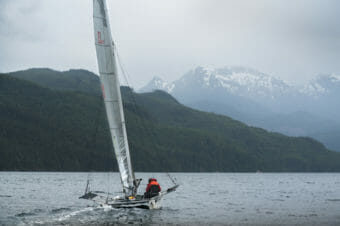
Team Ketch Me If You Kan competes in the Race To Alaska, a 750-mile engineless, unsupported boat race from Port Townsend, Washington to Ketchikan, Alaska. (Liv von Oelreich/Race To Alaska film)

The Race to Alaska — a 750-mile, engineless, unsupported boat race from Port Townsend, Wash., to Ketchikan — is back after a two-year hiatus due to the coronavirus pandemic.

First place wins $10,000 cash, which is nailed to a piece of wood in Ketchikan. Second place gets a set of steak knives. All that the rest of the finishers get is a sense of accomplishment and some good stories to tell.

There’s a new documentary out called “The Race to Alaska” that stitches those stories together to take the viewer along for an epic journey, while explaining what the race is all about.

Zach Carver directed “Race to Alaska,” which is hilarious in some moments and deadly serious in others. Carver says that duality is true to the competitors and the race itself.

Listen:

The following transcript has been lightly edited for clarity.

Zach Carver: I mean, it’s an interesting thing, because if you took your time, the Inside Passage is very doable. People have done it in just a basic canoe. But the element of racing makes it much more challenging. And when you remove the motor from the equation, it gets pretty harrowing. There’s huge tidal currents in the area that can run in some places over like 15, 16 miles per hour. There’s places that look like a river, which switches direction, you know, depending on the tide. The cold water, hypothermia, remote areas, hitting rocks, going 24 hours a day. And then, like, if you’re a smaller boat, there’s bears on the shore if you have to camp and whatnot. So there’s a lot to deal with.

Casey Grove: Yeah, I’ll say. There’s a quote from one of the co-founders, who says that the winner is the least interesting thing about the race. What does he mean by that?

Zach Carver: Just watching people get up this waterway is so fascinating. Like, there’s just incredible characters that take it on and a lot of really unique methods to doing it. So if you said, “Oh, I have to drive a mile.” Well, the person that drives a mile in a car — it’s pretty doable. But the person that decides to somersault a mile is much more interesting. And so I think when you see people on, like, a small, small craft, and there’s a stand-up paddle board that does it, there’s people that have made their homemade pedal drives doing it solo, it just starts to be more fascinating. Like, how do you approach this with different limitations?

Casey Grove: Yeah, totally. There’s, it seems like, a lot of humor, in the editing and stuff in the movie and striking that balance between the humor and the real serious aspects of this, where it is like a life or death situation out there, probably, sometimes, how did you strike that balance? Or how did you approach that?

Zach Carver: I mean, I really think it’s authentic to the event and the people that take part in it to create that humor. So much of where we started with that was just the people themselves, the stuff that they self-documented, stuff they chose to point their own cameras at. There’s often a lot of humor involved. And I think that the organizers, too, have a very, like, real gallows humor about them in a really, I think, a positive way. And so we wanted to, I wanted to, imbue the film with all of the same good-natured humor of the people that participate. And I also think it’s related to that kind of adventure — where if you don’t have a good sense of humor, you can’t get through the difficulty.

Casey Grove: I take it that different competitors in the race had cameras with them. And how did you pull off, you know, shooting all this video to make this film with folks, it sounds like, over different years and with different people in different boats. How did that all work?

Zach Carver: It was a lot. I mean, you have your teams spread out over 750 miles of racecourse. And there’s 40-plus teams every year. And there’s only two checkpoints. So there’s only two places you predictably know anyone’s going to be. And so we highly encourage people to film on whatever camera they had, you know, GoPros, cellphones, sometimes fancier cameras. We had a sponsor one year from a company called Intova that was like a GoPro competitor. So we gave everyone an Intova camera one year, which yielded a lot of fun things, because people didn’t expect to have that camera. So I think it made them performative, which was kind of cool. But yeah, in general, it’s the challenge of that, plus also finding opportunities to film context and get out there with drone shots, or aerials, or to document for other boats.

Casey Grove: So for the guy just walking in off the street who’s never really been into boating, for somebody that’s just never heard about this race, and sees the movie poster or whatever, what do you want them to know about it going into it?

Zach Carver: I want them to know it’s gonna be a fun ride. It’s a funnier movie maybe than the poster suggests. I know I had a funny moment. We had our Los Angeles premiere last night. And some friends who hadn’t seen it said there was a really fun moment where in the beginning, they’re watching it going, “Oh my God, I could totally do this. I could be one of these people. I could do this race.” And then about five or 10 minutes later, they see the gravity and seriousness of it and they go, “Oh man, I have a lot to learn. I do not think I can do this race.” Hearing that they were swept up in it and that they — I don’t know, I feel like it’s a movie that you can get swept up in, and there’s just a lot to learn about this, this area, these people, this waterway. I don’t know, that’s not like one takeaway. But I do think that it’s a fun emotional ride that, going through this, this experience really changes everyone that does it. Every racer that’s done this thing finishes with a look on their face of change and accomplishment, and I hope that the film conveys that, that it’s immersive, and you can feel some of that transformational quality.

The 2022 race kicks off June 13.

Red Carpet Concert: Jake Blount ‘Where Did You Sleep Last Night’

Jake Blount recorded this video of “Where Did You Sleep Last Night” at KTOO during the 2022 Alaska Folk Festival on Lingít Aaní (Juneau, Alaska). Inspired by NPR’s Tiny Desk Concerts, KTOO’s Red Carpet Concert Series features Alaskan and regional artists. Watch this video and other Red Carpet Concerts at ktoo.org.

Recorded at KTOO on April 7, 2022

Traditional Arrangement
Jake Blount

Learned From
Leadbelly

Fiddle & Voice
Jake Blount

Guitar & Harmony
Gus Tritsch

Fiddle
George Jackson

Bass
Mali Obomsawin

Producer & Director
Paige Sparks

Co-Producer
Sheli DeLaney

Camera Operators
Paige Sparks
Andrés Camacho

Sound Mixer
Rashah McChesney

© KTOO Public Media 2022

Red Carpet Concert: Your Favorite Heartbreak, ‘I Do Declare, Claire’

Your Favorite Heartbreak recorded this video of “I Do Declare, Claire” on Lingít Aaní (Juneau, AK) during the 2022 Alaska Folk Festival. Inspired by NPR’s Tiny Desk Concerts, KTOO’s Red Carpet Concert Series features Alaskan and regional artists. Watch this video and other Red Carpet Concerts at ktoo.org.

Recorded April 11, 2022

Composed by Amy Lou

Voice
Rashah McChesney
Cameron Brockett
Taylor Vidic

Voice & Percussion
Kelsey Riker
Marian Call

Camera Operator
Paige Sparks

Director & Producer
Paige Sparks

Editor Paige Sparks

© KTOO Public Media 2022

Red Carpet Concert: Robin Hopper, ‘I Miss Huggin’

Robin Hopper recorded this video of “I Miss Huggin” at KTOO during the 2022 Alaska Folk Festival on Lingít Aaní (Juneau, AK). Inspired by NPR’s Tiny Desk Concerts, KTOO’s Red Carpet Concert Series features Alaskan and regional artists. Watch this video and other Red Carpet Concerts at ktoo.org.

Recorded April 11, 2022

Robin Hopper, guitar, vocals

Camera Operator
Paige Sparks

Director & Producer
Paige Sparks

Editor
Paige Sparks

© KTOO Public Media 2022

Wrangell students hope to win Vans shoe design contest to fund high school art program

Lingít art-inspired shoes, held by Hagelman and Wiederspohn outside Wrangell High School. The shoes are part of the students’ entry for the Vans Custom Culture High School competition. (Photo by Sage Smiley/KSTK)

Wrangell High School is one of 250 schools nationwide selected to design a pair of Vans brand shoes that represent the community’s hometown pride. Wrangell students say they’re confident in their two painted pairs of canvas sneakers that could earn their school’s art program up to $50,000 in prize money.

Wrangell High School junior Paige Baggen said it was important to represent local and Native art in their designs.

One pair of Vans — the slip-on style — shows orangey-pink sunset landscape scenes on the toes. 

“So this is just a picture of the nose that I took in front of Bob’s,” Baggen said. “And I just thought it’s a pretty iconic Wrangell symbol. It’s on so many stickers and art and stuff, so it’s got to be on the shoes.”

That’s some Wrangell lingo: the nose is the tip of Woronofski Island, across the strait from downtown. It looks like the nose of an elephant. And Bob’s is the former name of one of the two supermarkets in town, Wrangell IGA. 

For the Vans shoe design contest, students created designs representing their hometown. Wrangell students created designs with fireworks and a summer sunset on the left shoe, Northern Lights and a winter sunset on the right shoe. (Photo by Sage Smiley / KSTK)

The sun setting over the Woronofski nose adorns the summer shoe, along with minute fireworks, bursting over the water painted along the heel — the Fourth of July is Wrangell’s biggest holiday celebration. Snowy sunsets and Northern Lights adorn the other shoe. 

“Winter symbols, summer symbols, just to kind of show like the spirit of our town,” Baggen said.

The second pair of sneakers is covered in red and black Lingít-inspired formline designs — a wolf and a raven. Tiny beaded blue flowers run down the laces, and white buttons line the heels, evoking a Lingít button blanket. Cuffs made of long brown fur spill out of the ankles of the shoes. It’s marten, trapped by senior art student Rowen Wiederspohn almost a decade ago

Baggen spearheaded the shoe-painting project, with assistance from Wiederspohn and other students in the class. Art teacher Tasha Morse says that designing two pairs of shoes wasn’t part of the high school’s curriculum at the beginning of this year.

“We found out about this competition, honestly, through TikTok,” Morse said. “There was a student who was like ‘I found this contest’ and told Paige about it. And Paige was like, ‘Oh my gosh, this is so cool.’”

Morse says that with the help of the school counselor, she filled out the application for the class. 

“Well, imagine my surprise when a few weeks later, I got a ‘Congratulations, you’re one of 250 schools in America to be gifted these vans shoes to paint for a chance at winning $50,000,’” Morse said. “And I was like, ‘Oh man, that just got really real, really fast.’”

It’s a part of Vans Custom Culture High School competition; now in its 13th year.

“The requirements are two pairs of shoes,” Morse said. “One is the hometown pride, which is obviously Wrangell. And the other pair is supposed to be one of the four pillars of the Van Doren legacy (the co-founder of Vans), which I found out are action sports, street culture, music and art.”

Van Doren shoes designed by Wrangell High School art students. Buttons on the back of the shoes pay homage to Lingít button blankets. (Photo by Sage Smiley / KSTK)

For the Van Doren shoes, the students chose to focus on art, specifically Lingít art. Morse says that boiling Wrangell down to iconic images for the other pair of hometown-focused shoes was a collaborative effort. 

“We had some class-wide discussions and my whole entire whiteboard was just filled with ideas like what makes Wrangell — Wrangell? Why are we lucky to live here?” Morse said. “And everything came out. We have the river. We have glaciers. We have wildlife. We have the Fourth of July. We have petroglyphs.”

The whole project came together on a tight timeline, Morse says. A lot of students got sick, some with COVID-19, after basketball regionals in mid-March, and the shoes got lost in the main office’s mail pile for a few weeks. 

Students met every day after school, Morse says, and Baggen took the shoes home over the weekend to continue the work.

“I’d say there’s over 50 hours of work into the shoes easily,” Morse said.

Morse says there’s a buzz in the class; they think they have good chances in the competition. 

“We’re just trying to be very positive and forward-thinking and keep it light,” Morse said. “We went from not thinking that this was probably never going to happen to ‘Oh my gosh, we have shoes and now we’re in the middle of this.’”

Baggen says the school needs the prize money. 

“Of course, there’s lots of schools across the nation, and everybody is suffering from the same issues,” she said. “COVID is a problem, it’s hard to get people to work, but we have really specific issues that apply only to us.”

From left: Art teacher Tasha Morse, junior Cassady Cowan, junior Paige Baggen, senior Sophia Hagelman and senior Rowen Wiederspohn hold Wrangell’s entries into the Vans Custom Culture High School competition. (Photo by Sage Smiley/KSTK)

Morse says Wrangell’s schools have had to cut back on art offerings.

“The last couple of years, I’ve been the art teacher, and I am a trained music teacher,” Morse said. “There are things that I can do in art; there are things that are very similar: mindset and creating, and the ‘Don’t give up’ attitude, and those kinds of things. But we went from having full-time art a few teachers ago to now it’s just myself and another teacher at the middle school, and that’s our art program right now.”

But it’s not just a personnel issue. Supplies are also expensive to get to an island.

“I just bought a gallon of milk for $9 at the store, and a gallon of paint is more expensive than that,” Morse said. “Add in barge costs or USPS charges, UPS charges or FedEx or whatever, it’s expensive. We do clay, we do glass, we do painting, we do portraits, we do all these things. And those are expensive. They don’t regenerate themselves. You can’t pick up the thing that you made last year and turn it into something new.”

Baggen, who wants to go into animation as a career, says she thinks it’s vital for the community to have art programs in the schools. Entering this competition could be a way that she and the other students give back, she says. 

“It’s important,” Baggen said. “You want a well-rounded, good, valuable education for your children. And we only have one school. So this is something that we can kind of offer to the community as, you know, we’re trying to improve things and make sure that everybody can get a good arts education because arts are super important.”

Walking outside the school to take photos, one of the hometown pride scenes miniaturized on the shoes appears in real size: down the hill from the school parking lot, the elephant nose of Woronofski Island looms over the water. 

In the next few weeks, judges at the shoe company Vans will determine the top 50 schools, and then open up a public voting period online from April 25 to May 6. There’s more information about voting on the contest’s website.

If Wrangell is one of the top five schools, students could win between $15,000 and $50,000 for Wrangell High’s art program. 

Correction: Cassady Cowan’s last name was misspelled in a photo caption in a previous version of this story. This story has also been updated to correct the type of fur used on the Van Doren shoes. The previous version stated it was ermine, but it is actually marten.

Site notifications
Update notification options
Subscribe to notifications