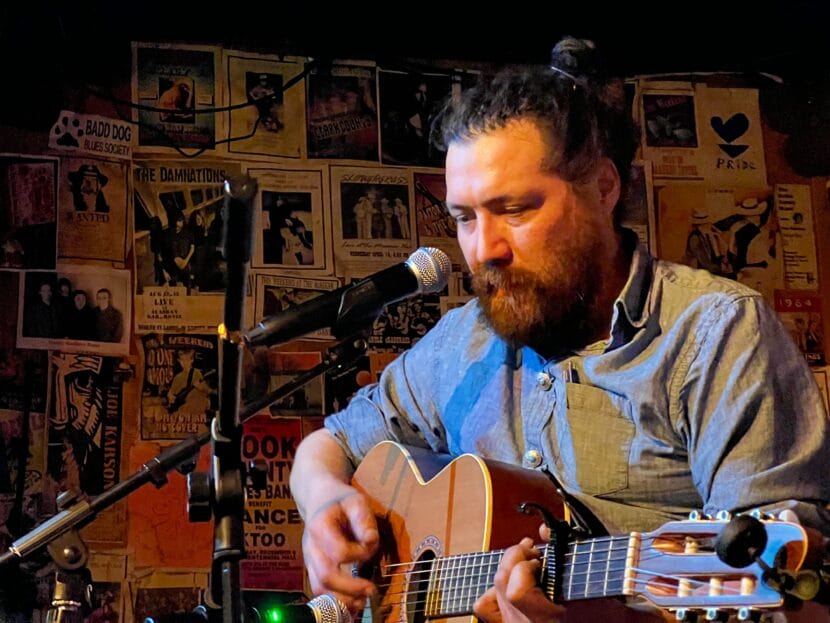
Daniel Firmin playing at the “Unceded” event at the Alaskan Hotel and Bar in April 2023. (Photo courtesy of Tripp Crouse)
Alaska-based storytellers will take the stage Wednesday at the Crystal Saloon to share what diaspora and belonging mean to them. The event, called “Displaced,” will feature writers of color from Juneau and Anchorage.
The idea came to Juneau musician Daniel Firmin about 10 years ago, in a poetry workshop. While his friend wrote about displacement of water, he immediately thought of his experience growing up in both Fairbanks and Fort Yukon, having a white father and an Alaska Native mother.
“I’m not quite sure what everyone else is going to do,” he said. “What I want to do is to talk about that feeling of not being accepted between two worlds that really are one.”
Firmin said that he never quite felt like he belonged — that he wasn’t ever white enough or Native enough for either community. After Unceded, an event this spring that featured musicians of color, Firmin pitched organizer Tripp Crouse the idea of doing a storytelling event.
For Crouse, the idea struck home, too. They’re Ojibwe and grew up in Illinois with the non-Native side of their family. Now, they’re in Alaska, with friends who have their own experiences with diaspora.
“A friend of mine calls Juneau the Island of Misfit Toys,” Crouse said.
Crouse says this mix of identity and belonging fosters Juneau’s rich arts scene.
“It’s a place where we all sort of get together and hang out and do fun things and put on really cool events,” they said.
Crouse said there’s no cover because they want anyone to be able to come without a financial barrier. Any donations will go to the artists.
They haven’t reviewed any of the stories or poems the speakers will read, either, and there’s just one rule: It must be original.
“I really want it to speak from who you are,” they said.
Other storytellers will include Ernestine Shaankaláx̱t Hayes and Na Mee. Displaced is Wednesday at the Crystal Saloon at 8 p.m.
Editors note: Tripp Crouse is a former KTOO employee.
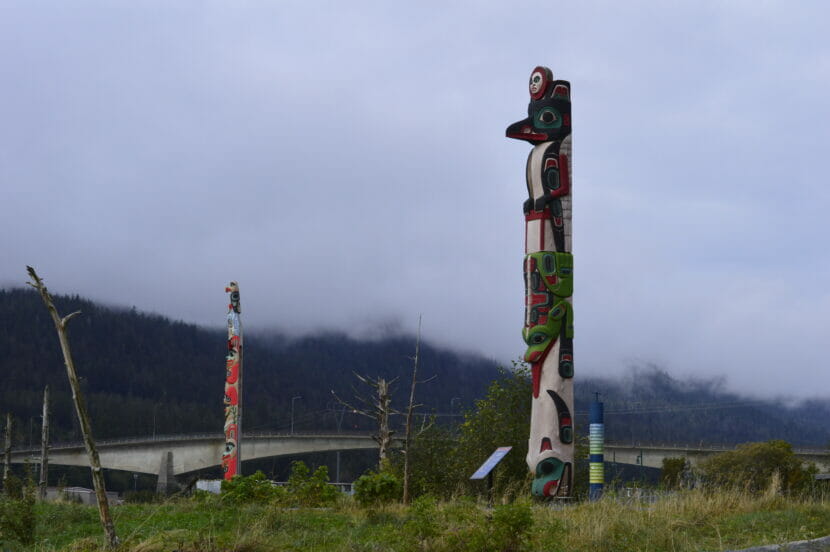
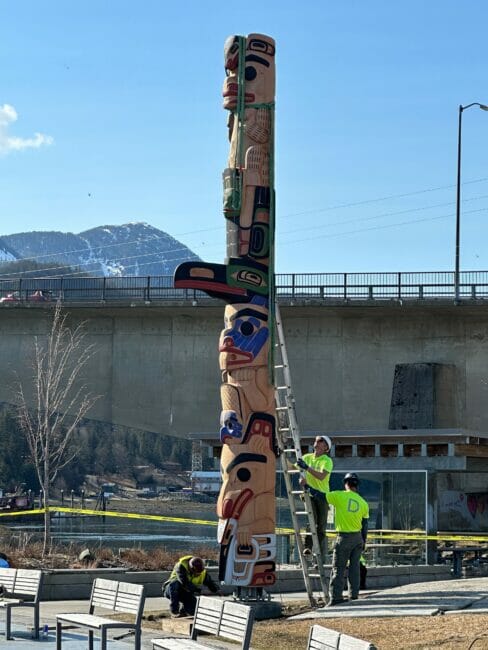
Two kootéeyaa on Juneau’s waterfront on Oct. 4, 2023. (Photo by Yvonne Krumrey/KTOO)
On a quiet October day, with no cruise ships in port, Noah Boos stood looking at a sign right next to a kootéeyaa, or totem pole, on Juneau’s waterfront. The sign breaks down what each of the carved figures are — a bear with curved teeth and large formline eyes, an eagle with a face painted in red on its back, a killer whale with a fish in its mouth — and at the top, a Kaagwaantaan clan member.
“I love these signs,” he said. “(They) tell you a little bit about what the totems are all about.”
Boos said he’s been to Juneau before, but not since the kootéeyaa sprang up. He said he likes that cruise ship passengers can learn so much after getting off their boats.
“First thing you’d see pretty much would be the totems and the signs,” he said.
Noah Boos looking at new signage for kootéeyaa on Juneau’s waterfront. October 4, 2023. Photo by Yvonne Krumrey/KTOO
The organization put up storyboards last week to educate visitors and protect the poles from mistreatment.
“These are objects that are sacred for Lingít people,” said SHI’s Ricardo Worl. “And we hope that the storyboards will help people learn more about our history and how sacred these kootéeyaa are for us.”
Each storyboard has a diagram of the pole, with a breakdown of what each symbol is and the story the kootéeyaa tells. It also lists the artist, their clan and clan stories.
Early in the cruise season, pictures surfaced of tourists putting children in the large, brass hands of the Shangukeidí Kootéeyaa. Community members were frustrated with these and other examples of people mistreating and touching the poles.
Worl said SHI discussed erecting barriers to stop it, but decided not to.
“We thought about that, putting verbiage on the storyboards: ‘Please don’t touch, these are sacred objects.’ But the more we thought about it, the more we believe that everyone in this community has a responsibility to educate our visitors,” he said.
Worl said mistreatment of the kootéeyaa likely stems from a lack of understanding about what they mean to Alaska Native people. He said he wants non-Native residents and those in the tourism industry to speak up when people act inappropriately with the kootéeyaa.
“For our visitors, this is an excellent opportunity to learn that this is more than art,” he said.
The 12 poles are part of the Kootéeyaa Deiyí, or Totem Pole Trail. Eventually, SHI plans to install 30 poles total along the docks, many representing clans.
The kootéeyaa will give Indigenous people keys to understanding their identities and their ancestors, he said.
“They tell our history. They tell clan stories. They make connections from our ancestors to our current generations,” Worl said. “Our grandchildren will now be able to come and view the Kootéeyaa and confirm their identity to their ancestors and to their crests.”
Worl said SHI has the funding to commission one more kootéeyaa and is seeking funding for 17 more.
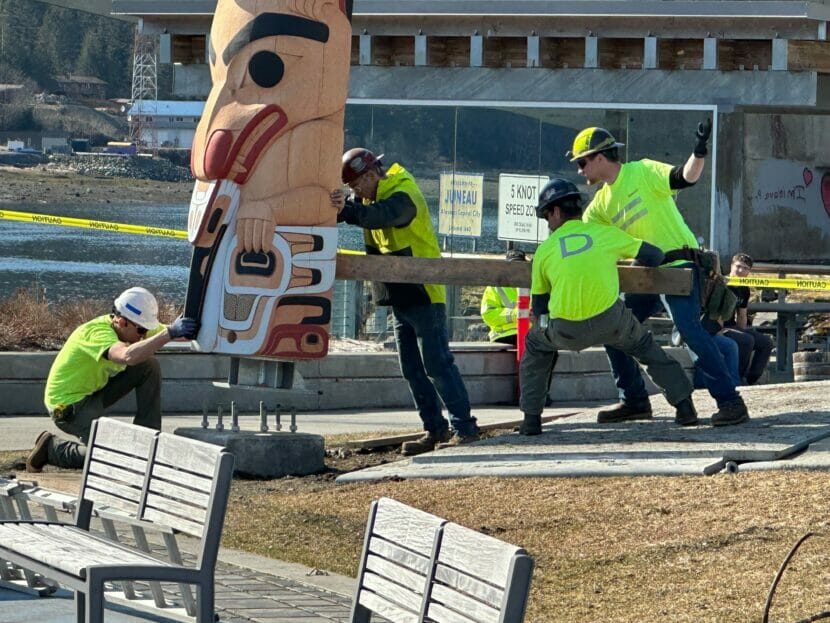
A totem pole carved by Gyibaawm Laxha David Robert Boxley is raised at Overstreet Park for SHI’s Totem Pole Trail on April 16, 2023. (Photo by Bostin Christopher/KTOO)
When it’s finished, 30 poles will line Juneau’s waterfront. On Saturday, the first 12 poles will be dedicated by representatives of the clans and tribes depicted on them.
One of those poles, carved by Gyibaawm Laxha David Robert Boxley, represents the Tsimshian people. He watched on SHI’s Facebook stream as it was raised Sunday at Overstreet Park.
“It went up a little earlier than it was going to. I’m flying up there tonight,” Boxley said. “There’s a couple of pieces I have yet to glue on.”
He said he doesn’t envy the organizers, who are rushing to get all the poles up by Saturday.
Boxley has been carving since he was 6 years old, and he’s carved nearly 30 poles in his life. Some are in places like Disney World and Washington D.C., but many are in his hometown of Metlakatla.
A totem pole carved by Gyibaawm Laxha David Robert Boxley is raised at Overstreet Park for SHI’s Totem Pole Trail on April 16, 2023. (Photo by Bostin Christopher/KTOO)
Boxley said carving a pole that represents all Tsimshian people was no simple task.
“They’re in order top to bottom of — the Killer Whale clan was first and then the Ravens and the Eagles and the Wolves,” he said. “So in the origin of our people, that’s it, it was a way to tell Tsimshian history and make sure everybody was represented.”
Boxley said he’s grateful to be a part of the project, with so many carvers he respects and admires.
“Through everything we’ve been through, the artists made this comeback, along with our culture and the strength of the civilization of Northwest Coast Native peoples,” he said. “And I think it’s beautiful to be part of.”
The dedication will be held at 11 a.m. on Saturday at SHI’s Heritage Plaza in downtown Juneau.
This story has been updated with the Lingít name of the trail.
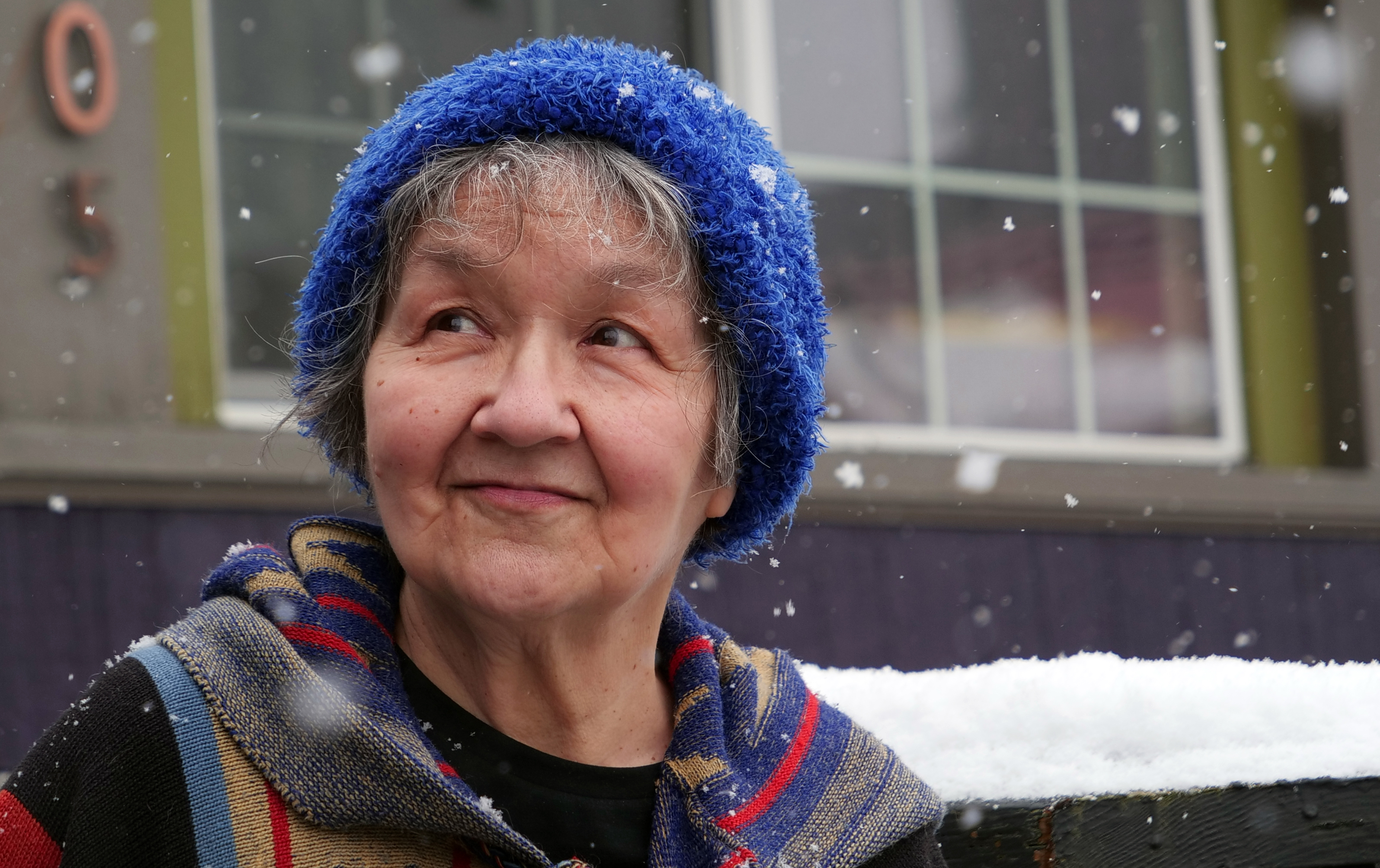
Ernestine Hayes is seen in Juneau, Alaska, this winter. (Photo courtesy of Pat Race)
In 2018, Ernestine Shaankaláx̱t’ Hayes’s house caught fire. Her writing was on hold while she spent countless hours negotiating with contractors and insurance. She lived in hotels and apartments, using her life savings to fix the house.
“I was here and there throughout and didn’t have any time to set up a computer and have a writing space at all,” Hayes said. “But I was writing on my iPad and writing notes to myself and doing a lot of texting to myself when things would occur.”
Now, the house is nearly finished, and she’s rebuilding her life.
“This fellowship allows me to catch up with what I owe the IRS on all this, all these expenses for rehabbing the house and has allowed me to be able to afford to rent my own little apartment,” Hayes said. “I’m in a better place now. And it’s going to allow me to devote more of my time and attention and energy on writing and to my next book.”
This is exactly the sort of thing the fellowship was made for. It’s awarded to artists in many fields, from architecture to theater to writing, at any stage of their careers.
Getting fellowships and awards like this has given Hayes more than funding, she said. It has made her feel valued.
“When I received the Rasmuson distinguished artist (award), I realized that I was part of a community, which is something that I never fully felt throughout my life,” Hayes said. “And it made me feel valued.”
Her next book, she said, is about what she calls the “spoken forest.”
“This thought came to me that there are beings in the spoken forest that are relatives and they are holding for us everything that we think that we have lost,” Hayes said. “People we don’t find, people who are missing, people who run away from boarding schools and are never found. And maybe even everyone who walks into the forest, I think they are all still there. And I believe that when it’s time and we enter the forest, they will be there to greet us.”
She kept track of these ideas through the chaos of losing her home. Now, with this award, she’s closer to putting them to paper.
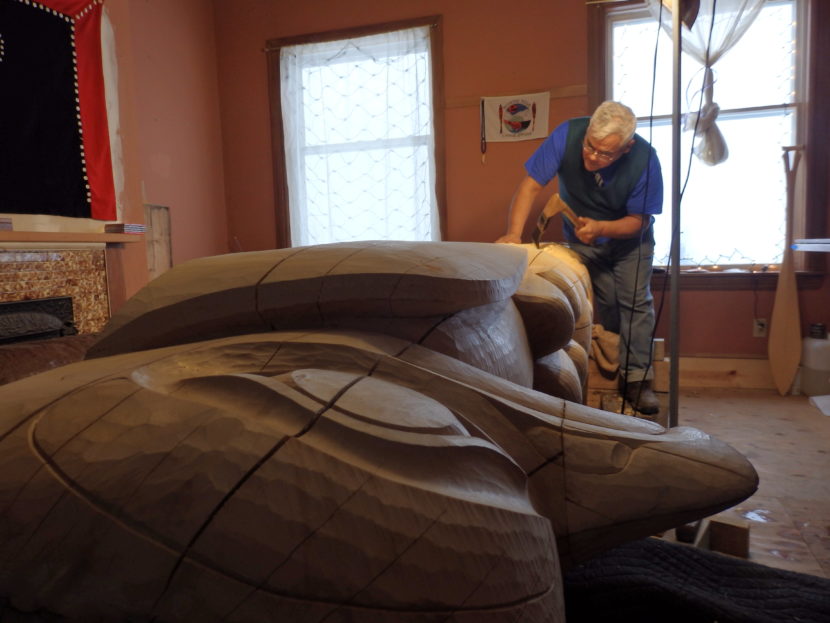
Wayne Price works on a 12 foot tall totem pole in his Haines studio. (Photo by Emily Files/KHNS)
Lingít Master Carver Wayne Price is returning to the University of Alaska Southeast as part of its Northwest Coast Arts program.
“The attention being paid to all branches of Northwest Coast Native art. I really feel the support out here at UAS,” Price said.
He will be teaching carving courses and formline design classes.
Both art forms have beginning, intermediate and advanced curriculums, but some of the classes are combined. Price says the formline class is intensive.
“In my formline class, they were sweating,” Price said. “It seems they were trying so hard.”
Price said he only found out last week that he would be teaching this term, but he thinks his classes will fill up fast. Students in the beginning carving class will be making paddles, while intermediate and advanced students can choose their projects.
“So they have the benefit of an artist who’s got 50 years of Northwest coast art under my belt. And I bring that all here to the University of Alaska, at Áak’w,” Price said.
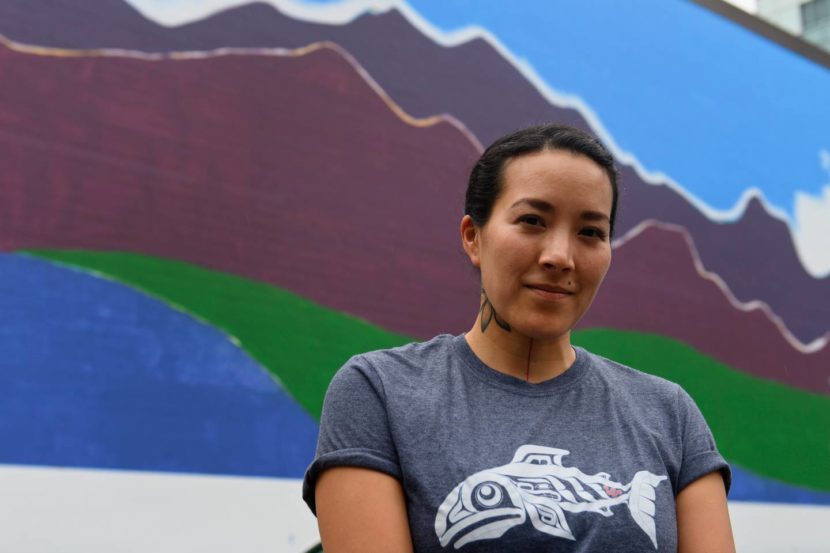
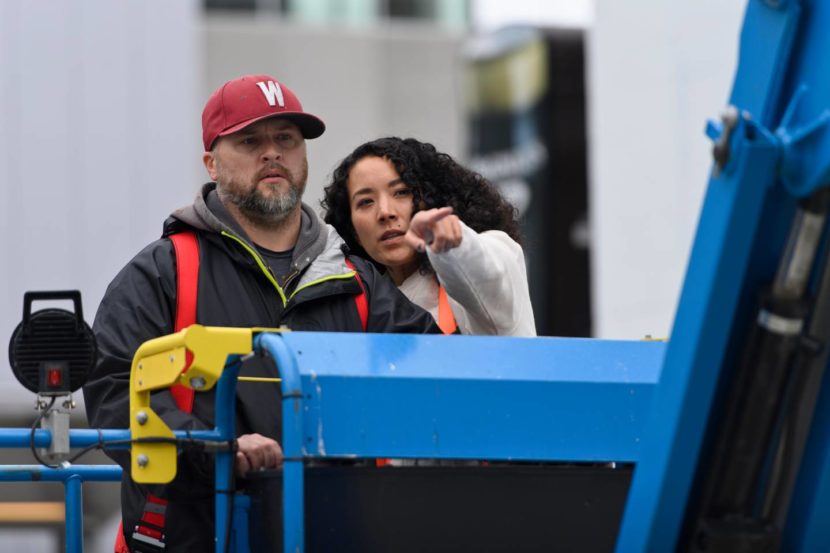
Crystal Worl is painting a 120-foot mural on a building at G Street and 7th Avenue in downtown Anchorage designed to reflect the diverse Alaska Native cultures in Anchorage. Photographed on August 11, 2022. (Photo by Marc Lester/ADN)
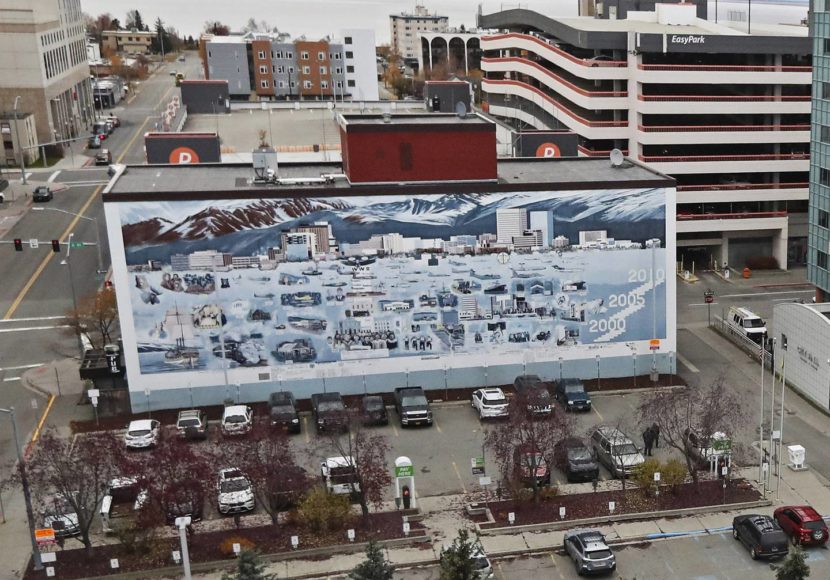
Growing up, Crystal Worl remembers looking up at the 120-foot-long mural on G Street that showed major events in Anchorage’s history: the Alaska Purchase, a Fur Rondy auction, a series of World War II planes.
For years, the wall of the RIM Architecture building behind City Hall featured the Anchorage History Mural, which was painted in 1995 by artist Bob Patterson.
But Worl said there wasn’t anyone in the painting who looked like her. She didn’t see many Alaska Native faces, or women.
“I felt that it was very lacking of being inclusive of Indigenous people, and I felt that the only acknowledgement it gave me was that I exist in the past and that my history is not present,” she said in a recent phone interview.
Nearly 30 years after the original mural was created, Worl is now taking a paintbrush to the same wall and designing her own. The art, she said, is a way to tell a different version of the city’s history — a story that celebrates the diverse Alaska Native people who make Anchorage their home.
‘It’s not like a marble sculpture’
A number of new murals have been installed downtown during recent years as part of the Alaska Mural Project, which was formed by the Anchorage Museum in 2020 to improve the community through public art.
The murals are an opportunity for Anchorage to update public art with new narratives and ideas about the city while giving the downtown area a makeover, said James Temte, Alaska Pacific University’s project manager.
Murals are not intended to last forever, said Temte, who’s also a muralist.
“It’s not like a marble sculpture or anything, and so I think murals, they come and they go, and this is just the next of a new series,” he said. “With street art, mural art, it’s very much a progress — it’s not stuck in time.”
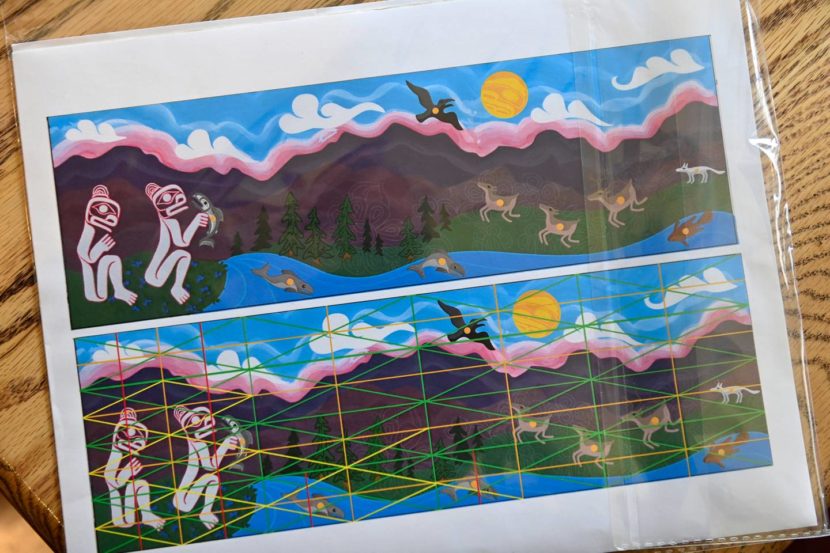
A small print reflects Crystal Worl’s plans for a large mural in downtown Anchorage. Photographed on August 9, 2022. (Photo by Marc Lester/ADN)John Osgood, of Oakland, works with Crystal Worl on a lift as they begin to paint a mural in downtown Anchorage on August 9, 2022. (Photo by Marc Lester/ADN)
Worl applied to be part of the mural project more than two years ago and was selected by a panel of community leaders from the Anchorage Museum, Alaska Pacific University, Anchorage Downtown Partnership and others.
Worl, who is Lingít, Athabaskan, Yup’ik and Filipino, said she was eager to bring Indigenous culture into everyday life for people in Anchorage. She recently finished a mural on civil rights activist Elizabeth Peratrovich in Juneau.
Museum officials reached out to the co-owners of the RIM Architecture building, Barbara and Larry Cash, about participating in the mural project.
The building has a large, exposed wall that is a perfect for a mural, Barbara Cash said.
“It’s about recognizing and celebrating the sense of place and the local identity. … We thought it was a refreshing, forward-thinking movement that they had put together and we were very excited to participate,” she said.
Murals and public art are an accessible way for visitors to learn about Anchorage on a deeper level, Cash said.
“I think the relevance of going back to recognize and celebrate the original owners and stewards of the land, it very much emphasizes our unique identity here,” she said. “When people come to visit Alaska, and when they live here, hopefully the visitors get to feel more and more the roots of the place rather than just what stores are open. I think that’s very meaningful.”
Making space for an overlooked history
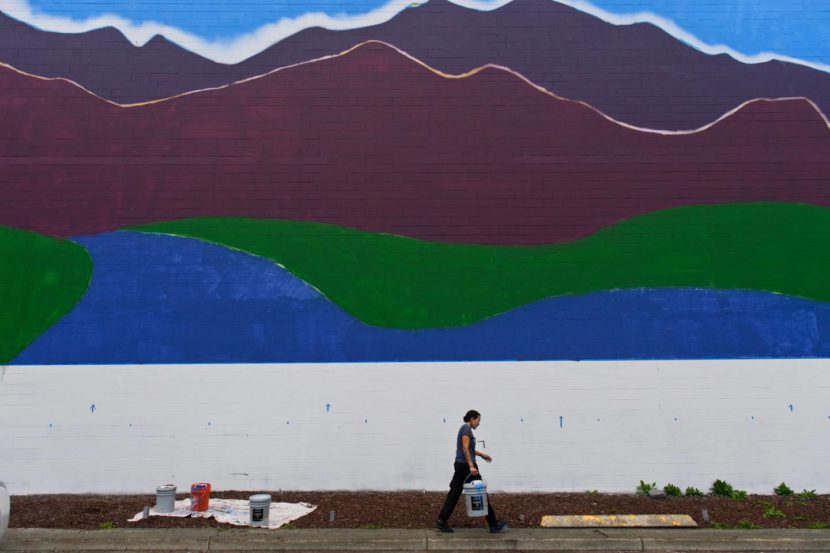
Crews covered the prior mural with white paint last week, and Worl began working this week on the new mural. She said she expects to finish in a few weeks, weather permitting.
The sight of the old mural getting painted over was met with some criticism on social media.
Worl said she knows some are upset the former mural is being replaced, but she feels it’s the right time for change given the cultural shift in Anchorage and around the country to recognize people of color in historical accounts.
“When I started doing public art, I was in lockdown during COVID, almost three years ago, and the Black Lives Matter movement happened and George Floyd happened and it was a whole chain of events that led to the removal of colonial statues,” she said. “And I saw that as opportunity, as space being made for people of color to step up and make art in place of those old pieces. And so it’s scary, but it’s exciting.”
The mural to the west of the City Hall parking in downtown Anchorage, photographed on Oct. 13, 2021. (Photo by Emily Mesner/ADN)
In the old mural, the highlights of Anchorage history largely began after 1778, when Captain James Cook arrived. But Alaska Native people have been in the area for thousands of years and their history is often overlooked, Worl said.
Her mural depicts human figures, animals and nature in the Chugach Mountains. Worl said she plans to incorporate Alaska Native tribes within the small details of the mural, such as beading texture in much of the landscape, including depictions of dentalium jewelry, an important part of Dena’ina culture. And Worl is incorporating formline design, a type of art associated with Lingít, Haida and Tsimshian tribes.
Worl said she is painting with vibrant colors as an homage to how innovative her ancestors were.
“They adapted to change,” she said. “They took on new tools and new pigments and new items that helped them ever evolve and create new work, so I’m really embracing that mentality in this project by bringing in new color palettes, new textures, new tools and methods to achieve the piece.”
Crystal Worl cleans up as rain starts to fall on August 11, 2022. Worl is painting a 120-foot mural on a building at G Street and 7th Avenue in downtown Anchorage designed to reflect the diverse Alaska Native cultures in Anchorage. (Photo by Marc Lester/ADN)Crystal Worl heads to a lift to begin the process of painting a mural in downtown Anchorage on August 9, 2022. (Photo by Marc Lester/ADN)
On Wednesday afternoon, Worl stood on a blue mechanical lift, high above the pavement, as she added swaths of purple to the mural just starting to take shape. Tourists milled about outside the Dena’ina Center across the street and locals stopped to pause at the new art.
Kat Barron and Oscar Avellaneda-Cruz specifically walked on G Street to see the mural after they took a break from work to buy ice cream on the sunny afternoon. Avellaneda-Cruz knows Worl, but said he is especially excited about the mural because he sees it as the community taking a step toward inclusivity.
“For a long time, a lot of the institutions that made or designed the city didn’t look at what the actual community or commons cared about,” he said. “And the board of the Anchorage Museum even listening is a good sign of the passing of the guard.”
Barron said the art made her feel hopeful. She wants a more inclusive community where everyone feels welcome.
That’s always been Worl’s goal.
“It’s a little bit rough and rugged when you can’t please everyone, but at the same time, this is who I am and this is what I’m doing,” she said. “There’s going to be some young person who looks up at that mural and is going to start growing up looking and connecting to that mural. And I want them to feel included.”