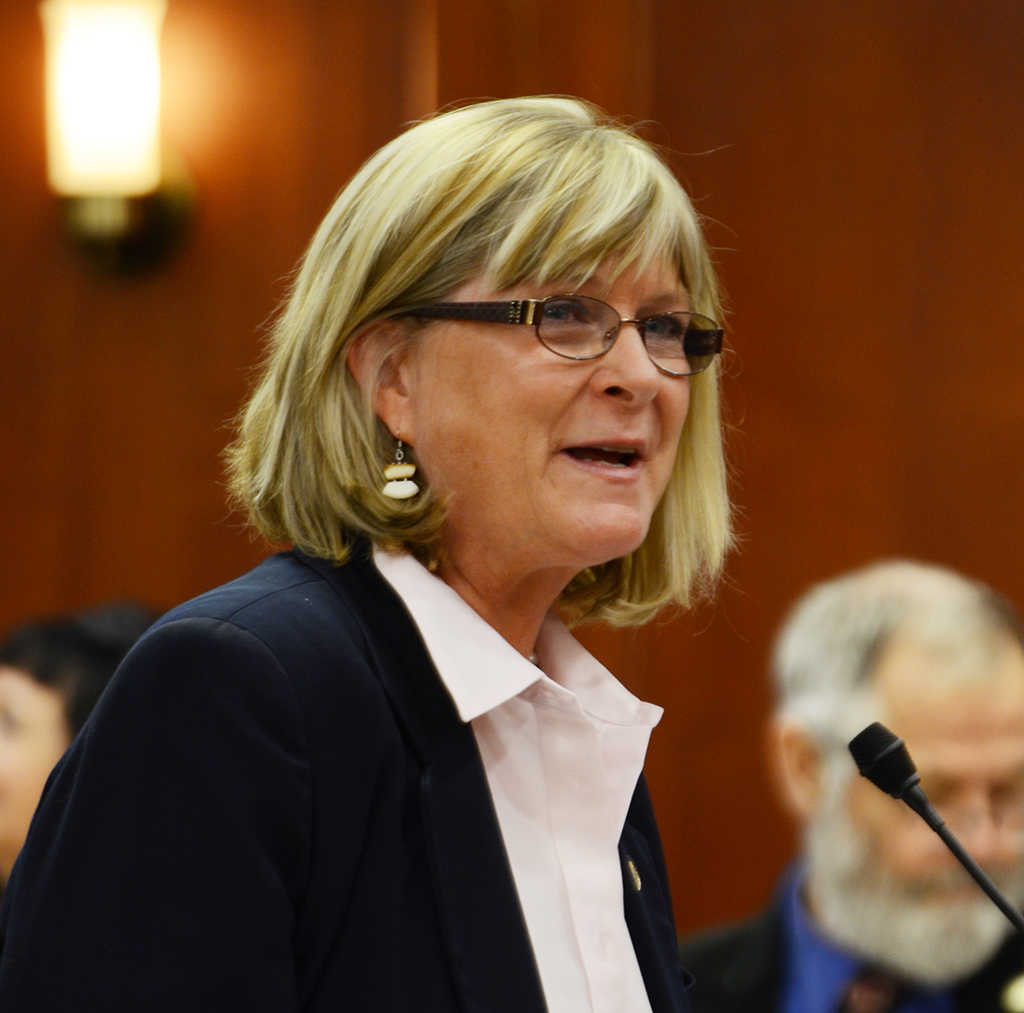
Rep. Beth Kerttula’s final day in office was Jan. 24. (Photo by Skip Gray/KTOO)
Gov. Sean Parnell on Thursday will interview candidates for the House District 32 seat vacated by Beth Kerttula.
Tongass Democrats earlier this month sent Parnell a list of three nominees: Jesse Kiehl, Catherine Reardon and Sam Kito III.
Kiehl is a Juneau Assembly member and aide to Sen. Dennis Egan.
Kito is a civil engineer, and in recent years has worked as a legislative lobbyist.
Reardon is currently a legislative aide for Anchorage Democratic Rep. Andrew Josephson.
Kerttula resigned as House Democratic leader on Jan. 21 and from the Legislature three days later to take a fellowship at Stanford University.
Parnell spokeswoman Sharon Leighow did not say when the governor would announce his choice. She said he planned to make the appointment within the 30-day window required by law. Sunday marks 30 days since Kerttula resigned.
Parnell’s choice must be approved by House Democrats.
All three nominees have said they would run for the seat, if they are appointed.
A bill that would save military spouses the trouble of going to the DMV has triggered an unlikely battle over gay rights in the state legislature.
When Rep. Doug Isaacson introduced the “Military Spouse Residency Relief Act” he didn’t expect it to be controversial.
“No! I was thinking this would be a yawner – that it would just be one of those things everyone would get behind because it’s a benefit to military,” says Isaacson, a North Pole Republican.
The bill isn’t complicated. Members of the military are already allowed to keep their out-of-state driver’s licenses, so this legislation would extend that perk to their husbands and wives.
What it wouldn’t do is extend it to their domestic partners. Because the bill specifically uses the word “spouses,” same-sex couples aren’t covered by this bill because Alaska doesn’t allow gay marriage. In 1998, Alaska was the first state to define marriage as existing between a man and a woman, and it doesn’t recognize gay marriages conducted in other states.
Without the ability to get married, there’s no way for same-sex couples to avail themselves of the driver’s license benefit. Rep. Max Gruenberg, an Anchorage Democrat, sees that as a violation of another part of the Alaska Constitution – the equal protection clause. He says even if the bill deals with a tiny perk, the language in it is still discriminatory.
“I think it’s important that we not permit this kind – even if it’s a small amount – of unequal treatment to continue,” says Gruenberg.
Gruenberg first offered an amendment to include same-sex partners in the bill during a hearing of the Military and Veterans Affairs Committee last week, and it failed on party lines. On Tuesday, the same amendment was offered in a different committee. And again, it failed, with one Democrat voting for it and five Republicans objecting. If the bill makes it to the House floor, the Democratic minority may offer up the amendment again.
Both times the amendment has been offered, opponents rejected it on fairly technical grounds rather than delve into the policy question. The State Affairs Committee found the amendment inappropriate because adding same-sex partners to the legislation would have required a title change for the bill. The Military and Veterans Affairs Committee shuttled it because the Alaska Supreme Court is expected to weigh in on whether same-sex partners should be included under the umbrella of “spouse” over the next few months. The Court heard Schmidt and Schuh v. Alaska — a case concerning property tax exemptions for married couples — in 2012, and a decision is still pending.
Gruenberg doesn’t think that’s how this bill should be handled. He says the Legislature regularly considers policy that would affect pending litigation. For example, a bill that would make it optional for local governments to fund their school districts was introduced after the Ketchikan Gateway Borough filed a lawsuit on the same subject.
“The Legislature shouldn’t shirk its duty to just wait for a court to decide something, when really it’s a moral issue that’s involved – the question of equal rights,” says Gruenberg.
But Isaacson still thinks the wait-and-see approach is the right one to take with his bill.
“‘Spouse’ is ‘spouse’ however defined, and if the law changes to say that ‘spouse’ means ‘partner,’ then this will still be a benefit to all parties concerned. So that amendment is unnecessary to the intent of the bill.”
The State of Alaska already extends benefits to the same-sex partners of its employees, after a different Supreme Court decision in 2005 determined that offering them only to straight couples violated the Constitution’s equal protection clause.
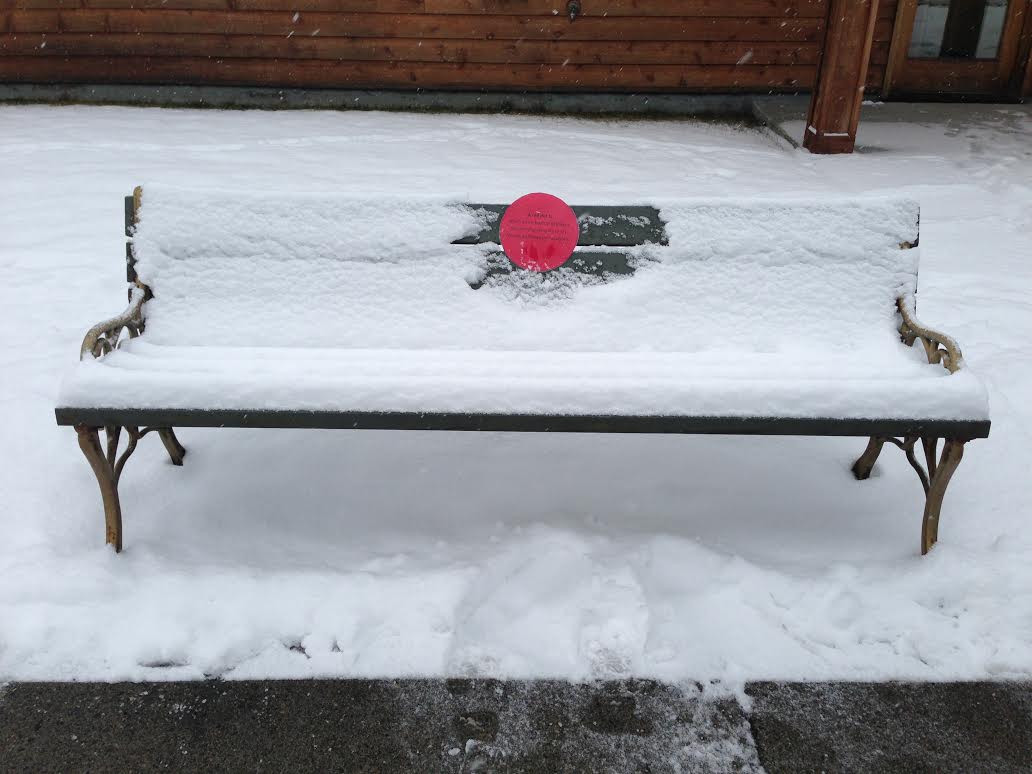
Last weekend, in the middle of the night, 100 red dots mysteriously appeared on benches, signposts and trees around Wrangell and Petersburg.
Word on the street is abuzz this week with curiosity about these little red dots.
Some find them surprising, others find them disturbing. But there’s one thing that’s for sure—they’ve been noticed.
“You know, we did notice that quite a few of those red dots were taken down and I think that’s perfect. We want those red dots to go away,” says Falle.
Julie Falle is a school counselor with Alaska Island Community Services, or AICS. She says that making people stop and pay attention is the whole point.
Each of the laminated paper circles describes some type of violent act.
There are dots for sexual violence, school bullying, domestic violence and stalking.
“You know, statistics show that 75% of Alaskans either have experienced some form of violence or know of someone who has and that’s a really high number. That’s definitely something that is maintained on our radar,” says Falle.
The red dots are part of a nationwide campaign called Green Dot. In Southeast, it’s funded through a Strategic Prevention Framework State Incentive Grant or SPFSIG. Falle is one of the AICS grantees and works on prevention and awareness of minor alcohol consumption and adult binge drinking.
But, she says, this is the first time she and her grant partners at Petersburg Mental Health Services have tried a project like this.
“It’s an intervention we are kind of tailoring to Alaska. It’s never quite been done in a community-wide setting. It’s always been very specific communities like college campuses, high school campuses, things like that. So it’s actually kind of exciting and interesting to see how people respond to it because it’s not been done before,” says Falle.
Photo by Shady Grove Oliver/KSTK
She says the response has varied from avid support to people feeling upset that the dots bring back bad memories.
And that’s why the red dots are slowly going away. Over the course of the month, each violent dot will be replaced by a green circle describing ways people can combat violence in their communities.
“Often we feel uncomfortable when we are witnessing a violent action. It could be the neighbor next door that’s yelling a little too loud. It could be the sound of a slap. It could be witnessing someone being pulled from the bar. We tend to feel uncomfortable and not know what to do in these situations. Green Dot kind of empowers people. The green dots you’ll be seeing around town give examples of what you can do,” says Falle.
Green Dot works with a three-tiered strategy of the three D’s—Direct, Delegate, and Distract.
Direct is self-explanatory—engaging with people in a violent situation to stop it.
Delegate means getting help from people who are better equipped to handle the problem, like police, EMS, or a family member.
Distract is a bit more passive. Falle says if you see someone being dragged out of a bar, for example, you can text or call the perpetrator. She says breaking a person’s focus during violence can be a calm, safe way to intervene.
“And they find that can be just as effective as stepping in—just as effective as physically getting in between a fight which often you don’t want to do. You want to protect your safety,” says Falle.
Falle says the red dot/green dot project may seem somewhat obscure at first. But, she hopes it will start a community discussion that needs to happen.
“I would say that Wrangell is no different from any community in that we’re identifying that violence is prevalent throughout Alaska and states down south as well so, we’re not singling Wrangell out as a violent community. We are merely trying to provide tools to prevent any violence in the future,” says Falle.
Falle says if Green Dot reaches just 20 percent of Wrangell or Petersburg, it will be a big step toward a future free from violence.
For the first time in Olympic alpine skiing history, two gold medals have been awarded in an event.
Swiss skier Dominique Gisin, of Switzerland, and Tina Maze, of Slovenia, skied the women’s downhill course in 1 minute, 41.57 seconds at the Sochi Olympics.
“Absolutely incredible,” the NBC announcer shouted as the race clock showed the exact same time for the two women.
To the average TV viewer, the Olympics are often about the incredible. But to an athlete who spends years and years preparing for that Olympic moment, it’s all about the possible.
Juneau’s Hilary Lindh was 18 when she qualified for the 1988 Olympics in Calgary, Alberta, Canada. She had been on the U.S. Ski Team full time for two years, racing World Cup events in North America and Europe. She’d already won a U.S. downhill title and the World Junior downhill title.
“Nothing is quite like the Olympics.”
Hilary Lindh helps take down the Mighty Mite race course at Eaglecrest. She helps coach the young skiers.
It’s a place where great expectations can turn into big disappointments. For Lindh, Calgary was a place to learn.
“You know people would say, ‘go for the gold,’ ” Lindh recalls. “I was taking them seriously, when I really had no business thinking that was possible.”
At that point, the best she’d placed in a World Cup event was ninth. The Calgary Olympics were a lot of pressure for a teenager, and not a lot of fun.
“I just felt like everyone was expecting me to have some miracle thing happen, so I was thinking that might happen. And it’s just not very realistic, so I learned a lot,” she says, laughing.
Lindh says she learned she could enjoy the Olympics, meet other athletes, and still concentrate on her event.
“The other aspect of it was to focus on the actual skiing instead of the potential outcome, and that’s something that served me for the rest of my career,” she says.
Four years later, she was ready for the 1992 Olympics in Albertville, France. Hilary Lindh won the silver medal in the women’s downhill, because she says, she was focused on her skiing and not on the result. She calls it being “right there in the moment.”
“If there was any distraction with thoughts about what possible results would be, it wouldn’t have happened. You know, the minute you start thinking about an outcome, you aren’t doing your best anymore.”
During that race, Lindh says, winning a medal wasn’t even a thought in her mind. And when she discovered she’d come in second, she had a private moment behind her face mask.
“That split second where nobody could see your face necessarily, and it was just me realizing what I’d done, that was the coolest thing. Before it was an external celebration, it was an internal one.”
In her 11 years of professional racing, including three Olympics, Lindh trained in all events, but concentrated on downhill. In a sport where races are won by hundredths of a second, she won the silver medal, three World Cup downhill championships, and had 27 top-ten finishes.
She says she had a training plan for every year, aimed at reaching her best performance when it counted the most.
After she retired from professional ski racing in 1997, Lindh completed her bachelor’s and master’s degrees, helped coach future Olympians, and three years ago moved back to Juneau. She works for the Alaska Department of Transportation, and she and her husband Jodie McCutcheon have an 8-year old daughter.
You can see mom, daughter and a number of other youngsters skiing on weekends at Eaglecrest Ski Area.
She’s a member of the National Ski Hall of Fame and was inducted in the Alaska Sports Hall of Fame in 2009.
Juneau police are now investigating two child endangerment cases.
Police reported earlier this week that an 11-year-old girl was approached by two men in a truck while she was walking home from school on Stephen Richards Memorial Drive. She ran away and reported the incident.
When word went out, it sparked the report of unreported case last July near Walmart.
A Juneau resident told police he witnessed a man in a maroon Ford Ranger watching two 8 or 9-year-old girls. The truck was reportedly parked between the bus stop and Walmart, and the witness was at the bus stop.
He told police a man got out of the truck, approached the girls and offered them a ride. Then the man grabbed one of the girls by the arm and started pulling her toward the pickup.
The witness told police he punched the man in the face and the girl was able to get away. Both girls ran into the trailer park across the street.
The Ford Ranger was an extended cab pickup with Texas license plates. The driver was described as Caucasian, about 6 feet tall, thin, in his late 40s or 50s, with black and gray hair, and a goatee.
Lt. Kris Sell says police are investigating a possible link between the two cases.
In the most recent case, the truck was described as a dark blue, older Toyota pickup with broken taillights and a black canopy with a missing back window. The driver was described as in his 50s, with a black and gray beard. A male passenger, possibly in his 30s, was wearing an olive green baseball cap and tan Carhartt coat.
Police say anyone with any information about either case should contact JPD immediately.
Juneau School District Superintendent Glenn Gelbrich talks with district Administrative Services Director David Means during a January meeting. Photo by Casey Kelly/KTOO.
The Juneau School Board wants input from school district staff and the community about Superintendent Glen Gelbrich.
The board annually evaluates the superintendent and opens the process to the public.
The evaluation form on the school district’s website looks at leadership, management, community relations, and personal skills.
Gelbrich is in the second year of a three-year contract with the district, which expires in June 2016. This is Gelbrich’s third contract with the district since he was hired in 2009. He makes $155,000 a year.
He was recently passed up for the superintendent’s job in Kalispell, Mont., where he was one of five finalists for the job.
After a year of contentious negotiations between Juneau teachers and the district, the two sides recently ratified an agreement with teachers.
The school board says it’s looking for “constructive and respectful feedback” on Gelbrich.
Close
Update notification options
Subscribe to notifications
Subscribe
Get notifications about news related to the topics you care about. You can unsubscribe anytime.