Juneau police are looking for two men in a truck who tried to pick up a child walking home from school last week.
Lt. Dave Campbell says a 6th grade girl was walking on Stephen Richards Memorial Drive Thursday when a pickup with two men inside pulled up next to her and asked if she wanted a ride.
“In this case, the student acted appropriately in that the student ran away from the truck after she’d been asked to go for a ride,” Campbell said.
JPD resource officers teach a program in the schools called “Stranger Danger”, where kids learn what to do if they are approached by a stranger.
“What the students are taught is to not go anywhere with strangers, to report these types of instances to adults, don’t listen to what a stranger says as far as if they’re offered something, or told they’re with another family member. In this case the student did report it to the parents and the parents reported it to the school,” Campbell says.
The truck is described as an older blue Toyota pickup with a black canopy. The driver is thought to be in his fifties with a black and grey beard. The passenger may be in his mid-30s. He was wearing a green hat at the time of the incident.
Police say anyone with information concerning the Toyota pickup or the two men should contact JPD immediately, at 586-0600, or Crime Line.
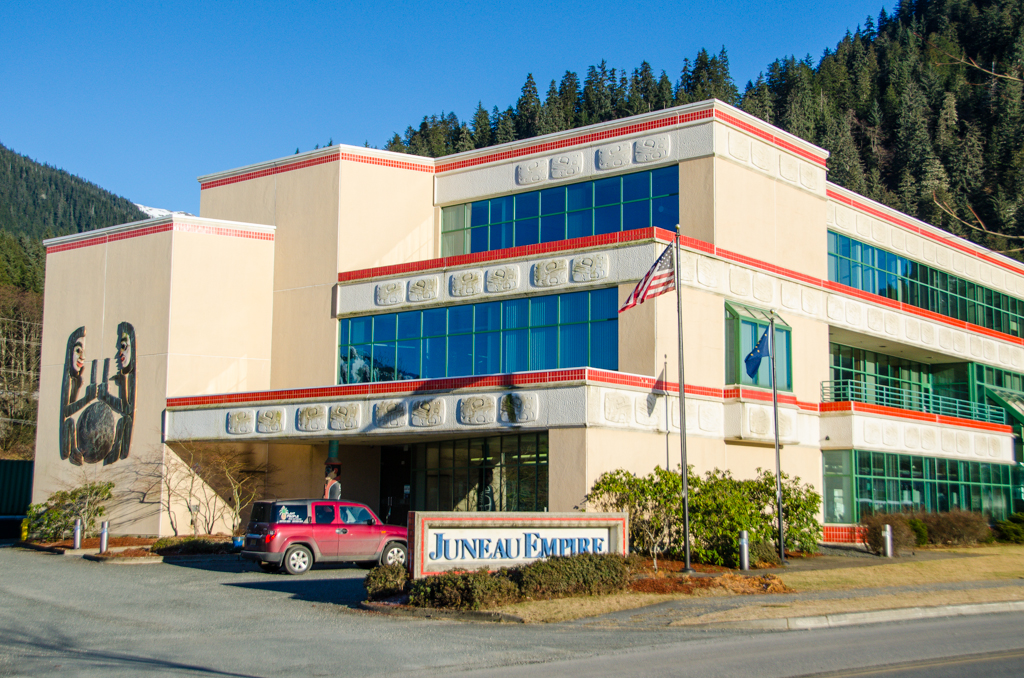
The Juneau Empire on Channel Drive. (Photo by Heather Bryant/KTOO)
A former Juneau Empire reporter says she was fired when she refused to set up a meeting between the publisher and a legislator on a bill that affects newspapers.
Jennifer Canfield left her job as state capital reporter last week.
The last few years at the Empire have been marked by turnover and some uncertainty as its parent company struggled financially.
Municipalities buy space in newspapers to publish notices on certain information, like raising taxes, meetings, and foreclosures. House Bill 275 would give municipalities another option – publish the information electronically, to be accessed on a municipal website.
Rep. Mike Hawker is the main sponsor of the bill. He says it would empower municipalities to find the most cost effective way to operate.
“It’s information that we have determined that it is in the public necessity and good that it’s made available and, as time has progressed and moved forward, there are alternatives to the traditional newspaper route of publication that might actually even do a better and more efficient and effective job of informing a public.”
Juneau Empire publisher Ruston Burton disagrees.
“It’s a common legislative move that’s made in a lot of states, it’s been made before, trying to basically take public information and hide it behind a website that nobody goes to essentially.”
After state government reporter Jennifer Canfield pointed out the bill to Burton, he asked her to set up a meeting with Rep. Hawker. Burton said he intended Canfield be present at the meeting as well.
“In my mind, I’m thinking that as we’re sitting with him, she’s asking the questions – a reporter would be asking the questions about, you know, ‘Why are you wanting to push this bill? What’s the reason behind it? What instigated it to make you feel it was super important?’ It’s pretty simple. There’s somebody pushing a bill, we want to know why, and we’re going to tell the story about it.”
Reporter Canfield didn’t think it was so simple. She didn’t want to do it.
“There really needs to be a firewall between the business side and the editorial side and I think any journalist understands that implicitly,” says Canfield.
To Burton, it was just a meeting. He says the Empire has a financial stake if HB275 passes, but says his concern is not about the money. He says less than 1 percent of the paper’s total revenue comes from municipal notices.
“I didn’t think anything of it at the time when I asked and I didn’t expect such a push back on it either. I don’t know that there’s anything unethical about saying, ‘Hey we’re going to go talk to this guy that’s trying to push a bill and I want to be there when you’re talking to him and you can report the news.’”
Canfield made it clear she didn’t want to set up the meeting.
“It was insisted that I do it, and eventually the conversation got to the point where I was told that if I didn’t do it, our working relationship could not continue. I again expressed my ethical concerns and I was fired.”
Canfield says she got notice of her termination the day after being asked to set up the meeting. She says being fired is a direct consequence of her saying no.
“In our conversation it was pretty clear that was the reason.”
Burton says the two events are unrelated.
“A decision had been made long before there was ever anybody asking for a meeting with Hawker,” says Burton.
Canfield is not the first reporter to abruptly lose their job at the Empire. In 2012, state government reporter Pat Forgey was dismissed from the paper; he went on to cover the capitol for the Alaska Dispatch. His replacement at the Empire, Andrew Miller, quit after just one day, claiming the work environment was “dysfunctional.”
At the time of the interview, Burton still hadn’t set up an interview with Hawker but says he plans to.
Editor’s note: Story updated to clarify that Canfield initially notified Burton about the bill.
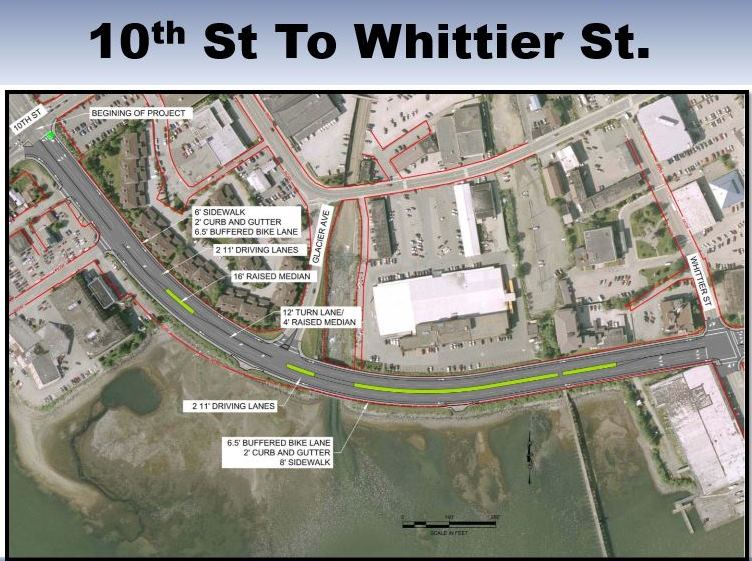
DOT map shows a section of the work to be done in 2015 from Main St. to 10th St. CBJ will also install a new water main.
The Alaska Department of Transportation will resurface Egan Drive from Main Street to 10th Street next year.
It’s a good time to put a new water main along the same route.
The Main Street water main, a Glacier Highway pressurized main, and a sewer lift station are the first of a decade’s worth of water and sewer improvements Juneau needs.
CBJ Public Works Director Kirk Duncan says about a quarter of the city and borough’s water and wastewater system will be replaced over the next ten years.
“We have (about) 275 million dollars in assets for water and wastewater in the city and borough of Juneau. A lot of them were installed in the 80s using federal money from Clean Water Act and the Drinking Water Act and those assets are coming due. We’re estimating it’s going to take about 72 million dollars over the next ten years to bring the assets back into good working order,” Duncan says.
A CBJ utility rate study, underway for several months, recommends paying for that work with CBJ sales tax revenue, cruise ship passenger fees, a revenue bond, and a customer rate increase.
“The rates would go up 9 and a half percent each year for the next five years for both water and wastewater and then 5 percent per year for the last five years of the rate study,” Duncan says.
The current study covers the city and borough’s utility needs through 2024. Customers rates would go up July 1 of this year.
Duncan and a consultant from Seattle-area Financial Consulting Solutions Group will present the funding suggestions Monday at a meeting of the Juneau Assembly’s Committee of the Whole in Assembly chambers at 6 p.m.
On Tuesday, the public can weigh in on rate study proposals at a meeting from 6 to 8 p.m. at Mendenhall Valley Library, and on Wednesday at Hangar Ballroom in Merchants’ Wharf, from 7 to 9 p.m.
(Note of full disclosure: Kirk Duncan is also a member of the KTOO Board of Directors).
Channel 2 News will soon be back on the air in Southeast Alaska. Rural cable subscribers from Valdez to the North Slope will also once again see NBC programming, just in time for the Olympic games.
After months of wrangling, Anchorage NBC affiliate and cable provider GCI have reached a carriage agreement that puts the station back on KATH in Juneau and KSCT in Sitka. The two Southeast stations and Anchorage CBS affiliate KTVA were purchased by GCI last year.
KTUU President and General Manager Andy MacLeod says he’s glad Channel 2 News will return to the Southeast airwaves.
In November, GCI dropped the KTUU signal on its rural cable system, leaving about 7,000 households without access to NBC programming, except what was carried on ARCS, the state-operated channel.
In December, GCI removed KTUU’s flagship news program, Channel 2 News, from the Sitka and Juneau stations, affecting both cable and satellite subscribers. GCI temporarily replaced the Channel 2 newscasts with a program called One America News.
The KTUU signal was restored Thursday in rural Alsaka. GCI says Channel 2 News will back on the airwaves in Southeast within a few days.
While the two companies had agreed on rates in December, the dispute centered on what would happen if KTUU ever acquired another station.
MacLeod says the station is satisfied on that front.
What we got is working with GCI, and they got the same thing. We got a provision that allows us to build our business into the future, unrestrained. So, that’s a significant thing.
McCleod says the agreement comes at a good time for Southeast viewers who want to watch the winter Olympics, carried exclusively by NBC. KTUU has two news reporters in Sochi, Russia, following Alaska’s Olympic athletes.
The negotiations between GCI and KTUU began when GCI bought the three television stations. GCI spokesman David Morris says it is characteristic of disputes across the nation between cable and content providers.
“So, will this happen again in Alaska? We sure hope not, we’re trying to figure ways out to make it not happen. But the way it’s set up right now, if you don’t have a company, whoever your provider is, who says no to some of these demands, then things will spiral completely out of control,” Morris says.
The new agreement covers about three years, so Alaskans shouldn’t expect any disruptions to NBC programming through at least 2017.
GCI recently announced subsidiary Denali Media Holdings is buying three CBS affiliates in Southeast: KXLJ in Juneau, KTNL in Sitka and KUBD in Ketchikan. The stations are owned by Ketchikan TV of Evergreen, Colo. The purchase must still be approved by the Federal Communications Commission.
Students and young athletes in Juneau are mourning the death of a popular coach and special education aide at Dzantik’i Heeni Middle School.
Brandon Mahle was just 31 years old when he passed away unexpectedly on January 30th. He had a wife and two young daughters.
Mahle graduated from Juneau Douglas High School in 2001. He worked at Dzantik’i Heeni for nearly 10 years. He also coached a number of youth sports, including basketball, soccer, and football.
He was Director of Coaching for the Juneau Youth Football League, where he focused on improving player safety. He told KTOO this past fall that safer practices led more players to turn out for the league.
“We have four teams at our younger level, and we usually have three teams,” Mahle said. “Our flag football has over 75 kids, which is just incredible. So numbers have gone up, because kids feel like they can come out and play and they’ll be safe doing it.”
Dzantik’i Heeni Principal Molly Yerkes says Mahle’s commitment to kids will be missed.
“He worked with students who had very serious disabilities and he always was positive, always was looking for ways to help students and allow them to have a positive experience at school,” Yerkes said.
A community celebration for Brandon Mahle will be held Friday from 5-7:30 p.m. at Thunder Mountain High School. A private service for friends and family will be held on Saturday.
He is survived by his wife, Tiffany, and daughters Makenzie and Zoe, as well as his parents, three brothers, and his maternal grandfather.
Note:This story has been updated with comments from Molly Yerkes.
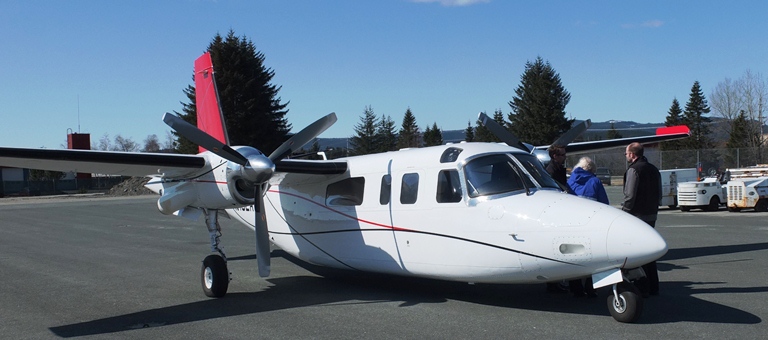
Airlift Northwest has added a Turbo Commander to the Southeast Alaska fleet, for access to communities where the Lear Jet can’t land. Photo by Dick Isett.
Airlift Northwest could bring back its popular membership program under legislation introduced in the Alaska House and Senate.
The state’s Division of Insurance last November told the company to discontinue its AirCare membership, because it no longer met the letter of Alaska law.
That prompted complaints to Southeast Alaska legislators, and Rep. Cathy Munoz started working on legislation to allow air ambulance membership programs in the state. Several Southeast legislators have signed on to the bill.
Airlift Northwest started the Alaska AirCare program in 2008. Nearly all of the more than 32-hundred members are in Southeast, a third of them in Juneau.
An emergency medical flight from Southeast Alaska to Seattle or Anchorage can cost $100,000 or more.
Karla Hart purchased her membership about four years ago, when she learned about the program through her doctor’s office. She says she did some research and figured it was a no brainer:
A hundred bucks to not have to worry if I’ll have a financial hardship if I need a medevac?
A number of Hart’s family and friends are also AirCare members, and so far no one has had to use it.
It’s peace of mind, she says.
AirCare is purchased by household; one membership covers everyone in living in a home. The cost is $100 a year.
It’s considered a supplement to other health care insurance.
Airlift Northwest executive director Chris Martin says the company has always been clear that AirCare is not an insurance program.
“In most medical situations, insurance is billed and then there’s a co-pay. What an AirCare membership guarantees you is that you have no out of pocket expenses or no co-pay. So we bill the insurance, we take what the insurance reimburses us and you as our AirCare member do not see a bill for any further services,” she explains.
The AirCare program operates in Washington state as a non-profit, and was allowed to operate as a non-profit in Alaska under an exemption.
Acting Insurance Director Marty Hester says Airlift Northwest was no longer considered a non-profit when the company restructured under the University of Washington Medical School.
“The program they were offering was a transfer of risk and that is the definition of insurance, when a risk in transferred from one person to another,” he says.
House Bill 300 and Senate Bill 159 should correct the problem. The legislation allows air ambulance providers to offer membership programs like AirCare, and permits the insurance division to adopt regulations covering such programs.
Rep. Munoz’s office worked with Hester on the legislation, but he would not comment on the bill.
She says she heard from a lot of constituents when they found out their supplemental plan was no longer good.
“The legislation will re-establish the opportunity for companies like Air Lift Northwest to provide membership service to residents that wish to have that extra coverage for emergency transport,” Munoz says.
She says more than 1,300 Juneau residents have an AirCare membership and many are senior citizens.
Certainly we live in an area that is somewhat isolated and people, especially seniors and people facing difficult health situations, want this added assurance that they can get out safely and at a reasonable cost,” Munoz says.
According to Airlift Northwest’s Martin, Alaska is the only state in the U.S. that does not allow medevac services to offer a supplemental membership program to help defray the cost of an emergency medical flight.
Close
Update notification options
Subscribe to notifications
Subscribe
Get notifications about news related to the topics you care about. You can unsubscribe anytime.