Community

Surveys profile Juneau’s most vulnerable

A survey of Juneau’s homeless community identifies 74 percent as vulnerable due to health issues, substance abuse, or mental illness. More than a third are veterans.

Volunteers last week conducted the Vulnerability Index Survey throughout the city and borough in an effort to compile a registry of those considered most in need. Survey organizer Kiel Renick says the average time spent on the streets was 10 years.

“It is very difficult to get off the streets in Juneau once a person has perhaps reached the stage that we were targeting with the survey,” Renick says.

Renick Monday presented some of the survey results to the Juneau Assembly Human Resources Committee, which has been working on the homeless issue for several months.

While the city’s homeless population is estimated at 560, the surveys targeted a specific group – who live mostly without any shelter and often have many other problems.

They survey is based on a Vulnerability Index of health and lifestyle risk factors that contribute to a person’s early death on the streets.

“Aspects of vulnerability include a person’s age; their ER, or hospital frequency; health conditions such as tuberculosis, cancer, heart disease, diabetes, things like that; physical disabilities and traumatic brain injury; alcohol or substance abuse, mental health issues and a few other factors,” Renick says.

The Juneau survey reached 47 individuals, ranging in age from 21 to 74, with an average age of 47. Most were males.

Sixty percent of those considered vulnerable were Alaska Native, 26 percent were white, while the rest were African American and other races.

Thirty-seven percent of the vulnerable were veterans.

Nearly half of those surveyed have had a brain injury or head trauma, more than half have a history of mental illness, while nearly 90 percent have had a history of alcohol or drug abuse.

Juneau is one of 114 U.S. cities to join the national 100,000 Homes campaign to identify the most needy individuals and families and find them shelter by the middle of next year.

Choose Respect rally draws big crowd

The crowd gathers across the street from the state capitol building.

As Juneau’s blustery wind blew in a cold driving rain about noon today, more and more people gathered on the capitol steps to “Choose Respect.”

The capital city was one of about 80 communities across Alaska to host events as part of Gov. Sean Parnell’s initiative to raise awareness of domestic violence and sexual assault. Before the week is out, 123 communities will have held a “Choose Respect” march or rally.
Lt. Gov. Mead Treadwell hosted Juneau's "Choose Respect" rally.

“One assault is too many, one rape is one too many, ” Lt. Gov. Mean Treadwell told the crowd of nearly 200. “We want all people to thrive in Alaska. We want Alaska to lead. But we should not lead in the grim statistics of sexual assault, domestic violence and hurting our children. We’ve got to turn that around.”

Anchorage Rep. Anna Fairclough gave some of the grim statistics. “In Alaska, compared to America and other states across our nation, women are 2 point 5 times more likely to be raped during their lifetime. Children, whom we all love and want to see grow to be happy, healthy, protected individuals, are six times more likely to experience child abuse in the state of Alaska,” she said.
Kotzebue Rep. Reggie Joule, an Inupiat Eskimo, has been a victim of abuse. “And choosing respect for me after that kind of violation meant that I had to learn to respect myself,” he said.
As the legislators spoke, the sideways rain started to soak the crowd and the signs. Joule seized the moment.
“In Juneau, in Southeast, where the strongest of the Southeast winds, the Taku, makes us shiver, it’s here to help us to carry this message all across Alaska,” Joule said. “It’s a strong message. It has to be taken to everyone’s heart.”
Thunder Mountain High School basketball players look on as head coach John Blasco spoke to the crowd.

The crowd included more than 30 members of the Thunder Mountain High School boys’ basketball team and their head coach, John Blasco. Two years ago, Blasco introduced the Coach Boys into Men program to his players, which teaches respect of peers, how to be accountable for one’s actions, to value relationships, avoid physical violence, and abstain from using derogatory language.

“We have seen over the last two seasons incredible changes amongst them, as a result of this program,” Blasco told the crowd.
Senior basketball and soccer player Coltin Lanz told this reporter that he was glad to participate in the rally, because choosing respect “is the right thing to do. Plain and simple.”
After the speeches, the crowd — lead by a squad of the Southeast Alaska Panhandlers motorcycle club — marched the four blocks to Marine Park, chanting “Choose Respect” along the way.

After the rally, much of the crowd marched to Marine Park, chanting "Choose Respect."
Before today’s rally began, the Alaska House of Representatives approved House Concurrent Resolution 28, which proclaims April to be sexual assault awareness month.

Homeless woman dies under bridge

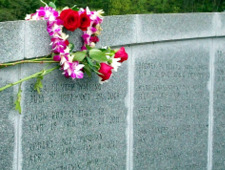
A week before a survey of Juneau’s most vulnerable homeless, a 61-year-old woman was found dead Tuesday under the Gold Creek Bridge.

Glory Hole Homeless Shelter Director Maria Lovischuk says Gloria Plummer periodically stopped into the Glory Hole for snacks and lunches.

“I think she was one of our regular chronically homeless people downtown,” she says.

Lovischuk says Plummer was originally from Angoon, and a number of family members are in Juneau this week for the annual Gold Medal Basketball tournament. The Glory Hole will hold a memorial service for Plummer at 5 p.m. on Friday.

Juneau Police Department spokesman Cindee Brown-Mills says Plummer’s body was found by a friend who called police. She says police do not consider Plummer’s death to be suspicious.

Homeless survey to begin
The Glory Hole next week begins a survey of homeless people throughout the city and borough. Kyle Rennick is directing the survey, paid for by a grant from the Alaska Mental Health Trust.

Rennick says Juneau’s homeless population is estimated at 560, but the survey will reach a smaller group.

“We’re trying to look at a more targeted survey here, to get at those who are living mostly without shelter at all,” Rennick says. “Oftentimes, it will be folks experiencing mental illness, some kind of alcohol or substance abuse issue, and other health issue as well.”

Juneau is one of 114 U.S. cities that have joined the national 100,000 Homes campaign, which has the goal of finding permanent homes for the most needy individuals and families by the middle of next year.

Rennick says 35 volunteers will go out in teams of four with socks, food, coffee and the survey on Tuesday, Wednesday and Thursday. He says they’ll cover Thane to Douglas to the Mendenhall Valley, with the goal of quickly connecting people to existing services.

“Basically identify them, find out what their needs are, what their health histories are, and then try to get them into treatment, or housing, or both, as fast as possible,” he says.

Rennick says the personal information will be condifential, but retained so those who cannot be placed now can be identified and helped later when more housing is available.

Though the survey is scheduled for three days next week, he says the Glory Hole will continue to collect information from homelss people who are missed.

Neva Egan collection donated for public research

State historians Tuesday welcomed the donation of materials collected by the State of Alaska’s first First Lady. Nineteen boxes of various sizes contain a treasure trove of items collected as far back as seventy years ago by Neva Egan, wife of Governor Bill Egan.

The documents include notecards detailing Bill Egan’s votes in the Territorial Legislature to Governor’s Mansion expense reports, newspaper clippings of Egan’s first year as Governor, drafts of letters that Neva dictated for her husband, and pictures of her christening ships and meeting with presidents. There’s an invitation to a White House dinner and letters from Mr. Snowhook’s class at Harborview School apologizing for breaking a ledge in front of the Mansion during a trip to the library.

Jim Simard, head of Historical Collections, says the materials present a unique view of the late Territorial and early Statehood years. Simard says they’ll continue to itemize the materials. Some of the pictures may be digitally reproduced for on-line archives.

iFriendly audio

All of the materials will be available for public research purposes.

Neva Egan passed away in January 2011 at the age of 96.

Her son, Senator Dennis Egan, and his wife Linda formally signed over the materials during a short event at the State’s Historical Collections Tuesday afternoon.

iFriendly audio

SE Native leader, former Alaska BIA chief Cesar passes away

A leader in moving Alaska Native tribes to greater self-determination died over the weekend. KNBA’s Joaqlin Estus has this story on the life of Niles Cesar.

iFriendly audio

A Tlingit Indian from Juneau, Niles Cesar served twenty years in the Medical Service Corps, including a year in Vietnam. He retired from the Navy as a Lieutenant then completed a B.S. degree in environmental health.

From 1979 to 1990, Cesar was executive vice president of the Southeast Alaska Regional Health Consortium. For the next 19 years, he served as director for the Alaska Bureau of Indian Affairs. His colleague there, Charles Bunch, says Cesar headed the region after the Native American Self Determination and Educational Assistance act opened the door for increased tribal self-determination and the transfer of responsibility for direct services from the agency to tribes:

“Almost half the federally recognized tribes in the United States are in Alaska and Niles made great, great strides in helping them to contract out these government services,” he says.

Bunch says Cesar’s push for tribal self-determination carried through to his advocacy of a mainstay of Native life.

“I think that the Natives of Alaska have lost a champion as one of the members of the Federal Subsistence Board I think Niles worked hard to ensure that way of life was continued in Alaska,” says Bunch.

Cesar served on the boards of the Native corporations Sealaska and Goldbelt, and was a council member on the Juneau Tlingit and Haida Community Council. He was a member of the Raven moiety and L’ukwaax.ádi clan. Anchorage services will be held at 1 p.m. Saturday at the St. Elizabeth Ann Seton Catholic Church. The family plans to announce Juneau services soon. Niles Cesar passed away last Saturday at age 70 after a long struggle with cancer.

Avalanche mitigation public hearing tonight

Mt. Juneau

An avalanche mitigation study for the neighborhoods at the base of Mt. Juneau says the best way to manage risk is to have the city buyout homes in the area.

Juneau Emergency Programs Manager Tom Mattice says that’s not the answer the city was hoping for when it commissioned the study. He’ll hold a public hearing tonight on the report.

We were hoping that we could build big diversion dams above the houses, and put in some kind of mitigation systems on the hill that did active avalanche control,” Mattice says. “Our goal was not to create a finding that we had to buy everything out and move it. But the reality is we asked the best people in the world to give us their assessment and that’s what they came up with.”

The study – conducted last year by consultants from the WSL Institute for Snow and Avalanche Research in Switzerland – says hillside diversion systems might work above the White Subdivision, but further study is needed.

Mattice will describe the research and proposed solutions, and take questions at tonight’s public meeting. Then he plans to rewrite Juneau’s All Hazards Mitigation Plan to incorporate the study’s findings. Changes to the plan must be submitted to the state and federal governments for approval. Once that happens, Mattice says the city could get funds for a potential buyout through the Federal Emergency Management Agency.

“Basically, anytime there is a disaster in the State of Alaska, if it is a federally declared disaster, there is a certain amount of money that is spent. At the same time, they earmark a percentage of that dollar figure, and set it aside for mitigating against future disasters,” he says.

Mattice stresses that any buyout program would be voluntary for homeowners.

“The city can’t just say, ‘This is what we want to do,’ without getting buy-in from other parties, including the public,” says Mattice. “So having this public hearing is one of the many steps that’s needed to gain approval of an update to the All Hazards Mitigation Plan.”

Mattice says he’s talked to some residents of the White Subdivision about the mitigation report, but has yet to discuss it with anyone who lives in the Behrends neighborhood.

Tonight’s public hearing starts at 7 p.m. in CBJ Assembly Chambers at City Hall.

Site notifications
Update notification options
Subscribe to notifications