A memorial service is planned for February 12th for former Hoonah Mayor Alf ‘Windy’ Skaflestad, who passed away last Saturday at the age of 75 after a long battle with prostate cancer.
Born and raised in Hoonah, Skaflestad served two-terms as mayor after retiring from the Public Health Service. His job as a construction supervisor for sanitation projects brought him all over Alaska.
“I was born right here, but I traveled all over the state, I worked all over the state from Point Hope to Hydaburg, so I got to know the state pretty well,” he told KTOO in December 2010.
Skaflestad was mayor in August 2010 when two Hoonah police officers were shot to death on the town’s Front Street.
The thing that helped Hoonah weather the tragedy, he said, was a strong sense of community and teamwork – like everybody pitching in to keep the town clean.
“We have a group of ladies that do a lot of walking, and they carry the garbage sacks with them, and they pick up the garbage that they do find along the road and dispose of it,” he said. “So, like I say, all of this working together as a team is just wonderful.”
Skaflestad is survived by his wife, Joyce, four children, five step-children, 12 grandchildren and a large extended family.
His memorial service will be held at the Hoonah ANB Hall.
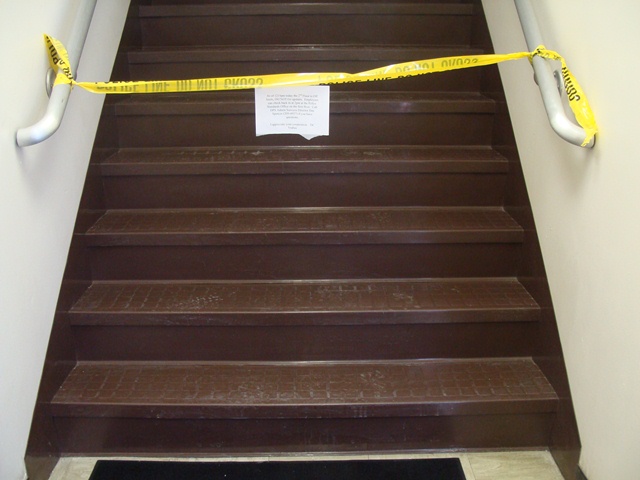
This sign warned employees at the Alaska Dept. of Public Safety building in Juneau not to go up to the 2nd floor. (Photo by Casey Kelly/KTOO)
The second floor of the Alaska Department of Public Safety building in Juneau was evacuated for about an hour this afternoon (Monday), while a structural engineer checked the facility.
State Chief Procurement Officer Vern Jones says employees in the building heard a noise, which was determined to be the main structural beam shifting under the weight of heavy snow on the roof.
“We’re told the design of the building was meant to allow for some deflection, and the question really was, was that within what the building was designed for? And we were told that yes it was, and the building was safe to occupy,” says Jones. “Almost certainly it was the snow on the roof, just the weight of the snow.”
Signs posted on the first floor of the building informed workers that the 2nd floor was off-limits as of 12:15 this afternoon. “DO NOT Go upstairs,” the signs warned. Deputy Public Safety Commissioner Terry Vrabec says employees were cleared to return at about 1:30 p.m. He says about 20 DPS employees were affected by the evacuation.
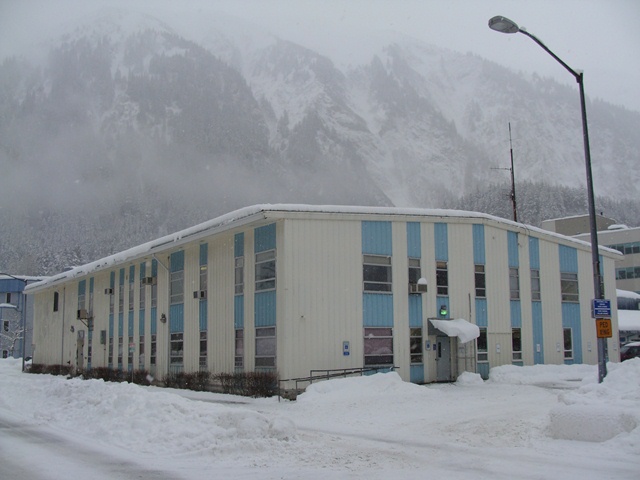
The Dept. of Public Safety Building in Juneau. (Photo by Casey Kelly/KTOO)
Built in the 1970s, the structure was originally meant to be a temporary home for Public Safety employees.
Last October, the Parnell Administration opted not to build a new state office building in Juneau, which would have housed employees from the Departments of Public Safety, Labor, Fish and Game and Corrections. Instead, the administration decided it would focus efforts on renovating the Douglas Island Office Building.
At the time, Administration Commissioner Becky Hultberg said the Public Safety building was not worth renovating and employees would have to be moved at some point. Jones says there’s no timeline for moving those workers.
“That’s still an ongoing process. I really don’t have any information to update you at this time. But it is an ongoing process,” says Jones.
In the dozen or so years he’s managed the Public Safety Building, Jones says this is the first time he can remember an issue with structural integrity.
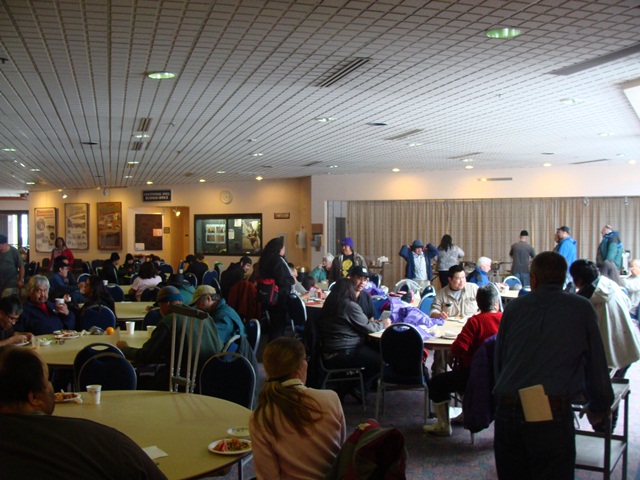
Hot lunch is served at Centennial Hall at Wednesday's Project Homeless Event in Juneau. (Photo by Casey Kelly/KTOO)
The Juneau Homeless Coalition’s 3rd annual Project Homeless Connect event was held at three downtown locations today (Wednesday).
The purpose is to take a snapshot count of the city’s homeless population, and provide them with free services, including health care, housing and legal help.
Event organizer and Juneau Economic Development Council Affordable Housing Coordinator Scott Ciambor says more than 50 social service agencies took part this year.
“The goal on a general basis is just to kind of get a gauge for the community on who might be experiencing homelessness on a broad scale,” says Ciambor. “Agencies coordinate with this information to try and dig down and solve particular problems.”
Ciambor estimates Juneau’s homeless population at more than 550 people. That includes individuals camping or living in cars, as well as those temporarily staying with family or friends, or at a motel. He says Juneau’s homeless population ranks very high compared to other communities on a per-capita basis.
“Our official count last year was 562 people homeless, and for a city this small, that’s a pretty large number of people to be displaced, primarily because the housing market is so tight and there’s not a whole lot of development going on,” he says.
In the first two years of the Homeless Connect program, Ciambor says the Homeless Coalition has been able to glean some information about Juneau’s homeless population.
“In 2010, there were 50 or so veterans above the age of 45 who were homeless. So, that enabled coalition agencies to make phone calls to the Veteran’s Administration to see if there was potential of solving those issues,” Ciambor says. “Last year, it was high number of Native Alaska shareholders. I believe it was 106 of the people we saw last year were Sealaska Native Corporation shareholders. So we were able to give that information to them and say, ‘Did you know?’ Who knows what the outlying statistics will be this year.”
19-year-old Willy Boone gets a haircut at Wednesday's Project Homeless Connect event in Juneau. (Photo by Casey Kelly/KTOO)
Nineteen-year-old Willy Boone says he’s been couch surfing for a while now. He took advantage of Project Homeless Connect’s free haircuts, but said his main reason for coming was to get a new ID.
“I need it to get a job and just, like, basic life things,” says Boone. “It’s not smart not to have one. It’s kind of like a passport. You can’t leave the country without one.”
Ciambor says it should take less than a month to finalize this year’s point-in-time count, as well as estimate how many people used services at this year’s event. He says Project Homeless Connect helped more than 150 people in each of the first two years of the program, and was on track to help at least that many on Wednesday.
Architect Brian Meissner with the Anchorage-based firm ECI/Hyer says the design team sees a 20-million dollar appropriation in Governor Parnell’s proposed capital budget as a green light to start actual construction this year.
“This is the current plan: Get in the ground this summer and be done by the end of ’14 – so moving in in 2015. It may adjust if the funding comes on a different plan. That’s yet to be seen, but we’re feeling very good about it,” says Meissner.
Total cost for the project is estimated at more than 120-million dollars, of which 32.5-million is already on hand.
PCL Construction Services has been chosen as general contractor. Meissner says the first order of business is to build a vault to house some of the museum pieces during construction.
“Basically what we’re doing is we’re building a temporary storage for the artifacts – not for people – then we’re going to build the rest,” Meissner says.
The State Museum will be closed in 2013 and 2014 while the SLAM facility is under construction. During that time, Museum Curator Bob Banghart says they hope to set up temporary exhibits in Centennial Hall for visitors in Juneau, and to expand services to other facilities around the state.
“We dedicate a good portion of staff time in support of other institutions around the state with expertise that’s not just servicing them with exhibitions. It’s everything to do with museology, library development, archival assistance, etc,” says Banghart. “So those are manpower issues. We can send people; we’ll still maintain the communications there. We won’t lose that.”
Banghart says he’s a little concerned about the museum losing cruise ship visitors during the closure. But he says tourism companies have told him they’re excited about the new facility.
“They’re very interested in ratcheting up marketing of our institution to their clients, which means I think we’ll see an increase,” Banghart says.
The 118-thousand square foot SLAM building will double the amount of space currently used to house the Division of Libraries, Archives and Museums. The facility will also bring all three functions under the same roof, creating more efficiency and better access to the state’s historical and archival material.
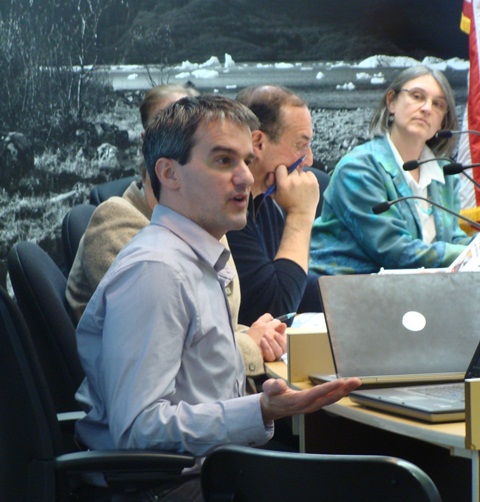
Meissner and Banghart updated the CBJ Assembly on the project’s progress at last night’s Committee of the Whole meeting.
COYA will air on 360 North television beginning Wednesday.
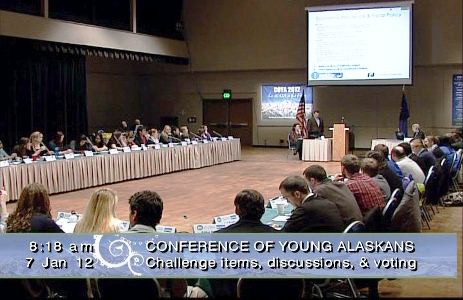
Reinstate Alaska’s coastal management program and maintain the current oil structure — two of many recommendations from last week’s Conference of Young Alaskans meeting in Juneau.
Fifty-five delegates from 28 Alaska communities, all under the age of 25, plan to present their vision of the state to the Alaska Legislature in the spring.
As the 2012 conference came to a close Saturday, delegates proudly patted their peers on the back, congratulating each other on the final document they produced.
The phrases awe-inspiring, empowering, honored, and eye-opening were used countless times to describe the three-day conference. Every delegate seemed positively affected by the conference, including 18-year-old Brad Gusty from Stony River.
“I now know issues for other people in Alaska, like other communities and what they want,” he said.
COYA delegates bonded over their passion for Alaska as they discussed issues pertinent to the state. The final result of their discussion and debate was a document that represents the consensus of the group on five topics – economic resilience and fiscal policy, education, workforce development, energy, and living harmoniously. In addition to oil and coastal management, recommendations include, among other things, reinstating a state income tax, mandating that all utilities use net metering at competitive rates, and repealing Article 1, Section 25 of the Alaska Constitution, which describes marriage as between a man and a woman.
Twenty-year-old Leyonty Williams is one of several delegates selected to present the document to the legislature in March.
“We set aside our differences and just came together for something greater,” Williams said. “It was kind of funny because a lot of us were pretty upset when there was only like 98 percent (agreement). That just shows what high expectations we have for this and how unified we feel.”
In the final report, the delegates leave Alaskan leaders with this challenge: “Just as our predecessors challenged us, we challenge you to help others to love and cherish our homeland and lead Alaska forward.”
The final report will be available at youngalaskans.org later this month.
The entire 2012 Conference of Young Alaskans can be seen on statewide television, 360 North, beginning Wednesday at 8 a.m.
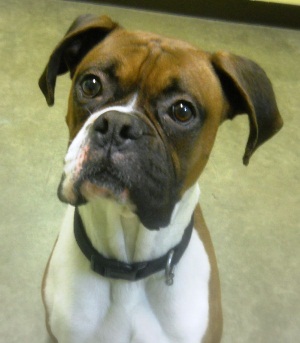
It’s a full and noisy house at the Gastineau Humane Society. The animal shelter over the weekend had more than 20 dogs up for adoption, including 11 puppies that have been in foster care.
Shelter director Chava Lee said Friday most of the dogs came into the shelter last week.
“You know every morning I’d hear, ‘Oh, we got two more dogs last night; well, we got another dog; well, we got three dogs today,’ ” she said. “And you know those added up to ‘What do you mean we have 22 dogs at the shelter?’ ”
Lee said the dogs are not Christmas rejects; she expects those to begin coming in next month.
And while the dogs have not been “dumped,” she said the shelter does have more than usual. She said they all came from people moving out of town who could not take their dog, or from homes where for one reason or another, families could no longer care for them.
Gastineau Humane Society maintains a list of foster families, who care for animals in their homes until permanent homes can be found. That was the case of the 11 puppies, born to a dog rescued from a Southeast village. She said the foster family had its hands full.
“They had to feed these pups by bottle every few hours and they did it,” Lee said. “They have small children and the small children have friends, so these pups have been around a lot of kids and they are just incredibly well-socialized, sweet dogs.”
She said the foster-to adopt puppies are a Rottweiler and possibly Lab mix.
Lee said the shelter also has 16 pups from two litters “waiting in the wings,” to be prepared for adoption.
Close
Update notification options
Subscribe to notifications
Subscribe
Get notifications about news related to the topics you care about. You can unsubscribe anytime.