Energy & Mining

Tree cutting causes morning power outage

Residents out the road in Auke Bay and Lena Loop lost power for about 20 minutes this morning. The rest of Juneau may have noticed a brief power glitch.

Debbie Driscoll with Alaska Electric Light and Power says a tree that was being cut down fell on a line.

It took out power to feeders in Auke Bay and Lena Loop. A crew isolated the affected transformer and restored power within 20 minutes.

Driscoll says AEL&P was not responsible for the tree cutting.

Oil prices surge as Alaskans stockpile for winter

Prudhoe Bay at night.
Prudhoe Bay at night. (Photo by J Weston/Flickr Creative Commons)

The state of Alaska wants oil prices high.

“Every dollar change in price is close to 100 -150 million dollars in state revenue,” said acting Revenue Commissioner Angela Rodell. “Short term volatility like you’ve been seeing in the past few weeks, given things going on around the world, create a lot of distractions.”

The recent coup in Egypt gets all the headlines is not the reason for the jump, said Frank Verrastro. Verrastro, a senior vice president at the Center for Strategic and International Studies, said fears over control of the Suez Canal are legitimate.

Other conflicts, he said, are having more tangible effects.

“The Iraq Ceyhan Pipeline has been down, and that’s reduced exports out of Iraq. There’s been problems down in Basra,” he said by phone Monday from Washington.  ”Syria, Yemen, Nigeria, and the fact that Libyan production is down 600,000 – 700,000 barrels a day.”

All this means that Alaska has little control over a global commodity. High oil prices translate to higher fuel costs, especially in hard to reach rural Alaska.

Throughout western Alaska, villagers are ordering and stockpiling hundreds of gallons of heating oil for the winter.

Bob Cox, vice president with Crowley Maritime Corporation – the company that barges refined oil products to western Alaska, said there are about three weeks left for the final barge of the season to make the journey.

The company stores the fuel in tanks throughout the state. Both Crowley and other companies sell the fuel to villagers.

Cox said the company monitors global oil prices to get the best price, and this year, it tried something new: Buying  300 thousand barrels of heating oil from China.

“That arrived off the west coast of Alaska in July. We offloaded that and brought that into our tank farms because that was a better value at that time, then U.S. prices,” he said.

The company still needs to finalize its price for the final barge.

Crowley uses the price per barrel the day the barge is loaded in its calculation for final prices.  Cox says about one-third of Crowley’s cost is overhead, distribution, profit and transportation – the rest is the product.

“So we’re somewhat hostage to whatever is going on in the oil markets at the time we’re loading the barges,” Cox said.

Oil prices have been higher before: They hit $120 a barrel when the Arab Spring erupted.

Coeur and Hecla see losses in second quarter

Greens Creek Mine.
Greens Creek Mine. (Photo courtesy Hecla website)

The parent companies of Juneau’s gold and silver mines have posted a net loss for the second quarter of 2013 that ended June 30th.

Coeur Mining, Incorporated reports a loss of $35 million, or 35 cents per share. Hecla Mining Company lost $25 million, or 8 cents a share in the second quarter.

Coeur owns Kensington Gold Mine about 45 miles northwest of Juneau. Hecla owns Greens Creek, a gold and silver mine on Admiralty Island.

Hecla reports an 18 percent increase in silver (to 2.2 million ounces) over the first quarter, due to strong production at Greens Creek and the re-opening of the Lucky Friday mine in Idaho.

Hecla also has completed its acquisition of Aurizon Mines of Quebec, which led to a significant increase in gold just for the month of June, the company says.

Both companies released their second quarter financial reports yesterday (Thursday).

Coeur President and CEO Mitchell Krebs said silver production increased 21 percent (to 4.6 million ounces) over the first three months of the year.

Gold production was up 7 percent (to 60,757 ounces.).

Coeur’s increases were mostly due to strong production and high grades of gold and silver at the Palmarejo Mine in Mexico. Krebs said that was not the case at the Kensington, which produces only gold.

“Kensington was basically flat compared to the first quarter due to lower grades, but is positioned for a strong second half.”

Krebs said Kensington, now in its third year, is expected to increase production of higher grade ore through the rest of the year.

To deal with falling metals prices, both Coeur and Hecla have reduced operating and capital costs company wide.


Pebble Mine waits, frustration grows

Bristol Bay Watershed Map
Bristol Bay Watershed. (Map courtesy EPA)

Pebble Partnership CEO John Shively has maintained for years that his company will submit its application soon.

“Well, we’re still working on that,” he said by phone Tuesday morning. “I do really think that there’s a better than even chance that we will submit our permit application later this year.”

The EPA should release its final watershed assessment for the mine site in the next couple of months. Shively and the mine’s backers fear the EPA could veto the mine outright – before the company submits its permit application – because of harmful affects to salmon habitat.

If it does not, the company could try to win approval with the Army Corps of Engineers.

Senator Mark Begich, like the entire Alaska delegation, said the company should have a chance to apply for a permit. The federal government could rule out the mine then, but he said the EPA should not use its authority to prohibit the permit process.

Still, he said the Pebble Partnership has gained a competitive advantage by waiting so long.

“What I always hear from the industry is ‘We just need to know what the agencies are going to require us to do. Ok? Well in Pebble’s case, you’re going to know before you pull a permit,” he said last week. “That’s not a bad position if you’re a mining company. Now you have an option to say: ‘now I know what they’re going to require me to do.’ You can say, does this meet our economic ability?’”

The Pebble Mine could be one of the world’s largest. Developers hope to extract gold, copper and molybdenum. The Pebble Partnership touts the copper for future renewable energy projects.

But opponents of the mine, including many local tribal governments and the Bristol Bay Native Corporation, worry it will destroy the salmon habitat crucial to both commercial and subsistence fishing.

They petitioned the EPA to veto the mine using its so called 404c authority. Its draft watershed assessment said the mine would destroy dozens of miles of streams.

Wayne Nastri reviewed the assessment for the Bristol Bay Native Corporation.

“And I found that its conclusions are sound, and if anything, conservative,” he told a House oversight panel last week.

Nastri, regional administrator for the EPA during the George W. Bush administration, consults for BBNC and has worked with Trout Unlimited in the past.

“The watershed assessment identifies significant adverse affects to the fishery, and is a key trigger for 404c action. EPA has the opportunity to provide clarity and certainty to those who live and work in the Bristol Bay region by initiating such action,” he said in prepared remarks.

Certainty is something that everyone wants: from local fisherman to the Pebble Partnership to legislators in D.C.

Senator Lisa Murkowski fired off a letter to Shively last month telling him to hurry up, that it’s in his company’s best interest to submit its application.

She didn’t say whether she thinks the mine is a good investment.

“When you think about development of Alaska’s resources – our oil up north, our fisheries, our timber. I think we can look historically to some actions and development proposals that we’re not exactly proud of in our state,” she said.

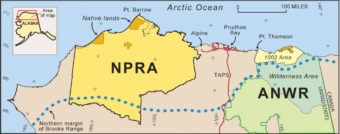
She ticked off a list:  near decimated fisheries, clear cutting in the Tongass National Forest, legacy wells in the NPR-A.

“There may have been a time when you could not build a dam, a tailings pond like Pebble is talking about, without it impacting the watershed,” she continued. “I happen to believe we’re pretty smart nowadays. Our technology has come a long way.”

The mine would be on state land. And that’s where Don Young comes in. To Alaska’s lone Congressman the issue isn’t about fish or metals or money. It’s about state rights.

“If EPA comes in with this decision says the mine can’t get developed on state land, we have lost our state totally,” he predicted. “There will be nothing done in that state: No more mining, no more drilling. It’ll be lawsuit after lawsuit after lawsuit.”

Young said both the mine and fishery can thrive can coexist in one of the poorest regions of Alaska. There are some 14,000 fishermen in Southwest Alaska.

“It’s an amazing thing people say they can’t [coexist]. That’s wrong. I believe this very strongly. Look at the Copper River king. Why do they call it the Copper River king?” he asked.

He answered his own question – because of copper. He said mining near Cordova never disrupted the King Salmon runs on the Copper River.

Pebble CEO John Shively said he hopes to meet with the new EPA Administrator Gina McCarthy to make his pitch.

Federal Judge Rules Shell’s Spill Plan Sufficient

BSEE photo of damaged containment dome on board the Arctic Challenger in Sept. 2012
The Arctic Challenger’s containment dome, crumpled after a field test in Puget Sound in Sept. 2012. Credit: BSEE

Shell’s 2012 campaign was not short on mishaps: A rig that ran aground, a failed test of spill containment systems, and small punishments from the government – including a ban on drilling deep into hydrocarbons.

The Department of Interior allowed the company to proceed with pilot hole drilling despite not having a system in place to contain a worst case scenario oil spill.

“We have both a government willing to accept corporate assurance, and a company that clearly is not prepared for the Arctic,” complained Oceana attorney Michael Levine.

Oceana is one of the groups that filed suit. Levine said the government should have forced Shell to file an environmental impact statement for its Arctic plan.

The judge ruled that Shell does not need to submit to the E-I-S process. Congress would need to rewrite the laws to require that.

“The government argued, and the judge agreed, that in approving a spill plan the Bureau of Safety and Environmental Enforcement has to do little more than check off on a list that Shell has particular equipment. It doesn’t have to decide whether it might actually work, whether those technologies have been tested, or might do the things the company says they will.” – Levine

Shell declined to speak on tape for this piece, but in a written statement, a spokesperson said the company welcomes the news.

Shell suspended its Arctic campaign after last year’s blunders. The federal government then released a report increasing expectations for any future drilling companies in the Arctic. Shell has not specifically said when it will return to the Chukchi and Beaufort Seas.

The groups could appeal the ruling to the Ninth Circuit in San Francisco.

AJ Mine compact renewal stands — without a public hearing

Despite a public outcry on a recent AJ Mine resolution, the Juneau Assembly Monday refused to reconsider a vote and discuss the issue.

The Assembly two weeks ago approved Resolution 2656, renewing a 1979 compact for property owners CBJ and AJT to act as a single entity for future mine exploration and development.

Before it appeared on the July 16 agenda, the resolution had not gone through an Assembly committee, nor had a public hearing.  Attempts by three members failed to table the resolution or send it to the Committee of the Whole. At the end of that  meeting, member Jesse Kiehl called for reconsideration of his vote, vowing to bring up the issue again.

The public beat him to it.  Several residents came before the panel on Monday, asking members to reconsider, including Juneau resident Bob Sylvester.

“I think that democracy, for lack of a better word, is time consuming and inefficient. I know people would like to get on with this project (re-opening the mine). But I believe the public has the right to be heard in a thorough public process,” Sylvester said.

The city and borough owns two-thirds of the AJ Mine property and one-third of the Treadwell Mine in Douglas. AJT Mining Properties, a sister company to Alaska Electric Light and Power, owns the rest. The 34-year-old compact joins the property.  City Manager Kim Kiefer previously called the compact update a “housekeeping” measure that only demonstrates the commitment of CBJ and AJT to make the property available for mining development.

In the two weeks since the Assembly approved Resolution 2656, members have received on online petition with 140 signatures as well as numerous emails asking that it be brought up again. They’ve have been stopped on the street by constituents, and criticized in letters to the editor.

Kiehl said he’s had personal conversations with ardent mine supporters and critics, all saying the resolution should have a public hearing.

“What I’ve heard overwhelmingly in those comments  from the public is that they still don’t know what it does, and they’re not sure if it’s a good idea and they’d like us to hash it out a little more and to do so in public,” Kiehl said.

Guy Archibald, of the Southeast Alaska Conservation Council, was one of those reminding the Assembly that re-opening the old mine has been one of the most divisive issues to ever come before the town.

“There cannot be any Assembly action on the AJ Mine that’s dismissed as either routine or just processing paperwork without also dismissing the very strong feelings and emotions from a large portion of this community,” Archibald said.

When Kiehl called for reconsideration of the resolution, his motion failed on a six to three vote.   Only Kiehl, Karen Crane and Loren Jones voted to hear the issue again.  Mayor Merrill Sanford, and members Carlton Smith, Randy Wanamaker, Mary Becker, Jerry Nankervis, and Johan Dybdahl voted against reconsideration.

Thane Road resident Larri Spengler was surprised that no members explained why they would not allow a public hearing on the resolution.

“I think it would have lost nothing to have a meeting, talk about it in public and then have the vote. And if the Assembly still thought it was a good idea they could still do it, but people would have been brought along, and that’s really the key,” she said.

The question before the Assembly was simply whether to talk about the AJ Mine compact update in public.  It was not a question of the merits of the compact .

Juneau’s main source of water comes from Last Chance Basin, which sits atop, adjacent to and beneath the ore body, just above downtown.

Site notifications
Update notification options
Subscribe to notifications