Energy & Mining

Stedman: Oil tax break a ‘gift’ to industry

Sen. Bert Stedman, a Sitka Republican.

Sen. Bert Stedman calls this year’s rollback of state taxes a “gift” to the oil industry. And while he’s not unhappy with many of the structural changes to the oil tax scheme in Senate Bill 21, he says the numbers just don’t make sense.

Stedman was one of nine Alaska senators to oppose the bill, which passed by a margin of one vote. He outlined his reasons for the Sitka Chamber of Commerce this week (4-24-13).

Bert Stedman has always been a numbers man. That’s why Gov. Frank Murkowski appointed him to the Senate ten years ago.

His defiance of his own party’s signature legislation this session was more mathematical than political.

Stedman told the Sitka Chamber that the costs of extracting oil from Alaska’s “legacy fields” — Prudhoe Bay and Kuparuk — were high, but not uneconomic. About $30 per barrel.

Given the price of oil, he couldn’t make sense of the billion-dollar-plus annual tax break.

“Oil today is at $100. You don’t need to move $1.7 billion. It doesn’t fix anything. So it was, in my opinion, quite a gift to the industry. And they have not come forward and expressed in any definitive terms or timelines what they’re going to produce.”

The Parnell administration, and even Stedman’s own Republican majority, frequently contrast declining production in Alaska with current booms in North Dakota and Texas. The economics of producing oil in the developing world were also debated this session.

Stedman pointed out that Alaska had the only publicly-owned super-fields in the world. Oil development in the lower 48, on the other hand, was taking place in areas where mineral rights are privately owned. (Note: KCAW News did not paraphrase this remark accurately as written here. A more accurate reading would be “…in the country” rather than “…in the world.” Listen to the source material here.)

As for the Third World, Stedman said the costs of obtaining oil in arctic Alaska were high, but there were advantages.

“We don’t have revolutions. So you’ve got to recognize that. We have a stable judiciary branch. You’ve got to take care of that. We’ve got shipping transportation across the Pacific that can be protected by our US Navy — we don’t have to go through choke points. You’ve got to take that into account. And you certainly have to take into account one of the top ten most prolific oil fields on the planet. This is not North Dakota.”

Stedman said Alaska’s North Slope could be producing for generations.

A citizen initiative to repeal SB 21 is already in the signature-gathering stage, with the hope of having a question on the ballot for the August primary election in 2014. Although the initiative is the brainchild of Democrats hoping to put the unpopular tax breaks before voters, Stedman is on board.

“I’m going to sign that thing if it comes around. That’s my opinion of it.”

Beyond the math, Stedman is concerned about the impact the loss of over $1-billion a year in revenues will mean for the state. He said Railbelt legislators were “circling the wagons,” and had no incentive to back issues important to coastal areas, like the Alaska Marine Highway.

He and four other senators from the Republican majority caucus organized a new caucus around coastal communities. Five doesn’t sound like a big coalition, but in the Alaska’s 20-member senate it’s enough.

“Once you have five, and there’s fifteen in the majority, it doesn’t take a mathematician to figure out you can’t get to eleven to move something without one of the Coastal Caucus members agreeing with that issue. So that changed the dialog internally with the senate. It changed their attitudes, quite frankly.”

Stedman says the reduction in oil revenues will force the state into deficit spending for several years, drawing down its $16-billion in reserves. As money gets tight, he expects the Coastal Caucus will ensure that rural and urban areas share the pain equally.

“So as this group coalesces and comes together you’ll see some of our rural issues on the table, or we’ll just start, hopefully, blocking and shutting down the system.”

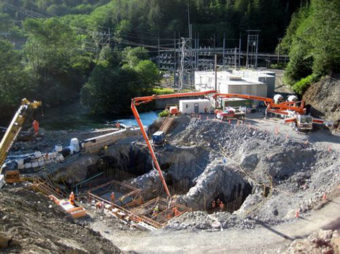
Stedman said he’ll continue to push for funding for the Blue Lake Dam expansion in Sitka, primarily through working with the Alaska Energy Authority. A driving course at the Public Safety Academy, the Mt. Edgecumbe swimming pool, and a road to Katlian Bay all remain priorities for him.

Stedman’s financial discipline and ability to cross party lines on major issues seemed welcomed by the Sitka chamber. Asked by an audience member if he would ever consider running for governor he replied, “The Republican party is heavily dominated by oil service industry contributions. That pretty much puts it in a nutshell.”


See Original Story and hear the audio here:

Stedman: Oil tax break a ‘gift’ to industry

Greenpeace searching for Arctic whistleblowers

Paula the Polar Bear in front of Helsinki encouraging president Obama to stop Shell's Arctic drilling.
Paula the Polar Bear in front of Helsinki encouraging president Obama to stop Shell’s Arctic drilling. (Photo courtesy Greenpeace Flickr)

Greenpeace is trying to coax would-be whistleblowers to come out against the Arctic oil companies they work for.

The environmental group launches a website today called Arctic Truth.

On it, workers are encouraged to anonymously tip off infractions.

“We don’t actually quite know what information we’ll get,” says Ben Ayliffe.

Ayliffe heads Greenpeace’s Arctic oil campaign. He says there haven’t been any responses yet, and it will take some time.

He hopes workers all over the Arctic, not just Alaska, will emerge and expose risks the companies might be taking.

He says information could come from anywhere, from workers offshore.

“To decision makers in Anchorage and Houston that have information we think is interesting and relevant.”

Spokespersons for Shell Alaska and ConocoPhillips had nothing to say about the latest attempt from Greenpeace to block their planned drilling campaigns.


Shell’s Arctic ‘beer can’ passes federal test in Puget Sound

BSEE photo of damaged containment dome on board the Arctic Challenger in Sept. 2012
The Arctic Challenger’s containment dome, crumpled after a field test in Puget Sound in Sept. 2012. Credit: BSEE

Shell Oil had to postpone its Arctic drilling for a full year after one of its oil rigs ran aground off the Alaska coast this winter. But Shell’s efforts to open a new frontier of oil exploration in the Arctic Ocean continue in Puget Sound.

The oil giant passed a key test with federal regulators last month in the waters off Anacortes, Washington.

It took several tries, and neither Shell nor the federal government announced the results.

But a contractor successfully deployed Shell’s Arctic oil-spill containment system in Samish Bay in March.

Crews from Superior Energy Services lowered a steel dome over the side of Shell’s Arctic Challenger barge.

They anchored the dome in 150 feet of water and successfully sucked up seawater at a rate of about 2,000 gallons a minute.

That’s what the dome’s supposed to do if a blown-out well gushes oil and gas from the bottom of the Arctic Ocean.

Earlier tests of the containment dome had gone badly. In September, the 20-foot dome wound up “crushed like a beer can.”

In an email, Nicholas Pardi with the federal Bureau of Safety and Environmental Enforcement said the spill system handled more than twice the volume of oil that’s expected in a worst-case well blowout.

Pardi did not respond to KUOW’s requests to interview one of the two BSEE officials who were on board the Arctic Challenger.

Nor did he provide the requested documentation of the test results.

On his first day in office, President Barack Obama ordered federal agencies to take steps to make his administration the most transparent ever.

Here’s President Obama speaking to world leaders on transparency in 2011.

Obama: “We pledge to be more transparent at every level. Because more information on government activities should be open, timely and freely available to the people.”

But journalists and open-government advocates complain that many agencies—from the EPA to the FDA— didn’t seem to get the memo.

It can be difficult or impossible to get many Obama administration officials to answer questions.

Curtis Smith of Shell-Alaska declined to comment on the successful test of the oil-spill system, except to say that Shell has a 10-day information blackout before its quarterly earnings reports.


Group files to begin tax repeal process; ConocoPhillips plans additional rig on Kuparuk

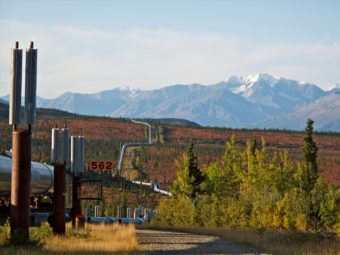
Pipeline near Fox

A new non-partisan group seeking repeal of an oil tax cut has filed an application with the Division of Elections to begin a petition drive.

Prime sponsors of the referendum are former state Sen. Vic Fischer, former Alaska First Lady Bella Hammond, and former Fairbanks North Star Borough Mayor and state Rep. Jim Whitaker.

They call the tax changes made by the state legislature a massive giveaway that will benefit major oil companies and hurt Alaskans.

Fischer was member of Alaska’s Constitutional Convention 57 years ago.  He says the tax break is unconstitutional  and lawmakers have an obligation to manage Alaska’s resources for the maximum benefit of Alaskans, not oil company shareholders.

The group has 90 days to collect 30,000 signatures of registered voters to get the initiative on the 2014 primary ballot.

Meanwhile, Gov. Sean Parnell says ConocoPhillips’ announcement that it will bring an additional rig to Kuparuk this spring is the first step to “an Alaska oil comeback.”

ConocoPhillips said Wednesday it will work with other owners on funding for a new drill site on the Kuparuk River Field. The company credits the decision on the legislature’s decision to reduce oil industry taxes.


Few benchmarks for judging oil tax changes

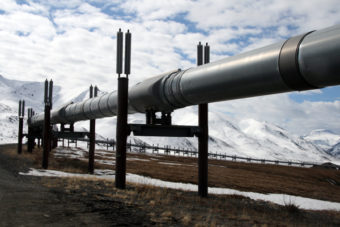
The Trans-Alaska oil pipeline. (Photo by Brian Cantoni/Flickr Creative Commons)

Oil companies operating in Alaska will enjoy lower state taxes on their production beginning next year, but what will the state get in exchange?

That’s the question many are asking now that the Legislature has reworked the tax regime at the request of Gov. Sean Parnell, who believes it will spur the companies to boost their investment on Alaska’s North Slope, putting more oil in the Trans-Alaska Pipeline System.

At a news conference on Monday,  he said he expects to see changes in the level of oil production within the next three years, and his administration is basing its budget outlook on the idea that oil companies will add a handful of rigs to legacy fields.

Parnell says his administration also will be watching the amount of money that producers put toward capital expenditures.

“The major companies have invested approximately $2 billion a year on average to kind of maintain where they are,” he said. “I think that’s a good base-level starting point to say, ‘What are you going to jump up to? What are you going to bump up to?’”

But Parnell didn’t provide any concrete metrics for judging his oil tax policy. He stayed away from defining success in specific terms, and avoided offering a timeline for evaluating the tax change.

Parnell also tried to temper expectations, saying he didn’t expect dramatic growth in oil production immediately.

At their post-session news conference, Democratic legislators criticized the governor for not offering clearer benchmarks.  Anchorage Sen. Hollis French said they also worry the administration might count projects currently scheduled to go online as new investment.

“We’re going to be watching, we’re going to be measuring, and when they start having those ribbon cuttings, and the brass bands, and the big hullabaloos over new things happening on the North Slope, we’re going to remind the public these were already planned,” French said.

The new tax structure is scheduled to go into effect in 2014.

Kensington leads Coeur to increased gold production

Higher production at Kensington Gold Mine near Juneau and a Nevada mine led Coeur d’Alene Mines to a 30 percent increase over the year in gold production.

The company says it produced 56,913 ounces of gold during the first quarter of 2013, compared to 43,901 in the first quarter of 2012.

A company news release says Kensington produced 25,206 ounces of gold in the first three months of this year, more than triple the production during the same period last year.

Coeur’s silver production of 3.8 million ounces was 22 percent less than first quarter 2012, due to lower grade ore processed from the Palmarejo  mine in Mexico.

Realized gold prices during the first quarter of this year averaged $1,630 an ounce, down 4 percent over the first quarter of 2012.  Silver was down 6 percent, averaging $30.61  per ounce.

Coeur is scheduled to report first quarter full operating and financial results on May 9th.


Site notifications
Update notification options
Subscribe to notifications