Energy & Mining

Oil tax cut could impact state credit rating

A legislative agency says the state’s credit status will be at risk if the oil tax reductions proposed by the governor become law.

One of the most controversial issues expected during next year’s legislature is a bill introduced by Gov. Sean Parnell that would reduce oil taxes from the current levels by as much a $2-billion a year, depending on oil market prices.

The non-partisan Legislative Research Service reported Wednesday that the substantial decrease in revenue from the tax cut could be seen as a negative factor by credit agencies.

Anchorage Democrat Bill Wielechowski, chairman of the Senate State Affairs Committee, says the governor’s numbers show the state would be losing billions of dollars under his tax proposal.

“The governor’s numbers show that within the next decade the state will be broke. According to this non-partisan legislative research report – the research they’ve done – it is very likely to put downward pressure on our credit rating. The loss of our credit rating will have a severe impact all across Alaska,” Wielechowski says.

As an example, Wielechowski says that by lowering the credit rating by one level – from AAA to AA+ – the price for the Susitna hydroelectric project alone would increase by more than $300 million, due to higher interest on bonds for the project. He says Alaska needs the revenue to build infrastructure projects and protect jobs.

“Two billion dollars into the Alaska economy every year creates thousands and thousands of jobs across the state,” Wielechowski says. “If you take that money out of the capital budget, which is going to have to happen if you pass the governor’s bill, you’re talking about losing probably thousands of jobs all across Alaska.”

Economist Gregg Erickson is Editor at Large for the Alaska Budget Report, which reported in February on the connection between the governor’s tax cut and the state’s credit standing. He is not willing to project the effects of credit ratings on job growth.

But Erickson says the Parnell administration recognized the reason for high Alaska credit ratings was the savings and income from the current oil tax regime. In the Budget Report’s story, however, the administration denied any possible negative effects of a lower income.

“But, of course, their denial, which they issued in an e-mail to me, was totally devoid of any backup at all. They just said it,” Erickson says. “It’s been remarkable how little analysis was done to support the proposed policy. And it’s no surprise, given the lack of analysis, that they haven’t made much progress with it.”

The Parnell administration did not reply to requests for a response to the Legislative Research report, or to Wielechowski’s comments.

Coeur d’Alene Mines names new CFO, COO

New officers have been named for Coeur d’Alene Mines Corporation, the parent company of the subsidiary that runs the Kensington Mine about 45 miles northwest of Juneau.

Frank Hanagarne, Jr. will become the new Chief Financial Officer and Senior Vice-President next month. He recently was Chief Operating Officer of Swiss miner Valcambi and director of corporate development for Newmont Mining.

K. Leon Hardy, who started work at Coeur d’Alene Mines eight years ago and was most-recently Senior Vice-President of Operations, will become Chief Operating Officer and Senior Vice-President.

It was just last July that former Chief Financial Officer and VP Mitchell Krebs was promoted to President and Chief Executive Officer as long-time CEO Dennis Wheeler retired. It was expected back then that Krebs would continue with his duties as CFO.

MSHA updates Kensington accident report

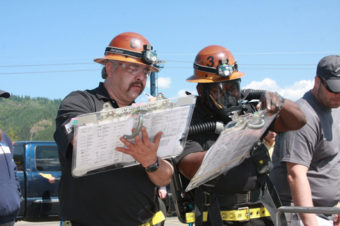
The Kensington mine accident that killed Juneau resident Joe Tagaban last week is the eighth U.S. mining fatality in 2011, according to the Mining Safety and Health Administration. It was also the first explosives fatality for the year.

An updated report from MSHA indicates Tagaban was waiting on a ramp for the blast to be initiated. And when it was, small rock and debris traveled through a 3-inch diameter diamond borehole, striking him.

The regulatory agency says the hole should have been mapped and plugged.

The report lists several best practices for using underground explosives; that includes evacuating all persons from the designated blasting site.

MSHA is asking for other suggestions to prevent such an accident.

The underground section of the Kensington mine where the accident occurred was closed for a week during the initial investigation.

While the mine is back in full operation, no blasting can be conducted in production areas underground until MSHA says it’s safe.

The company is working with the agency to finalize blasting protocols in production stopes. Blasting activities related to mine development are continuing.

According to MSHA, there were 14 U.S. metal and non-metal mining fatalities reported in 2010.

Click here for the MSHA “Fatalgram.”

Kensington mine back in full operation

Kensington Mill

The Kensington Gold Mine is back in full operation, following a week closure in an area where a miner was killed last week.

Mine owner Coeur Alaska says all underground activities are at full capacity. But according to the Mining Safety and Health Administration, no blasting can be conducted in production stopes until the agency says it’s safe. Stopes are openings – or rooms – created in the process of extracting the gold ore.

MSHA’s preliminary report indicates 30-year-old Joe Tagaban, of Juneau, was struck by rock – initiated by a blast — that flew through a previously drilled hole intersecting the stope where he was working.

Coeur Alaska spokesman Tony Ebersole says blasting activities related to development are continuing and the company is working with MSHA to finalize protocols in production stopes.

The mill is also back in full operation after being down earlier this week for planned maintenance.

The company says it doesn’t expect the closure will impact 2011 production levels. Through the first six months of this year, Kensington produced 49, 434 ounces of gold.

The Kensington Gold Mine is about 45 miles northwest of Juneau.

Coeur official says mine housing will promote local hire

The Kensington Mine near Juneau began operations in June 2010, and currently employs about 300 people. According to mine owner Coeur Alaska, most Kensington employees – 72 percent – are Alaskans, while 61 percent live in Southeast. But just a little over half – 53 percent – live in Juneau.

Last night (Tuesday) the Juneau Planning Commission approved changes to a 2004 permit issued to Coeur, which set conditions for the mine within the city and borough. The modifications allow the company to build more permanent housing at Kensington, which officials say will make it easier for workers to live nearby. Casey Kelly has more.

Coeur applies to build more dorms at Kensington

Coeur Alaska wants to build more employee housing at the Kensington Gold Mine.

On Tuesday, the Juneau Planning Commission reviews Coeur’s application to modify a 2004 allowable use permit, which set conditions for the mine within the city and borough.

In addition to construction of a new three-story, 96-bed dormitory, modifying the permit would allow Coeur to convert two temporary dorms built last year into permanent housing. The result would be permanent on-site housing for 216 employees at the mine, located 45-miles north of Juneau.

Kensington also has 10 trailers on-site, which serve as temporary housing for 64 workers. Five of the trailers will be transitioned to office or storage space, according to a memo from CBJ Planner Beth McKibben.

Kensington Environmental Superintendent Kevin Eppers submitted a letter along with the company’s application to modify the permit. In it he says the new dorm is needed to provide 24-hour coverage, and account for winter weather which may prevent travelling to and from the mine. He also says it will provide for additional local and regional hire.

The company says utilities are already in place at the mine site for the new dormitory.

Employee commuting practices are not expected to change as a result of any new housing. Goldbelt Corporation currently operates 12 round trip buses per week from Engineer’s Cutoff Road to Yankee Cove, about 30 miles north of Juneau. From there a boat takes workers the rest of the way to the mine in Berners Bay.

Tuesday’s Planning Commission meeting starts at 7 o’ clock in CBJ Assembly Chambers.

Site notifications
Update notification options
Subscribe to notifications