Energy & Mining

BC power line spurs transboundary development

Alaska and Canadian scientists are among a large group of experts hoping to convince the British Columbia government to study the cumulative impacts of proposed development in the transboundary region.

In a letter sent Tuesday to B.C. Premier Christy Clark, 36 scientists say industrialization spurred by construction of B.C. Hydro’s Northwest Transmission Line threatens the area.

The 287-KV Northwest Transmission Line will stretch 214 miles north from the Skeena substation near Terrace, British Columbia.  The B.C. Hydro project will provide reliable, economical power to communities and resource development.

The power line has touched off what Dr. Jim Pojar of Smithers, B.C. calls a gold rush mentality in the transboundary region.  At least 11 mines, coal-bed methane and 18 hydroelectric projects are proposed for the Canadian side.

“There’s no complete assessment of what could happen if all of them get developed within five or 10 years,” Pojar says.

He is one of the scientists to sign the letter.  They say the Stikine, Iskut and Unuk rivers – important to both sides of the border – are the most vulnerable.  To the north, the scientists believe the Taku River is already threatened by the existing Tulsequah Chief Mine at its B.C. headwaters.

It’s an impressive list of Ph.D.-level scientists.  Dr. Jack Stanford of the University of Montana at Missoula is among them.

“That’s a very broad cross-section of the scientific expertise of the U.S. & Canada,” Stanford says.

He believes it should carry some weight with politicians.

“If it doesn’t it just means the disconnect between science and government is more profound than we think.  We want them to listen to this,” Stanford says.

The scientists’ letter requests a “transparent ecosystem-based approach” for assessing new development in the transboundary watersheds.

Pojar says it’s the sum-total of the projects that have them worried.  While environmental impact statements will be done for individual mines, no one knows the effect of five or ten mines in a region.

A forest ecologist, Pojar has spent a lot of time in the transboundary area. He calls big chunks of the watersheds still “fearsomely wild.”

This isn’t just another piece of northern bush. Sometimes we who live up north kind of take it for granted, the landscape we live in, but you know on a continental scale this is just incredible,” Pojar says.

The transboundary rivers support all five species of Pacific salmon that sustain Alaska and British Columbia commercial, sport and subsistence fisheries.

Dr. K.V. Koski of Juneau has studied Southeast Alaska’s transboundary rivers, including many years on the Taku.  The Habitat Restoration  Specialist spent 30 years with the National Marine Fisheries Service at the Auke Bay lab.

“All those transboundary rivers basically are the same type of the system and they rely on so much of the woody debris is those areas for forming the habitats, maintaining the channels and the sloughs and things like that,” Koski says.  

He says hundreds of thousands of salmon rear every year in the lower Taku River in Alaska.

“In the Taku the majority of the juveniles actually come downstream from Canadian waters and rear so it’s really important that those habitats are protected,” he says. 

Stanford calls the transboundary rivers the primary salmon-producers of North America.

“And most of them are entirely intact, not influenced by any activity other than harvest of fish and thus they’re the last best places for fish, particularly salmon,” he says.

The B.C.  Environmental Assessment Office is responsible for evaluating mining, energy and transportation projects for the province.  But a recent Auditor General’s report indicates the E-A-O is erratic when it comes to monitoring and enforcement.

If that’s the case, the scientists say, the B.C. government cannot assure environmental protection at the headwaters of the transboundary rivers, or downstream in Alaska.

They say even if only some of the proposed development happens,  it could transform the ecological landscape of the region.

Record 3Q metal sales for Coeur d’Alene

The owner and operator of the Kensington Mine says last quarter was an all-time company record for any third quarter. Metal sales for company’s entire operations came in over $343 million dollars. That’s nearly half-again higher than the second quarter of 2011 and nearly three times as much as the third quarter of 2010.

Sales for the first nine months of 2011 totaled $774 million.

Coeur d’Alene Mines came out with their third quarter results Monday morning. They reported adjusted earnings of nearly $94 million or a $1.05 a share. That’s a big change from last year’s third quarter net loss of $4.5 million or $0.05 a share.

There was a record $151 million of operating cash flow for the third quarter as well. Overall silver production for entire company was up to 4.9 million ounces for the company, while gold production was down slightly to 57,052 ounces.

In addition to the Kensington Mine near Juneau, Coeur d’Alene Mines also operates the Rochester silver mine in Nevada, the San Bartolome silver mine in Bolivia, and the Palmarejo silver and gold mine in Mexico which is considered the company’s biggest generator of sales and cash flow.

Latest exploration efforts at the Kensington Mine included the Raven zone that’s located west of the Kensington ore body, and a new target called Kensington South.

Meanwhile, company officials say processing at Kensington will be reduced to 700 tons per day, about half of previous levels.

That’s expected to allow time to accelerate underground development, a fill-in drilling program, completion of an underground paste backfill plant and other facilities underground and on the surface, and overall safety improvements.

Docks & Harbors board approves Kensington permit request

Juneau’s Docks and Harbors Board has approved a permit for the Kensington Mine to launch and moor employee commuter boats at Echo Cove this winter.

Kensington’s parent company, Coeur Alaska, asked for and received the permit last year as well. It allows the mine to use Echo Cove as a backup to the company’s private dock at Yankee Cove when weather creates unsafe conditions in Lynn Canal. It’s good from November 14th through April 30th.

CBJ Port Director Carl Uchytil told the Docks and Harbors board that the mine pays the city for using the dock.

“It’s about 12-thousand dollars for Docks and Harbors,” says Uchytil. “Not a great amount of money, but certainly it’s something that helps the mine and helps Juneau’s economics to provide this service.”

Kensington plans to beach load and offload passengers on the north side of the Echo Cove boat launch. The number of employees commuting to and from the mine and the schedule for Kensington’s shuttle buses will not change. The company will also plow the Echo Cove parking lot on days that it’s used by the mine.

The permit request was approved unanimously at last night’s Docks and Harbors board meeting.

Herbert Glacier test drilling done for season; new mine partnership finalized

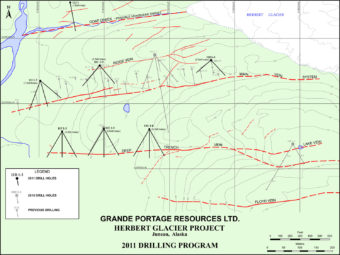
Two Vancouver-based mining companies say they’ve finished this year’s test drilling for gold and silver deposits at Herbert Glacier. Both companies have also finalized their joint venture agreement for development of a mine.

Quaterra Resources in June of last year partnered with Grande Portage for exploration and development of the area. Grande Portage committed to spending $1.25 million dollars in exploration costs before next June in exchange for a 65-percent interest in the project.

In late 2007, Quaterra Resources acquired the 1700 acre property, now with as many as 91 federal mining claims either staked or leased from three local prospectors. There are at least four to five significant veins that strike east-to-west and dip sharply to the north around the Herbert Glacier about 18-miles north of downtown Juneau.

In a statement issued Wednesday by both companies, the agreement appears to differ little from when it was first announced last year. It includes a new provision that if any party does not contribute their proportionate share of development costs, then a dilution formula will be invoked if any party’s interest is reduced to 10-percent or less. The partner’s interest will be automatically converted into a 1-percent net smelter returns royalty, which may be acquired by the other party for $1 million.

Field test drilling at Herbert Glacier is now over for the season. Both companies announced that they completed 46 drill holes from 9 platforms totaling 6532 metres of diamond drilling.

Some of that drilling has included high-grade concentrations of gold from 2- to 6-ounces per ton. One test drill revealed nearly 39-ounces of silver per ton.

Assays from the latest set of test drilling are still pending from a laborartory.

Grande Portage President Ian Klassen said in a printed statement that they’re delighted with the significance of the results. He says they intersected five separate high grade bodies, four of which are new discoveries.

“A new vein which was previously only hypothesized now shows as much potential for gold as our other big veins,” wrote Klassen.

A test drilling schedule for 2012 that will help define the ore bodies is expected to be submitted for permitting during the last quarter of 2011.

Admiralty Enviromental of Juneau has been hired to do baseline water studies that are required under State of Alaska’s Large Mine permitting requirements.

AJ Mine meetings planned for next two weeks

Over the next two weeks, City and Borough of Juneau Engineering Director Rorie Watt will hold a series of informational meetings on the AJ Mine.

Starting tomorrow (Thursday), four sessions will be held to talk about the history of the old mine and the city’s current consideration of reopening it. Then, a week from tomorrow (October 20th), Watt will host the first of two sessions described as an open discussion about the city’s water system study. The AJ ore body is located in Last Chance Basin, Juneau’s main source of drinking water.

On Monday, Watt told the CBJ Assembly Committee of the Whole that the meetings are designed to bring the public up to speed before the drinking water study gets underway.

“The intention is, if they’re new they can come to an introductory session and then come to a water session, or if they’ve been following it all along, come to a water session,” says Watt. “But just trying to open the doors and get as much input as possible.”

The city and borough owns two-thirds of the old AJ Mine and Alaska Electric Light and Power owns the rest.

Earlier this year, a committee appointed by Mayor Bruce Botelho produced a report that attempted to define under what circumstances, if any, the city should promote development of the mine. In August, the assembly created a 250-thousand dollar AJ Mine Capital Project Fund to pay for the water study and other work surrounding the effort.

All of the upcoming meetings will be held in the CBJ Engineering Conference Room on the 3rd floor of the Marine View Building. See the full schedule below:

Introduction to the AJ Mine:
October 13th – 12:00 noon
October 13th – 5:00 p.m.
October 19th – 12:00 noon
October 19th – 5:00 p.m.

AJ Mine Related Water Study:
October 20th – 5:00 p.m.
October 26th – 12:00 noon

Falling rock damages water line at Kensington

No injuries reported after loose rock fell underground at the Kensington Mine Sunday, damaging a water line.

Coeur d’Alene Mines Vice President Wendy Yang says crews were doing routine maintenance in a main access drift – stabilizing an excavation by bolting rock – when some of the loose rock fell. No one was trapped and both the primary and secondary access routes remained open.

Yang says the water line has since been repaired, and normal operations were not disrupted.

Site notifications
Update notification options
Subscribe to notifications