Energy & Mining

Coeur has record setting 2011

Coeur d’Alene Mines Corporation set new records for production, metal sales, and cash flow in 2011.

The Idaho-based company, which owns the Kensington Mine near Juneau, released year-end financial results today (Thursday).

Company-wide metal sales nearly doubled from 2010 to $1-billion dollars. Gold production surpassed 220,000 ounces – an all-time high and a 40 percent increase from 2010. Silver production also set a record at more than 19.1 million ounces – a 14 percent jump from the previous year.

Coeur’s profits from the Kensington Mine were $49.5-million dollars last year – its first full year in production. Metal sales from the Berners Bay mine totaled $151.2-million dollars, offset by $101.7-million in operating costs. Gold production at the mine more than doubled to 88,420 ounces.

As KTOO previously reported, production levels at Kensington have slowed since November to allow for an expansion of underground development activities. Chief Operating Officer Leon Hardy told a conference call for investors that Coeur is focused on long-term stability at the mine.

“Through our accelerated development in the underground operations, we are opening up a new mining area in the lower region of the deposit to compliment the mining from the upper region,” Hardy said. “We expect to have four to six working faces in each of the two regions to enhance our mining flexibility.”

Hardy said new surface facilities at Kensington, including a new dormitory and kitchen, are now in use. An expanded warehouse and administrative offices are currently under construction.

Kensington also has a new general manager, Wayne Zigarlick, who’s been on the job for about a month. He had been assistant general manager and has worked at the mine since March 2011. Previous GM John Kinyon lasted less than a year.

Coeur d’Alene Mines also has operations in Bolivia, Mexico and Nevada. The company’s stock price was up 18 cents on Thursday to $29.32 a share.

Outage in Auke Bay and Lena Loop

Roughly 1700 customers were without power for a few hours Monday morning as several feeders went off-line.

Deb Ferreira of Alaska Electric Light and Power says the cause was the malfunction of a monitoring device or meter in Auke Bay. A total of six distribution feeders in the Auke Bay and Lena Loop areas powered down just before 7 o’clock Monday morning.

Most of the power was restored about 9:15 a.m. The last feeder to come back up was for Auke Bay and the University of Alaska Southeast. Because of some undetermined malfunction on that feeder, power was not restored for those 500 customers until about 10 o’clock.

Parnell sets gasline “road map” for producers

Gov. Sean Parnell Wednesday night set out a “road map” for getting access to North Slope gas.

In his annual State of the State address to the Alaska Legislature, Parnell said he talked with the CEOs of Alaska’s major oil producers within the previous 24 hours and it was clear they have not reached agreement on key issues. So he delivered what he calls a “road map” for an Alaska natural gas pipeline.

“First, these companies need to agree to resolve the Point Thomson litigation,” he said. “If no settlement in the state’s interest can be reached with all parties, the state will fight for Alaska’s interest at the Alaska Supreme Court hearing on February 8th in Anchorage.”

Parnell said he also expects the companies to align under the framework of the Alaska Gasline Inducement Act (AGIA) and consolidate all gasline projects. By the third quarter of the year, he wants financial estimates and work schedules for a large-diameter Liquified Natural Gas (LNG) pipeline through Alaska to tidewater.

“If these milestones are surpassed, the 2013 legislature can take up gas tax legislation designed to move the project forward,” he said. “The path ahead is better defined, and benchmarks for progress are in place. And while a lot more work remains, Alaska is closer to the day when our gas can move from the ground to Alaskans and to markets beyond.”

Parnell also took time during the speech to promote the budget he made public last month, saying it holds the line on government spending while adding nearly $4 billion to the state’s savings accounts. He also repeated his call for reducing oil taxes in an attempt to increase North Slope oil production.

“For many years, the TransAlaska Pipeline has provided a pathway to prosperity for Alaskans. But where more than 2-million barrels of oil per day once flowed through the pipeline, less than 600,000 barrels now inch through. And unless we act to reverse this decline, we will pay a stiff price in lost jobs, lost state revenues and lost opportunities,” Parnell told legislators.

Oil taxes promise to be one of the most controversial issues during this year’s session. After the speech, Senate President Gary Stevens said the governor’s tax plan table is flawed and he would like the Senate to introduce its own plan.

Minority Response

House Democrats pledge to fight the governor’s plan to reduce oil taxes.

In the House Minority response to the governor’s State of the State address, Minority Leader Beth Kerttula called Parnell’s plan a “give-away.”

“Alaskans are already investing hundreds of millions of dollars every year in the oil industry in tax credits – three billion dollars in the last four years. Through these credits, actually, we are the biggest investor on the North Slope,” she said.

Kerttula said Alaskans should know where their money is going.

House Democrats voted against Parnell’s bill last session when it passed the House. The caucus this year supports legislation that would increase reporting requirements for oil companies claiming tax credits, including the number of jobs created and the number of Alaskans employed in those jobs.

Democrats also advocate legislation that would invest $10-billion of Alaska’s nearly $13-billion surplus into the state’s Permanent Fund.

“We’ve got to save some of our surplus in the Permanent Fund. That’s what that fund does. It turns a resource that’s not renewable into a future resource for future generations of Alaskans,” she said.

Kerttula also called for investment in education and job training. She criticized Parnell’s education budget, which includes money for rural school construction and college scholarships, but the amount districts receive for operations is the same as last year. Districts across the state stand to lose revenue.

House Democrats are calling for legislation that would require the state to annually adjust the base student allocation for inflation.

Egan in middle of oil tax debate

The legislative session begins in Juneau today (Tuesday), with a lot on the plate of lawmakers. Casey Kelly spoke with Juneau Senator Dennis Egan and has this preview.

Sen. Dennis Egan. Photo courtesy State of Alaska.

Juneau Senator Dennis Egan is feeling good heading into the 2012 legislative session.

He’s in the second year of his first full term, after being appointed to the seat on the last day of the 2009 session. More importantly, Egan starts off the year with a clean bill of health, after undergoing heart surgery just two and a half months before the start of last year’s session.

“I didn’t have a medical procedure this year,” says Egan. “I feel great.”

In addition, Egan is the only Senator who won’t have to run for re-election this fall due to redistricting, or the redrawing of legislative boundaries every 10 years according to the U.S. Census.

Under the Alaska Redistricting Board Plan, Egan won’t run again until 2014, though next year his district will pick up several new communities, including Skagway and Petersburg. Egan says the extra time will help him to get to know those communities a little better, but he doesn’t expect it to change the way he serves.

“I’ve always represented Southeast, and people from those communities have always come in to our office, and we’ve worked very hard in trying to get their issues resolved, and their requests for capital projects and issues that directly affect their communities,” he says.

Egan is squarely in the middle of the biggest issue facing the Senate this year: The governor’s proposal to cut taxes on oil companies. The bill ended last session in the Senate Labor & Commerce Committee, which Egan chairs. During the interim the committee held four days of hearings on the bill in Anchorage and Fairbanks. Egan says the Senate still has concerns about the lack of Alaskans employed on the North Slope.

“The people own the resource,” says Egan. “And we as a Senate Bipartisan Working Group think that we should get something in return. We’re not opposed to providing some kind of an incentive for the industry. But we need something in return.”

To get a better handle on employment in the oil industry, the Senate hired Juneau-based McDowell Group to do a study. Egan expects the analysis to get at least one hearing early in the session.

“It shows there is a lot of non-resident hire, and we want to address that issue,” he says.

Egan is one of six co-sponsors of a bill that would exempt a proposed natural gas pipeline from property taxes during construction. He says the idea came from discussions Senators had with the industry.

“Trying to reach some sort of a conclusion to providing an incentive for industry and Alaskans to increase our portfolio,” Egan says.

Another bill Egan worked on during the interim would give public employees the option of choosing either a defined benefit or defined contribution retirement plan. Alaska was the first state to do away with a traditional pension, or defined benefit for state workers. Since 2006, all new hires have been set up with a defined contribution plan, similar to a 401(k) savings account.

Egan’s bill has 10 co-sponsors – including two Republicans – who feel the defined benefit is a better deal for Alaska’s retired public employees, because it guarantees them a pension check every month.

Egan’s office is currently trying to get the Parnell administration to agree on a cost estimate for the bill. The administration’s actuary says it would cost the state more to offer a defined benefit option. Unions and other backers of the bill hired their own actuary, who says it would not increase costs. At a hearing during the interim the two actuaries were asked to work together to settle the discrepancy.

“We’re trying to make it as close to revenue neutral as we can,” Egan says. “We want people to retire in Alaska, and I think Senate Bill 121 allows those folks to do that.”

Egan says he’s happy with Juneau projects in Governor Parnell’s proposed capital budget, especially ongoing funding for the State Library Archives and Museum, or SLAM project, as well as renovations or repairs to the Douglas Island Office Building, the State Office Building parking garage, and the Juneau Pioneer Home.

He says other priorities for the Senate Bipartisan Coalition will be affordable energy, expanding Alaska’s infrastructure and pre-kindergarten through post-secondary education.

Hecla closes Lucky Friday Mine in Idaho

Hecla Mining Company announced a year-long closure at its Lucky Friday Mine in Idaho yesterday (Wednesday).

The federal Mine Safety and Health Administration ordered the closure after investigating two deaths and several injuries at the mine in 2011. The latest incident occurred in mid-December, when seven miners were injured by a rock burst. Last week, investigators determined that conditions flagged at the mine during an investigation into the incident had not been fixed.

Over the next year, Hecla will be required to clean up sand and gravel build up in the Lucky Friday’s main shaft.

About 200 miners and contract workers will lose their jobs during that period. Hecla also revised down its projected silver production for 2012, from 9.5 million ounces to about 7 million.

Hecla also owns Green’s Creek Mine on Admiralty Island near Juneau.

Chieftain says no road, no mine

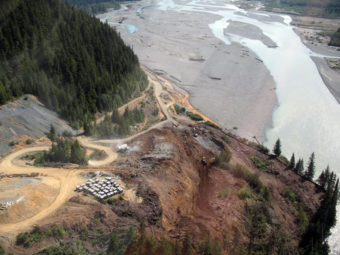
Water treatment plant at Tulsequah.
Courtesy Chieftain Metals.

The company building a mine at the headwaters of the transboundary Taku River expects a new road to be completed by the end of next year. That will allow year round access to the Tulsequah Chief Mine.

The Taku is the most abundant salmon-producing river in Southeast Alaska. But on Saturday Chieftain Metals tried to reassure members of the Taku River Fact-Finding Task Force that barging would soon cease.  

[Files relating to the task force are posted on the legislature’s committee hearing web site here. Click on the folder icon.]

Chieftain Metals’ Chief Operating Officer Keith Boyle paints an aggressive timeline for the multi-metals mine under construction in British Columbia, 40 miles northeast of Juneau. And it hinges on a proposed road.

“The mine won’t go without the road,” Boyle told skeptical task force members.

Boyle was speaking by teleconference from Toronto, Ontario, headquarters for the Canadian-owned company. He said the company expects to have a B.C. government permit for the road by the middle of this year.

Chieftain Metals purchased the Tulsequah Chief Mine and adjoining properties in 2010 after former owner Redfern Resources went bankrupt.

Juneau has terrible memories of Redfern: The number of times Redfern barges hit bottom in the Taku River; Redfern’s proposal for a hover barge towed by an amphibious vehicle; its years of promises to clean up acid mine drainage from the defunct mine.

The company nixed the hover barge idea soon after it acquired the Tulsequah. And mine cleanup is underway. As KTOO previously reported, a water treatment plant has been installed and is treating mine effluent.

When Chieftain took ownership, it acquired Redfern’s permits from B.C. regulatory agencies, except a permit for a road through Taku River Tlingit First Nation territory. The company has been negotiating a new route to the mine with the tribe, which has historically opposed any overland route.

“This past summer, we jointly hired an engineer, this engineer looked at different options, we evaluated the different options and Chieftain has now submitted an application for an amended permit,” Boyle said.

The 130 kilometer road (approximately 81 miles) would go from Atlin, B.C. to the mine site, still through some First Nation territory. It’s now up to the B.C. government to get First Nations to agree.

Months ago Chieftain Metals said barging equipment, supplies and concentrate up and down the Taku River is not an option for two reasons: It’s a difficult river to navigate, especially with its fluctuating water levels, and bankers want to know the product is getting to market.

“What were the parameters to make that decision? And secondarily to that were some of those parameters run timing in terms of the salmon run?” asked Task Force member and commercial fisherman Len Peterson.

“It had nothing to do with the salmon runs, it had everything to do with sitting in front of the bankers and saying, ‘you know we want to build a mine,’ and they looked at us and said, ‘if you think you’re going to do it with hover barges we’re not giving you any money,’ ” Boyle responded.

Before the road is built, Boyle said the company expects to haul fifteen to twenty 100-ton barge loads from Juneau up the Taku River to the mine beginning in late May. Chieftain Metals will contract with tug and barge company Wainwright Marine Services out of Prince Rupert, B.C.

“Any material, equipment, what not, it’s got to fit within 15 trips up the river,” Boyle said. “We’re contingency planning – we’re trying to figure out what it is, but you know 15 to 20 trips for the entire summer.”

Some of those loads will be road construction equipment. Boyle says construction will start simultaneously from Atlin and the mine site.

The Juneau legislative delegation created the Taku River Fact-Finding Task Force in response to concerns about mine development on both the U.S. and Canadian side of the river. Alaska has no jurisdiction over the Tulsequah Chief project, or barging up the river.

After two three-hour meetings with state and federal agencies and Chieftain, the eight-member task force seems to have more questions than answers.

It will meet again on Friday, Jan 13.

Site notifications
Update notification options
Subscribe to notifications