Energy & Mining

Great Bear executive says shale could be “game changing”

Great Bear Petroleum today (Wednesday) announced it is within a month of drilling up to six exploratory shale oil wells on its holdings along the Dalton Highway. Dave Donaldson reports.

iFriendly audio

Great Bear’s President Ed Duncan told the Senate Resources Committee that the goal is to gather data the company will use to begin a pilot production operation early next year.

“The plan of operation’s on file,” Duncan said. “Well plans have been designed, redesigned, edited, improved, refined. We believe the technical work program we have today is as good as we could have hoped for.”

Duncan said Great Bear now has a venture agreement with Halliburton Oilfield Services Company for testing and analysis of the test wells in exchange for a quarter interest in the project.

Preliminary geological studies indicate that success is likely. However, he said the tests could find an air ball – nothing to produce. But Duncan said the tests could prove the resource potential is “beyond game changing.”

“The numbers are staggering,” said Duncan. “We won’t go into the details, but it’s fair to say the retained hydrocarbons in the source rock is significant. It certainly could be on par with … well in excess of the hydrocarbons actually contained in the known tracts.”

Great Bear plans to be getting into full production by 2015. Duncan anticipates having as many as 200 wells a year – not seasonal, but year-round. The biggest problem Duncan sees right now is finding the tens of thousands of people to work in the new shale industry – as well as training them and finding accommodations for them to live. He says too many are finding jobs in North Dakota.

“It’s not a challenge we can solve on our own. It’s a giant challenge for the state of Alaska,” Duncan said. “We all may be willing to do everything we can from a technical perspective, but if we don’t have people in the field to run the rigs, drill the well, lay the pipe, weld the pipe, we’re stuck.”

The Resources Committee is currently studying Governor Parnell’s plan to change the state’s oil tax regime to encourage new production. Co-Chair Joe Paskvan says other big shale developments were done without any change in those state’s tax structures.

“I think that he is accurate in his conclusion that the uptick in production in Texas and the uptick in production in North Dakota is a result of technology and pricing and not as a consequence of any tax change,” Paskvan said.

Duncan updated legislators on one other change in Great Bear since his last report to them. Former Revenue Commissioner Pat Galvin has gone to work for them. Galvin was the individual often credited as most responsible for creating the state’s current oil tax system.

First resource estimate made by potential Herbert Glacier mine developers

Herbert Glacier
Herbert Glacier survey photo courtesy of Quaterra Resources.

Developers of a proposed mine at Herbert Glacier believe there’s at least 245,145 ounces of gold. That’s based on an independent resource estimate after exploratory drilling over the last two years and recent assays.

Herbert Glacier, 18-miles north of downtown Juneau, is in the middle of the historic Juneau mining district, with Kensington Mine currently operating 25-miles to the north and Greens Creek Mine about 12-miles to the west. The area is being jointly developed by Grande Portage Resources Limited and Quaterra Resources, both of Vancouver, British Columbia.

Tom Patton, CEO and President of Quaterra, hinted that latest estimate is only a partial picture of Herbert Glacier’s potential.

“We think that this thing has the potential for million-plus ounces of high-grade gold,” said Patton during a Wall Street analysts conference on April 10, 2012.

His comments were made before Monday, April 16th’s release of the inferred resource estimate for two of the four potential principal veins. Total resource is estimated at 1.57 million (metric) tonnes with an average grade of 4.86 grams per tonne (0.142 ounces per ton).

If those inferred estimates are correct, then the value of the 245,145 ounces of gold at today’s market price would be worth approximately $404 million.

“We got interested in this thing just because of the address,” said Patton who made a reference to Juneau’s post-World War I mining boom. “This Herbert Glacier deposit was not discovered at that time because it was under the Herbert Glacier which has since receded.”

Patton told analysts that his company expects to spend about $700,000 for additional work at Herbert Glacier this year.

The resource estimate was done by Wasilla-based Yukuskokon Professional Services.

In a prepared statement, Ian Klassen, CEO and President of Grande Portage which is the majority partner in the joint venture, said that they’re “delighted with the initial report.” Klassen said they hope to discover additional mineralized zones and expand the known resource area with more drilling this summer. That includes 36,000 feet of infill drilling and 9,000 feet of exploratory drilling.

Coeur to spend $4 million on Kensington exploration this year

Coeur d’Alene Mines Corporation is spending $4-million on exploration at its Kensington Gold Mine this year. But company officials say they’re focused on stabilizing existing operations at the nearly two-year old mine in Berners Bay, about 45 miles north of Juneau.

iFriendly audio

Kensington Gold Mine General Manager Wayne Zigarlick. (Photo by Casey Kelly/KTOO)

Kensington General Manager Wayne Zigarlick says the mine has “outstanding potential” beyond its 13 years of proven reserves. But as it develops there will be plenty of time to look for new gold.

“Right now we’re focusing on primarily in the next three to four, five years to make sure that we have a sustainable future,” Zigarlick says. “And then start focusing on growing the resource.”

Zigarlick and Coeur d’Alene Mines CEO Mitchell Krebs spoke at a joint Juneau and State Chamber of Commerce luncheon Thursday. While they did not mention specific areas where exploration is taking place, Coeur officials previously have said they are looking to the west and south of the main Kensington ore body.

The company ramped down production at the mine during the last quarter of 2011 in order to build up its infrastructure. That includes a new 200-bed dormitory, a new warehouse, a new administration building, and a new underground paste plant, which comes on line later this month.

A paste plant uses leftover tailings to make concrete that can be used to backfill drill holes and stabilize the mine shaft. Zigarlick says it’s essential to future growth at Kensington.

“We had mined a year and a half without a paste plant, which means we were creating voids and starting to run out of places to mine,” he says. “If you don’t have the backfill mechanism in place, then it was creating problems for us.”

Zigarlick says it cost the company about $1,068 to produce an ounce of gold at Kensington last year. He says that’s fine when gold prices are over $1,600 an ounce. But he thinks the mine can be more efficient.

“We think that Kensington can be an $800 or $900 dollar an ounce producer, and maybe more than that, depending on what sort of optimization things that we can realize,” Zigarlick says. “We’re really not in that phase yet. We’re really looking to try and stabilize production, stabilize our workforce, stabilize all of our infrastructure, and then we’re going to really start to focus on cost reductions.”

Right now Kensington has about 260 employees and a $35-million payroll. Zigarlick says about 70 percent of the mine’s employees are Alaskans, and about 50 percent live in Southeast. Another hundred contractors are working at the mine at any given time.

Coeur d’ Alene Mines CEO Mitchell Krebs. (Photo by Casey Kelly/KTOO)

As a publicly traded company, CEO Krebs says Coeur’s main focus is getting a return on shareholders’ investment. He says Coeur believes the way to do that is by protecting the value of the company.

“That is really in three areas. That’s in the safety, in the environmental, and in the community relations aspects of an operation and of a mining company,” Krebs says. “We put those things ahead of sales, ahead of cash flow, ahead of ounces produced, because if you don’t produce them in an environmentally responsible way, in a safe fashion, it doesn’t matter.”

Coeur d’Alene Mines involvement in the Kensington project began 25 years ago. Krebs has been with the company for 16 years, serving as Chief Financial Officer before being promoted to CEO. Zigarlick started at Kensington in March 2011 as assistant general manager. He was promoted to GM earlier this year.

House speaker says oil tax could drag out session

House Speaker Mike Chenault says it’s important the oil tax debate not drag on past the legislative session, so he’s willing to stay in Juneau until the work is done.

Monday is the 84th day of the 90-day session. The House has not yet received the Senate’s oil tax bill.

“I think it’s very important for Alaska’s future to resolve this tax issue, not drag it out over the summer, and also not to drag it out to next year or the following year,” Chenault told reporters Monday.

Work on the oil tax continues in Senate Finance Committee. Senate President Gary Stevens has said the Senate won’t be rushed on an issue of such great importance to Alaska’s economy.

Chenault today raised the potential for Gov. Sean Parnell to call lawmakers back if they don’t finish their work by Sunday.

Over the weekend, Senate Finance finished the $2.8 billion capital budget. While Chenault says the houses have determined the size of the budget, they haven’t discussed the projects. He says that will happen before the capital budget comes over from the Senate. He also expects the House to add about $300 million in projects to the budget.

Juneau’s share of the Senate version is nearly $56.5 million in state general funds, federal funds and general obligation bonds. The bonds would cover improvements to Glacier Highway from mile 4 to mile 6, and to Mendenhall Loop Road.

State general funds and federal receipts would cover Douglas Island Office Building renovation, State Office Building parking garage repair, and maintenance to a number of state buildings in Juneau.

Funds also are in the budget for LED lighting on Egan Drive, work on Aurora Harbor, and other Juneau road projects. The Senate version includes $49 million for SLAM – the new Alaska State Library, Archives, and Museum facility, considered a statewide project.

Click here for details.

AJ Mine water study back before CBJ Assembly tonight

Juneau Assembly dives back into the AJ Mine issue tonight (Monday).

Members have had more than a month to review a draft study of the city’s water system, compiled by Engineering Director Rorie Watt. At tonight’s Committee of the Whole meeting, Watt says he’ll be seeking direction on what to do next.

“The Assembly has asked for this investigation,” Watt says. “And we’ll find out if they feel like it answers their questions, or if they need more information about water, or if they want to continue to consider mine development, or if they want to debate the topic. I’m not going to predict what they’re ready to do.”

Over the past year, the Assembly has been considering whether to pursue re-opening the old AJ Mine near downtown. The city owns part of the ore body, located in Last Chance Basin – Juneau’s main water supply.

A mine advisory task force last year urged the Assembly to request the water study. The draft report gives an overview of city’s water system, and identifies several scenarios and management concepts, with and without a gold mine operating nearby. The scenarios range from no action to leasing the AJ property to a mining company.

Watt has been gathering public input on the draft study. He says most people have had questions about the city’s water system, though a few categorically oppose mine development. Some of the written comments are included in the latest version of the study.

Watt says ultimately the Assembly will need to decide if the drinking water issue is a fatal flaw to any proposal to re-open the mine.

“That’s, at a policy level, what they need to decide,” says Watt. “And then once they are comfortable in having enough information to make that decision, we’ll see what happens.”

The Assembly last year appropriated $250,000 dollars for the water study. So far, Watt says $68,000 has been spent – about $33,000 to consultants Juneau Watershed Partnership, TetraTech and Carson Dorn. The rest has been spent on CBJ Engineering staff time.

Watt says he hasn’t made any major changes to the draft report, since bringing it to the Assembly at the end of February. At members’ request, he did add a better explanation of water flow rates to a technical section of the report.

Tonight’s Committee of the Whole meeting starts at 6 p.m. in Assembly chambers.

Link:
AJ Mine Water Study Draft Report
Water study public comments [PDF]

Chieftain reiterates: No mine without a road

Courtesy Rivers without Borders
An email from a Canadian mine developer to the Taku River Fact Finding Task Force has flummoxed some members and Juneau’s senator, but the company official who wrote it says it’s just semantics.

The group over the weekend produced its final report. The task force was created last fall by Juneau legislators to address potential impacts of development in the Taku River watershed, particularly from the Tulsequah Chief Mine in British Columbia.

Rosemarie Alexander takes a look at the confusion that beset the group as it wrapped up its work.

Chieftain Metals’ Chief Operating Officer Keith Boyle recently emailed his comment on the task force draft report: “The financing is not conditional on a road. The project cannot be financed with a barging system that cannot deliver product to market.”

In January, Boyle told the task force that financiers will not loan money for the Tulsequah mine project if it depends on barging equipment up the Taku River to the mine, and barging product down the river to market.

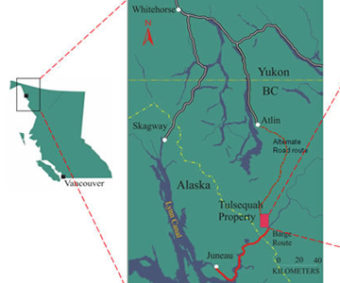
The old mine at the headwaters of the Taku River shut down in the 1950s. Chieftain hopes it will be back in production by 2015.

Boyle couldn’t have been clearer in his January report to the eight-member citizen committee.

“The mine won’t go without the road,” he said by teleconference from his Toronto office.

His March 16 email, he thought, just clarified the point.

Juneau Senator Dennis Egan took it differently.

“It upset me very much when I saw that email. As far as I’m concerned that is absolutely not what was told to us on the Taku River Task Force,” Egan said at Saturday’s meeting, called to finalize the report.

Task Force facilitator Kevin Ritchie said Boyle, perhaps, “changed his mind.”

Neither the task force nor Egan have called Boyle for an interpretation of the email, and it appears only as a comment in the final task force report.

Boyle said Monday in an interview with KTOO that nothing has changed since he spoke to the committee three months ago.

“I have said that before. There’s no mine without a road, because barging does not work,” he said.

Late last spring, Chieftain loaded equipment on barges to be transported up the river to the mine site. A few loads made it, but the rest were stymied by low water and bad weather.

While Boyle has said the Taku River is too undependable, some task force observers, including Chris Zimmer of Rivers without Borders, interpret the email as implying “there might be a barge transportation contingency plan if the road doesn’t work.”

Boyle said his message has been consistent.

“I just wanted to clarify to people the use of the term ‘financing is conditional.’ The way it lands for me is we have the financing upon getting the road. Well, the road is part of a project as a whole, it’s not its own little beast on the side here,” Boyle said. “At the end of the day, there’s no project without a road, because barging does not work.”

When Chieftain Metals bought the Tulsequah Chief Mine out of receivership it inherited permits from previous owner Redfern Resources. The most controversial is a road from Atlin, B.C. to the mine, through Taku River First Nations territory.

The company last month submitted a new route to the B.C. provincial and Canadian environmental assessment agencies. It avoids many of the most contentious places, and is within an area included in a land use agreement signed last summer between the B.C. government and the Taku River Tlingit.

The final application is due soon then the B.C. government will take public comments on the road. Boyle is hopeful environmental regulators will grant the permit sometime in the next few months.

Representatives for the Taku River Tlingit have not responded to reporters’ phone calls regarding the road.

In the meantime, Chieftain still plans to barge loads up the Taku River beginning in late May, as water levels permit. He also told the task force in January that the company would barge its last loads to the site this summer.

“That’s still the plan, to get equipment to site so we could start building a road this summer,” Boyle said.

Task force to stay in place
The Taku River Fact Finding Task Force final report may not be the end of the group’s work. Even if Tulsequah gets its permits and a road is built, a separate company has plans to open a mine at the headwaters of the international river.

Task Force member Richard Yamada, representing charter fishermen, says he’s less concerned about the impacts of summer barging than future development on the B.C. side of the river. Alaska has no jurisdiction over Canadian projects.

“What’s happening above the river probably in the long term is going to have a greater risk and we need to get some kind of control over that, or some understanding about what kind of risk it presents us,” Yamada said.

Though the task force has answered the initial questions presented when it was created by Juneau’s legislative delegation, it has not disbanded. Members said they would be willing to stay together for future discussions on the Taku River.

Site notifications
Update notification options
Subscribe to notifications