Energy & Mining

Comments due on Greens Creek mine tailings expansion draft EIS

The public comment period ends Monday, June 4th for a proposal to expand the tailings facility at a Juneau area mine. The Hecla Greens Creek silver mine on Admiralty Island is one of Juneau’s biggest employers. Nearly six-hundred jobs are associated with the mine. But the facility also straddles a boundary for the Admiralty Island National Monument, one of the more-pristine areas in Southeast Alaska.

Greens Creek mine loading dock in Hawk Inlet. Photo by KTOO News.

The Greens Creek mine is running out of space to stack tailings. The 65-acre tailings facility will be at capacity in two years. It’s earlier than expected because of increased- and prolonged-production, earlier dumping of waste rock, and various geo-technical factors that prevent the stacking of dry tailings too high.

“Once the capacity was exhausted, the mine would shut down,” said Greens Creek manager Scott Hartman.

He said his company needs to expand the facility to provide for another 30- to 50-years of mine life.

Tailings are what’s left after the valuable minerals are extracted. They’re hauled by truck from the mine and mill located within the Monument and stacked at a facility – actually right on the Monument boundary – near the old Hawk Inlet cannery and current ore terminal.

“Over half the existing facility is already in the monument. So while the Monument is a very special place, the entire island is for that matter.”

Hartman says it’s actually cheaper to reuse tailings, mix with cement to back-fill voids or previously mined areas. But it’s impossible to reuse all of it since that would block access to key areas underground.

“You have to leave areas open so you can access the next piece adjacent to it.”

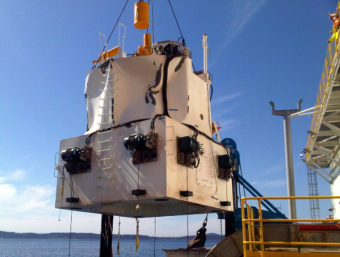
Current Greens Creek mine tailings facility as viewed from the water. Photo by KTOO News.

The draft Environmental Impact Statement includes four alternatives. ‘B’ is a major expansion of the current facility south within the Monument. Two other alternatives — ‘C’ and ‘D’ — include expansion of the current tailings along with construction of a new facility north of the Monument on the road to the Young Bay commuter ferry dock. The ‘No Action Alternative’ would lead to the mine’s closure.

“We accept the fact that mine is going to continue and they’re going to need more capacity for disposal. That’s really not the question. The question is where should this occur.”

Bruce Baker of Friends of Admiralty Island says they prefer Alternative C that includes building an additional tailings facility outside the Monument and a fractional expansion to the current facility. The conservation and advocacy group recently chartered a catamaran trip to Hawk Inlet and to discuss the environmental and cultural significance of the area.

“It’s common to have acid drainage flowing off of upland storage piles no matter what precautions, mitigation is taken,” said Baker.

Guy Archibald of the Southeast Alaska Conservation Council says sulfate in the rock has the potential to generate that acid.

“The sulfuric acid dissolves out a lot of the other heavy metals and makes them mobile in the water,” said Archibald.

The Forest Service is working with the mine to minimize those heavy metal discharges. Chad VanOrmer is district ranger for the Admiralty Island National Monument.

“We’re really trying to design the tailings facility so all that water is contained and treated before being released back out,” said VanOrmer.

Juneau resident Joe Zuboff spent his childhood in Angoon, and – as a clan leader – often returns. He’s upset that few from his home village are working at the mine. He already considers the tailings facility as an eyesore when you fly over. He wonders about the potential impact to subsistence resources on land, and in the Inlet where fishing boats used to be tied up.

“There are halibut in here, said Zuboff. “But they’re not the large halibut that we normally used to get in here.”

Mine manager Scott Hartman says he would rather not build a new, additional tailings facility outside the Monument.

“It disturbs more ground. It disturbs more wetlands. It requires more construction of pipeline. It adds 6-miles to round-trip of heavy hauling.”

Hartman believes extending out the current tailings site would be more cost-effective, and easier to monitor and maintain. However, that proposal would also cover the headwaters of Tributary Creek which is habitat for Dolly Varden char and coho.

“We think it’s best to keep all the eggs in one basket and watch that very closely,” said Hartman. “That applies not only to the design and construction and the operational phase, but even more so for the long-term reclamation and closure phase.”

The last day to comment on the draft EIS is June 4th. VanOrmer says the Forest Service will likely issue the final EIS and record of decision on a selected tailings disposal alternative in November.

Link:
Greens Creek Mine Tailings Disposal Facility Expansion Draft EIS [PDF]

Begich looks to drilling, legislation to lower fuel prices

Efforts to curb speculative trading in the oil futures market have run into partisan opposition, or are hung up in the courts.

U-S Senate Democrats have sponsored several bills to put limits on how much oil can be held by any trader for the purposes of buying and selling to profit from price fluctuations.  Senator Mark Begich is a co-sponsor and enthusiastic supporter of the legislation. He says speculators are running up the price of crude oil, far beyond what would result from simple supply and demand:

“They estimate for every gallon of gas that you and I and your listeners put into their car, 56 cents is speculators.  So we have a piece of legislation that gets speculators out, unless you use it for end purpose, freight companies and so forth,” Begich said.

With no bi-partisan support, the bills are going nowhere. Instead, they’ve become politically entangled with other oil and gas issues, particularly the Obama administration’s push to end federal tax subsidies for oil companies, adamantly opposed by Republicans.

Two years ago, the Dodd-Frank Act directed the Commodity Futures Trading Commission to enact what they call “position limits” on the number of oil contracts traders can hold.  But implementing the regulation was immediately challenged by the industry in court.

That case is still pending.

Begich says everywhere he goes in the state, people urge him to take action to curb high fuel prices.

Begich is among a group of Democratic Senators involved in the legal case over the CFTC’s “position limit” regulation, filing an amicus brief spelling out their intention to get speculators out of the business of trading in oil futures:

“We’ve joined and I say we, I and other senators have joined a group during over this issue, because these speculators have no business in this market.”

The speculation issue has not always been as partisan.  In 2008, when the price of crude oil approached $140 a barrel, Republican Senator Ted Stevens introduced a bi-partisan bill to limit positions held by certain types of investors.  He said in five years the amount of crude oil futures held by market index funds had skyrocketed.  The bill did not pass.

Those efforts  are just one aspect of Begich’s campaign to stabilize costs.

The New York Times credits Begich for helping gain President Obama’s support on oil drilling in Arctic waters off the coast of Alaska.

It’s recognition the senator gladly takes.

The article outlines Shell’s Arctic quest, a seven year, $4 billion effort to win over two presidential administrations and gain federal permits. the company was pursuing permits during the Deepwater Horizon oil spill in the Gulf of Mexico in 2010.

Times’ reporters says Begich’s fervor for Arctic oil exploration helped win over the president to Arctic drilling.

In an interview Tuesday on APRN’s Talk of Alaska, Begich was happy to take some credit.

“When I got elected, here’s what people said. They not only said it behind my back, they said it to me. And they said ‘with Obama in the presidency and a Democrat from Alaska, we’ll never get anything done in regard to oil and gas.’ Oddly enough, the place we’re having development and aggressive development, is going to be in the federal waters,” Begich said.

“You think about oil production in the Chukchi and Beaufort, it could be close to 900,000 additional barrels per day.”

The company plans to begin drilling this summer in the Beaufort and Chukchi seas. Shell awaits final permits from the U.S. Interior Department. Its ships are in Seattle, ready to be deployed to the Arctic this summer. Begich toured one last week.

Tulsequah Chief Mine road permit to be delayed

British Columbia environmental officials say a permit for a road to the Tulsequah Chief Mine will be delayed.

Mine owners Chieftain Metals had hoped for the permit in time to start construction this summer. The proposed road would run south of Atlin, B.C., through Taku River First Nations territory. Until the road is built, the company has said it planned to barge equipment and supplies from Juneau up the Taku River to the mine. The old mine is located near the confluence of the Tulsequah and Taku rivers.

The Tlingit group has historically been opposed to the road, and it appears an alternate route does not satisfy main concerns. Chieftain Metals in February submitted its permit application to Canadian environmental assessment agencies.

CBC’s Vic Istchenko was in Atlin last week and reports from meetings on the mine.

Curtailed Kensington production to pick up for the rest of year

A six-month planned reduction in mining activity at the Kensington Gold Mine near Juneau should lead to lower operating costs. That’s according to Coeur d’Alene Mines Corporation officials, who held an investor conference call today (Monday) to announce first quarter financial results.

Kensington temporarily curtailed mining and milling activity last November in order to complete several underground and surface projects. The mine recently resumed full production two months ahead of schedule.

During the first four months of 2012, Kensington produced 7,444 ounces of gold at a cost of about $2,700 per ounce. Coeur President and CEO Mitchell Krebs expects the mine’s production costs to average $1,150 to $1,250 an ounce over the entire year.

“Obviously what that means is that by the fourth quarter we’ll see costs on the low end of that average, given where we were in the first quarter,” says Krebs. “So, we’ll be seeing costs as we end the year in the $900 range to pull that average down.”

Kensington is expected to produce as much as 86,000 ounces of gold this year. The two-year-old mine contributed $10.4-million in metal sales to Coeur’s first quarter bottom line, but spent nearly $11-million on infrastructure. That included completion of an underground paste backfill plant, an electrical upgrade, a new warehouse, and a new 200-bed dormitory.

Krebs says Coeur’s silver and gold Palmarejo Mine in Mexico remains its largest producer. The company also has operations in Bolivia, Argentina, Australia, and Nevada. Company-wide, metal sales were up and operating costs were down during the first quarter of the year.

Public can comment on Greens Creek tailings expansion EIS

Greens Creek Mine camp. (Photo courtesy Hecla Mining Co.)

Hecla Mining Company wants to expand the tailings disposal facility at its Greens Creek Mine near Juneau in order to extend the life of the mine an additional 30 to 50 years.

The mostly lead, zinc and silver mine is located about 18 miles southwest of the Capital City on northern Admiralty Island, and is Juneau’s largest private employer with 370 full time workers.

Greens Creek Environmental Manager Jennifer Saran says the mine was expected to have a lifespan of 10 years when it started operating 23 years ago.

“Here we are, over 20 years later, we’re still here, we’re still operating, and we still have a 10 year mine life,” Saran says.

Tailings are the materials leftover after valuable minerals have been extracted from ore during the mining process. Saran says about half of Greens Creek’s tailings are combined with cement and used as fill to support mined out areas underground. The rest are stacked at a dry tailings facility located a few miles from the mine portal.

The dry stacked facility will run out of room in two years unless the mine is allowed to expand its tailings footprint. So in 2010, Hecla proposed an expansion to the south, which would hold an additional 9.7-million cubic yards of tailings.

Because Greens Creek is within the Admiralty Island National Monument, the U.S. Forest Service is conducting a National Environmental Policy Act review of the proposal. On April 20th, the agency released a draft Environmental Impact Statement for the project.

As typically is the case for such reviews, the EIS included four possible alternatives: No action, or no expansion of the tailings facility; The mine’s proposal to expand the existing facility; an option to build a separate dry tailings facility a few miles from the current one; and the last option, which would combine alternatives two and three.

Greens Creek Environmental Manager Jennifer Saran. (Photo by Casey Kelly/KTOO)

Saran says mine officials believe option two – expanding the current facility – is the best.

“We believe that keeping one tailings disposal facility allows us to keep all of our eggs in one basket, so to speak,” says Saran. “We can monitor, we can operate, and we can close for reclamation one facility rather than numerous facilities.”

Saran made her presentation at last night’s CBJ Assembly Committee of the Whole meeting. Assemblyman Jesse Kiehl asked why the mine doesn’t just continue to stack tailings at the current disposal site. Saran said some additional stacking could occur, but if the mine continues to find new reserves, the facility will need to expand at some point.

“That’s actually one of the benefits to our proposal. Keeping them at the same site allows a smaller footprint for the expansion, because we can go higher,” Saran says. “Building a new facility would mean a larger footprint. We can’t go extremely high for geotechnical stability reasons. But we can go higher than we are currently.”

The Forest Service’s draft EIS is currently out for public comment through June 4th. Once all of the comments have been taken and analyzed the agency will issue a final EIS and Record of Decision, likely in November.

Link:
Greens Creek Mine Tailings Disposal Facility Expansion Draft EIS [PDF]

Full production resumes at Kensington Gold Mine

Coeur d’Alene Mines Corporation today (Thursday) announced that full production has resumed at its Kensington Gold Mine near Juneau.

Mining and milling activities were cutback temporarily last November to complete several underground and surface projects at the mine site, at Berners Bay about 45-miles north of the Capital City.

Coeur Alaska Spokeswoman Jan Trigg says most of the projects were finished ahead of schedule, and the rest should be complete by the end of July.

“The underground paste backfill plant is now in commissioning. The mine’s electrical infrastructure has been upgraded. Underground development continues to advance. And we’ve completed some new surface facilities, including a new warehouse, a worker dormitory, and an expanded kitchen and dining facility,” says Trigg.

According to the Coeur d’Alene Mines’ website, the company put $34-million dollars toward capital expenditures at Kensington last year.

Trigg says the upgrades should make the mine more efficient.

Kensington has about 260 employees and a $35-million dollar payroll, according to recent statements by Coeur officials. About half of the workers live in Southeast Alaska. The mine also employs about a hundred contractors.

Couer d’Alene Mines will announce first quarter 2012 financial results on Monday May 7th.

Site notifications
Update notification options
Subscribe to notifications