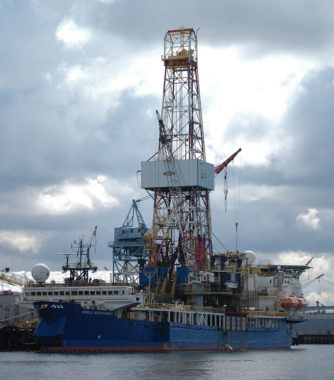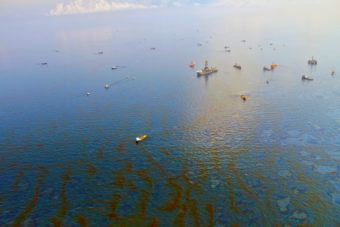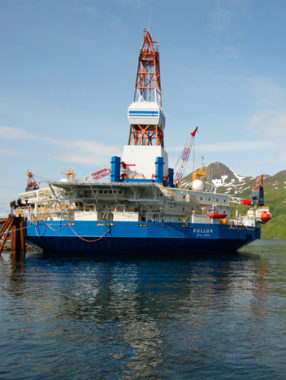
Environmental groups are suing the federal government, arguing that Shell Oil does not have an adequate plan to deal with a spill. The coalition says the goal is not to delay drilling this summer.
The brief was filed in U.S. District Court in Anchorage this morning, practically as the doors opened for business.
It’s just the latest suit in a string of them filed over Arctic drilling and it takes aim at the Department of Interior, specifically, the Bureau of Safety and Environmental Enforcement, or BSEE.
Earlier this year, BSEE approved Shell’s response plan to a spill. Something Michael LeVine says never should have happened. He’s an attorney with Oceana – one of the groups filing suit.
“Those plans are based on unrealistic assumptions, like the ability to recover 95 percent of a worst case blowout,” LeVine said.
For its part, Shell is exuding some confidence even though the suit it brought earlier this that would have prevented these very groups – including Oceana – from brining suits like this very one, didn’t play out as they had hoped.
But officials with the company like spokesman Curtis Smith, are still sounding upbeat and optimistic things will go as planned this summer.
“We anticipated that lawsuits like this would come at the 11th hour. There may be more, and no matter what the lawsuit pertains to, we feel very confident that the process used to review all of our permits was very robust, and that will be validated by the courts,” Smith said.
The critics though, don’t buy into that review. They say that Shell has not demonstrated an ability to cap a gushing well in Arctic waters. A few weeks back Interior approved Shell’s capping stack – which is designed to slow down runaway wells – in Puget Sound. The groups happily point out there are no floating ice caps in Washington State.
The lawsuit challenges the government on a whole host of laws – laws that were passed in response to the Exxon-Valdez spill. Violations, the suit contends, to the Clean Water Act, the Endangered Species Act and others.
Shell has about three ice-free months to begin operations this year. And, Smith says, the company will move forward as it has planned all along.
Charles Clusen, with the Natural Resources Defense Council concedes that, yes, this lawsuit may in fact slow Shell down, but that’s not the ultimate goal.
“Our objective is to prevent oil and gas activities in America’s Arctic until such time we can all be sure there will not be an accident that is devastating to that ecosystem,” Clusen said.
Getting everyone on board, though, won’t be easy, let alone, quick.
Royal Dutch Shell could drill several exploratory oil wells into the waters off the north shore of Alaska this summer. The potential prize is huge, but so is the risk, should there be an oil spill in this pristine and remote region. And that risk is on everyone’s mind since the BP blowout in the Gulf of Mexico two years ago.
Shell is now training hundreds of workers to confront oil in icy waters. But for now, the training is taking place in the calm, ice-free waters far to the south, near the port of Valdez.
Trainees with Royal Dutch Shell learn to deploy oil spill booms in the waters near the port of Valdez in Alaska. The company is training about 200 spill responders. (Photo by Richard Harris/NPR)
A blue and white vessel, the Nanuq, pulls away from the dock and heads out into open water. This is just a few miles from where the Exxon Valdez came aground and spilled more than 10 million gallons of oil back in 1989.
Geoff Merrell, Shell’s superintendent for emergency response in Alaska, is here to observe a program that will train about 200 spill-responders. The plan today is to deploy and retrieve 1,000 feet of oil containment boom.
Anyone who has seen an oil spill response knows that step one is to corral the oil, as best one can, inside a ring of rubbery material.
“In this way the oil would be prevented from spreading out over the water’s surface in a large geographic area,” Merrell says.
The boom is slowly reeled off of a large yellow spool. As it’s dragged across the deck, the crew steps up with giant air hoses to inflate it, like an oversized air mattress.
As a 34-foot vessel off the stern pulls the inflated boom off the Nanuq, crew members take turns getting a feel for the air hoses. They deploy the first reel, containing 500 feet of this floating boom. They’re paying attention to detail, not urgency.
Geoff Merrell is Shell’s superintendent for emergency response in Alaska. The training mission on this day is to deploy and retrieve 1,000 feet of oil containment boom.
“These are fairly new trainees,” says Merrill. They’ve been in training for a week and a half so far. “In an actual situation, when these would be seasoned responders, this evolution would happen much more quickly.”
How Good Is State-Of-The-Art Oil Cleanup?
This training is taking place in ideal conditions, with no ice in the water. Merrell says he does have experience deploying this boom in icy waters, and the crew will get training in that as well — presuming there’s still floating ice in the Arctic Ocean once they get up there this summer.
It’s still possible to encircle spilled oil around ice, Merrell says. But it is more challenging. Ice can cut the floating boom, and if chunks of ice get inside the boom, they can push the boom out of the way, “which would then release the oil that we had spent all that time trying to contain,” he says.
Merrell watches as the crew pulls out a hacksaw and starts in on a cable attached to the end of the boom.
“I’m not happy with what I’m seeing here,” he says. This is not standard procedure. But the improvised procedure resolves the hang-up, and the last of the boom drops off the stern of the ship.
The first step in responding to oil spills is to try to ring the oil with floating booms.
The first step in responding to oil spills is to try to ring the oil with floating booms. (Photo by Richard Harris/NPR)
It’s hard to imagine, standing on this deck on a calm and sunny day, what a real response would look like in the typical high winds of the northern Beaufort or Chukchi Seas, especially late in the season as ice starts to move back in.
Shell’s operation involves multiple vessels in the open ocean, other activity close to shore and contractors ready to hit the beaches should oil wash up. And the U.S. government has approved it. But just how good is the state-of-the-art in an actual oil-spill cleanup?
“It’s pretty abysmal,” says retired Coast Guard Vice Adm. Roger Rufe. “I don’t think anybody’s really proven they can clean up a spill very effectively in the ice.”
Spill response is a last resort, of course. The hope is that Shell will never have a blowout, or if it does lose control of a well, that a device called a blowout preventer will actually work, unlike what happened at the BP well in the Gulf of Mexico. If that fails as well, Shell is bringing along a device that’s designed to cap a runaway well.
“I think the chances of being able to get a cap on something more quickly than what happened in the Gulf is probably much better now than it was then,” Rufe said at a meeting in Washington, D.C., sponsored by the Pew Environment Group. “But once oil is in the water, it’s a mess. And we’ve never proven anywhere in the world — let alone in the ice — that we’re very good at picking up more than 3 or 5 or 10 percent of the oil once it’s in the water.”
Little On-The-Water Experience With Cleanup
Shell is also equipped to burn spilled oil on the sea surface, and it could use dispersants, which were used with much controversy at the BP blowout in the Gulf.
So an oil spill — and many of the possible response strategies — poses a risk to sea birds, whales, walruses and other wildlife that native villagers rely on for food. And there is very little on-the-water experience to demonstrate how well all of this would work.
“It’s Alice-in-Wonderland kind of promises that are being made and accepted by the government,” says Peter Van Tuyn, and environmental lawyer in Anchorage.
He says responding to a spill in the Arctic would be vastly more difficult than responding to one in the Gulf of Mexico.
“They have a miniscule number of boats compared to what was available in the Gulf of Mexico,” he says, and in the Gulf, “they didn’t have to deal with the extreme weather conditions that we’ve got in the Arctic.” High winds are the norm, and sea ice is always a possible hazard, “and yet they [Shell] claim they can collect as much as 95 percent.”
Deploying Oil Containment Booms
Watch Shell workers practice how to deploy and retrieve a containment boom. The boom is slowly reeled out, then inflated with giant air hoses. In a real spill, the boom would be used to contain the oil and make it easier to recover.
Credit: Richard Harris and Benjamin Morris/NPR
Merrell says the company has made no such claim. Instead, he says, the oil company’s plan is to confront 95 percent of the oil out in the open water, before it comes ashore. That doesn’t mean responders can collect what they encounter.
“Because the on-scene conditions can be so variable, it would be rather ridiculous of us to make any kind of performance guarantee,” Merrell says.
Cleanup success depends on how thick the oil is, how well trained the crew is, and, of course, weather and ice conditions. Of course, he hopes that this $100 million, 300-foot-long Nanuq will never have to be used for anything more than drills and training.
And as for that training, it’s clear these new recruits have a lot to learn before they become proficient.
They will have more time to practice. If Shell does get the final go-ahead to drill exploratory wells this summer, the company is permitted to start on July 15. But there’s been unusually thick ice off the coast of Alaska this year, so drilling is likely to be delayed by a matter of weeks.
U.S. Senator Lisa Murkowski has introduced legislation to allow road access to two proposed mines on Prince of Wales Island in Southeast Alaska.
Murkowski says the Niblack and Bokan Mountain mines could provide stable, well-paying jobs for hundreds of people. But with no roads to either site, workers would have to be boated or flown to and from the mines.
Murkowski’s bill would authorize a road across 18 miles of the Tongass National Forest currently designated as a “roadless area.” The U.S. Forest Service would choose one of two identified routes to connect the Prince of Wales Island road system to the claims, picking the one the minimizes costs and disturbances and complies with environmental laws and regulations.
Drilling is expected to begin Saturday on the Herbert Glacier Gold prospect near Juneau.
Majority owner Grande Portage Resources says two rigs will drill 60 to 70 holes during the first phase.
An independent estimate, based on drill results of two of four principal veins, shows the project holds more than 245,000 ounces of gold.
The Herbert Glacier Gold project is about 16 miles north of Juneau in the Juneau mining district. Coeur Alaska’s Kensington Gold Mine is about 19 miles south, and Hecla Greens Creek Mine is about 12 miles west.
The company says its exploration over the last two years indicated at least six promising gold bearing vein-fault structures on the property.
In a news release, Grand Portage says it has granted incentive stock options to purchase up to 1,750,000 common shares at an initial price of 15 cents per share for a period of five years from date of issue.
Herbert Glacier is a joint venture between Grande Portage and Quaterra Resources Inc., both based in Vancouver, British Columbia. Grande Portage has 65 percent and Quaterra has 35 percent interest in the Herbert project.
A map of previous drilling sites and potential future sites. Map courtesy of Grande Portage Resources Ltd.
Photo courtesy Teresa Cummins/Hecla Greens Creek Mining Company
Three workers from Juneau’s Greens Creek Mine were among the emergency responders to the Pogo Mine in the Interior Tuesday, after an early morning underground fire forced the evacuation of 34 workers at the facility near Delta Junction.
The Greens Creek miners are part of “Central Mine Rescue” – a cooperative made up of workers from nine different mines in Alaska and the Pacific Northwest. They all train on the same equipment and are ready to assist other mines in the event of an emergency.
“Say like up at the Pogo Mine, we didn’t have to pack up, bring anything with us,” says Greens Creek Health and Safety Manager Teresa Cummins. “Our personnel are trained so that we can work with other underground mine rescue teams. We all are speaking the same language for an efficient and quick response when these nine members are in need.”
Cummins says the Green’s Creek miners were called in to assist Pogo’s mine rescue team. She hasn’t had any contact with them, but says it’s likely they didn’t see any action.
In the event of an underground emergency, the “Central Mine Rescue” agreement requires two teams of six respond – one in a primary role, the other as backup. The cooperative is run out of Couer d’Alene, Idaho, and puts out a call anytime there’s an emergency at one of the member mines. In the case of the Pogo incident, Cummins says Greens Creek was the first to respond that it had a team available.
“This is what they train for and I’m very, very proud of them,” Cummins says. “I had more volunteers than I had spots to send.”
Cummins says about 20 workers make up the Greens Creek’s Mine Rescue Team. Last month they competed in a “Central Mine Rescue” competition in Kellogg, Idaho, pitting workers from the nine member mines against each other in drills and training exercises.
Nobody was hurt in the underground fire at the Pogo Mine. The incident is under investigation by the federal Mine Safety and Health Administration.
Photo courtesy Teresa Cummins/Hecla Greens Creek Mining Company
The price of oil is headed for the biggest decline since December 2008.
U.S. crude has dropped almost 16 percent based on predictions that world demand will not be as high as previously thought.
Despite the slump, North American oil and gas production is expanding.
Energy Policy Research Foundation President Lou Pugliaresi cites technology, better policy and access to federal land as being key components to the domestic expansion.
Pugliaresi can be seen on KTOO’s 360 North television Friday (June 1), at 8 p.m.
He recently spoke to the Juneau World Affairs Council on the “Coming Renaissance in North American Oil.”
“We should have policies that hold up fairly well under uncertainty, and that is a basic flaw in American energy policy,” Pugliaresi said. “We think we know what the future looks like and we don’t. So we end taking policies that try to reinforce the worst expectations about the future.”
Pugliaresi said government needs to change its thinking about permitting and the trade-offs between economic value and environmental costs.
“If we get appropriate policies in place we are going to become a dominate energy producer in the western hemisphere. I think it’s only a matter of 10 to 15 years where the whole western hemisphere no longer buys any oil from the Middle East,” Pugliaresi said.
Pugliaresi worked for the federal government in the 1970s and ’80s with jobs in the National Security Council, Department of State, Department of Energy and the Department of the Interior.
“The Coming Renaissance in North American Oil” airs at 8 p.m. on 360 North.
Close
Update notification options
Subscribe to notifications
Subscribe
Get notifications about news related to the topics you care about. You can unsubscribe anytime.