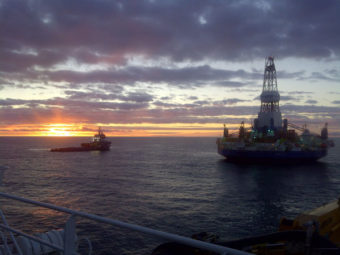
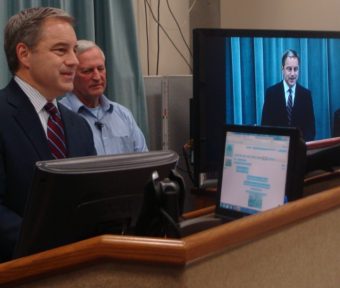
The U.S. Department of Interior announced this morning it is allowing Shell Oil to proceed with its drilling operations in the Chukchi Sea. Peter Granitz reports.
This is just the latest hurdle overcome in Shell’s quest to drill for oil in the Arctic Ocean.
The Department of Interior granted the go-ahead to Shell to begin installing some of its safety mechanisms, including a mud-lined cellar that will eventually house a blowout preventer.
On a conference call, Secretary of the Interior Ken Salazar stressed today’s announcement is not final. It does not permit Shell to drill exploratory wells for oil.
“The action we are taking today is one we are very comfortable in taking, because we are confident it can be done safely and without risk to the environment,” Salazar said.
He says Shell needs to improve its containment capacity on the Arctic Challenger. Drilling cannot begin until that vessel is approved and in the Arctic.
Statoil is inching closer to exploratory drilling in Alaska’s Chukchi Sea. The only question is: When?
A delegation from the Norwegian oil company held a public meeting in Nome on Monday. Statoil acquired 16 leases in a 2008 sale, and would partner with ConocoPhillips on another 50 leases. The potential drill sites are located about 150 miles northwest of Barrow.
Statoil’s Alaska Exploration Manager Lars Sunde said the company is optimistic about Alaska’s role in its future.
“Alaska is an important emerging area for Statoil. And we are confident from the Norwegian waters and the Norwegian Arctic, we feel that our technology and knowledge level is a very good fit for Alaska,” Sunde said.
Statoil started conducting fieldwork in the Chukchi Sea in 2010, completing 2D and 3D seismic testing of the sea floor. In, 2011 work included sonar to look for shallow gas pockets that could present risks. They also took soil core samples to get a sense of sea floor stability.
Sunde detailed plans for one exploration well, and one or two appraisal wells at depths between 115 to 145 feet. A mobile offshore drilling rig or a jack-up rig would be used, along with a contingent of support ships and oil spill response vessels. The company plans to drill only during the open water season, in ice-free conditions. But Sunde says the schedule is still up in the air.
“What we’re doing is to plan an execution of a drilling program. We don’t know when that might take place. It will not be earlier than 2015, maybe later. But we want to do a very thorough job in understanding all the challenges that are associated with operating in the Arctic and make sure that we do this properly,” Sunde said.
Nome residents who attended the company’s presentation raised questions about the impact Statoil’s ships would have on subsistence. The company’s marine biologist Jurgen Weissenberger said the goal is to have “zero impact” on marine and subsistence species.
Statoil is the national oil company of Norway. Founded in 1972, it was partially privatized in 2001. The Norwegian government retains 67 percent of the company’s shares. It operates in 40 countries and opened an Anchorage office in 2009.
The Tulsequah mine sits above the Tulsequah River which flows into the Taku River. Image from Chieftan Metals website.
Juneau Mayor Bruce Botelho is asking Canadian environmental officials to come up with a plan to treat acid rock drainage from the Tulsequah Chief Mine at the headwaters of the Taku River.
Botelho has joined the growing sentiment on the Alaska side of the salmon-rich river that mine owner Chieftain Metals will not be able to remedy the 60-year-old problem.
“What is the long-term plan, recognizing that there may not be a mine in operation?” Mayor Bruce Botelho asked in a recent letter to Canadian Minister of Environment Peter Kent.
Since Chieftain Metals shut down its water treatment plant in June, after six months of operation, folks downstream are looking for a permanent solution to the acidic discharge.
“Right now, we’re on the dirty end of this,” Chris Zimmer said.
Chris Zimmer is Alaska Campaign Director for the trans-boundary conservation group Rivers without Borders. His group echoes the sentiment of Botelho, Juneau legislators, the Taku River Tlingit First Nation, and others who want Canadian officials to look outside the mining industry for a solution.
“I got to believe that if the river flowed the other way and Canada was on the receiving end of the pollution and problems, that we’d see a much different situation here,” Zimmer said.
Chieftain put itself in violation of its federal and provincial environmental permits, when it stopped the water treatment, based on the cost of operating the plant.
At the time, the B.C. Ministry of the Environment required Chieftain to develop an action plan to get back into compliance.
That plan is now in place, according to B.C. Environmental Protection Regional Director Ian Sharpe.
In an email response to KTOO questions, Sharpe says one requirement is to remove sediment by redirecting runoff and mine site water through settling ponds. He said the clear water is then discharged into the Tulsequah River, which flows into the Taku.
Sharpe has required that the company monitor the discharge weekly.
The company’s mitigation plan indicates sampling began on August 6. It says Chieftain Metals expects a new feasibility study by the end of the year. The company says that will attract full financing for the mine project, and allow it to resume treating the acid rock drainage by the middle of next year.
A map of the Tulsequah and Taku Rivers watershed from Rivers Without Borders.
Zimmer says the action plan doesn’t ring true, if you look at the company’s current financials, which foretell a far different story.
“Their plan is basically, you know, just trust us,” Zimmer said.
Botelho says it’s time the British Columbia and Canadian national governments show they can enforce their own laws as well as international obligations.
“Part of this is wanting to receive that high level of assurance that there is a long term and not a limited situational response,” Botelho said. “Is there a permanent strategy in place to protect the watershed?”
Chieftain Metals purchased the property two years ago from bankrupt Redfern Resources, acquiring Redfern’s permits and the condition that it clean up the acid rock drainage. The Tulsequah Chief Mine has been discharging the acidic water since Cominco closed it in 1957.
Alaska’s congressional delegation says restrictions on land proposed for the 36,000-square mile National Petroleum Reserve-Alaska could create problems for Arctic offshore drilling.
Sens. Mark Begich and Lisa Murkowski and Rep. Don Young say the restrictions proposed to protect wildlife in the 36,000-square mile reserve could add expense to or block a pipeline transporting oil from the Chukchi Sea to the trans-Alaska pipeline.
Begich says the Bureau of Land Management’s new preferred alternative seems to close off several options for building a pipeline across the reserve.
Murkowski said she’s hearing concerns that a non-direct route will make a pipeline so expensive that an oil company could instead consider moving crude in tankers instead of the 800-mile pipeline.
Minor oil spills at Bellingham have plagued construction of an oil spill containment barge needed for Shell Oil to drill exploratory wells in the Arctic Ocean off Alaska.
The Washington Ecology Department says hydraulic systems leaked on July 24, Aug. 4 and Aug. 6, each releasing about a quart of oil into Whatcom Waterway. The department sent a notice of violation to Superior Energy Services, which is building the Arctic Challenger.
Ecology spokeswoman Katie Skipper told The Bellingham Herald the spills could be the result of crews working in haste.
Shell is waiting on the barge to start drilling. The barge will carry a dome-shape containment system that could be lowered onto a leaking well to funnel oil and gas to a barge.
About 3,000 Mendenhall Valley households and businesses were without power this morning for about an hour when a switch failed at the Alaska Light and Power Loop substation.
Electricity went off at 7:23 a.m. and was restored by about 8:30 a.m.
AEL&P spokeswoman Deb Ferreira says the switch failure caused all four feeders at the substation to go offline.
“Some customers reported seeing a flash of light. We believe that was caused by the disconnect switch burning out,” she said.
The outage caused the Dimond Park Aquatic Center to shut down for most of the morning.
Aquatics Manager Kathie Millhorn says the surge affected the small pool circulation pump and chlorine generation system.
“So we closed the facility until we could get the circulation pump back up and get our disinfectant levels back up, so that it’s a healthy, safe environment,” Millhorn said.
She says it took a couple minutes to repair the pump, and the center reopened about 11 a.m. after the chlorine got back to a safe level.
AEL&P’s Ferreira recommends customers use grounded surge protectors and other measures to prevent damage to electronic equipment from power blips that occur regularly.
Close
Update notification options
Subscribe to notifications
Subscribe
Get notifications about news related to the topics you care about. You can unsubscribe anytime.