Energy & Mining

Oil tax reform may play big role in national debt discussions

It’s been a slow week on Capitol Hill with lawmakers out for Thanksgiving. But talks are ongoing between Congressional leaders and the White House about working to stave off the fiscal cliff … and establishing the frame work for a deficit reduction package.

Tax reform could play a significant part of the debt package, and the oil and gas industry is making sure it keeps its tax breaks.

President Barack Obama campaigned on a promise of fairness in the tax code.

Speaking in the White House Rose Garden in March, Mr. Obama said there was no reason oil companies with record profits should receive billions of dollars in subsidies paid for by everyday citizens.

[quote]“Instead of taxpayer giveaways to an industry that’s never been more profitable, we should be using that money to double down on investments in clean energy technologies that have never been more promising.”[/quote]

But with the country facing the combination of spectrum-wide tax increases and across the board cuts to government spending, it’s unlikely any money saved from ending oil subsidies would go to more investments in wind, solar and biomass. It’d likely go to lowering the nation’s debt.

There’s a lobbying frenzy going on in Washington and in Congressional districts across the country. The industry wants to preserve specific, beneficial tax breaks. U.S. Senator Mark Begich says he met with representatives from Shell and BP last time he was in Alaska, and he met with the American Petroleum Institute earlier this week.

[quote]“I get it. There are some people who don’t like the oil and gas industry. They paid over 140 billion dollars in taxes last year. I can point to some industries that pay very little taxes and get a bunch of credits,” Begich said.[/quote]

Some of that 140 billion was certainly passed on to consumers because it came from excise taxes.

Senator Begich says if the government tackles the debt through tax reform, there’s no reason to single out just one industry.

And that’s the argument Stephen Comstock is making. He works on tax policy at the American Petroleum Institute.

[quote]“You should not take this time to have tax raises on one particular industry,” Comstock said.[/quote]

Comstock says API is willing to sit down and discuss its tax preferences when the government takes on true, fundamental tax reform … but not right now.

“We aren’t in any way shape or form offering anything at this point,” Comstock said.

Many think Congress will work to overhaul the tax code, for both citizens and corporations in the spring. And when it does, Daniel Weiss has his eyes on certain deductions used by major oil producers. Weiss is a senior fellow at the Center for American Progress Action Fund.

He says the subsidy for intangible drilling benefits has been on the books since 1916. It allows oil companies to write off the cost of labor upfront – instead of over the lifespan of the well.

“Companies that don’t drill have to take deductions for their expenses over time rather than getting those deductions all at once. Getting them all at once is like getting a lump sum instead of an allowance every week,” Weiss said.

Not all oil companies qualify for the various subsidies, and it’s not the biggest producers who necessarily benefit the most.

Eric Toder is a co-director of the Tax Policy Center. He also served as an undersecretary of the Treasury. He says that independent producers, meaning not the integrated companies that refine and market products, fare better than the majors.

Independent producers are worried about losing what’s known as the percentage depletion allowance. That allows companies to deduct fifteen percent of gross revenue – not cost – of a well. Opponents say the subsidy is worth most when oil prices – and profits – are high.

[quote]“You can deduct, right off the top, 15% of your gross revenues. So that deduction could exceed the amount you’ve spent on developing that property over time,” Toder said.[/quote]

Toder says the depletion allowance and the subsidy for intangible drilling benefits actually don’t amount to much money.

“These provisions are not that expensive in terms of their overall revenue loss to the treasury. You’re talking about things that cost a billion a year roughly,” Toder said.

That’s not much money in Washington terms. But it’s enough to keep both the major and minor producers lobbying hard.


Shell concludes exploratory drilling operations in Arctic Ocean

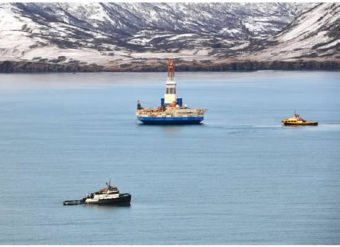
Kulluk in the Beafort Sea. (Image courtesy Shell Oil)

Shell Oil wrapped up its exploratory drilling season in the Arctic yesterday. As promised, not a drop of oil was spilled in the process — but not a drop was drilled either.

Shell only started drilling in early September, which limited the numbers of wells the company was able to complete this season.

“We drilled a top hole at our Burger prospect in the Chukchi Sea and one at our Sivulliq prospect in the Beaufort Sea,”says spokesperson Curtis Smith.

The two top holes extend only 1500 feet below the seafloor, stopping well short of the oil reserves that Shell is trying to access. That’s because the Department of the Interior prohibited the company from drilling deeper without its oil spill containment barge on site. That vessel was under construction for most of the summer and didn’t receive final approval from the Coast Guard until mid-October, too late for it to be of use this year. But Smith says the Arctic Challenger is ready for next summer.

“Our intention is literally to pick up where we left off. We’re actually leaving anchors at both of our prospects so that when the sea ice retreats, hopefully in July of 2013, we can get back on those well sites, make the most of the time we have and drill to the objective.”

Whether that happens as smoothly as Shell hopes is contingent on a number of things going according to plan. The company faces potential legal battles over proposed revisions to its air quality permits. For this drilling season, the Environmental Protection Agency effectively waived some of the requirements of the permit, but formal revisions are still working their way through the public process. Smith says Shell isn’t worried.

[quote]”We think these permits are very robust. They’ve withstood the scrutiny of the public, the regulators and even the courts. So we’re very confident that we’ll be back at work in 2013 with all of the necessary permits.”[/quote]

Shell will also need to show regulators that its oil spill containment dome is fully functional before drilling starts next year. The dome was damaged during testing in Puget Sound in September.

“The internal investigation determined that the Arctic Challenger’s dome was damaged when it descended too quickly, apparently due to a faulty electrical connection, so we’re modifying those elements of the dome so that it’s ready for next year.”

Meanwhile, environmental groups told APRN’s Peter Granitz that this year’s drilling season was a failure.

Mike LeVine is senior counsel at Oceana. He says Shell’s mishaps this summer should read as a cautionary tale.

[quote]“Shell lost control of its drill ship in Dutch Harbor, backtracked on its commitments to recover spilled oil and to protect air, and ultimately damaged its own containment dome in an effort to test it.”[/quote]

LeVine says this summer offers many lessons and indications for the future, for citizens, government regulators, and the companies.

“Hopefully Shell will learn what the company needs to do to be prepared, and hopefully other companies will look hard at the difficulties at drilling in the Arctic Ocean and responding to a spill.”

And by many accounts, they already are. Last month, the head of oil giant Total warned other companies about the dangers in offshore drilling in the Arctic.


New road route for Tulsequah Chief Mine approved

Proposed road route map. (Image courtesy Chieftain Metals website)

British Columbia environmental officials have approved a new route to the Tulsequah Chief Mine that avoids several traditional Native use areas and eliminates the need for Taku River barging.

A Canadian company hopes to re-open the old mine by 2015.

The Tulsequah Mine has long been a concern to Juneau because of its connection to the Taku River.

The Taku River Tlingit First Nation has steadfastly opposed a road from Atlin to the mine located near the confluence of the Tulsequah and Taku Rivers.  The new route, however, grew out of discussions last year between mine owner Chieftain Metals and the tribe.

Garry Alexander is Project Director for the Environmental Assessment Office for B.C. Ministry of Environment.  He said the fact the two sides worked together was important to the approval process.

[quote]“The proponent, in this case, Chieftain Metals, has an existing approval under the Environmental Assessment Act, as well as a permit to actually build the road.  Now on the basis that this wasn’t the alternative that the First Nation wanted, the proponent worked with the First Nation last year to come up with an alternative route that would better meet the needs of the First Nation and the proponent,” Alexander said.[/quote]

The new route is also within the Atlin Taku Land Use Plan, agreed to in 2011 by the First Nation and British Columbia government.

The plan came after years of litigation, including a lawsuit over the original permit for a mine access road permit.

When Chieftain Metals purchased the property two years ago, company officials knew the route was contentious, but maintained a road would be the only way to attract mine investors; especially since barging up the Taku River is so uncertain.

The Taku River watershed agreement presented an opportunity for Chieftain and the First Nation to negotiate a better route.  Keith Boyle is Chief Operating Officer for Chieftain Metals.

“They signed a land use plan and said, ‘You know what, find an alternate route within this particular area if you want access to the Tulsequah valley’ (I’m simplifying it).  So that’s the work we did all last year to actually come up with that route to avoid those  contentious issues and stayed within that strategic access area,” Boyle said.

In an interview just after the company applied for the new route last spring, Boyle said it would be better for both the First Nation and Chieftain.

[quote]“It avoids the Mackinaw trail, the heritage trail that the TRT has said has always been the biggest contention around that road. And the other thing too, is actually avoids what they call the Blue Canyon area, which is the area where there is a lot of moose and caribou,” Boyle said.[/quote]

The EAO’s Alexander said the prospect of less impact on habitat for grizzly bear, caribou and moose — the majority of wildlife species in the area — was a selling point for the new route.  He also said it avoids a lot of potential impact to fish habitat.

“There are significantly fewer bridge crossings on the amendment then there are on the approved route,” Alexander said. “It’s quite a significant change in the number of crossings alone.”

According to Chieftain, the approved route is shorter and will reduce construction costs.  It will connect with the B.C. road network at the end of Warm Bay Road, south of Atlin.

While the Taku River Tlingit First Nation worked with Chieftain on the road realignment — and was part of a government-led Tulsequah Mine working group – the tribe pulled out of discussions in July, when the company shut down a plant that was treating acid rock drainage from the mine.

At the time, the group said Chieftain had breached commitments made to the tribe.

The company said it needed to improve treatment plant operations as well as raise money to run it.  The old mine has been discharging acidic water since former owner Cominco stopped mining in 1957.  Chieftain Metals’ federal and provincial environmental permits require the drainage be cleaned up.

Since the B.C. government approved the new access route, First Nation leaders have had no comment. Calls to tribal leaders have not been returned.

While Southeast Alaskans should be relieved at the prospect of a road instead of barging materials and ore up and down the Taku River, transportation is just one aspect of the proposed mine.

The international group Rivers without Borders may be the most vocal mine opponent.  Spokesman Chris Zimmer said the access road would provide a foot in the door for more industrialization.

[quote]“You know the road versus the barge, they have different impacts. I think the biggest worry for the road is once you put in a road like this you’re likely to see additional spin off industrial development,” Zimmer said.[/quote]

Zimmer believes both transportation routes would be a problem for the Taku River watershed.

The river flows from British Columbia into Alaska waters about 10 miles south of Juneau. The Taku River is considered Southeast Alaska’s most prolific salmon producer.

Energy Independence For U.S.? Try Energy Security

Gone from this year’s presidential campaign are most mentions of climate change, environmental pollution, or green jobs. Former Gov. Mitt Romney, the GOP presidential nominee, prefers to call attention instead to the country’s continuing dependence on foreign energy sources.

“I will set a national goal of North American energy independence by the year 2020,” Romney declared in August.

The line is now a standard part of Romney’s stump speech, and he repeated it in his first two debates with President Obama.

With that promise, Romney joins a long line of U.S. leaders who have preached the virtues of energy independence. Few, however, have explained precisely what this goal means.

A Global Market

In truth, it would be virtually impossible for any country to be totally independent where energy is concerned. Not only would it have to produce all its own oil; it would also have to be independent of the global economy.

Like sugar, wheat, gold and other commodities, oil is also bought and sold on a global market. All the oil produced in the world becomes part of the global oil supply; all the oil used comes out of that supply. The global oil price depends on the supply/demand relation, and the price is essentially the same for all countries.

Energy analyst Amy Jaffe likens players in the global oil market to swimmers in a swimming pool.

“If you’re in the deep end or the shallow end and somebody takes water out of the pool, it affects both swimmers equally,” Jaffe says. “[It’s the] same thing if we start pouring water in. You’re not pouring the water into just the deep end or just the shallow end.”

With oil, all countries are affected when the total supply is down relative to demand; the price goes up. When the supply is boosted and there is plenty of oil for everyone, the global price goes down.

With respect to price, therefore, there is no such thing as energy independence. Even if the U.S. were producing as much oil as it was consuming, a halt in production by Iran or Saudi Arabia would still drive up the oil price in the U.S.

Energy Security

But there is another way to think about energy independence. If a country produces as much oil as it uses, it is less vulnerable to some foreign country shutting the tap. Jaffe, executive director of energy and sustainability at the University of California, Davis, says this is the big reason governments want to reduce their dependence on foreign oil producers.

“If someone is going to cut off your supply, because they don’t like your foreign policy or they want to keep you from attacking a country, this is a dangerous thing,” Jaffe says.

But is “energy independence” the proper term to describe the national goal?

“I prefer the term ‘energy security,’ ” says Roger Altman, who served as deputy Treasury secretary under President Clinton.

“What that means,” Altman says, “is, ‘Let’s get to the point where the amount we import from rogue or potentially rogue nations who might be hostile to us is down to a point where, if suddenly that supply was interrupted or shut off, we go right on.’ ”

The U.S. learned the importance of “energy security” in 1973, when Arab countries imposed an oil boycott on the United States to protest its military support for Israel in its war against Egypt and Syria. Americans were soon waiting in long lines at gas stations.

In response to the Arab oil boycott, President Nixon set a new national goal in his 1974 State of the Union speech.

“At the end of this decade, in the year 1980,” Nixon proposed, “the United States will not be dependent on any other country for the energy we need to provide our jobs, to heat our homes and to keep our transportation moving.”

A Glimmer Of Hope

The fact that we are still talking about this goal nearly 40 years later shows how hard it is to achieve. But there is reason now to believe that energy security may finally be within reach. Energy production in the U.S. is booming, thanks in large part to new techniques for extracting oil and gas from hard-to-reach deposits.

According to the latest estimates from the U.S. government’s Energy Information Administration, U.S. production of oil and other liquid petroleum products could soon overtake production from Saudi Arabia, the world’s No. 1 oil producer. Oil imports, meanwhile, are declining.

U.S. energy demand remains high, however, and it is likely to be years before the United States has an energy supply entirely its own.

Even in that case, however, the U.S. could significantly boost its energy security, because new production throughout the Western Hemisphere would leave the country less vulnerable to a shutoff from the Middle East or elsewhere.

“It doesn’t mean we would never import another barrel of oil outside the Western Hemisphere,” says Altman, who is now the chairman of Evercore Partners, an investment banking firm. “What it means is that most of our oil imports would come from Canada, Mexico, Brazil and so forth, and whatever happened in the Middle East would have no severe downside for our economic stability.”

This is progress. It’s hard to imagine how a conflict with Brazil or Mexico, much less with Canada, could jeopardize the U.S. energy supply.

Increased energy security on the supply side, however, does not mean energy independence on the economic side. A smaller share of the oil we use in the U.S. comes from foreign sources today than was the case a decade ago. But an increase in the world oil price has left U.S. consumers paying more at the gas pump and reminded them of their continued dependence on market events beyond White House control

Can small wood-gas systems lower energy costs?

Wes Tyler, left, stands by a new wood gasifier at Icy Straits Lumber in Hoonah. John Hillman of the Hoonah Indian Association is on the right
Wes Tyler, left, stands by a new wood gasifier at Icy Straits Lumber in Hoonah. John Hillman of the Hoonah Indian Association is on the right. Photo courtesy Sealaska.

Wes and Sue Tyler run Icy Straits Lumber & Milling in Hoonah, about 40 miles west of Juneau. They make log cabin kits, siding, beams and other finished products out of Southeast Alaska wood.

But high energy prices have increased operating costs. A particular problem is equipment used to dry damp wood.

So Wes watched closely as a new system using wood chips to generate electricity was turned on earlier this month.

“All of a sudden the engine comes to life and we’re able to go in and turn on all the lights in the building and a fan that was pushing some warm air around in the dry kiln and with a few more KWs involved, why you could ultimately have the dry kiln running on that sort of fuel,” Tyler says.

The system is called wood gasification.

It’s part of an experiment to see if compact devices – this one is 4 by 4 by 8 feet high – are a viable alternative to oil-powered systems.

So far, the generator at the Tylers’ has been working fine.

Sealaska Executive Vice President Rick Harris, speaking at a press briefing in Juneau, says Icy Straits Lumber is the right place to try it out.

“He’s already got the wood supply there. He has the technical know-how to deal with these kinds of things. But based upon his experience then we can see if we can transfer this type of technology to other areas,” Harris says.

In fact, a second unit is also being tested at the mill, for eventual use at a Hoonah tourist attraction.

Wood gasification is not new technology. It’s been around, in one form or another, since the late 1800s. Small gasifiers were even used to power cars, trucks and trains in German-occupied territory during World War II fuel shortages.

How they work is not that complicated.

“So what we do in a gasifier is burn part of the wood and generate heat, which converts the solid to a gas,” says consultant Tom Miles of Portland. He worked with Sealaska’s Haa Aaní subsidiary and Icy Straits Lumber to select and install this particular system.

“And then the mixture of the gas with charcoal solids further reduces the fuel to a fuel gas. And the fuel gas is about half nitrogen, about 20 percent carbon monoxide, and about 20 percent hydrogen. And that will burn in an internal combustion engine,” Miles says.

Sealaska’s Rick Harris talks about wood gasifiers at a Thursday press briefing while consultant Tom Miles listens. Photo by Ed Schoenfeld.

It’s not as efficient as gasoline or propane. And it won’t replace hydropower. But if wood scraps or leftovers from milling or thinning trees are easily available, it can be cheaper.

Miles says it can take about a third off the cost of a diesel-powered generation. (Read more about wood gasifiers.)

“We will be not only generating electricity but we can capture waste heat from the engines so it’s micro-scale combined heat and power [system],” he says.

Sealaska’s Harris says a Hoonah lodge-owner has already shown interest in the system.

And the corporation is working with the Icy Strait Point tourist attraction, which is owned by Hoonah’s village Native corporation, to use gasification to power and heat a cultural center, and eventually, a greenhouse.

“It’s one of those things where in the summer they have a lot of visitors come in. So we can grow in the greenhouse certain plants and vegetables that they can use. And then in the winter when they’re not using it, we can move that stuff into the Juneau market or the local market,” Harris says.

Sealaska and its consultant have looked at a lot of gasification options. Harris says the Hoonah experiments will show whether they chose the right technology.

“In a month, Wes may tell us this just isn’t going to work. I think we’re fairly optimistic that it will work. But that’s why we’re doing it in a place where we have the ability to make the necessary adjustments and to prove it can work in a rural community environment,” he says.

Sealaska’s energy experiments have been funded in part by the federal Department of Energy and other sources.

It’s already heating its Juneau headquarters with a wood-pellet boiler, which is cheaper than diesel heat. It also considered building a waste-wood ethanol plant at Ketchikan’s Ward Cove, but concluded it wasn’t economically feasible.


AELP beefs up Snettisham avalanche protection

A second avalanche diverter protecting Juneau’s major power source has been completed.

It’s part of AELP’s plan to mitigate powerful snow slides that threaten towers along the Snettisham line.

The company has been working on the plan since 2008, when a series of huge slides  – considered a one-hundred year event – severed the capital city from low-cost hydroelectric  power for 45 days, forcing the company to burn expensive diesel fuel.

Eric Ericksen is vice president of transmission and distribution for Alaska Electric Light and Power.   He says most of the mountainous terrain along the line is avalanche prone, but the site near Snettisham is the steepest and spans about a 10-thousand foot section of line, where there are eight towers.

The diverters are large steel column and beam structures bolted to the bedrock, surrounding the transmission towers.  The first was completed in 2009 to protect tower 4-6. It was truly put to the test this past March when snow from a massive avalanche reached about the 24-foot level of the 40-foot diverter, Ericksen says.

“The structure is about 200-thousand pounds of steel sitting in a wedge shape right  in front of it and (snow) plowed into and kind of curled around the edges,” he says.  The tower was not damaged.  “So we were happy and we’re moving forward with plans to build more.”

 The latest diverter protects tower 4-5; the foundation is already in for the third to be built around tower 4-4.

In addition to the three steel diverters, the mitigation system includes a number of actions.  One particularly vulnerable tower has been taken out and the transmission line moved, other towers have been beefed up, and break-away links installed, so if there is damage to any structures, it will not have a cascading effect among other towers.

AELP also conducts avalanche control on the Snettisham line, to bring down snow before it builds up.

“We get a lot of inquires, so I like to think that we’re at this point kind of  leading the industry in the country on avalanche mitigation and students and modeling and that, trying to evaluate options,” Ericksen says.  

 Each diversion structure costs about $2.2-million, covered in part by a grant from the state’s Renewable Energy Fund.  AEL & P rate payers are paying the rest, factored into current rates.

Site notifications
Update notification options
Subscribe to notifications