Fisheries

Historically low hooligan run in the Upper Lynn Canal remains a mystery

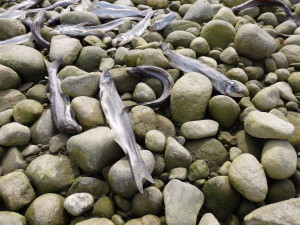
Dead hooligan on the shores of the Taiya. (Photo by Emily Files/KHNS)

Hooligan fishing is a tradition for many people in the Upper Lynn Canal. But this spring, those who fish in the Chilkoot had disappointing results. Researchers say the mysterious fish seem to have turned right instead of left into the Taiya, near Skagway, and there’s no way to know exactly why.

“I didn’t catch any on the Chilkoot side, but I caught some at Jones Point,” says lifelong Haines resident Sonny Williams. “I caught ten gallons and that was it.”

Williams says he usually catches 20 to 30 gallons of hooligan each spring. The small herring-like fish is traditionally used for oil and smoking. He says the only other times he’s seen the run this low in the Chilkoot is when the lake has been frozen.

“It was a lot lower than the previous four years that we have data on,” said Meredith Pochardt, executive director of Takshanuk Watershed Council.

Takshanuk is the only group that monitors hooligan in the Upper Lynn Canal. They’ve monitored the runs in the Chilkoot from 2010-2012 and in 2014. This year, they estimate the run was about 300,000. Last year, it was between three and four million. In 2011, it was about 12 million.

So why did the hooligan cross to the other side? Why a big run in the Taiya, and not the Chilkoot? Williams, the hooligan fisherman, thinks he knows. He says he was watching the hooligan as they swam north.

“I watched them come around Battery Point and get right in the river there. And we’re like ok, they’re gonna show up,” Williams said. “They started trickling off and all of a sudden, the pounding at the ferry terminal had a definite effect on them moving out of here.”

Williams says he watched the hooligan turn around near the ferry terminal. A new ferry dock has been under construction since April. The State Department of Transportation says they have not heard any complaints.

Hooligan are not well-researched like salmon and halibut. Brad Ryan, director for Southeast Alaska Watershed Coalition, says Alaska Fish and Game doesn’t monitor hooligan because they’re not as economically important as other fish. But they are traditionally important to subsistence fishermen in the Upper Lynn Canal.

Since there’s so little research on hooligan, it’s hard to predict what the little fish will do next spring. Haines locals hope the Chilkoot will see a stronger run. And Skagway locals hope their hooligan luck continues.

Seafood plants offset minimum wage hike through room & board

A machine slices Pacific cod at Alyeska Seafoods while processors create fillets. (Photo by Annie Ropeik/KUCB)

In the next few weeks, thousands of seafood processors will return to Unalaska for pollock B season. They’ll be earning more money, thanks to the state’s minimum wage hike — but they’ll also be paying more to live.

Added room & board costs are just one way processing plants are hoping to offset the wage increase.

Alyeska and Westward Seafoods have never charged for room & board. But on June 1, president Mark Johanson says that’ll change.

“This has been a very, very hard, soul-searching decision for us,” he says. “We’ve been trying to buck the trend, and make it a reasonable and a good place for people to work. The work is hard and challenging, and we understand that … but because of global competition and pressures, we have had to unfortunately make that decision.”

They’re implementing the state’s maximum room & board charge of $15 a day at their shoreside plants in Unalaska. Johanson says it comes out to about a dollar of every hour’s wages, including overtime. Since the minimum wage also went up a dollar this year, he says the changes are a wash, for now.

“And then, of course, as of Jan. 1, [2016], the minimum wage will increase again by a dollar,” he says “So there is no remedy on room & board — we’ll just need to either eat that cost or find other ways to become more efficient in our operation.”

Johanson’s also worried about the $1 to $4 million cost of adding employee health coverage under the Affordable Care Act. So in the long term, he’s hoping to pare down, and automate more of their processing lines.

That’s going to happen at UniSea, too. Unalaska’s biggest seafood processor has plans to shrink its pollock operations back into one factory in the next few years.

They’re also upping their room & board charge. It’s started at $10 a day for the past couple of years, decreasing the more a processor works. But this spring, facing a $3 million cost bump from minimum wage, president Tom Enlow says they’ve gone to the upper limit, too.

“We’re not really in a position to just take that cost — any cost increase, for that matter — and pass it onto our customers,” he says.

That’s because they’re working with set market prices for seafood, where costs are shared between the harvesters and the processors. Since the wage hike impacts the processors, Enlow says they may want to renegotiate those price formulas down the line.

But for now, room & board is their first line of defense, along with some cuts to staffing. That’s come through the natural attrition Enlow says they see at the start of every season.

“There’s always going to be a certain amount of workers that come up and say ‘Oh, I had no idea I was going to have to work all day,’ and they end up leaving,” he says.

This year, UniSea wanted to see how low they could go. They didn’t rehire for those empty jobs, and went through A season about 80 people short.

“Our crab and cod throughput always suffers when our headcount is down below a certain number, and we certainly saw that take place this year,” he says. “But it’s just all in an effort to try to hold those costs down.”

In pollock B season — which covers 60 percent of the year’s huge quota — they’ll move staff around and focus on producing surimi. Right now, there’s a better market for the imitation crab product than there is for fillets.

Over at Alyeska and Westward, president Mark Johanson says they’re keeping their headcount the same for now. In fact, they’ve had to work harder than normal to recruit to fill those jobs.

With higher wages up against room & board costs, and an improving job market down south, Johanson says it’s not as easy as it once was lure new processors up to Alaska.

No further appeals planned in Native fishing rights case

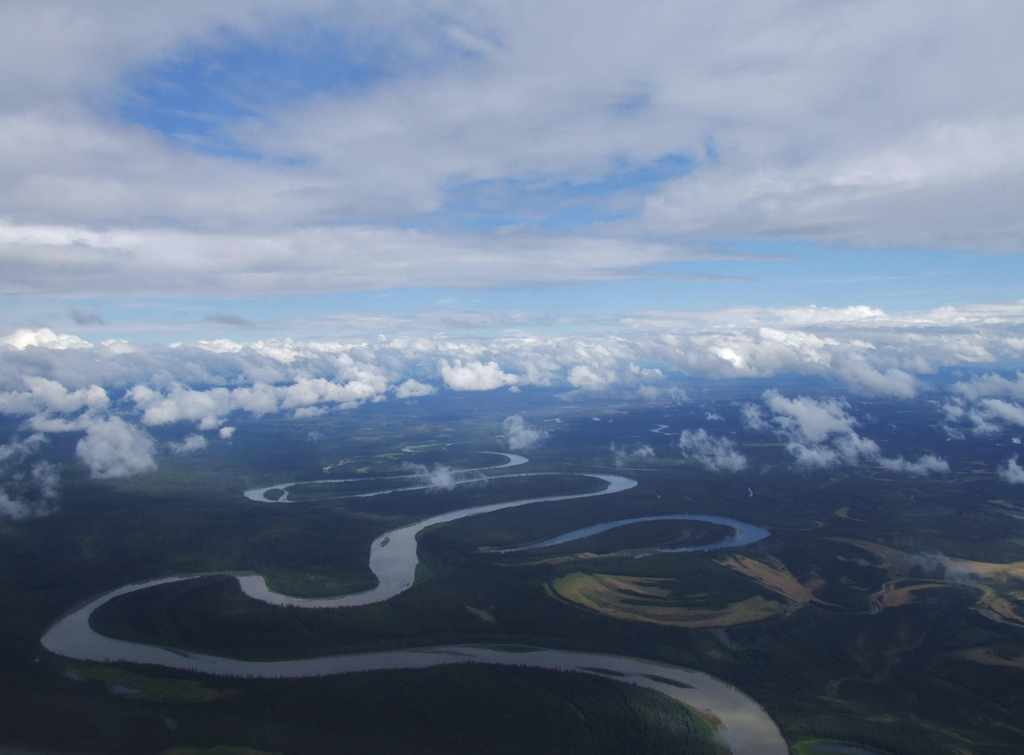
Aerial photo of the Kuskokwim River.
Aerial photo of the Kuskokwim River. (Photo by Travis S.)

The Yup’ik fishermen who were cited for fishing during a closure on the lower Kuskokwim River will not appeal their case to the Alaska Supreme Court.

The Alaska Court of Appeals affirmed a lower court’s decision in March.

The fishermen were represented by James Davis, an attorney with the Anchorage-based law firm Northern Justice Project. Davis says they decided not to appeal for several reasons.

First, he said they did not think there was a very good chance of the Supreme Court acting to protect Native subsistence rights based on his interpretation of the court’s history.

Secondly, the court of appeals acknowledged that Native subsistence rights had a spiritual component, said Davis, and might be deserving of protections under the religious protections of the constitution and they did not want the Supreme Court to invalidate this idea.

Davis adds that the new governor wants to build bridges to the Native community and is interested in partnering with tribes.

In 2012, dozens of Yup’ik Alaska Native fishermen were charged with violating the Alaska Department of Fish and Game’s emergency orders when they fished for king salmon on the Kuskokwim River. Thirteen defendants appealed. The defendants argued their fishing was a religious activity, and that they were entitled to a religious exemption under the free exercise clause of the Alaska Constitution.

The court of appeals said the health of the diminished king salmon run outweighed the fishermen’s individual rights.

Davis says the better forum to challenge the state’s undermining of Native subsistence is in federal court, but says they are not pursuing a federal case now.

Davis adds that even though the Yup’ik fishermen didn’t prevail in court, they accomplished what they set out to do, which is to make the state acknowledge the critical importance of Native subsistence rights and their connection to Yup’ik spirituality.

Yukon Kuskokwim Delta tribes have been working toward tribal co-management of the Kuskokwim River’s struggling salmon population in meetings in Bethel this week.


Tribal fish commission seeks larger role in Kuskokwim salmon management

The Kuskokwim River Inter Tribal Fisheries Commission met for the first time in Bethel. (Photo by Ben Matheson / KYUK)

The path to unified management of Kuskokwim salmon stocks is uncharted, but along the way, the newly established Kuskokwim River Inter-Tribal Fisheries Commission wants involvement at each step. That begins with tribal consultation in preparations for another summer of sacrifice. The commission’s inaugural meeting concluded Wednesday in Bethel.

Another weak run of king salmon is expected this summer after several years of decline. State and federal managers are planning a slate of restrictions on par with last years, which brought in the smallest king salmon harvest on record.

Delegate Arthur Lake of Kwigillingok wants tribes to be parts of the decisions.

“Management, not advisory. It’s our hope that state and federal managers and regulators embrace that,” Lake says.

A wide ranging discussion revealed a vast spectrum of ideas on what conservation means. Mary Sattler of Bethel said the commission has a big opportunity and responsibility for the future of the at-risk king salmon.

“Our fishermen are so good at fishing, they’ll catch them all if that’s what the tribal fish commission wants them to do,” Sattler says. “The only way we can conserve this king run is if we say conservation starts with me, conservation starts with family, conservation started with my village.”

The million dollar question is what federal and state managers do with a more vocal and organized tribal presence in another critical year.

“This commission is going to have way more ability to influence decisions and discussions,” says Geoff Haskett who oversees the U.S. Fish and Wildlife Service in Alaska. “We’ve been working on this for the latest month and a half, working with the state, trying to get as many comments as we possibly can. We’re not going to get everything right. But I need to let you know our intent is to utilize this commission to act upon the things we talk both and have more discussions. We’re trying.”

Closures on the lower Kuskokwim will go into effect beginning May 21st.


Fish labeled ‘Alaska Pollock’ may actually be Russian-caught

(Photo courtesy of NOAA)

If you’re in a supermarket and see a product labeled “Alaska Pollock,” it could well be Russian-caught pollock. And the FDA considers that perfectly legal. U.S. senators Lisa Murkowski, and Maria Cantwell of Washington, are urging the Food and Drug Administration to change that practice.

At a Senate hearing yesterday on seafood issues, Cantwell had a simple question for an FDA witness: “Do you agree that the term ‘Alaska pollock’ would give consumers the impression that the product is from Alaska?”

Steven Solomon, the FDA’s deputy associate commissioner for regulatory affairs, didn’t answer directly.

But on the FDA’s official “seafood list,” the acceptable market name for the fish is either “pollock” or “Alaska pollock.” Same thing, says the FDA.

Cantwell says the policy allows Russian fish to masquerade as Alaskan, but she says the Russian fleet has “labor issues.” Cantwell cited the sinking last month of a Russian pollock boat that killed at least 65 crew members.

“These lives are being lost because of lack of training and survival skills,” she said, “and then consumers are seeing a product that’s labeled Alaska and it’s not really Alaskan pollock.”

The Bering Sea pollock fishery is one of the world’s most valuable, and it’s dominated by companies based in Cantwell’s state.

Jim Gilmore, of the Seattle-based At-Sea Processors Association, says Russian pollock is usually processed in China then re-frozen before it’s exported to the U.S., and when it arrives, it’s priced lower than real Alaskan pollock.

“Russian pollock right now that’s imported into the U.S. takes about 40 percent of our domestic market. So being able to call it ‘Alaska pollock’ when its Russian pollock has been quite a boon for them,” he said.

This market name issue is different from the controversies over the USDA’s “country of origin” rules. Under those rules, Gilmore says a Russian-caught fish can be labeled “product of the U.S.” if it’s substantially transformed in America – say, turned into a breaded fish stick.

“But if FDA would grant our request, they wouldn’t be allowed to call it ‘Alaska pollock,’” Gilmore said. “That, we think, is misleading.”

Gilmore says the extra irony is that Russia last year banned the import of all U.S. seafood, in retaliation for the international sanctions that followed Moscow’s move on Ukraine.

“So now the Russians can sell their pollock in the U.S. and call it Alaska pollock, and we can’t even sell pollock into the Russian market,” he said.

Solomon, the FDA witness at the hearing, told Sen. Cantwell he didn’t know when the agency would decide whether to remove “Alaska” from *the* fish name. The request was made last fall.


Arctic fisheries could be affected by sea ice retreat, warming ocean

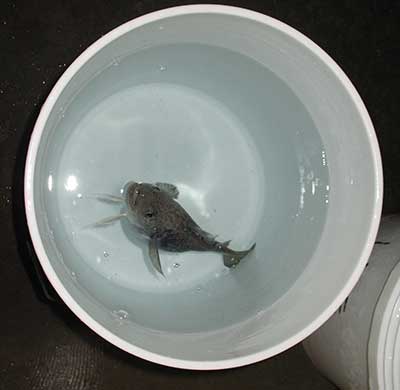
Egg-bearing Arctic cod in bucket. Scientists were able to extract eggs from mature fish and successfully rear them in a laboratory setting. This is a big deal because now scientists will be able to learn a lot more about Arctic cod spawning, which has been difficult to study, as much of this activity occurs during winter months under the Arctic ice. (Photo courtesy NOAA Fisheries)
Egg-bearing Arctic cod in bucket. Scientists were able to extract eggs from mature fish and successfully rear them in a laboratory setting. Arctic cod spawning has been difficult to study since much of this activity occurs during winter months under the Arctic ice. (Photo courtesy NOAA Fisheries)

Scientists say climate change and diminishing sea ice could affect the health of Arctic fisheries.

Ed Farley, a fisheries research biologist at National Oceanic and Atmospheric Administration’s Ted Stevens Marine Research Institute in Auke Bay, says warming ocean temperatures may affect abundant Arctic cod populations in the Chukchi Sea. Temperatures there have been increasing about 0.5 degrees Celsius every decade.

“Their growth rate is maximum at about 7 degrees Celsius as opposed to saffron cod where the maximum growth rate is about 15 degrees Celsius,” Farley says. “So, Arctic cod prefer cold water for growth. In fact, if they get above 7 degrees Celsius, their growth rate declines, and  above 10 they tend to die. So, warming water is not good for Arctic cod while it’s very good for saffron cod.”

Farley says saffron cod have significantly less fat content than Arctic cod. An ice seal would have to eat nearly three times as much saffron cod to get the same nutritional value of an Arctic cod. Seals, in turn, are a favorite prey of polar bears.

Farley says scientists are planning further research to determine how sea ice and water temperatures affect Arctic cod habitat.

“One of the things that I want to mention that if you’re a fish or marine mammal in this region, you’re going to want to store as much fat as possible before winter,” Farley says.

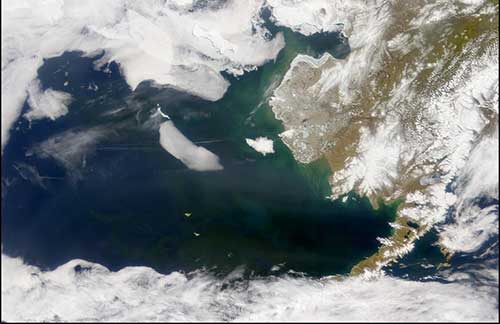
Sea ice extent during warm years (2002- 05). Actual image is from May 2002. (Image courtesy NOAA Fisheries)

Much of that fat content is in the form of zooplankton, a favorite meal of many fish species. Farley says an early sea ice retreat generates more small zooplankton while a late ice retreat prompts growth of zooplankton that are larger or have more fat content. Farley says walleye pollock grow fatter themselves and have better rates of winter survival when large zooplankton is in abundance.

“Take home message here is if you’re a fish, you want the larger zooplankton to get a better food packet,” Farley says.

The Bering Sea pollock fishery is worth $497 million with much of the product showing up in stores as fish sticks or fake crab. Fishery managers and scientists have been curious about what caused a four-year decline in pollock abundance starting in 2004 that coincided with a warming trend. Abundance has since rebounded and NOAA says it’s now at historic levels.

Jeff Key of NOAA’s Satellite and Information Service says Arctic sea ice cover has expanded slightly within the last two years, but it is still trending downward toward record minimums.

“What we’ve learned very recently — and haven’t even published yet — is that changes in winter time cloud cover can affect summertime sea ice,” Key says. “That’s hard to grasp because that’s a difference in time of seven to nine months.”

Sea ice extent during colder years (2007-12). Actual image is from May 2012. (Image courtesy NOAA Fisheries)

Key says they’re also monitoring how changes in the Arctic can prompt extreme weather events in the Lower 48.

“We know that the polar jet stream has shifted. It’s strengthened somewhat over Eurasia, but weakened over Canada,” Key says. “What’s important about that is that this affects mid-latitude climate. As the jet stream weakens, it tends to meander more and we get more extreme weather in the mid-latitudes. So, here’s another example of what happens in the Arctic isn’t staying in the Arctic.”

Key says they don’t have all the satellites and sensors that are necessary for Arctic research. He says they rely on partnerships with other agencies and cooperate with other countries to monitor sea ice thickness and melting, plant growth, and ocean circulation.

Farley and Key answered questions from the press in Washington D.C. Tuesday on climate change in the Arctic.

Site notifications
Update notification options
Subscribe to notifications