Fisheries

Trident’s new fishmeal plant to go online soon in Naknek

Spin drier sits at the Trident fishmeal plant
50 foot, 60,000 pound spin drier sits at the center of the new Trident fishmeal plant in Naknek (Photo by Matt Martin/KDLG)

The newest processing plant in Bristol Bay is about to go online this month. Trident Seafood’s multi-million dollar fishmeal plant should get a test run with Togiak herring. Trident agreed to build the plant as part of a 2011 settlement over alleged EPA Clean Water Act violations, and now the company, and residents, should get to see (and smell) it if works as intended.

Construction workers hammer and weld to the twang of country music as they wrap up construction on fishmeal plant in Naknek. The walls are still unfinished drywall and wooden stairs stand in for a future elevator.

Project Manager Bob Bates stood in front of the largest piece of machinery in the plant, a 50 foot long and 60,000 pound dryer.

“We actually set this unit here when this was still all mud and dirt. We build this building around this dryer,” said Bates.

The dryer looked like a giant rolling pin as it spun in the center of the warehouse.

“The inside of this thing looks like something out of a sci-fi movie with all the teeth and the blades and everything in it to mix it, and turn it, and churn it through,” added Bates.

Metal tubes run up a hill
Tubing runs up the hill and takes the raw fish guts from the processing plant to the new fishmeal plant. (Photo by Matt Martin/KDLG)

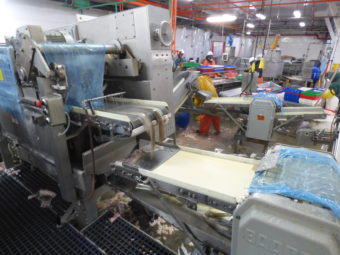
About a quarter mile of tubing move all the leftover parts after a fish is filleted or canned – that’s the head, guts, fins, and bones – they’ll come from Trident’s processing plant to the new 15 million dollar plus fishmeal plant.

After being ground up and dried, the byproduct of salmon can become animal feed and even those fish oil pills you can buy at Costco. Trident also owns separate business that produces fishmeal products. Along with helping their business model, Trident agreed to build this plant as part of a 2011 settlement with the EPA, which had tallied a number alleged Clean Water Act violations against the company’s Alaska operations.

Officials at Trident said they weren’t required to build a fishmeal plant in Naknek, but they think this is where the Bristol Bay fishing industry is probably heading anyway. The EPA and Alaska’s DEC are tightening down on how processors handle the millions of pounds of fish waste that is traditionally ground up and put back in the water, hopefully washed out with the tides.

Large metal silos in fishmeal plant
Inside this metal silo are thousands of tiny round scrubbers that help to clean the fish odor out of the air. (Photo by Matt Martin/KDLG)

But some Naknek residents were, and still are, leery about having a fishmeal plant in town. They have a reputation of being …smelly.

Jay King runs an aviation service in Naknek and is among those still not convinced that plant won’t stink up the town. King’s not opposed to the plant so much as he’s opposed to its location.

“Being next to the Post Office, the school, the clinic, my brother’s apartment building. “I just didn’t think it was such a good idea to have a potential odor issue with all of these entities,” said King.

Others say with or without the new fishmeal plant, summertime odor is a common issue and comes with the territory. Russell Phelps is a commercial fisherman and said Naknek is a fishing town. He thinks taking waste out of the water might actually help the smell.

“So the beaches in late July and August stink considerable already, so if we could avoid that I’d be very happy,” said Phelps, who is also a member of the Borough Assembly.

Before the Borough gave its consent to Trident to build, a few members traveled to Newport, Oregon to tour a 20-year-old fishmeal plant that has been upgraded with modern technology similar to what’s being used in Naknek. They came back less skeptical. The Assembly heard from plenty of concerned residents, but in the end voted to approve the fishmeal plant. Some supporters think fishmeal may be the future of the fishery, and others appreciate what will be added tax revenue to the Borough. Phelps was among the yes votes.

“We shouldn’t stop a project just because we think it’s going to stink,” argued Phelps.

Trident has a favorable reputation in the town, and the seafood giant says it puts near a million dollars in taxes annually to the Borough, and tens of thousands more in charitable donations. Project Manager Bob Bates says Trident will do it what it takes to stay good neighbors with the community.

“From day one, the goal was to keep the odor down, clean up the river, and basically produce some meal,” said Bates.

And at the heart of its effort to keep the odor down is a new air filtration system.

Standing at the base of a three story metal tube with ducting that snakes around the entire warehouse, Bates describes how it will keep the smell of drying fish waste out of the breezy bayside town of Naknek.

“So basically what we are doing is we’re drawing fresh air down below and we are sucking everything up to insure that we capture all the odors and everything that comes through this facility and gets pushed through these scrubbers,” explained Bates.

Inside are thousands of scrubbing balls that look like whiffle balls, water is sprayed down as the air raises. The odor molecules stick to the water.

“By the time the air come back out of here, we’ve pulled the majority of all the odor out with this system,” added Bates.

Some residents like Jay King say they’ll just have to wait and see, or rather smell, what happens.

“Well, it’s here. I am just honestly hoping it is as advertised by Trident,” said King.

They’re going to get their chance soon. Trident plans to run final tests of the system with water in a few days, but as far as a true test with fish heads and guts. Bob Bates said he can build factories but he can’t control fish. They’ll test it for real when the Togiak herring arrive, probably before the month is out.

PSP: tribal partnership seeks modern solution to an ancient problem

Esther Kennedy of the Resource Protection Department collects water samples every week from Starrigavan.
Esther Kennedy of the Resource Protection Department collects water samples every week from Starrigavan. Along with six other tribes in Southeast, the group is working to create an early warning system to protect shellfish diggers from PSP. (Photo by Emily Kwong/KCAW)

Of all the traditional seafoods in Southeast Alaska, none are more shrouded in myth — and genuine risk — than clams and mussels. Paralytic shellfish poisoning (PSP) killed two people in Southeast in 2010 and dozens more have fallen ill over the recorded history of the state.

For subsistence harvesters, there has been no way to measure the risk of clam digging — until now. In part 1 of a two-part series, KCAW reports on a partnership among Southeast tribes to create a regional water monitoring program.

In Southeast, between Chicagof and Baranof Islands, there’s a waterway called Peril Strait. The name doesn’t come from winds ripping through the channel, but from a shocking event that happened in 1799.

“A Russian ship came in and the villagers had gone out and collected a bunch of clams from an area now called Poison Cove,” explained Jeff Feldpausch, the Resource Protection Director for Sitka Tribe of Alaska.

The incident he’s describing is the earliest documented case of PSP in the state. After eating the shellfish, 100 Aleut crew members of fur trader Alexander Baranof – died. Feldpausch added, “They only made it a few miles to the area that’s now called Dead Man’s Reach.”

Eat the wrong clam and you can die on the beach. That’s the grim pathology for PSP, which one state publication in 1982 called “Alaska Roulette.” In order to protect subsistence harvesters, the Sitka Tribe decided to invest in the latest science and to look really closely at what the clams themselves are eating.

aralytic shellfish poisoning is transmitted through bivalves, especially butter clams, mussels, and cockles. But it all begins in the water, in the naturally produced toxins of certain kinds of plankton. (Photo by Emily Kwong/KCAW)

I met Esther Kennedy of STA’s Resource Protection Department near the Starrigavan dock. She took note of the day’s conditions. “So it’s 10AM, it’s sunny, it’s calm.” Every Tuesday, Kennedy starts her morning by collecting water samples. From far away, it looks like she’s flying an underwater kite, dragging a net sedately through the water as microscopic creatures called phytoplankton get trapped inside.

“Most plankton is just beautiful and it looks like little Christmas ornaments and I have no problem with that,” said Kennedy. “But it’s a little bit unnerving to be looking at that and be like, ‘How many of those have I swum through in the past?’”

Alexandrium is a genus of dinoflagellates that leads to Paralytic Shellfish Poisoning. This cell was identified by a team of researchers at NOAA’s biotoxin testing lab in Seattle. (Photo courtesy of NOAA).

The vast majority of phytoplankton are totally harmless. But a few of them, particularly of the genus Alexandrium (they look like an acorn under the microscope) produce a chemical called Saxitoxin. Saxitoxin is 1000x more potent than cyanide, so potent it’s listed as a chemical weapon by the US military. Saxitoxin is what’s responsible for PSP.

The timer beeps. Three minutes are up and Kennedy pulls up net and bottle – now filled with water. She’ll take these drops of water back to a lab, and using a microscope, count what kinds of phytoplankton, toxic or not, are in the water that week.

So, how do these tiny creatures poison us? It works like this: when toxic-bearing phytoplankton accumulate in the water, it’s known as a harmful algal bloom, or a HAB. Some HABs are visible, even red, earning the nickname “red tide,” but many are not. As shellfish feed, the bloom’s toxins get trapped inside and have the potential to poison whoever eats the shellfish, whether a sea lion in Kodiak or a subsistence user in Klawock.

SEATT partners are monitoring for other kinds of toxic phytoplankton, such as Dinophysis. “It kind of looks like a pitcher filled with punch with Sangria,” said Kennedy. “We’re worried about that because it produced diuretic shellfish poisoning, which is very unpleasant but not high priority.” (Photo courtesy of Esther Kennedy)

“Here we are living with hundreds of bears wandering that will wander through the streets, but everyone is worried about the clams,” said Chris Whitehead, STA’s Natural Resource Specialist.

Chris Whitehead joined STA’s Resource Protection Department in the fall of 2013. In his former home of Washington State, there’s a hotline you can call to know which beaches are safe for shellfish digging.

WA HOTLINE: You have reached the Washington State Department of Health Shellfish Safety Hotline…

No such system exists in Alaska, so Whitehead wanted to create a local solution. He pitched the idea for a HAB monitoring program to several tribes. The response was instant.

“This is kind of the first step or kind of the poster child for collaboration on environmental issues,” said Jeff Feldpausch. Six other tribes have signed on for the project. Together, they form Southeast Alaska Tribal Toxins group, or SEATT, with membership from Sitka, Juneau, Yakutat, Petersburg, Klawock, Craig, and Kasaan.

Matt Anderstrom does the water testing for the Yakutat Tlingit Tribe at the Yakutat Lagoon. Two weeks ago, the lab saw its first sighting of Alexandrium – that’s the one that makes Saxitoxin. It was spotted by his younger daughter, Nellie.

“I’ve got flashcards and identification keys,” said Anderstrom. “[My daughter] was asking what the bad ones look like and as soon as she seen it, she lit up and was like, ‘That’s it, right there!”

Identification keys from NOAA’s Phytoplankton Monitoring Network in Charleston, SC.
Identification keys from NOAA’s Phytoplankton Monitoring Network in Charleston, SC. Representatives came to Alaska to provide training to SEATT’s field workers. (Photo by Emily Kwong/KCAW)

Using the data field workers like Anderstrom and Kennedy are gathering, each tribe hopes to eventually create an early warning system for toxic bloom events in their area. In Sitka, Feldpausch imagines it will be a stoplight published in the daily paper.

“A green should be good to go, a yellow is proceed with caution, and a red, we have found saxitoxins out there,” said Feldpausch.

Right now, the Sitka Tribe is only testing the waters at Starrigavan. Feldpausch recognized that may not be enough for some harvesters.

“Eventually we may be able to grow and do other areas,” he said, “But I imagine there’s probably 50-60 beaches around here that people get their shellfish from. There’s no way to cover all those areas.”

Each tribe has focused their first year of fieldwork on one site and for Sitka, the choice of Starrigavan is strategic. In 2013, two locals suffered mild PSP cases in the middle of October.

White explained, “It used to be wintertime was somewhat safe, you didn’t have to worry about it. But because of climate change and warming conditions, the bloom may last all the way through October, November.”

So the old rule of thumb, that safe harvesting months had an “R” in them, basically September through April, is no longer true. In 2012, Alaska Magazine got in trouble with the state for saying otherwise. With PSP a threat any time of year, Whitehead says it’s more important than ever for communities to reclaim their beaches and know exactly what lurks in the water.

For more on PSP safety and prevention, check out the Alaska Department of Environmental Conservation’s fact sheet.

Record low snowpack in Southeast, warm summer ahead

It’s been a record low year for snowpack in Southeast Alaska, but the peaks in Juneau were recently dusted with powder. Last weekend, EagleCrest Ski Area received 20 inches of precipitation at its highest elevation, and about 6 inches at the base. Senior Hydrologist Aaron Jacobs says overall, our winter has been mild and wet.

The FY 2016 capital budget includes $3 million for treatment of water from Juneau's Salmon Creek Reservoir. It will allow the reservoir to be a drinking-water source year-round. Turbidity shuts it down part of the year.
Photo by Casey Kelly/KTOO

“You put those two things together, you get a lot of liquid precipitation but not much of the frozen stuff,” he says.

Jacobs works for the Juneau office of the National Weather Service. He says it’s common to see these conditions at sea level. But this year it extended up into the higher elevations. This could mean less mountain runoff for smaller streams in Juneau, like Jordan and Montana creeks.

“If we don’t have that snowpack, those waters are going to start to get very low. When fish come into the water systems, it could really warm the water temperatures and that’s not conducive for the fish. The fish don’t like the water too warm,” says Jacobs.

The lack of moisture could also lead to forest fires as temperatures heat up this spring. Last year, Southeast saw similar weather patterns. But heavy rains in the summer months offset some of the negative impacts. Although there’s been snow recently, Jacobs says it may be too little, too late.

“Up in the higher elevation there’s been some significant snowfall, but nothing that will make up all the lost ground that we’ve had,” he says.

The climate predicted for the summer months calls for a 70 percent chance of above normal temperatures.

PSP: With new lab, STA takes a gamble on shellfish testing

Jeff Feldpausch and Chris Whitehead stand in the soon-to-be biotoxin testing lab at STA’s Resource Protection Department, intended to test shellfish for commercial entities. (Photo by Emily Kwong/KCAW)

Despite the risk of paralytic shellfish poisoning — or PSP — Southeast Alaska has a robust dive fishery that includes geoduck clams. The entire industry hinges on weekly testing results from the Department of Environmental Conservation laboratory in Anchorage.

This scenario could change in the not-too-distant future. In part 1 of our 2-part series, KCAW’s Emily Kwong reported on efforts by Sitka Tribe of Alaska to monitor the waters of Southeast for PSP. In part 2 today, she tracks their plans to launch a commercial testing lab.

If you’ve ever seen Willy Wonka and the Chocolate Factory, you may remember that scene with the golden eggs.

Willy Wonka: These are the geese that lay the golden eggs.

Veruca Salt: Are they chocolate eggs?

Willy Wonka: Golden chocolate eggs.

The green haired Oompa Loompas weigh the eggs on a scale to decide if they’re good or bad.

Wonka: If it’s a good egg, it’s shined up and shipped out over the world. But if it’s a bad egg, down the chute.

The same could be said for geoducks. These giant bivalves, with lolling necks like space worms, have a high market value, where they’re called xiàngbábàng (象拔蚌) or elephant trunk clams in China. Because these clams run the risk of carrying PSP toxins, divers cannot harvest an area before a few of it’s clams have been sent to the DEC and cleared for consumption.

“If you’re lucky you get the sample on a plane that day and it gets up to the lab in Anchorage,” said Larry Trani, a diver and member of the Southeast Alaska Regional Dive Fisheries Association, or SARDFA. Harvest has to happen within a week, which means that by the time divers get a test result, they tend to do all their actual harvest in just one day. And that’s not a lot of time.

“Time is off the essence on this,” said Trani, “As far as making all the connections from Southeast Alaska to Hong Kong, or wherever they’re going.”

Divers like Trani go down to the bottom of the ocean floor, breathing surface supplied air through a diving hookah, and walk the bottom, blasting the sand with a water gun and prying gooey ducks from their beds. It’s dangerous work, which Trani believes could benefit from the kind of lab Sitka Tribe wants to open.

“I can see that that would save time on the sampling and give us more days in which to conduct our diving,” said Trani. “I think it’s an excellent idea.”

That’s the appeal of a lab in Southeast, one Sitka Tribe hopes will persuade divers like Trani, shellfish growers, and harvesters to relocate some of their testing work to Sitka.

“It was two offices so we removed a wall and made this one large space…”

The man with the plan is shellfish biologist Chris Whitehead, who pitched the idea for a biotoxin lab to Sitka Tribe two years ago.

“I got really busy at writing grants and somehow they all got funded, said Whitehead. “Now it’s a matter of doing the work.”

That includes over half a million dollars from the Administration for Native Americans’ (ANA) Environmental Regulatory Enhancement Program to build the lab from scratch.

Jessica Gill is the tribe’s fish biologist and said, “When we get our first order, it’s going to be like Christmas!”

The most eagerly anticipated order is for the receptor binding assay, or RBA machine. The machine isn’t authorized to test gooey ducks for PSP yet, just mussels and soft shell clams, but Chris Whitehead believes that will change soon. And the exciting thing about the machine is that it eliminates the traditional testing method, practiced by labs throughout the country.

Whitehead explained, “They run whats called a mouse bioassay. So they inject this slurry of shellfish into a mouse…”

And time how long it takes for the mouse to die. Based on that number, the lab can calculate the relative toxicity of the gooey duck for humans. With the RBA method, no mice need be harmed.

Jessica Gill, for her part, is relieved. She said, “I don’t think I could take the lab manager job thinking, ‘Oh, we’re going to kill a bunch of rats today.’”

AmeriCorps volunteer Esther Kennedy is helping STA launch an early warning system for beaches in Southeast, so harvesters can know when it’s safe to dig and when to steer clear. (Photo by Emily Kwong/KCAW)

With staff to be trained and testing to launch, STA has secured 1.3 million dollars in grant money for the PSP project for the next three years. That includes $210,000 from the Environmental Protection Agency’s Indian General Assistance Program (IGAP) for fiscal year 2015, with plans to continue through 2017, $48,000 from the Bureau of Indian Affairs (BIA), $527,000 from ANA to the build the new lab, and an additional $150,000 to support SEATT to conduct cellular toxin analysis, as detailed in Part 1 of our series.

Jeff Feldpausch, the Resource Protection Director, recognizes it’s a luxury that won’t last.

“We couldn’t keep this lab open on grants forever,” Feldpausch said. “It was going to have to be something that could stand on it’s own.”

And that means attracting commercial business. The goal is for the lab to become a source of unrestricted funds for the tribe.

But among SARDFA and other potential customers KCAW spoke with, the big question on their minds was this: Would the state of Alaska by okay with handing PSP testing over to a commercial entity?

Elaine Busse Floyd, the Environmental Health Director of the DEC, said, “Well I think that if they achieved FDA certification, that would be a terrific benefit to the Southeast Alaska community.”

Busse Floyd said that while it would nice to have a lab servicing Southeast, it’s never been done before and for good reason. The state does PSP testing for free.

“So it’s possible that the big influx of customers that you might think you were going to get because of being closer, you might not get because you’d be charging and we wouldn’t be,” Bussy Floyd said.

But the state may not always be there. Funding for PSP testing is safe this fiscal year, but that may change with future budget cuts.

The lab in Sitka would also have to earn certification from an alphabet soup of agencies, such as the FDA and the International Shellfish Sanitation Commission. Easier said than done, but STA’s Chris Whitehead has determination in spades.

“For a long time, there’s probably been a need to do something like this,” said Whitehead.
“I don’t know if I lucked out and just came in the right time to start it, but doors are opening for us to do this.”

Whithead hopes to win FDA certification by 2017 and to first test shellfish collected through subsistence, through the Southeast Alaska Tribal Toxins Group, or SEATT. It’s an ambitious plan trying to address a basic problem.

“It all started out I just wanted to go dig clams and I had no one to call to see if it was safe or not.’

And Whitehead hopes this little-lab-that-could can answer that call.

NPFMC addresses Chinook bycatch

Chinook Salmon (Photo by Pacific Northwest National Laboratory)

This week, the North Pacific Fishery Management Council has been looking at ways to cut back on the number of Chinook salmon that get scooped up by commercial trawl boats in the Bering Sea.

The goal is to send more salmon back to subsistence users around the state.

It hardly needed to be said — but as state biologist Katie Howard pointed out in a presentation to the North Pacific council:

“These recent declines in run abundance for Chinook salmon [are] really a statewide phenomenon, but it has been very notable in Western Alaska stocks,” Howard said.

That’s led to commercial closures and subsistence restrictions around the region. At the same time, Western Alaska salmon made up about half of all the Chinook that were pulled up commercial trawl boats, out looking for pollock in the Bering Sea.

Researchers have spent the past few days trying to explain how the North Pacific Council could change that.

One option is make trawl vessels fish earlier in the year — when there are fewer salmon feeding in the Bering Sea. Another is to increase the penalties for the boats with the worst track records.

Alan Haynie is with the Alaska Fisheries Science Center.

“There’s a speed limit. And if you go over the speed limit, there’s something that you’re going to pay,” Haynie said.

Signing up for fines and voluntary closures is part of the reason why the pollock fleet has avoided heavy restrictions on bycatch until now.

Working together to avoid salmon has been pretty successful. The pollock fleet has never come close to catching their absolute limit of 60,000 Chinook — or having their harvest immediately shut down.

Lowering that cap is technically an option. But the North Pacific council’s advisory board voted against it this week.

As Haynie, the Alaska Fisheries Science Center scientist pointed out:

“One thing that’s really become clear in terms of assessing the impacts on the fleet is that the impacts aren’t just a little more fuel,” Haynie said. “They’re big changes in product value. When people move off of fish that are the optimal size and move somewhere else, there’s a real loss in that sense.”

Haynie says it won’t be possible to account for those losses before the North Pacific council takes a final vote this weekend.

When they do, they’ll be down one member. Simon Kinneen has been asked to recuse himself from voting on salmon bycatch.

Kinneen is a vice president for the Norton Sound Economic Development Corporation, or NSEDC. They’re a community development quota group for Nome and surrounding villages — with their own piece of pollock quota and ownership shares in other seafood businesses.

Lauren Smoker is an attorney with the NOAA Office of General Counsel.

“If a council member has financial interests that exceed 10 percent of the harvests or processing, that is a threshold that has been exceeded and a recusal determination follows,” Smoker said.

Kinneen appealed the ruling, but it still stands.

Transboundary mine measure before state House

Ketchikan Rep. Dan Ortiz is prime sponsor of a House resolution addressing transboundary mine concerns. (Courtesy Dan Ortiz)

Three Southeast Alaska lawmakers want their colleagues to sign on to a campaign to protect the region’s fisheries from British Columbia mines.

Ketchikan Rep. Dan Ortiz authored House Joint Resolution 16. It urges the federal government to use a boundary waters treaty with Canada to investigate potential impacts.

“Certainly I’ve heard from my constituents across the region, not just in the fishing industry, about their concern. Not that it’s an automatic, forgone conclusion that there will be harm done. But we just need a seat at the table to make sure we’re doing everything we can so there isn’t harm done to those river systems,” Ortiz says.

The measure asks the U.S. State Department to refer the issue to a panel called the International Joint Commission.

The resolution is in the House Resources Committee. It has not yet had a hearing, so it’s doubtful it will go anywhere this year.

Ortiz is an independent caucusing with House Democrats. Two Southeast Democrats – Sitka Rep. Jonathan Kreiss-Tomkins and Juneau Rep. Sam Kito III – are co-sponsors. Two other Democrats and two Republicans also are co-sponsors.

Ortiz’s measure is similar to resolutions supported by a number of Southeast cities, tribal groups and environmental organizations.

“We need to do everything we can to make sure that if and when those mines move forward, they do so with the strongest security measures you can put into place to protect those watersheds. Because, that’s the lifeblood of the fishing industry,” he says.

The concerns focus on mines or mine projects near the Unuk, Stikine and Taku Rivers. Owners and Canadian officials say their technology will protect the fisheries.

Site notifications
Update notification options
Subscribe to notifications