Fisheries

Sitka’s fish-to-schools a ‘success story’ at foods conference

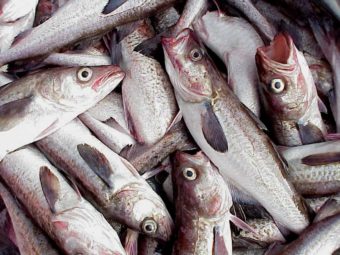
(Photo courtesy Pixabay)

Sitka’s Fish-to-Schools program was one of the featured presentations last week at a regional meeting on sustainable food systems.

The first Southeast Farm & Fish to Schools Conference convened in Juneau on April 2-3.

Cassee Olin is the business manager for the Sitka School District, and also the director of food service. She delivered a talk called “Local Food Success Stories,” as the conference got underway Thursday morning.

Sitka’s Fish-to-Schools began four years ago, with fisherman donating 500 pounds of salmon for school lunches once a month. This year’s donation was a healthy 4,000 pounds, including halibut, black cod, and rockfish.

“Sitka is a very giving community. Not very many ports in the state will donate their catch to the school district. That alone is the big thing we have.”

But thanks to a state-funded program called “Nutritional Alaskan Foods in Schools” Olin was able to start purchasing local seafood instead – about $40,000-worth over the past two years plus a lot of other Alaskan products.

“Three cows from up north, so we had some ground beef, some stew meat, some steaks, some roasts that are Alaska-grown. And we’ve also done some pork, some chicken. And we’ve gotten some vegetables from around the state that have been put into the lunch program also.”

The state spent roughly $3-million across 52 districts last year in the “Nutritional Alaskan Foods in Schools” grant. While Olin is not optimistic that the funding will survive the state’s current budget crisis, she is hopeful that the district can fall back on donated fish.

Fishermen and processors have taken pains to accommodate the district, she says. Additional processing by Sitka Sound Seafoods, for instance, has made fish lunches more cost-effective, and safer for young children.

“They are actually de-boning it for us, which sav es many, many hours of labor in pulling pin bones for any of these meals. That in itself has allowed us to have salmon or any kind of seafood on our menu once a week.”

The Southeast Farm & Fish to Schools Conference is a collaboration between the Southeast Conference and the Sustainable Southeast Partnership. The overarching theme of the conference is food security and sustainability, according to organizer Lia Heifetz.

Cassee Olin, and Lexi Fish from the district’s main partner, the Sitka Conservation Society, are two of about 30 speakers on the two-day agenda, which also has an entrepreneurial track. Sitkan Bobbi Daniels was scheduled to present on local farming.

Heifetz says most schools around the region are implementing some kind of fish-to-schools program, but Sitka is pioneering the way toward sustainability.

“I think that there are quite a few challenges that go along with using local foods in the school lunch program. Along with those challenges, there’ve been a lot of innovative and creative strategies that the schools have come up with. Sitka’s an example of how they’re able to sustain their fish-to-schools program, they have a curriculum that goes along with it. And it sounds to me like the way they’re able to do it is to create community around the fish in schools.”

And creating community seems to come naturally to Cassee Olin. Earlier in the year, when the kitchen at Keet Gooshi Heen elementary was short-staffed, Olin would trade her spreadsheets for an apron in the dining hall.

“So I’d go down there every day for lunch and help serve the kids. Yeah, kinda enjoy it. It’s one of those parts of my day that I enjoy.”

And is it unusual for a school district business manager to be preoccupied with local foods? Not if you grew up on a farm in Iowa. “I’ve traded black dirt for the ocean,” Olin says. Sitka schools now enjoy fish lunches every Wednesday.

Fish and Game online store streamlines permitting process

Screenschot of the Alaska Fish and Game Online Store.

Getting your fishing and hunting licenses just got a whole lot easier. The Alaska Department of Fish and Game has launched its new online store, streamlining the permitting process for many prospective anglers and hunters.

The new store boasts several new features, including buying and printing your sport fishing and hunting licenses at home.

“When you finish your transaction, you are sent an email with your license attached to it, so you can print it at your convenience whenever you get to a printer,” Michelle Kaelke, the licensing supervisor at the Alaska Department of Fish and Game, said.

Previously, when a customer bought a hunting or fishing license online, Fish and Game would process the application and mail the license.

King Salmon and duck stamps will also be printed directly onto licenses purchased online.

Kaelke says another change is allowing customers to purchase more than one license per transaction online.

“So, for your whole family, you can purchase all your fishing and hunting licenses in one transaction,” she said. “And, also, we have hunting and fishing lodges who purchase licenses for their clients, and so now they can purchase all of those licenses in one transaction.”

The new system also allows commercial fishermen to purchase their licenses online, which was not allowed in the past.

Kaelke says there is another major digital update in the works.

“Our next project that we’re working on is going to be selling, or showing your license on a mobile device, rather than any type of paper,” she said.

Though the exact numbers aren’t clear, Kaekle says Fish and Game expects substantial savings on everything from labor, to printing, to postage.

Fishing rights case likely headed for Alaska Supreme Court, federal court

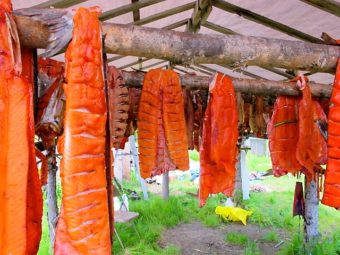
Salmon strips drying on a rack in Bethel, 2015. (Photo by Daysha Eaton/KYUK)

The Alaska Court of Appeals has affirmed a lower court’s decision that Yup’ik fishermen who fished for King salmon during a state closure should be convicted. The decision was issued Friday.

The Attorney for the Yup’ik Fishermen is James Davis with the Northern Justice Project. He says the court asked the wrong question.

“The court asked ‘should the Yup’ik fishers be allowed to be allowed to catch any fish when there are not fish to be caught?’ and therefore got the wrong answer which is, ‘No they shouldn’t be allowed to catch any fish,” said Davis.

In 2012, dozens of Yup’ik Alaska Native fishermen living a subsistence lifestyle were charged with violating the Alaska Department of Fish and Game’s emergency orders when they fished for king salmon on the Kuskokwim River. Thirteen defendants are appealing.

The defendants moved for dismissal of the charges, asserting that their fishing for king salmon was a religious activity, and that they were entitled to a religious exemption from the emergency orders under the free exercise clause of the Alaska Constitution.

Davis says there are two right questions he asked the court to consider and they ignored:

“If there were no king salmon to be caught by the Yup’ik fishers, why did the state open up the fishery to allow 20,000 king salmon to be caught the very next week after citing the Yup’ik fishers for catching any king salmon? And the second question which the court ignored as if it hadn’t been asked is, if there were declining runs of king salmon on the river over the last few years, why did the state continually vote for high salmon bi-catch by the pollock fleet, which the court of appeals effectively ignored,” Davis said.

Davis says he plans to appeal the case to the Alaska Supreme Court. Myron Naneng is President of the Association of Village Council Presidents, the regional tribal non-profit. He says their organization is pleased the case will be appealed but they are also considering taking the case to federal court.

“We should have gone to the federal court in the first place because the feds did not do their responsibility under Title VIII of ANILCA, section 807, where they’re required to give priority to rural Alaska and they’re supposed to have federal management first instead of requiring the state of Alaska to issue citations like they did in 2012. That’s something that we’re gong to be looking into,” Naneng said.

Federal managers took over the Chinook fishery in 2014 and have requests to take over management again this season. Naneng cites a case from the 1970’s upon which Attorney Davis’s case for the fishermen was built: Frank versus the State of Alaska, in which a judge ruled an Athabascan man from the Minto area could take moose out of season for a funeral potlatch, on religious grounds.

“When there’s a death in families, there’s a law in the state of Alaska that currently exists where families can go harvest a moose for religious purposes, and we feel that being able to harvest salmon for food as well as for the well being of (our families), that’s part of our life and has been our livelihood,” Naneng said.

Naneng and Davis reason that the Yup’ik Alaska Native fishermen’s spiritual connection to the salmon as their primary food source, should be reason enough for the exemption.
Laura Fox is the Assistant Attorney General with the state who argued the case before the Court of Appeals. She says the decision is sound.

“It will allow the state to continue to protect threatened fisheries by enforcing fishing restrictions when necessary, when there’s a shortage like there was on the Kuskokwim in 2012,” Fox said.

The District Court said the state’s responsibility to protect the declining species of fish outweighed the men’s claim of religious rights. The Court of Appeals decision affirms the lower court’s decision.

Strong king salmon catch means early closure for Southeast trollers

Southeast Alaska’s commercial salmon trollers are heading back into port now that the winter season has closed, thanks to strong catches of king salmon on the outer coast near Sitka.

The season was closed at midnight on Wednesday, March 25th. That’s the earliest closure on record by just over two weeks. “And the previous record for closing early was set 10 years ago, April 9th 2005,” Pattie Skannes, the Alaska Department of Fish and Game’s troll management biologist for Southeast.

The fishery opened in October. The season remains open until the fleet catches 43 to 47-thousand non-Alaska hatchery king salmon, or until the end of April, whichever comes first. It’s the seventh time since 2003 that the season has closed early. The department said the catch had topped 44-thousand non-Alaska hatchery fish the day before announcing the closure and expected to reach the upper end of that range once all the fish were landed.

Skannes said the number of trollers out fishing this winter has been above average for many weeks of the season. “So far we have 397 permits that have fished,” she said. “Catch rates have been well above average during most weeks. And price per pound is currently $8.73 and it’s down after being over 10 dollars a pound for several weeks. And this year’s prices are very similar to last years.”

Nearly three-quarters of the catch during the winter season came from district 113 on the outer coast near Sitka. Another 11 percent of the region’s harvest came out from Yakutat bay this season.
Spring troll fisheries targeting kings returning to Southeast Alaska’s hatcheries will be opening in mid April, May and June.

Meetings for those fisheries are planned around the region in April. The first is in Sitka April 2nd at 1:30 in the conference room at the Northern Southeast Regional Aquaculture Association.


Former Sen. Kookesh takes subsistence violation to state’s high court

Angoon Democratic Sen. Albert Kookesh talks about Southeast politics during a 2011 start-of-session interview. Now, he’s ending his legislative career after losing a tough election to Sitka Republican Bert Stedman. (Photo by Ed Schoenfeld/Coastalaska)
Former Sen. Albert Kookesh, D-Angoon, in his old office at the state Capitol. In 2009, Kookesh and three friends were cited for over-fishing near his hometown. He and two of the friends are challenging the Alaska Department of Fish & Game’s authority to unilaterally set subsistence bag limits. (Photo by Ed Schoenfeld/Coastalaska)

The Alaska Department of Fish & Game’s authority to unilaterally set subsistence bag limits is being tested in the state’s highest court.

The Alaska Supreme Court this month heard oral arguments in a case brought by former state Sen. Albert Kookesh and three friends from the senator’s hometown of Angoon, who were cited in 2009 by troopers for over-fishing their subsistence permits.

The outcome has flipped in two lower courts. The Supreme Court could be the last stop for the case, which the defendants are trying — in part — to frame as a Native rights issue.

The case — officially titled Estrada, et al v. State of Alaska — is not very hard to understand, at least from a fisherman’s perspective.

Sen. Kookesh, who at the time represented Angoon and many other communities in the former District C, was fishing for sockeye in Kanalku Bay not far from town.

Kookesh, Stan Johnson, Rocky Estrada, and Scott Hunter were using a set net and doing pretty well. They had landed 148 fish.

A state trooper dropped by in a float plane to check on the fishermen. Only Kookesh, Johnson, and Estrada held subsistence permits. The bag limit that season was 15 sockeye for each permit, putting the group over their limit by 103 fish. Scott Hunter had not yet obtained his permit.

The trooper wrote tickets for the men, and the illegally-caught fish were turned over to the Angoon Senior Center. Scott Hunter’s violation was later amended to fishing without a permit.

But Sen. Kookesh and the two others decided to contest the tickets. In a 2010 ruling, Judge David George — presiding in Angoon District Court — agreed that the state had violated the Administrative Procedures Act because the Department of Fish & Game set the 15-fish bag limit unilaterally, with no public process.

Judge George dismissed the case.

The state subsequently appealed. The Appellate Court found that the state — through the Board of Fish — has the constitutional authority to delegate responsibility to the Department of Fish & Game to set bag limits, as well as to use other measures, like emergency closures, to manage the state’s resources.

The Appellate Court overturned the lower court’s dismissal. Now it’s up to the Supreme Court to settle things.

Kookesh’s defense team submitted a 52-page brief to the state’s high court last October. The justices heard oral testimony this March.

Attorney John Starkey spoke on behalf of former Sen. Kookesh and his two fishing partners. He argued that the 15-fish bag limit was arbitrary, and failed to account for the traditional approach to sockeye harvest in Angoon.

“The problem with the bag limit,” Starkey argued, “is that there’s no showing — there’s no requirement in the regulation — that the department consider reasonable opportunity in setting the bag limit.”

Starkey reinforced the argument originally supported in District Court by Judge George, that the subsistence harvest limit in Kanalku Bay was set in violation of the Administrative Procedures Act, with no input from the community. His reasoning held implications for fish and game management far beyond Angoon.

“To read this one statute as somehow allowing the Board (of Fish) to delegate its responsibilities to the department — and the department doesn’t have to do it in regulation, they can simply name the bag limit — undermines practically the entire structure of not only the entire subsistence statute, but also the structure of 16.05, that defines the administrative functions of the department and the regulatory functions of the Board,” he said.

16.05 is the set of statutes establishing the office of the the Commissioner of Fish & Game, the department, and the Board of Fish.

The fishermen’s case boils down to one key idea: Must the state set harvest limits in regulation by the Board of Fish, or can it set harvest limits in permits from the Department of Fish & Game?

The Alaska Attorney General’s office sees things quite differently. When a justice asked the state to elaborate on the claim that the Kanalku Bay subsistence permit was set without public input, attorney Seth Beausang responded:

“I would respectfully quibble with your honor a bit to say there hasn’t been a public process. The Board of Fish and the Board of Game are perhaps the most public of agencies. They have public meetings like no other agency where they adopt regulations on a regular cycle.”

Beausang also disputed the claim that the state took no account of Angoon’s traditional subsistence needs or manner of harvest when it established the 15 fish bag limit, as sockeye returns went into decline.

“There was a period of about five years where the department tried to work with the community and tried to come up with a solution other than lowering the bag limit, which was set at 25 at the time,” Beausang said. “There was a period where the department tried to engage the community to agree to a voluntary cessation of fishing, which was successful for a time, and ultimately proved unsuccessful. And only after all those efforts was the department forced to reduce the bag limit to 15 in 2006.”

Perhaps the most compelling argument brought by the state was that Kookesh and his friends Stan Johnson and Rocky Estrada were simply breaking the law. Regardless of how that bag limit was established, whether or not it was adequate to the needs of Angoon — the men were over it.

“These harvest limits are clearly listed on these permits. The defendants applied, signed for these permits acknowledging that they would comply with the harvest limits, and they did not,” said Beausang. “They harvested more than three times the sockeye than was allowed by the permits. Even if the harvest limits had stayed at 25, as the defendants think should happen, they would have been well, well over the limit. Even in that case.”

But in his rebuttal, attorney Starkey again drove home the idea that Sen. Kookesh and his partners were cited for exceeding a harvest limit that was set illegally.

“There are many permit hunts — that’s true. There are many permit fisheries,” he said. “There are not permit hunts and fisheries across the state where the department unilaterally sets the bag limits behind closed doors — that’s the difference.”

Kookesh lost his seat in 2012 to Sitka Sen. Bert Stedman, when redistricting brought Angoon into a district with Sitka and Ketchikan. Kookesh remains on the board of directors of Sealaska, Southeast’s regional Native Corporation.

A decision from the supreme court could come as early as this spring.

Bill to eliminate Commercial Fisheries Entry Commission clears first hurdle

The House Fisheries Committee heard public testimony on House Bill 112 Thursday morning. The bill would eliminate the Commercial Fisheries Entry Commission.

The House Fisheries Committee on Thursday advanced a bill that would eliminate the Commercial Fisheries Entry Commission and transfer its duties to the Department of Fish and Game and the Office of Administrative Hearings.

House Bill 112 would get rid of the CFEC’s three commissioners, put in an executive director and move the remaining 25 full-time employees to Fish and Game. This would mean an immediate savings to the state of $424,000, according to a Fish and Game estimate.

During public testimony, several commercial fishing associations urged the committee not to move forward with the bill.

Paul Shadura II from the Kenai Peninsula testified on behalf of the South K Beach Independent Fishermen.

“We adamantly oppose reconfiguring the Commercial Fisheries Entry Commission into the schizophrenic Department of Fish and Game. The commercial fishing community feels very strongly in our area that to have an independent body within the state agencies is a blessing,” Shadura said.

Julianne Curry is executive director of United Fishermen of Alaska, a commercial fishing trade association representing about 35 groups statewide.

“We have the results of a legislative audit that will be coming out in June and we recommend that this committee holds onto the bill until that audit is complete,” Curry said.

Anchorage Rep. Charisse Millett highlighted the backlog of 28 cases more than 15 years old and says CFEC heads have been working at a slow pace.

“This is a serious conversation that we’re having with a group of employees that have been tasked with doing something and some commissioners, at best, that have been dragging their heels,” Millett said.

Millett credited licensing staff for doing the majority of the work at CFEC. Fish and Game Deputy Commissioner Kevin Brooks said those same employees would be doing the same work under Fish and Game. He said Fish and Game doesn’t have a formal position on the bill, but assured the committee his department would make the transition work.

Ben Brown is a Commercial Fisheries Entry Commissioner. He pointed out potential conflicts with transferring CFEC duties to Fish and Game. For example, if the director, deputy commissioners and commissioner are allowed to have an ownership in a commercial limited entry permit or commercial fishing business interest.

“We certainly are aware that there is a lot scrutiny being applied to us and a lot of justifiable questioning about the nature of our workload and the best way to go forward as an agency,” Brown said. “I would respectfully submit that none of that militates in favor of the nuclear option of destroying the agency in one fell swoop.”

Rep. Millett said she took offense to Brown’s comments.

“Destroying an agency is not my mission. My mission is efficiency and budgetary crisis does add for efficiencies and opportunity, and I see this as an opportunity,” Millett said.

She added that the Department of Law could review any potential conflicts and make recommendations to avoid them.

The bill to eliminate CFEC still needs to clear several legislative hurdles before it becomes law.

Site notifications
Update notification options
Subscribe to notifications