Fisheries

British Columbia: Alaska will get larger voice in mine development

British Columbia Minister of Mines Bill Bennett has announced a plan where Alaska officials will have more chances to comment on projects under development. (Photo courtesy of the B.C. government)

British Columbia Minister of Energy and Mines Bill Bennett says he wants to open more of the province’s permit process to Alaska officials.

State government already has a chance to comment on environmental certificates needed for mines to open.

Bennett says he’s willing to expand that opportunity.

“We would propose to have Alaska also have access into the second part of a development of a mine, which involves my ministry and the Mines Act here in British Columbia and the permitting for the actual construction of the mine and how water treatment is built,” he says.

The mines minister made that announcement after meeting with Alaska’s lieutenant governor.

Byron Mallott is in charge of a state working group looking into potential damage to Unuk, Stikine and Taku river fisheries if B.C. mines release toxic materials. Those rivers begin in the Canadian province and flow through Southeast Alaska before entering the Pacific Ocean. Most concerns are focused on the Red Chris, KSM and Tulsequah Chief mine projects.

Mallott says the state wants a larger voice in resource development and other projects along those rivers.

“Certainly, mines have the greatest chance of impacting water quality and the environment. But from Alaska’s public policy and sovereignty perspective it’s about what the water quality is that reaches our shores,” he says.

Lt. Gov. Byron Mallott sits at his desk, beneath the state seal Feb. 26. mallott heads up a new administration transboundary mines working group. (Ed Schoenfeld, CoastAlaska News)
Lt. Gov. Byron Mallott heads up the Walker administration’s transboundary mines working group. He’s meeting with British Columbia officials this week. (Ed Schoenfeld, CoastAlaska News)

Mallott says he’s encouraged with British Columbia’s commitment to including Alaska in a wider range of decisions.

Bennett planned to hold meetings in Southeast Alaska this spring to address environmental concerns. He pushed those back until his agency had a chance to hear from Mallott.

He says the discussions addressed what he acknowledged to be “legitimate concerns.”

“I think we have the beginnings now, a good foundation if you will, to proceed with a discussion with Alaska on a memorandum of understand that will capture the obligations that B.C. is prepared and is committed to taking on,” he says.

“[They would] meet the expectations of the Alaska government in terms of them understanding what is being proposed in B.C. And Alaska also having a hand in the assessment of these projects.”

Bennett says his province has a similar arrangement with Montana. It covers the Flathead River, with headwaters in southeastern British Columbia.

“We have a memorandum of understanding that guides the relationship and there’s water testing done at the border as it crosses into Montana. We would visualize a similar process with Alaska,” he says.

Bennett says concerned Alaskans could comment through the state government.

Mallott’s trip to the province includes meetings with mining industry and tribal representatives, including the B.C. Assembly of First Nations.

He’ll also meet up with a delegation of Southeast Alaska fishing, tribal and environmental groups to tour the area around August’s Mount Polley Mine dam breach.

The Mount Polley Mine tailings dam breach damaged nearby lakes and rivers. (Photo courtesy B.B. government)
The Mount Polley Mine tailings dam breach damaged nearby lakes and rivers. Lt. Gov. Byron Mallott will visit the site this week. (Photo courtesy B.B. government)

Critics of Canadian miners and government regulators say not enough is being done to keep such a disaster from happening again.

Jill Weitz, of the Juneau-based Salmon Beyond Borders campaign, is part of the delegation. She met with the Canadian consulate in Seattle before heading to B.C. She said she’s optimistic.

“They were interested in hearing what we’ve done as a campaign in bringing together different sectors of Southeast Alaska. And really wanting to engage with us and understand what we see as a solution,” she says.

Like most other mine critics, Salmon Beyond Borders wants transboundary mining to go before a U.S.-Canada panel that addresses cross-border water conflicts.

Federal biologists to manage Kuskokwim kings

Federal staff will manage the 2015 king run within the Yukon Delta refuge boundary. (Photo by Shane Iverson / KYUK)

Federal staff will again manage king salmon on the lower Kuskokwim River after requests from tribes. Earlier this year, a handful of tribal governments asked the federal subsistence board to implement federal management. The Federal Subsistence Board deferred last month, but at a Friday meeting of the Kuskokwim River Salmon Management Working Group, US Fish and Wildlife Service leaders announced a plan for federal management.

Federal staff plan to limit the chinook fishery to federal qualified users from 32 Kuskokwim villages and manage the fishery day-to-day within the boundaries of the Yukon Delta refuge. U.S. Fish & Wildlife Biologist Brian McCaffery, the in-season manager last year, points to guidance from federal law and the weakened state of king salmon.

“In a time of conservation needs, in resource shortage, if anyone gets a shot at the resources within the conservation unit, it has to be first the federally qualified subsistence users. By implementing the federal special action, we set that sidebar as the bounds for which any harvest can occur,” said McCaffery.

Only residents of the 32 villages would be able to fish for king salmon under federal management. The reason dual management exists is because state and federal law don’t match. While both have subsistence priorities, federal law includes a rural preference the state doesn’t have.

Federal staff managed the king salmon run last summer on federal lands after the Federal Subsistence Board took action on a request from the village of Napaskiak. Five tribal governments asked this year for federal management. The fishery has been in decline for years, and with another poor run expected, Yukon Delta Refuge Manager Neil LaLonde says king salmon fishing may not even be a possibility.

“We expect little to no harvestable surplus,” said LaLonde.

The state estimates the run at 96 to 163-thousand kings, well below the average run of 240-thousand fish. The drainage wide escapement goal range is 65 to 120 thousand kings. LaLonde says his team is still working out management details.

“The season framework itself will likely look very similar to what it was last year in 2014. It wouldn’t be things that would be drastically different. We want to improve on things we did last year and be more effective in different ways,” said LaLonde.

One area to improve is the early season set net fishing. Managers expect to close the river in mid-May to big salmon gear and allow fishing for white fish with four-inch set nets for a period each week, instead of 24/7 fishing like 2014, in which thousands of king salmon were caught.

If there are enough kings for some harvest, LaLonde says it’s too early to say how the harvest would occur. They could implement a limited community permit system or, as the state has proposed, allow a very short king salmon fishing period, with limits on net length, to keep the number of salmon harvested to a minimum.

At a meeting Friday of the Kuskokwim River Salmon Management Working Group, fishermen from the length of the river tried to make sense of what this year’s version of dual management means. Working Group Chair Bev Hoffman emphasized that however it pans out, the goal should be the same for managers and subsistence fishermen.

“We’re going into another year of chinook conservation,” said Hoffman. “Any opportunity, 4” or 6” is not to target chinook for the drying rack.”

Members asked for consistency between federal and state regulations, which could change at Aniak. The state retains management outside of the boundaries of the refuge and the federal action only concerns king salmon. The state has new management options this year that should make it easier to match federal rules, like requiring set nets to be within 100 feet of shore and limited driftnet lengths. State and federal staff emphasized that they plan to work closely this summer and include the working group. The next Working Group meeting is not yet scheduled.

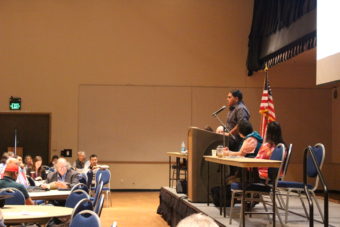
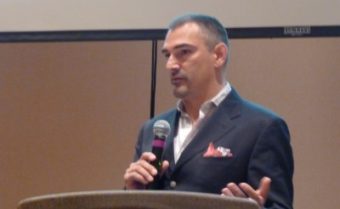
Tlingit-Haida pushes for larger tribal role in U.N.

Tlingit-Haida Central Council's Will Micklin attends the United Nation's World Conference on Indigenous Peoples Sept. 22, 2014..
Tlingit-Haida Central Council’s Will Micklin attends the United Nation’s World Conference on Indigenous Peoples Sept. 22, 2014.. (Photo courtesy Indianz.com)

Alaska’s largest tribal government has joined an international effort to boost Native influence in the United Nations.

The Juneau-based Central Council of Tlingit and Haida Indian Tribes of Alaska wants a larger forum to address its concerns.

The U.N. has focused attention on indigenous issues in recent years, such as returning artifacts to tribes and preventing violence against women.

Jacqueline Johnson-Pata is executive director of the National Congress of American Indians, as well as part of the central council’s leadership.

She told a recent tribal assembly that a more formal arrangement is needed.

“Tribes and governments, elected representatives of indigenous nations, should have a voice in the United Nations. We shouldn’t just go as an organization. But we should go as a representative government,” she says.

Central Council First Vice President Will Micklin agrees.

“We are a nation with longstanding international relations with other countries and have issues that cross boundaries,” he says.

Micklin is also CEO for an Indian band near San Diego and executive director of the California Association of Tribal Governments. He’s a strong advocate of United Nations involvement.

“The only way to address these issues like climate change, like water resources, like fisheries, like the environmental impacts of extractive industries is to engage in the international arena,” he says.

The 30,000-member central council is part of a nationwide movement pursuing increased involvement in the United Nations. It’s been active for several years.

Micklin says the effort stems from the U.N.’s 2007 Declaration on the Rights of Indigenous Peoples, which also targets discrimination and human-rights violations.

un-declaration-poster“We envision and have proposed to the secretary general all rights and privileges for indigenous governments the same as a member state,” he says.

That would put tribal members on committees and allow them to submit reports.

“The only distinction is we would not be able to vote as a member state in the general assembly,” he says.

He says tribal governments have met with U.N. and federal officials, and they’ve found support.

Terry Sloan is director of the New Mexico-based group Southwest Native Cultures. The Navajo-Hopi, who already serves on United Nations committees, says more outreach is needed.

“What’s happening is that a lot of the tribes aren’t fully aware of this declaration, what it means and what it contains. So there is going to be some sort of an educational process throughout the country,” he says.

He also says many indigenous groups outside the U.S. aren’t aware of the effort. Many have faced violence when attempting any form of organization.

Sloan just returned from a meeting following up on the U.N.’s World Conference on Indigenous Peoples.

He says there was no consensus and years could go by before formal recognition happens. But he remains optimistic.

“When and if and how long it takes to get the implementation process through, we will see great gains for the Native Americans of the United States,” he says.

Sloan says despite differences, the Obama administration is very supportive of the U.N. effort.

He says the U.S. could become a model for other countries’ tribal government roles in the international organization.

Epidemiologists confirm first case of PSP in 2015

State epidemiologists have confirmed the first case of paralytic shellfish poisoning in Alaska this year.

The case originated with recreationally harvested clams on a private beach near Ketchikan. The victim had typical, but not severe, symptoms within half an hour of eating the clams on April 24.

Report PSP cases

Paralytic shellfish poisoning is considered a public health emergency. Suspected cases must be reported immediately to the Section of Epidemiology by health care providers at 907-269-8000 during work hours or 800-478-0084 after hours.

For more information, read the Alaska Division of Public Health’s PSP fact sheet.

Leftover clams were tested for the PSP toxin and came back with levels more than 13 times over the Food and Drug Administration’s threshold for commercial shellfish.

“The real scary part of course is that death can result in a really short period of time,” says department of health spokeswoman Dawnell Smith.

Early paralytic shellfish poisoning symptoms include lip and tongue tingling. That can progress to fingers and toes, losing control of your arms and legs, and difficulty breathing. It can be fatal within a few hours.

Commercially harvested shellfish are tested and safe to eat. There’s no convenient way to know if recreationally harvested shellfish are safe.

“You know, every, every year this comes up. Somebody gets sick, or begins to feel ill and goes and reports it,” Smith says.

State epidemiologists’ last confirmed case of paralytic shellfish poisoning was in December.

U.S. House panel advances fisheries law

The U.S. House Natural Resources Committee today passed a bill to renew the Magnuson-Stevens Act, the nation’s fundamental fisheries law. The sponsor, Alaska Congressman Don Young, says the law has kept foreign fishing fleets off America’s shores and sustained healthy fisheries.

“And we’re trying to maintain the integrity of the original act by adding some smaller changes, and (among) the smaller changes are flexibility,” he told the committee.

The bill has alarmed some fishermen and conservationists. They say the bill undercuts a key element of Magnuson-Stevens: That fisheries managers act on science. Several Democrats on the committee voiced that argument, too.

“H.R. 1335 would take us back to the dark ages by gutting science-based requirements to rebuild overfished stocks and to set annual catch limits,” said Rep. Raul Grijalva of New Mexico, the committee’s top Democrat.

Among the new flexibilities, the bill removes the requirement of a 10-year stock assessment period for rebuilding depleted fisheries. Young says some regions of the country lack enough scientific data to adhere to rigid rules, and he says management councils should be able to respond more quickly to dynamic situations.

Another controversial measure Young added to the bill says the regional fisheries management councils are responsible for reviewing environmental impacts and no separate agency review is required. Critics say that would weaken a bedrock environmental law known as NEPA, the National Environmental Policy Act. Young says he’s trying to avoid duplicate reviews, and remove opportunities for lawsuits.

“I’m trying to keep the legal beagles out of the fishing industry, where they’ve used the legal beagles for the environmental community to impede the fishing process and the proper harvesting of the fish and healthy stocks. And they’ve done that,” Young said.

That provision is likely to disappoint tribal advocates in Alaska who claim federally managed fisheries are damaging salmon runs important to subsistence. Last year, the Association of Village Council Presidents, Kawarek, Tanana Chiefs Conference, and the Yukon River Drainage Fisheries Association wrote a letter asking Young to leave the NEPA process as it is because it gives tribes a stronger voice in fisheries management.

Chris Oliver, executive director of the North Pacific Fisheries Management Council in Anchorage, says he doesn’t think the bill would erode the fundamentals of the Magnuson Stevens Act, although he says his council is fine with the existing law.

“We don’t think the changes they put in the act are really likely to have any effect on how we manage fisheries in the North Pacific,” Oliver said. “I think it could allow for some legitimate flexibility in other regions — and even perhaps in future situations in the North Pacific — without eroding the basic underlying conservation measures” of the law.

Young says he’s still working on additions to the bills concerning subsistence and the Community Development Quota program, so the bill is likely to be revised before the full House votes on it.

Blessing and remembering Alaska’s commercial fishermen

The names of Toivo and Margaret Andersen have been added to the Alaska Commercial Fishermen's Memorial this year. (Photo by Casey Kelly/KTOO)
The names of Toivo and Margaret Andersen have been added to the Alaska Commercial Fishermen’s Memorial this year. (Photo by Casey Kelly/KTOO)

This weekend marks the 25th anniversary of Juneau’s Blessing of the Fleet. The annual tradition honors those who participate in one of the state’s largest industries.

It’s held at the Alaska Commercial Fishermen’s Memorial on the downtown waterfront. Five names have been added to the memorial’s granite wall this year, bringing the count to 203 men and women.

25th Blessing of the Fleet Ceremony
What: Honoring Alaska’s commercial fishermen
Where: Alaska Commercial Fishermen’s Memorial
When: 10 a.m. Saturday, May 2
The Twisted Fish will serve free brunch after the ceremony.

Carl Brodersen stands in the half-moon shaped fishermen’s memorial, pointing out members of his family whose names are etched on the wall. He starts with his grandparents, then his uncle, and finally, his parents:

“John and Elizabeth Clauson are right here, of F/V Lightly. John Eric Clauson is more towards the middle. I always have to try and pick him out. Yeah, there we go. So, yonder with the star, you can kind of see him just past the center point. And my parents are more toward the left here. Right here in the middle, the third panel. Mark and Christine.”

As with all of the names on the wall, each of Brodersen’s family members worked in the commercial fishing industry in some capacity.

He lost both his parents to illness at a young age. His grandparents lived into their 80s and 90s. Though, his grandfather died unexpectedly in a drowning accident. His uncle, whose name is marked with a star, died at sea.

Brodersen says the blessing ceremony every year serves as a reminder of his family’s commercial fishing roots.

“It’s affirming. It’s nice to know that there’s a place where their names can go to be remembered,” Brodersen says. “But also sad of course as well that they’re there in the first place. A lot of people on this wall shouldn’t be. They were entirely too young.”

Brodersen is a board member of the nonprofit that manages the memorial and organizes the annual Blessing of the Fleet.

Commercial fishing is a multibillion dollar industry in Alaska, employing thousands of people. But Brodersen says in some ways the fishing community in the state, like the population of Alaska itself, is rather small.

Carl Brodersen
Carl Brodersen. (Photo by Casey Kelly/KTOO)

“You grow up within the fishing system, you know about people from far and wide,” he says. “And so, you look along this wall and I could probably point out a quarter of the names as people that I’ve at least heard of or recognize in some fashion.”

During the blessing ceremony each name on the wall is read out loud.

This year, the names of Toivo and Margaret Andersen – longtime friends of Brodersen’s grandparents – will be read for the first time.

“They lived in Pelican a long time ago. You know, good proper Fins, very stoic Nordic types,” says Brodersen. “It was often said of Toivo that he was such a good fisherman that he could catch a salmon simply by dragging a herring across a muskeg.”

Besides paying respects to those who’ve died, the ceremony is meant to honor the men and women still fishing. A procession of boats will pass the memorial in Gastineau Channel to receive a blessing, performed this year by Pastor Phil Campbell of Northern Light United Church.

“Fishing is such a central part of the lifeblood of Juneau, and all of Southeast for that matter,” Campbell says.

This’ll be the second time Campbell has performed the blessing. He says it’s kind of like life itself in that you can’t always separate the happiness from the sadness.

“Here’s this excitement and anticipation, and getting ready for the new season, and everybody’s happy, and it’s a party,” he says. “And at the same time, there is somber reflection.”

Campbell says he plans to spend a little time during this year’s ceremony talking about the Spanish word for blessed.

“It’s bienaventurados. So, literally translated in English it means ‘May the adventure go well with,'” Campbell says.

He says he can’t think of a better word to sum up what the Blessing of the Fleet is all about.

Site notifications
Update notification options
Subscribe to notifications