Fisheries

Early tests show B.C. tailings spill water ‘safe’

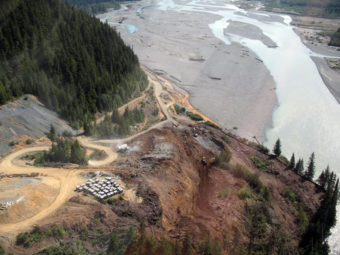
This aerial image from a British Columbia emergency office video shows the Mount Polley dam breaks and some of the damage downstream.

British Columbia’s Environment Ministry says water that poured out of a massive mine-tailings pond Aug. 4 appears to be safe.

But local emergency officials continue to warn area residents against drinking, bathing or swimming in affected water.

Some tribal and environmental groups on both sides of the border doubt the test results. They say polluted water could damage salmon runs on the Fraser River, which enters the ocean at Vancouver.

Some of those fish swim north to Alaska. And a smaller Fraser River run could change Pacific Salmon Treaty allocations, reducing Alaska’s catch.

The dam break took place at the Mount Polley Mine, about 400 miles southeast of Ketchikan. Officials say the escaped wastewater and silt could fill almost 6,000 Olympic-size swimming pools. That’s almost three times an earlier estimate.

The central British Columbia open-pit copper and gold mine is owned by Vancouver-based Imperial Metals. The corporation plans to open the similar Red Chris Mine this year near the Stikine River, which ends near Wrangell.

The Environment Ministry says early tests showed levels of dissolved metals and acid are within government standards. It says the levels are also within limits that protect fish and other aquatic life.

But ministry officials say further tests are needed. It also says the tests could not measure all dissolved metals.

Critics say the province’s water-quality standards are too weak. They also say metal concentrations that don’t kill salmon can still disrupt their senses, making it difficult to find their spawning grounds.

The area affected by the dam break is home to a large sockeye fishery. The run is just starting and will peak in several weeks.

Judge awards stiff penalties for out-of-season fishing

Two fishermen recently learned that commercial trolling out of season – even by a single day – can be expensive.

The captain and crewman of the fishing vessel Chief Joseph pleaded guilty in a Sitka courtroom on July 29 to charges of fishing during closed season and unlawful possession of fish. Judge Leonard Devaney sent the vessel owner — 49-year-old Jeffrey Angelo of Samoa, California — to jail for five days and ordered him to pay over $6,000 in fines. The crewman, Alec Hurst, received a suspended jail sentence and a $1,500 fine. Alaska Trooper Sgt. Aaron Frenzel said that cases of pre-season fishing such as this are relatively rare.

On June 30, Alaska Wildlife Troopers came upon Angelo and Hurst at anchor in Still Harbor, on the southwest corner of Baranof Island, with evidence of recent fishing on deck. According to the Troopers’ report, Angelo and Hurst knowingly fished 12 king salmon in Whale Bay the day before the king season opened on July 1.

Wildlife troopers escorted the Chief Joseph back to Sitka and ordered Angelo to deliver the caught salmon to a processor, forfeiting $691 in proceeds to the state. Both men were then allowed to fish in the opening.

Angelo was also cited for failing to display his commercial numbers on the boat and sentenced to three years’ probation. 29-year-old Hurst – a resident of Fort Bragg, CA – was placed on probation for two years.

The same day he sentenced the Chief Joseph crew, Judge Devaney ordered 23-year-old Douglas McNamee to pay $1,500 in fines by August 8 for tampering with someone else’s shellfish pots and furnishing sport-caught shellfish to a client.

Four-day troll closure starts this weekend

Trollers in Sitka’s ANB Harbor. The annual troll closure starts at midnight on Saturday. (Photo byRachel Waldholz/KCAW))

Southeast Alaska’s commercial troll fishing fleet will have to stand down for a few days, starting this weekend.

The Alaska Department of Fish and Game announced Aug. 5 that the Southeast troll fishery for all salmon will close for four days, starting at midnight on Saturday, Aug. 9. It will reopen at 12:01 a.m. on Thursday, Aug. 14.

The fishery typically shuts down for several days in August to allow coho salmon to escape back into their home streams to spawn.

Fish & Game also announced that trollers will get a second king salmon opener next week. Trolling for kings will re-open on Aug. 14. The opening will last just three days, and close at midnight on August 16.

Fish & Game estimates there are about 36,000 kings left to catch before the fleet reaches this year’s target harvest. Trollers caught nearly 200,000 fish during the first summer king opening, which ran from July 1 through July 7.

Trollers may still target chum salmon in certain areas throughout the troll closure, including in much of Sitka Sound. Trolling for all species will also remain open in select terminal harvest areas, including Deep Inlet near Sitka, so that fishermen can target salmon returning to hatcheries.

*Editor’s Note: This story previously incorrectly stated the length of next week’s king salmon opener for Southeast commercial trollers. The king opening will last three days, not two. It will run from 12:01 a.m. August 14 through 11:59 p.m. August 16. The story has been updated to correct the error. We regret the mistake.

Auriga crew okay after capsizing in Prince William Sound

The crew of a seiner is okay after their fishing vessel capsized in the Prince William Sound earlier this week. The Auriga was seeking at shelter from a storm at the time of the incident.

The Coast Guard says the Auriga was fishing near Eaglek Bay when its crew stopped in preparation of an incoming storm Monday afternoon. A large wave caused the 40-foot vessel to capsize. The four people onboard were able to climb aboard the vessel’s skiff. The Good Samaritan vessel Cornelia Marie rescued the crew and transported them safely to Valdez.

The Auriga remains capsized and partially submerged near Unakwik Inlet. Yesterday, the vessel’s owner contacted Cordova-based Alaska Marine Response to help the Coast Guard and the Alaska Department of Environmental Conservation with salvage operations.

Is the mine tailings dam failure in B.C. a warning for Alaska?

Muddy water from the breached Mount Polley Mine tailings pond dam floods a downstream creek and road Monday. Fishing and environmental groups say the same could happen at new B.C. mines near the Southeast border. (Cariboo Regional District Emergency Operations Centre photo)
Muddy water from the breached Mount Polley Mine tailings dam floods a downstream creek and road Monday. Fishing and environmental groups say the same could happen at new B.C. mines near the Southeast border. (Photo courtesy Cariboo Regional District Emergency Operations Centre)

A tailings dam failure at a British Columbia copper and gold mine could threaten Southeast Alaska salmon fisheries.

That’s according to critics, who say similar dams closer to the border could suffer the same fate, polluting Alaska waters.

Monday morning’s dam break took place at the Mount Polley Mine, about 400 miles southeast of Ketchikan.

Scroll down or click here for a video showing the damage.

Observers estimate enough water, mud and rock to fill 2,000 Olympic-sized swimming pools escaped. Emergency officials warned downstream residents against drinking from affected waterways.

That includes salmon-rich tributaries of the Fraser River, which empties into the Pacific Ocean at Vancouver, B.C.

Brian Lynch of the Petersburg Vessel Owners Association says some of those fish swim north.

“The United States has a harvest-sharing arrangement for Fraser sockeye and pink salmon through provisions of the Pacific Salmon Treaty. So any problem associated with salmon production on the Fraser will affect U.S. fishermen,” he says.

Imperial Metals, the Mount Polley Mine’s owners, did not respond to a request for comment. That’s been the case with requests on other issues too. The corporate website says the mine is not operating and they don’t know how long repairs will take.

A half-dozen or so similar mines are planned for northwest British Columbia, closer to the Alaska border.

This aerial image from a British Columbia emergency office video shows the Mount Polley dam breaks and some of the damage downstream.
This aerial image from a British Columbia emergency office video shows the Mount Polley dam break and some of the damage downstream.

Guy Archibald of the Southeast Alaska Conservation Council says they all plan to store tailings, which contain acidic rock and toxic metals, behind dams similar to the one that broke.

“They’re all basically the same systems. They have to comply with the same regulations and design criteria,” he says.

Archibald and Lynch are especially concerned about the Kerr-Sulphurets-Mitchell project, under development about 20 miles from the Alaska border.

KSM will store tailings behind dams upstream from the Nass River, which ends just south of Alaska’s border with British Columbia.

Environmental Affairs Vice President Brent Murphy says it’s not the same as the Mount Polley dam.

“The design of the tailings management facility is such that water will not be standing up against the crest of the dam. Any ponds will be at least kilometers away from the crest of the dams,” he says.

The Mount Polley break may have been caused by heavy rainfall and increased production added pressure to the dam.

The KSM also plans a water treatment storage dam upstream from the Unuk River, which enters the ocean northeast of Ketchikan. It would be part of a system treating acidic water from mine pits and tunnels.

Murphy says it’s designed to spill extra water rather than hold it beyond capacity.

“That contact water would have characteristics very similar to the water that is currently flowing naturally within the Suphurets-Unuk river system,” he says.

KSM’s dam plans have been OK’d by Canadian provincial and federal officials. Murphy says they also passed muster with independent engineers. Public comments on provincial environmental approval are being taken through Aug. 20.

Lynch of the Petersburg Vessel Owners Association says the Mount Polley dam had the same approval.

“This was not only obviously a tailings dam failure but it appears to be a regulatory oversight failure as well. And that’s what we want to prevent on any mines going into the transboundary systems,” he says.

The Mount Polley mine owner, Vancouver-based Imperial Metals, plans to open the Red Chris Mine, in the Stikine River watershed this fall. Like Mount Polley and KSM, it’s an open-pit copper and gold mine.

Wrangell’s new boat lift tests upper limit

A boat lift hauls a 300-ton tug boat at the Wrangell Marine Service Center Wednesday, July 30, 2014. (Photo by Katarina Sostaric/KSTK)

Wrangell’s new boat lift is the second biggest in Alaska and is expected to boost the former logging town’s growing marine industry. The 300-ton lift last week tested its upper limit.

Harold Medalen is the skipper of the Marauder, a tug based in Juneau. He said it was scheduled to be lifted over a week ago, but there were two problems.

First, the boat lift’s scale needed to be re-calibrated so it could measure the tug’s weight. A technician from Ascom, the manufacturer, flew in from Italy to fix it.

And Medalen said the boat was just too heavy, so they took a few days to make it lighter.

“I guess it was heavier than I thought. We took about 10 tons of fuel off and about 4 tons of tires and 4 tons of tow wire. But it’s worth it to be able to haul out here,” Medalen said.

Medalen said he usually goes to Port Townsend or Bellingham to get hauled out.

“It’s wonderful to have someplace that’s within a day’s run of Juneau where we can get hauled out and do our maintenance,” Medalen said

The Marauder will be at the Wrangell Marine Service Center for a few days. It just needs bottom paint and some routine work.

Harbormaster Greg Meissner said Wrangell’s smaller, 150-ton lift has brought business to town, but those boat owners often do the work themselves. He expects the bigger, 300-ton lift to create new boat yard jobs.

“You start pulling the 100-foot class boats out here, the great big fish packers or yachts, those types of boats–they’re not do-it-yourself,” Meissner said. “For the most part, they’re hiring somebody.”

He said the $1.3 million lift will also help Wrangell retain jobs.

“If you look back 10 years ago and wonder what the marine industry was doing, many folks were hanging on by a shoestring trying to keep afloat. And all of a sudden you bring more boats to town all of a sudden those folks who are barely making it are keeping busy.”

Meissner said business has been a bit slow for the new boat lift. It hauled eight boats in two months. But he said that’s because it arrived in late spring, when all the big commercial boats head to the fishing grounds.

“There’s quite a few boats out there that have been waiting for somewhere to get hauled. So I think this fall you’ll start to see more and more business migrate this way. And we’ll be out of space.”

The new boat lift will only be limited by space for storage and work. The boat yard is on five acres between downtown Wrangell and the waterfront, with little room to expand.

“So for us to build every year we’re gonna need to start looking at where to put some boats. It’s a good problem to have, but you gotta get creative.”

Some boats are being stored in a lot across the street from the boat yard. Proposed solutions for significant expansion are several years and millions of dollars away.

For now, the Marine Service Center will welcome boats to its new lift and aim to build a bigger client base.

Medalen said although the Marauder is only in Wrangell for routine maintenance, he could come here for major repair work, too.

“It’s difficult because of our line of work to schedule a dry dock appointment and keep it. We don’t know exactly when we’re gonna get down there. So here, midsummer there’s usually a lull and it’s a good time to work on boats so we can come right to Wrangell now.”

Medalen estimated having a boat lift close by saved $20,000 in fuel alone.

Site notifications
Update notification options
Subscribe to notifications