Fisheries

Southeast commercial troll fleet gets second shot at king salmon

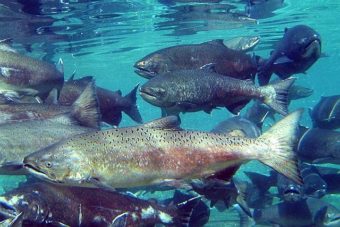
Commercial troll caught king salmon. (Photo courtesy of Matt Lichtenstein)

Southeast Alaska’s commercial troll fishing fleet will have another crack at king salmon in August even with a big haul from the first Chinook opening in July.

Trollers had their first summer king opening July 1st through July 7. The Alaska Department of Fish and Game had expected the opening to be longer with a large quota for kings this year.

Pattie Skannes, the department’s troll management biologist for Southeast, said Chinook catch rates were more than double those of a year ago. And she said the number of boats fishing was also up.

“We had 106 permits in addition to what we had last July,” Skannes said. “So we had a feeling there’d be more people up here fishing, some coming from the Lower 48. We also expected that there wouldn’t be as many trollers targeting chum this year during the king opening, which was true. But we were surprised to see how much higher the effort was, when all the numbers were in. But the catch rates were the most amazing aspect of the fishery. The abundance is just incredible out there.”

Overall 820 permits were fished during that first king opening. The highest catch rates were on the northern and central outside waters. The total harvest from that opening was 198,760 kings.

Skannes said the daily haul started strong and did not drop off this year.
“The catch per fleet per day was one of the highest we’ve ever seen, it was about 28,400. So our catch came in over our target by about that amount. So in other words, in hindsight we fished about one day too long,” Skannes said.
Southeast troll caught kings were worth $3.55 a pound for at the docks in July. Fish averaged 11.5 pounds, a little small for Chinook. The daily average catch per boat was around 35 kings a day, compared to 20 a day last year.
Even with the big first opening, the fleet will have a short, second opening sometime in mid-August.The season typically shuts down for a few days in early August to allow coho salmon to return to streams on the inside waters. A closure of at least two days is planned to start just before midnight August 9. The second king opening will follow.Since the first king opening, some trollers have been catching coho salmon. Skannes said the total haul of silvers by the final week in July had reached just over half a million. “They’re actually looking above average so far though nothing like last year.”Fish and Game forecasts this year’s total coho run in Southeast will be around 4.2 million fish and the all-gear catch is projected at 2.2 million silvers. That’s down from a big season last year but still ahead of long term averages. Troll-caught coho are fetching a dollar 10 cents a pound at the docks in late July while chum are fetching 65 cents a pound.

B.C. gives KSM mine environmental OK


A glacier reflects in a naturally occurring pool of rusty, acidic water at the site of one of the KSM Prospect's planned open-pit mines. (Ed Schoenfeld/CoastAlaska News)
A glacier reflects in a naturally occurring pool of rusty, acidic water at the site of one of the KSM Prospect’s planned open-pit mines. (Ed Schoenfeld/CoastAlaska News)

A controversial mine planned for an area northeast of Ketchikan just won environmental approval from the British Columbia government.

Toronto-based Seabridge Gold was granted what’s called an Environmental Assessment Certificate on Wednesday.

The corporation is developing the Kerr-Sulphurets-Mitchell prospect, near rivers that empty into the ocean in or near Southeast Alaska.

Seabridge still needs similar approval from Canada’s federal government. The KSM mine got a provisional OK earlier this month, and the final public comment period ends August 20th.

British Columbia government approval was granted a day after the National Council of American Indians released a statement opposing the KSM and similar developments.

The statement supported efforts by a Southeast tribal coalition critical of a half-dozen projects near transboundary rivers.

Seabridge Gold still needs to raise much of the $5.3 billion needed to develop what’s expected to be one of the largest copper and gold deposits in the world.

British Columbia environment and mines ministers say their assessment has legally-enforceable mandates that protect rivers, fish, wildlife and people downstream.

Conditions include building water treatment facilities before ore is extracted and developing a wetlands-protection plan. The corporation must also minimize conflicts with bears and contribute to a moose recovery trust.

The conditions were developed with input from the Nisga’a First Nation and other B.C. tribal governments downstream of the mine.

Southwest, Southeast Alaska face highest risks from ocean acidification

Individual components of the final ocean acidification risk index for each census area showing the communities with the highest risk are in the Southeast and Southwest of the state. (Map courtesy NOAA)

Coastal communities in Alaska that depend on fisheries were warned Tuesday to prepare for the impacts of ocean acidification. A study from federal agencies says many of the science questions remain unanswered but changes are already happening.

The first concern is likely shellfish, because when the chemistry of the ocean changes, it’s harder for them to form shells. But which commercial shellfish and when they might be affected and in what waters are questions they can’t answer yet. But what the study can say is which communities are most vulnerable. This is the first product from the Synthesis of Arctic Research effort that combines the work of the National Oceanic and Atmospheric Administration with that of the Bureau of Ocean Energy Management and University researchers in social sciences.

Co-author Sarah Cooley, who wrote the report while at the Woods Hole Oceanographic Institution, and is now Scientific Outreach Manager of the Ocean Conservancy, says Wrangell, Petersburg, Sitka and the Lake and Peninsula Borough are specifically named because they are fishing towns.

“And what we find is that dependence on fisheries is really the key link between ocean chemistry conditions and human communities,” Cooley said. “Right now in Alaska, we have a very heavy dependence on specific harvests.”

“And those specific harvests of crabs and clams and shellfish are actually the things that we think are sort of at the front lines of harm from ocean acidification.”

Acidity is directly related to rising levels of carbon dioxide in the air. It is worst in colder waters and in melt water. To the north in the Chukchi Sea, measurements show the cold acidic water from below increasingly rising to meet the cold acidic waters at the surface…with largely unknown biological effects. Of particular concern are the shell dependent plankton – krill and copepods and a little aquatic snail known as the pteropod, which is heavily fed on by Pink Salmon. But acidity also affects the tiny squid that the King Salmon eat.

“Some species of squid respond poorly to ocean acidification, too, because they have such a high metablolic rate that they can’t exhale as efficiently,” Cooley said.

That’s called an indirect effect in the study. They just can’t say what might be happening to salmon and other fin-fish because of it. Cooley says It is a big and complicated ecosystem out there.

“I think there are more surprises in store, because ecosystems are amazingly resilient,” Cooley said. “But I would love it if we could figure out where the surprises are going to be before we have nasty surprises, like in the Pacific Northwest, when we had nasty surprises of sudden losses of oysters. I’m hoping we can figure it out before we have more losses for people.”

In the case of oysters, the fix turned out to doable. It just took monitoring. When the acid waters shoal up, the oyster farmers change timing, depth, or even dose their larvae with antacids. It took them time to learn all this. And Sarah Cooley says that’s the real point of this report – it’s an effort to try to start getting ahead of the acidity change curve.

“But I think when we start to do studies like this, we can actually kind of go under the hood and figure out the pieces that make a community more or less likely to be hurt, and so we can try to fix those ahead of time,” Cooley said.

Cooley says the options include diversification and securing local government control, but might simply mean things like changing fishing areas and different times.  But certainly better monitoring of acidity levels is going to be key for adaptation by coastal communities in Alaska.

Southeast crabbers hauling in big Dungeness catch

Dungeness crab is currently worth about $3 a pound. (Creative Commons photo by Kevin Cole)

It’s been a big summer season for commercial Dungeness crabbing in Southeast Alaska with a big harvest, a high price and a bump in crab boat numbers in the Panhandle.

That’s a turnaround from last year’s summer season, which was shortened by one week for the first time ever, due to low catches. It’s not the case this year. The fleet will have a full two-month summer season and is already close to surpassing the 2013 catch for the combined summer and fall seasons.

Crabbing time is set based on catches in the first week in mid June. The Alaska Department of Fish and Game uses that first week’s catch to estimate the total season harvest. Joe Stratman is department’s lead crab biologist for the region.

“This season the initial full season harvest estimate is 6.46 million pounds, which is the largest full season harvest estimate ever produced,” Stratman said. “Pounds landed in the first week of the fishery, included in this estimate, were 1,077,000 pounds by 150 permits.”

That’s more than double the first week’s catch from last year and it’s almost double the 10-year average for the first week. As of July 18 the catch was just under 2.5 million pounds. Last year’s combined summer and fall catch was just under 2.6 million pounds.

Not only is it a big catch, it’s worth more this year. The average price at the docks is around $3 a pound. That’s up about 50 cents a pound from last year and the highest price in over a decade. Stratman said this year’s catch has already beaten last year’s for value. “The total value of this year’s fishery to date is $7,325,000. This value to date already exceeds the previous full season’s total value of $6,437,000.”

Usually the fleet catches 80 percent of Southeast’s total Dungeness haul during the summer season and the remaining 20 percent in a fall season during October and November. The summer season is open though August 15.

Watch the sockeye come up Steep Creek

The Steep Creek fish cam is back on line. The U.S. Forest Service has reactivated the underwater view on the active salmon stream near the Mendenhall Glacier Visitor Center.

Fisheries biologist Pete Schneider said the webcam is the latest incarnation of a project started years ago by Eagle Scout Matt Statsny. An early versionof the fish cam included a basic camera hooked up to monitors at the pavilion and Visitor Center. It evolved to streaming imagery over the internet from a temperamental Forest Service server.

“We were actually paying a hosting company,” Schneider said. “We would upload the image, the video to them and they would host it. That way, the computer in the back closet up in the Visitor Center didn’t crash with all people viewing it.”

Schneider said Forest Service officials in Washington D.C. later suggested that a dedicated YouTube channel would be more accessible and provide more exposure.

Visitors at the Mendenhall Glacier can watch sockeye salmon make their way upstream at the viewing platforms along Steep Creek. (Photo by Heather Bryant/KTOO)

The analog camera is set in twelve inches of water aimed toward a pool where sockeye salmon may rest and congregate. Schneider said the sockeye salmon recently seen on camera have actually descended downstream.

“The sockeye are just coming in right now,” Schneider said. “Right before the jökulhlaup (Mendenhall Glacier outburst starting July 9th), we had a whole bunch of fish come in. But then when it all flooded with the jökulhlaup, they headed back downstream. They’re still downstream.”

An avian or mammal or two might also come into view.

Every once in a while, the bears will reach into the pool and pull out a fish that’s just about dead,” Schneider said. “They don’t do that until they start getting kind of hungry, but that’s always fun. You’ll see an occasional duck or merganser paddle by. Beavers will go by. River otter. Coho fry will come hang out by the camera.

The Forest Service said 27,000 people tuned in to the Steep Creek feed last year and collectively watched 10,314 hours of video.

Schneider said the camera project recently won a Forest Service ‘Rise to the Future’ award which recognizes work in fisheries and watershed enhancement.

(Pete Schneider was interviewed on Tuesday’s A Juneau Afternoon program hosted by Ken Fix and produced by Jeff Brown)

Judge allows set-net ban initiative to move forward

A superior court judge has ruled in favor of an initiative to ban commercial set netting for salmon in urban areas.

Earlier this year, Lt. Gov. Mead Treadwell blocked the initiative sponsors from collecting signatures in their effort to appear on the ballot. The decision was based on a recommendation from the Department of Law that the measure would qualify as an unconstitutional appropriation. The state also argued that such an initiative would count as an allocation to sportfishermen and that it would erode the authority of the Board of Fisheries.

Superior Court Judge Catherine Easter dismissed those arguments, finding that the initiative does not qualify as a give-away program and that it is a permissible regulatory measure.

The Department of Law is currently reviewing the decision to see if an appeal is appropriate. The Division of Elections will begin preparing signature booklets in the meantime.

The initiative is being sponsored by the Alaska Fisheries Conservation Alliance, with the aim of getting it on the 2016 ballot. It is backed by key sportfishing interests, including real estate developer and major political funder Bob Penney. The group argues that set net gear should be prohibited to reduce the number of king salmon taken by the commercial sector.

The measure would shut down the commercial set netters who operate on Cook Inlet, the only region in the state that would be practically affected by the ban.

Site notifications
Update notification options
Subscribe to notifications