Fisheries

BC’s KSM mine nears environmental approval

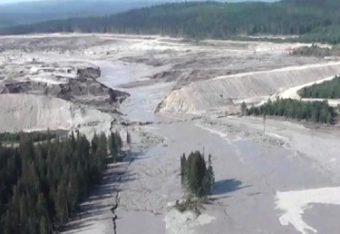
Oxidized rock colors a valley where one of Seabridge Gold's KSM Project's open pit mines will be dug. Canadian officials have opened their final comment period before environmental approval. (Ed Schoenfeld/CoastAlaska)
Oxidized rock colors a valley where one of Seabridge Gold’s KSM Project’s open pit mines will be dug. Canadian officials have opened their final comment period before environmental approval. (Ed Schoenfeld, CoastAlaska)

Canadian environmental officials just gave provisional approval to a controversial mine planned for an area northeast of Ketchikan. Their counterparts in British Columbia have done the same.

Fisheries, tribal and other activists on both sides of the border say this is one of the last chances for critics to let Canadian officials hear their opposition.

Brent Murphy stands on a windy, alpine ridge covered with short plants and wildflowers. He’s overlooking a deep valley, not far from the Alaska border.

Murphy’s a spokesman and environmental official for Seabridge Gold. That’s the company working to develop the Kerr-Sulphurets-Mitchell prospect into a mine.

Seabridge Gold’s Brent Murphy points to a valley that will be dammed to hold treated mine tailings from the KSM Mine. (Ed Schoenfeld/CoastAlaska)
Seabridge Gold’s Brent Murphy points to a valley that will be dammed to hold treated mine tailings from the KSM Mine. (Ed Schoenfeld, CoastAlaska)

“We’re on the west slope of the proposed tailings management facility for the KSM project. You can see, in front of us, is the valley that we’re proposing to utilize,” he says.

Working with the government and tribal officials, the company chose this valley to dam and store mine tailings. That’s the waste rock left after gold, copper and other valuable minerals are removed.

“From an environmental, economic, operational safety point of view, this is the best location to ensure a responsible project,” he says.

A helicopter takes us across snowfields and glaciers to another valley, this one barren, with steep, iron-red-brown stained walls.

Trickling streams and gushing waterfalls carry the naturally occurring acid rock drainage into a nearby creek. It drains down the slope and eventually into a waterway that feeds into the Unuk River, which crosses the border north of Ketchikan.

This is where miners will dig one of several huge pits to extract the ore. Most of the water will be diverted. Murphy says what they can’t keep out of the pits will be collected for treatment.

“And there’ll be a dam located just downstream and that will basically hold the water back. And then we’ll direct the water into a treatment plant and then it will be discharged into Sulphurets Creek … and that goes into the Unuk,” he says.

Those plans, and many more details, are part of an environmental assessment that just won provisional approval from Canadian officials. It’s now open for public comment, which will be considered before the approval becomes final.

It follows a similar decision from the province.

The federal report says, quote, “The agency concludes that the KSM Project is not likely to cause significant adverse environmental effects, taking into account the implementation of the mitigation measures described in this report.”

Greg Knox of the Skeena Wild Conservation Trust discusses fisheries near  the Skeena River in Terrace B.C.
Greg Knox of the Skeena Wild Conservation Trust discusses fisheries near the Skeena River in Terrace B.C. (Ed Schoenfeld, CoastAlaska)

Greg Knox is executive director of the British Columbia watershed protection group called Skeena Wild Conservation Trust. He says the decisions are no surprise.

“Government in British Columbia is very pro-industry and they try to do what they can to make projects go ahead. So, their statements are as expected,” he says.

The company’s measures include the water-treatment plant, in the Unuk watershed. They also include the tailings storage facility, which drains into the Naas River, which empties into the ocean not far from the Southeast Alaska border.

Members of the public have through August 20 to comment on the lengthy plan.

That may not be easy, says biologist Kevin Koch, who works for the Gitanyow Fisheries Authority, part of the tribal government for a region including the Nass River. He says many projects are proposed for northwest British Columbia.

“These facts might be buried, like with KSM, within a 33,000-page environmental assessment application. And sometimes it’s tricky to make sure you have the right facts within these massive applications,” he says.

Alaska critics won’t hesitate to let their views be known.

Kevin Koch, a fisheries biologists with the Gitanyow (First Nation) Fisheries Authority, poses neak the Skeena River in Old Hazelton, B.C. (Ed Schoenfeld, CoastAlaska News)
Kevin Koch, a fisheries biologists with the Gitanyow (First Nation) Fisheries Authority, poses neak the Skeena River in Old Hazelton, B.C. (Ed Schoenfeld, CoastAlaska)

A press release citing representatives of the Tlingit-Haida Central Council, the Petersburg Vessel Owners Association, Rivers without Borders and a sport-fishing company, names numerous problems with the project.

Rob Sanderson of the Central Council of Tlingit & Haida Indian Tribes of Alaska, and co-chair of the United Tribal Transboundary Working Group, says officials should add another level of review.

They say polluted mine water from the KSM will damage salmon and other fish that spend part of their lives in Alaska waters. They worry a catastrophic dam collapse could destroy extensive areas of habitat. And they say the project will create much more acid drainage than occurs naturally in the area.

“One way for Canada to do this would be to establish what is known as a Panel Review, which would provide an opportunity to better address our concerns,” he says.

Critics say there’s no guarantee that the people promising to protect the environment will be around when they’re most needed.

Knox, of the conservation trust, agrees.

“If they do either start to build the mine or they build the mine and operate it for part or all of the timeline, and then something happens to the company, then there’s a real risk to the people of B.C., the people of Canada, and potentially those folks downstream,” he says.

Seabridge Gold’s Murphy says the company is sincere in its efforts to protect the environment.

He says the assessment plan is full of ideas from environmental activists, tribal leaders, fishermen, hunters and others concerned about the project.

Japanese fishermen visit Alaska for ideas on sustainability

A group of Japanese fishermen is touring the Northwest United States to get an education in fisheries. The group’s first stop was Juneau.

37-year-old Fumihiro Sugawara is a chum salmon fisherman in Rausu, which is located in the northeast of Hokkaido Island in Japan. He’s been fishing for 16 years.

He and 12 other Japanese fishermen are visiting Alaska for the first time.

“In the last few years, amount of their salmon and trout is declining, so they want to learn some of the idea from Alaska salmon fish industry and to enhance their business in Japan,” says Yoshimi Sato interpreting for Sugawara.

Sugawara says he learned a lot after touring DIPAC’s Macaulay hatchery Monday morning.

“He was impressed by the way they catch directly from their ocean and then release directly into ocean,” Sato says.

In Japan, hatcheries release juvenile chum salmon in rivers. In Alaska, they’re released in the open ocean.

The group also heard presentations by the Alaska Department of Fish and Game. Sam Rabung is the state’s hatchery program coordinator.

“Alaska’s hatchery program is unique and Alaska’s salmon fisheries are unique. We manage differently than just about anywhere in the world,” Rabung says.

Alaska’s fisheries are managed to maintain the wild stock population.

“It’s a really strange concept to a lot of people from around the world who are more familiar with just harvesting quotas. We don’t want to forego harvest opportunity and conversely, if there are unanticipated weak runs, we can rein things in,” Rabung says.

The more people from around the world know about Alaska fisheries, the better, he says.

“We think it’s important that other countries realize that our fisheries are managed sustainably. They always have been. It’s not new to us. It’s in our constitution and it’s one of the reasons we’re a state, and we think it’s important to spread that message,” Rabung says.

Shunji Murakami is traveling with the fishermen as the group’s main interpreter. He’s based in Japan and is a consultant for the Wild Salmon Center, a Portland-based nonprofit that works to protect wild salmon and the ecosystems they depend on.

“Alaska is such a rich country in terms of environment for salmon, but in Japan, 98 percent of our rivers are dammed and we have scarcity of wild salmon population,” Murakami says.

He says the group of young fishermen came to Alaska to learn from the best. The hope is they will spread the message of sustainability to others back home.

“We cannot apply Alaskan way of resources management a hundred percent to Japan but, to some extent, we can kind of learn from the resource management that’s going on here and apply that in Japan, where environmentally [it’s] a little bit poor, to rehabilitate the wild populations,” Murakami says.

The Japanese fishermen want to expand their international market. One of the ways of doing that is getting their fish certified by the Marine Stewardship Council. Murakami says that’s another incentive to make their fisheries more sustainable.

“So then they can make money and, at the same time, do the right thing,” he says.

The group travels to Sitka next to meet with the Northern Southeast Regional Aquaculture Association. They’ll also go to Portland and visit the Bonneville Hatchery which is run by the Oregon Department of Fish and Wildlife.

Seiner engine room floods, USCG responds

Coast Guard Station Ketchikan boarding team members help the crew of the F/V Vernon dewater their engine room near Ketchikan on Friday. (Photo courtesy U.S. Coast Guard Station Ketchikan)
Coast Guard Station Ketchikan boarding team members help the crew of the fishing vessel Vernon dewater their engine room near Ketchikan on Friday. (Photo courtesy U.S. Coast Guard Station Ketchikan)

A six-person seiner taking on water near Ketchikan Friday morning was helped out by U.S. Coast Guard personnel, and escorted back to port.

According to the Coast Guard, a call for help was received from the F/V Vernon, reporting about a foot of water in the engine room. Coast Guard Sector Juneau issued a marine information broadcast, and deployed two rescue boats from Station Ketchikan.

Coast Guard teams used four dewatering pumps to control the flooding, and later escorted the 65-foot purse seiner back to Ketchikan.

The cause of the flooding is under investigation.

How to shuck: a primer for OysterFest

Anthony Lindoff, mariculture program manager for Haa Aaní, teaches volunteers how to shuck oysters.
Anthony Lindoff, mariculture program manager for Haa Aaní, teaches volunteers how to shuck oysters. (Photo by Sarah Yu/KTOO)

Volunteers are learning how to shuck bivalves in preparation for the Third Annual OysterFest this weekend.

Alana Peterson, the economic development coordinator at Haa Aaní, says that she hopes attendees will be more hands-on with their food, shucking the oysters themselves.

“Shucking oysters is kind of an art. It takes a little practice, and so we didn’t want to just tell people ‘good luck, shuck your oysters,’ so we thought we’d get some volunteers trained,” she says. She says it usually takes five or six tries for people to learn the technique.

Some helpful shucking tips include: start shucking at the hinge of the oyster, make sure to sever the adductor muscles and to use a flathead screwdriver if a shucking knife isn’t available. Tapping on the oysters will help determine if they are alive, with a dead oyster producing a hollow sound.

Oysters from different farms will also shuck, and taste, slightly different.

Haa Aaní has ordered 12,000 oysters from five different farms with an extra 2,400 as backup. Last year, 9,600 oysters were consumed. The oysters come from Yakutat, Angoon, Halibut Cove and Prince of Wales. They’ve been tested for paralytic shellfish poison and other toxins.

OysterFest begins at 2 p.m. Saturday, in the Sealaska Plaza. Tickets are $12 for six and $20 for a dozen oysters.

B.C. mines get financial boost, one to open soon

The KSM, Red Chris and Galore Creek projects are among several planned for northwest British Columbia, near the Alaska border. (Map courtesy Seabridge Gold)

Canadian investors are putting millions of new dollars into mining projects near the Southeast Alaska border. They include the KSM and Tulsequah Chief prospects, which critics say could damage regional fisheries.

KSM is a multi-metal deposit about 150 miles northeast of Ketchikan. It’s near rivers or their tributaries that drain into the ocean northeast of Ketchikan and just south of the Alaska-B.C. border.

A group of Canadian financial firms are in the process of purchasing a million shares of Seabridge Gold, KSM’s parent company. They have an option to buy more, with the total new investment between $13 million and $15 million.

That’s not a lot for a large mine. So Seabridge, headquartered in Toronto, is negotiating to find much larger investors.

“We continue to seek partners and we have confidentiality agreements with several,” says Brent Murphy, vice president of environmental affairs for Seabridge Gold.

Exploration continues at the KSM project, sometimes compared Western Alaska’s Pebble Prospect.

In an interview at a Vancouver, British Columbia, office, Murphy said the company has drilling rigs on site right now.

Officials say the more-than-$5-billion project could be built and ready for operations by the end of the decade.

“We currently have about 35 to 40 people in camp and the drilling program will continue until the end of September,” he says.

Seabridge has numerous regulatory steps to complete. But officials say the more-than-$5-billion project could be built and ready for operations within five or six years.

Another near-border project is within a few months of completion.

The Red Chris Mine is already stockpiling copper and gold ore. The project, about 125 miles east of Juneau, is completing its onsite buildings, mill and tailings-storage system. It’s near the upper watershed of the Stikine River, which empties into the ocean near Petersburg and Wrangell.

Officials at its owner, Vancouver-based Imperial Metals, did not respond to repeated interview requests. But Imperial’s website says the $530 million project is expected to open within a few months.

Imperial Metals Corporation's Red Chris Mine is close to opening. Camp housing is shown in this photo. (Courtesy Imperial Metals Corp.)
Imperial Metals’ Red Chris Mine is close to opening. Camp housing is shown in this photo. (Courtesy Imperial Metals)

Like most other near-border mines, development is being helped along by a transmission line to new hydroprojects in the province’s northwest.

“The ability to hook up to power is a very important part of development or any considerations for investment,” says Karina Brino, president of the Mining Association of British Columbia.

She says the line is part of a province-wide effort to boost mineral-extraction projects.

Another project in the Stikine watershed is the Galore Creek copper-gold mine.

Development has been suspended so co-owner NovaGold can focus on its Donlin Creek project in Western Alaska.

But Communications Vice President Mélanie Hennessey says exploration continues. During an interview in her Vancouver office, she said the corporation is reviewing drilling and other work conducted during the past two summers.

“It involves quite a bit of work, quite a bit of technical work on modeling. And so it’s more desktop work than it is physical, onsite work,” Hennessey says.

Identifying more ore would allow NovaGold and co-owner Teck Resources, also Vancouver-based, to find new investors.

“We do have a process underway to looking at selling a portion of our interest or our full interest in the asset,” she says.

Another near-border project is the Tulsequah Chief Mine, which Chieftain Metals Corp. is trying to reopen. It’s on a tributary of the Taku River, which ends near Juneau.

Toronto-based Chieftain recently announced it had acquired a nearly $20 million loan to look for ways to lower construction and operational costs.

Those and other mines have raised numerous concerns with Southeast Alaska environmental, fisheries and tribal organizations.

“It’s going to create a lot of acid-generating waste rock,” says Guy Archibald, mining and clean water program manager for the Southeast Alaska Conservation Council.

He says that acidic water can disrupt transboundary rivers, and those nearby.

“It can have very significant impacts, starting with the fisheries. And that leads to problems with the economy, which leads to issues in the small communities, whether they can continue to maintain their populations,” Archibald says.

The group Rivers Without Borders is also highly critical of the projects’ impacts.

Several other mine projects are being explored or developed in the near-border region.

One is Schaft Creek, a copper, molybdenum and gold mine owned by Calgary, Alberta-based Copper Fox Metals and Vancouver’s Teck Resources. It’s in the Stikine River watershed, about 150 miles northeast of Petersburg.

Copper Fox says this summer’s work includes a series of studies aimed at finding more ore and reducing construction and mining costs.

(This report is one in an ongoing series on mines that could affect transboundary rivers flowing into Alaska and nearby waters.)

Strong start to season for gillnetters

For gillnetters in Northern Southeast, the season started off with lots of big, heavy fish and boats from around the region flocking north for a piece of the action.

In the first four weeks of fishing, record number of gillnet boats have fished in the Northern Lynn Canal, the area officially designated 15C. Last week, 240 boats were counted – and that’s up from last year record count of 190 boats for the same week. It also means that according to numbers from the Commercial Fisheries Entry Commission, more than half of the total number of salmon gillnet permits in Southeast are being fished in the Lynn Canal these last two weeks.

But, that’s because there are plenty of fish to catch. A total of 385,000 chum salmon were caught last week by the fleet – an average of about 1,600 fish a boat, a hefty haul for a gillnetter. Alaska Department of Fish and Game commercial fish biologist Randy Bachman says the fish are big.

“The average weight on chum is close to 10 pounds so that’s quite a bit larger than it was last year,” Bachman says.

The chums are hatchery fish from Douglas Island Pink and Chum in Juneau and have become the bulk the salmon harvest for Northern Southeast gillnet fishermen.

While the hatchery chum are the target right now for most fishermen, the wild sockeye runs are not being overlooked. Eight thousand sockeye were recorded caught last week by the commercial fleet in the region. Bachman said the Chilkat sockeye run near Haines is looking strong and the fish wheels are showing some of the highest numbers on record .

“The Chilkat Lake sockeye early return seems to be extremely strong. We’ve had good showings, good catches in our fish wheels as well as extremely high sonar counts up at Chilkat Lake early this season. It was a strong forecast for a Chilkat Lake return and it’s looking even stronger than that.”

Biologists expected a less successful run for the Chilkoot, also near Haines, but Bachman said, that run is also looking stronger than projected.

“It’s about three times as good compared to where we were this time last year and well above the escapement during the parent year in 2009,” Bachman said.

The sockeye, like the chum, are lunkers, too, said Bachman.

“The sockeye are also very large this year and probably pushing 7-and-a –half, 8 pounds when they’re usually 6 or 6-and-a-half.”

Processors are reportedly paying between 60 and 65 cents a pound for chum and around $1.80 a pound for sockeye. Those prices are about the same as last year.

While early returns seem positive for the gillnet fleet, fishermen aren’t known to be overly optimistic. Texting from the fishing grounds, Captain Norm Hughes writes “When they say it’s opening strong, that’s nice. But I need a whole month of strong to make my season.”

Site notifications
Update notification options
Subscribe to notifications