Fisheries

Tribes push to restore salmon to upper Columbia River

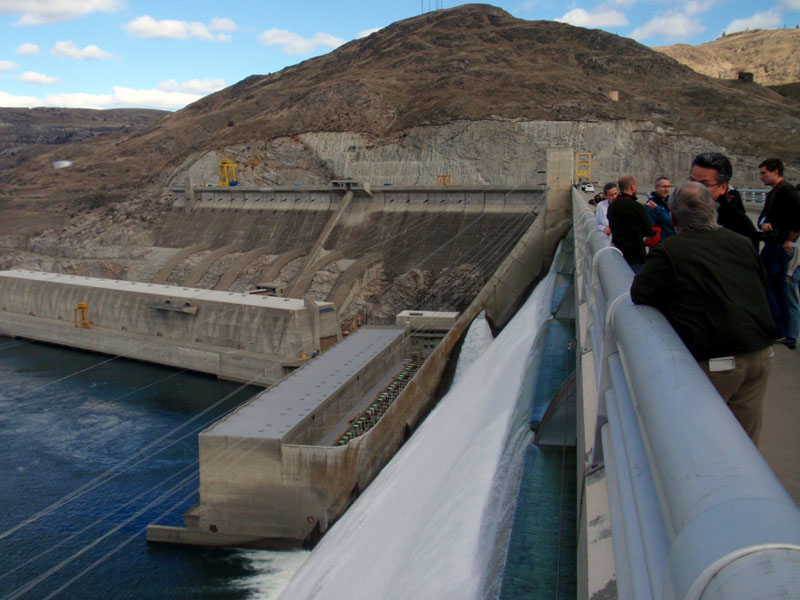
A pre-conference tour of Grand Coulee Dam on Monday kicked off a conversation about restoring salmon to the Upper Columbia Basin. (Photo by Tom Banse/NNN)

Once upon a time, salmon and steelhead swam over a thousand miles upriver to the headwaters of the mighty Columbia River, at the foot of the Rockies in British Columbia.

Those epic migrations ended in 1938 with the construction of Grand Coulee Dam.

This week, tribes from both sides of the U.S.-Canada border along with scientists and policymakers are meeting in Spokane to figure out how Columbia River fish could be restored to their entire historical range. The idea draws passionate supporters, but has unknown costs that you might be asked to help pay.

Uncharted waters 

Salmon and steelhead have been absent from the upper Columbia River for 75 years. But tribes on both sides of border still miss the fish. Colville tribal member D.R. Michel senses an opportunity “to correct a lot of wrongs.”

“The tribes never surrendered to the loss of salmon,” he says. “You see old photos of the chiefs standing on the reservation side looking down on the project with all of those promises of, ‘We’ll take care of you. You’ll have your fish. We’ll put in hatcheries.’ None of that stuff ever really happened.”

Tribes are taking the lead to examine options for restoring migratory fish to the upper Columbia River. Five dams built without fish ladders now stand in the way — two in Washington and three in Canada.

The Bureau of Reclamation’s Lynne Brougher led a tour Monday of Grand Coulee Dam for tribal leaders and biologists from British Columbia and the U.S. Northwest. She stopped the tour van in the center of the enormous concrete span so the group could peer over the edge at the torrents of water plummeting down the spillways.

“What you’re looking at here is a 350 foot difference between the water at the base of the dam and uplake in the reservoir,” Brougher explained over the din of rushing water.
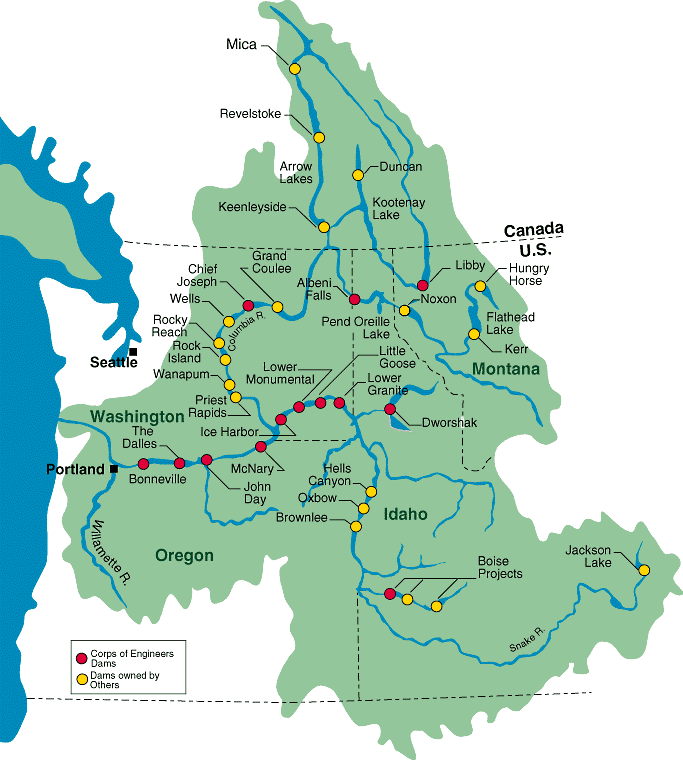
A map of dams in the Columbia River Basin (Map courtesy of U.S. Army Corps of Engineers)
A map of dams in the Columbia River Basin
(Map courtesy of U.S. Army Corps of Engineers)

Nobody has built a fish ladder on a dam this high according to Canadian Columbia River Inter-Tribal Fisheries Commission biologist Will Warnock of Cranbrook, British Columbia.

“It would be going into uncharted waters to build that kind of passage facility. There’s other things you can do to get salmon past dams this high, though. You can trap them and manually truck them around the dam.”

That’s one idea. An elevator actually is another. A long fish ladder would be very expensive and a last resort, if tried at all.

A separate suite of technologies would be needed to help juvenile salmon migrating downstream get past the hydropower turbines and long stretches of slack water behind the upper Columbia dams.

Who would pay?

Who would pay for this? Nearly all of us, as D.R. Michel sees it. He directs the Upper Columbia United Tribes of North Idaho and Eastern Washington.

“It’s potentially a shared cost between ratepayers, the federal government, farmers and irrigators,” says Michel. “Some of the folks who benefit directly from use of this water and what comes out of this dam should help pay for this also.”

The unknown costs of reintroduction could add up, and that worries the Public Power Council’s Scott Corwin. He represents public utilities who get electricity from Columbia River dams.

“There are just a lot of questions about whether that is even possible and how it would impact other species. Yeah, we have a lot of questions.”

The U.S. and Canada are about to open negotiations to renew the 50-year-old Columbia River Treaty. That is the forum chosen by fish advocates to advance their idea. But last week, British Columbia’s government declared it doesn’t want to discuss it at the treaty talks.

A position paper forwarded to Ottawa reads, “British Columbia’s perspective is that the management of… salmon populations is the responsibility of the Government of Canada and that restoration of fish passage and habitat, if feasible, should be the responsibility of each country regarding their respective infrastructure.”

“We are very respectful of the importance of salmon to First Nations,” said provincial Energy Minister Bill Bennett, using the Canadian term for native tribes. But during an interview, Bennett also maintained that ratepayers of BC Hydro should not have to pay more for fish passage. “Our (electricity) rates are already going up in B.C.,” Bennett noted.

Tim Personius, deputy regional director of the U.S. Bureau of Reclamation, says Canada’s position could be a problem.

“The position of the United States is that we should not move forward without Canada participating. I think that’s a good idea.”

Personius says it looks like a lot of the spawning habitat for upper Columbia River fish is in Canada. He says it would not make a lot of sense “for the United States to spend millions or billions of dollars on fish passage” only to have the salmon run to British Columbia and “stub their noses” on a Canadian dam.

The U.S. government is taking an open-minded position in Personius’ telling. But given the many unknowns, “We should kind of approach this cautiously and probably in small steps.”
Herring Update: Third opening lasts one hour, ten minutes

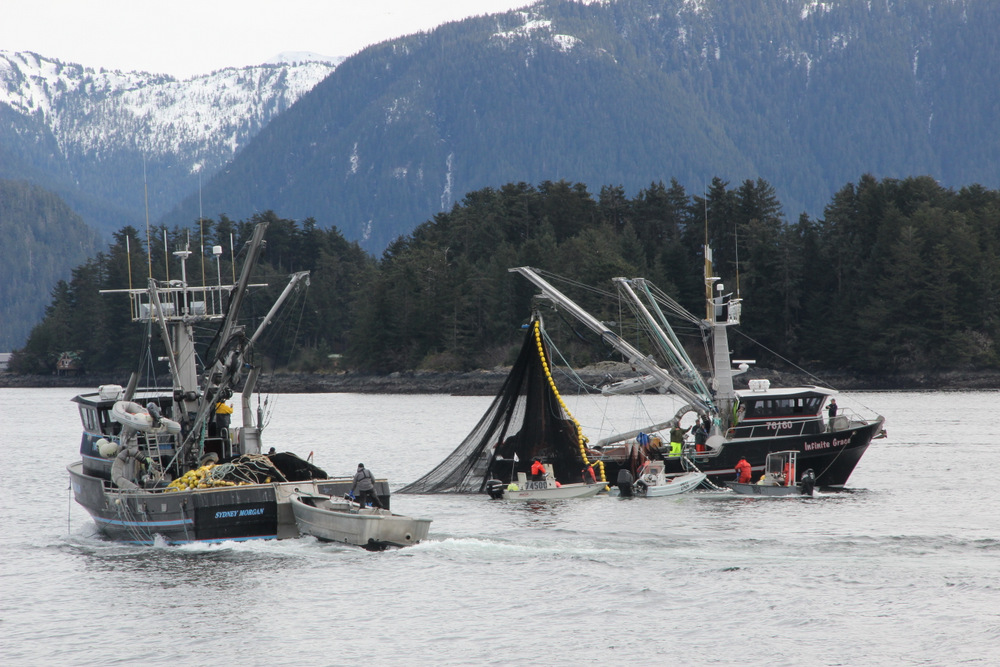
The seiner Infinite Grace pursing up during the third opening in the Sitka Sound sac roe herring fishery, on Wednesday, March 26, 2014 (Photo by Rachel Waldholz/KCAW)

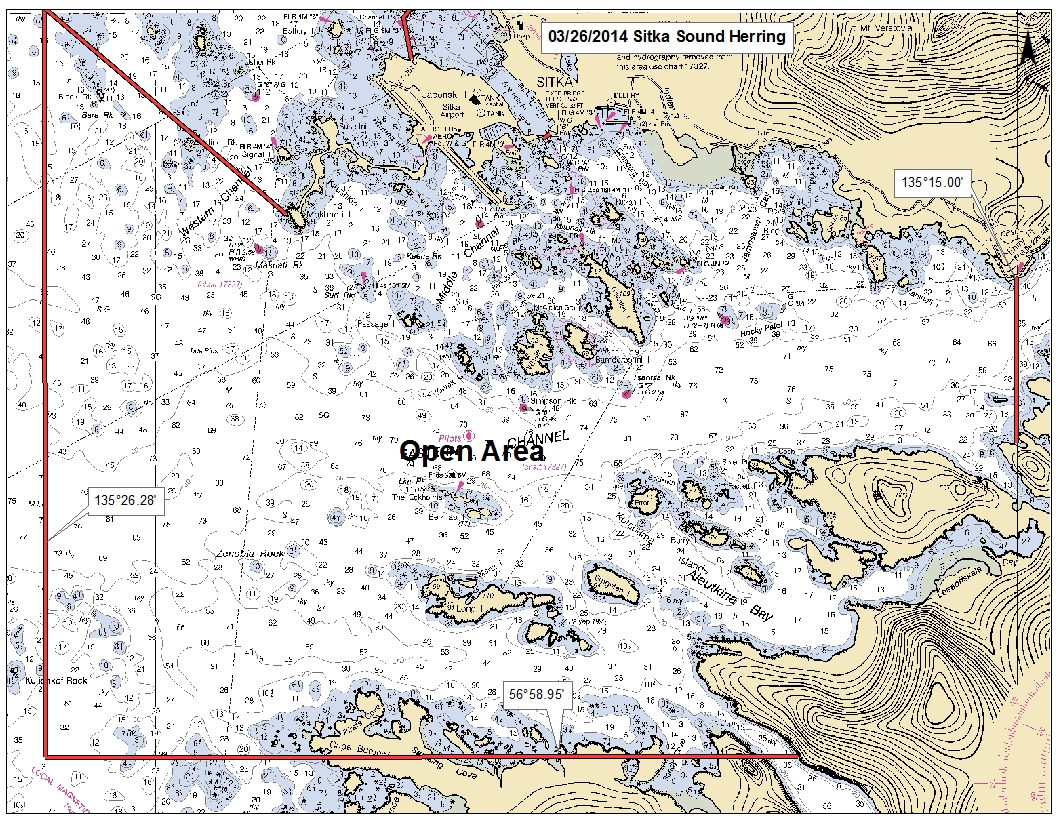
The Sitka Sound sac roe herring fishery had its third opening Wednesday, concentrated in the waters just south of downtown.

The opening lasted one hour and ten minutes, starting at 2:30 p.m. and closing at 3:40 p.m. As of 4:30 p.m. Wednesday, the Department of Fish & Game had not yet issued an estimate of how much was caught.

The action took place close enough to shore that Sitkans could stroll to the water’s edge from downtown businesses to watch the fleet make sets. People lined the Sea Walk and stood under the O’Connell Bridge with binoculars and cameras, as spotter planes circled overhead. The location of Wednesday’s fishery was different from the prior two openings, which both took place north of town, in Starrigavan and Katlian Bays.

The Alaska Department of Fish & Game released this map, showing where fishing is allowed in Wednesday’s herring opening. (Map courtesy of ADF&G)

Fish & Game biologist Dave Gordon had set a goal of about 3,000 tons for this third opening. That was a smaller amount than the Department had initially hoped for. Gordon had said earlier in the week that he hoped to catch the remaining tonnage left in this year’s harvest limit in one opening. But as it became clear that the amount left would exceed 6,500 tons — and exceed processing capacity — Gordon decided to aim for two openings.

During his 11 a.m. update on Wednesday, he said that a large volume of herring had also moved into waters near town that are out-of-bounds to the commercial fishery to protect subsistence use. Instead, the fishery targeted smaller schools of herring scattered throughout the waters south of town, Gordon said.

Despite the smaller volumes, Gordon said this morning, “I feel compelled to provide this opportunity,” given the quality of fish seen in test samples.

ADF&G also revised their counts from the previous two openings, on Sunday and last Thursday. Fish & Game now estimates the fleet caught a total of about 9,800 tons of herring in those first two openings, out of a total harvest limit of over 16,000 tons.

Gordon said that an aerial survey this morning found a few hundred yards of herring spawn on Middle Island; no other spawn was seen. In the sac roe fishery, the eggs are taken intact from the females. It’s critical to the success of the commercial harvest to land the fish prior to spawning.

Once the spawn begins, the focus in Sitka will switch to subsistence harvesting of roe on hemlock branches.

Herring update: ‘We’re going after these fish’

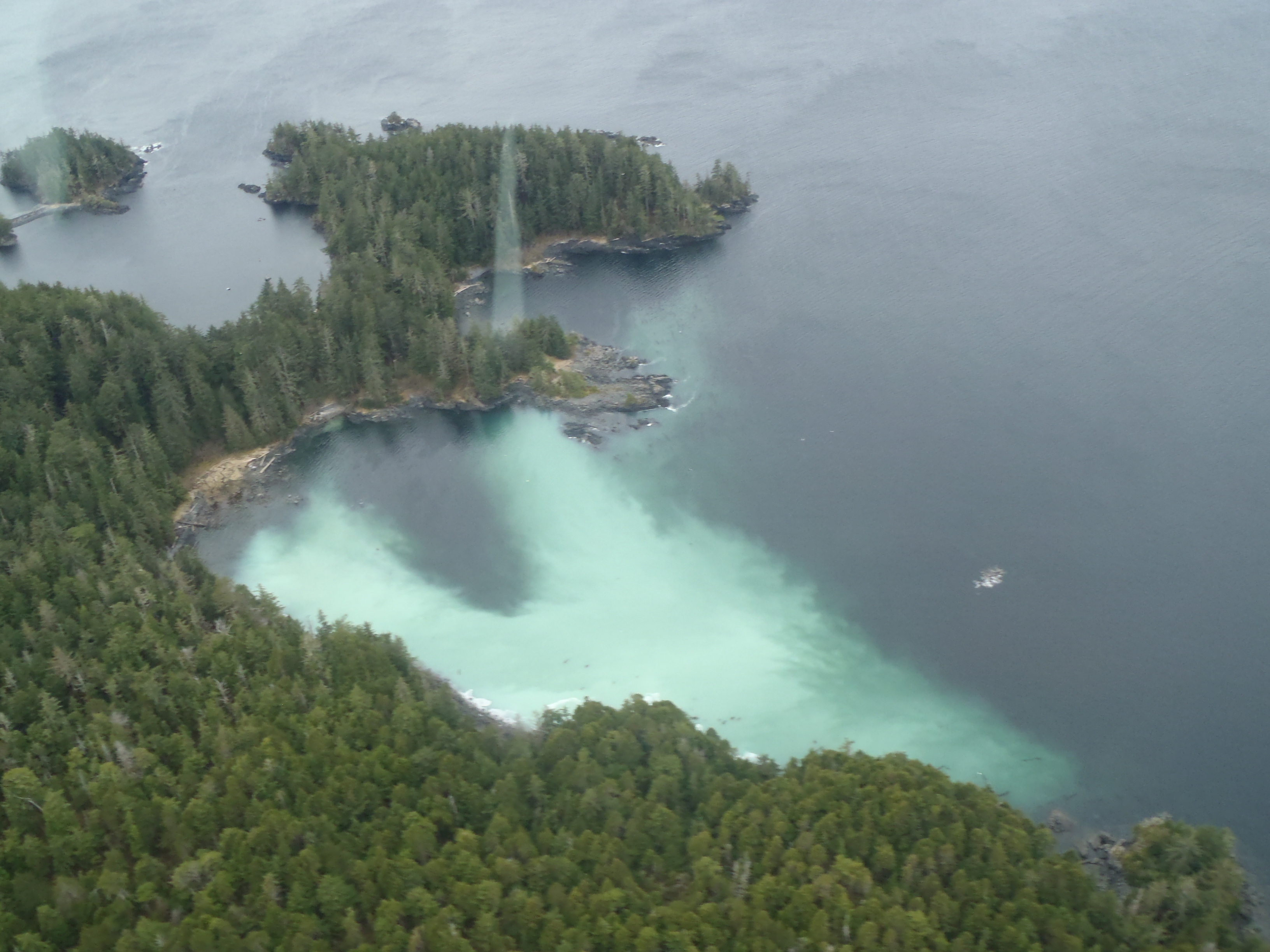
Herring spawn, on the west side of Middle Island Tuesday morning (3-25-14). (Photo courtesy ADF&G/Dave Gordon)

With the herring spawn starting in Sitka Sound, the Alaska Department of Fish & Game is quickly developing plans for a third commercial seine opening — possibly on Wednesday.

ADF&G biologist Dave Gordon reported seeing one area of intense spawn on the west side of Middle Island, during his aerial survey yesterday morning. Large concentrations of herring were visible along the Sitka road system, as well as between Whale and Galankin islands.

In his 11 a.m. radio update, Gordon said he had spoken with processors, who are going full bore on the 10,300 tons landed in the previous two openers on Sunday and last Thursday. In addition, longliners took advantage of some nice spring weather and brought in several hundred thousand pounds of black cod and halibut to the already-stressed plants.

Nevertheless, Gordon said, “Given the developments of spawn, I think it’s in our interest to go after these fish.” He said the opener — when it occurs — will likely target the entire 6,000 tons left on this year’s harvest limit.

In the sac roe fishery, the eggs are taken intact from the females. It’s critical to the success of the commercial harvest to land the fish prior to spawning.
 

Petersburg mayor: state will rebuild hatchery

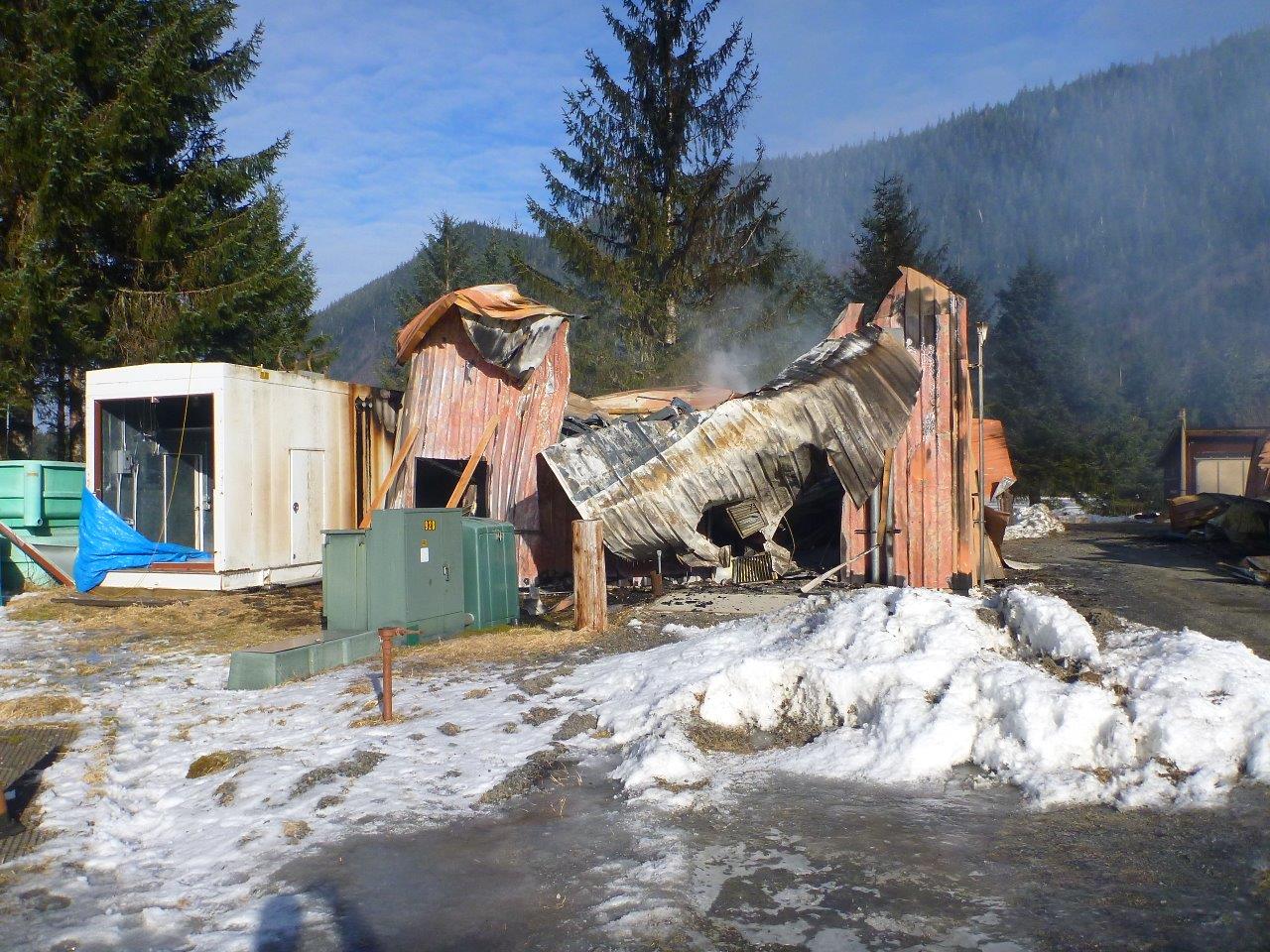
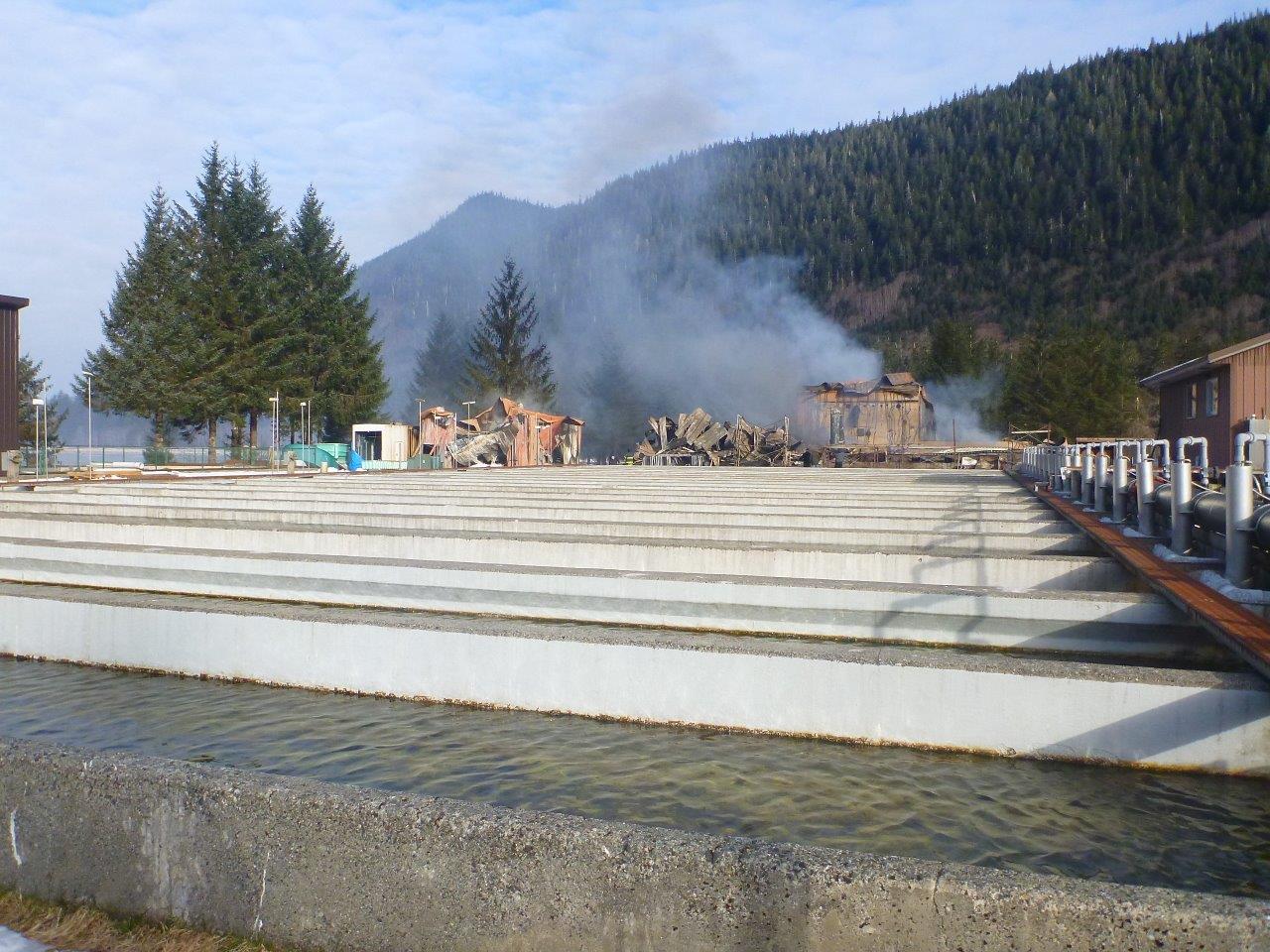
One of the burned hatchery buildings. (Photo courtesy ADF&G)

Petersburg mayor Mark Jensen said he got word from the state last Friday that Fish and Game would be rebuilding the Crystal Lake hatchery facility destroyed in a fire earlier this month.

Crystal Lake is a king and coho hatchery operated by the Southern Southeast Regional Aquaculture Association about 18 miles south of Petersburg. The hatchery buildings are owned by the state. Crystal Lake’s incubation room burnt down on March 4th.

Mayor Mark Jensen said he spoke Friday with Kevin Brooks . He’s director of Fish and Game’s division of administrative services. “I had met with him and a few other Fish and Game personal and Sam Kito and Dennis Egan in Senator Egan’s office when I was up there for the regional tournament,” Jensen said. “At that point they didn’t really have a definite answer but Kevin Brooks conveyed the message to me today that they are going to go ahead. The hatchery will be rebuilt. Fish and Game and SSRAA are already looking at design concepts and ideas. So it’s positive.”

Jensen said Fish and Game officials have the message of the importance of Crystal Lake to commercial and sport fishing fleets and the community. Local residents started a letter writing campaign this month to urge the state to rebuild.

Seiners land 4K tons in herring season opener

Seiners in Starrigavan Bay during the first opening of Sitka’s 2014 sac roe herring fishery. (Photo by Rachel Waldholz/KCAW)

The Sitka herring fishery had its first opening yesterday afternoon.

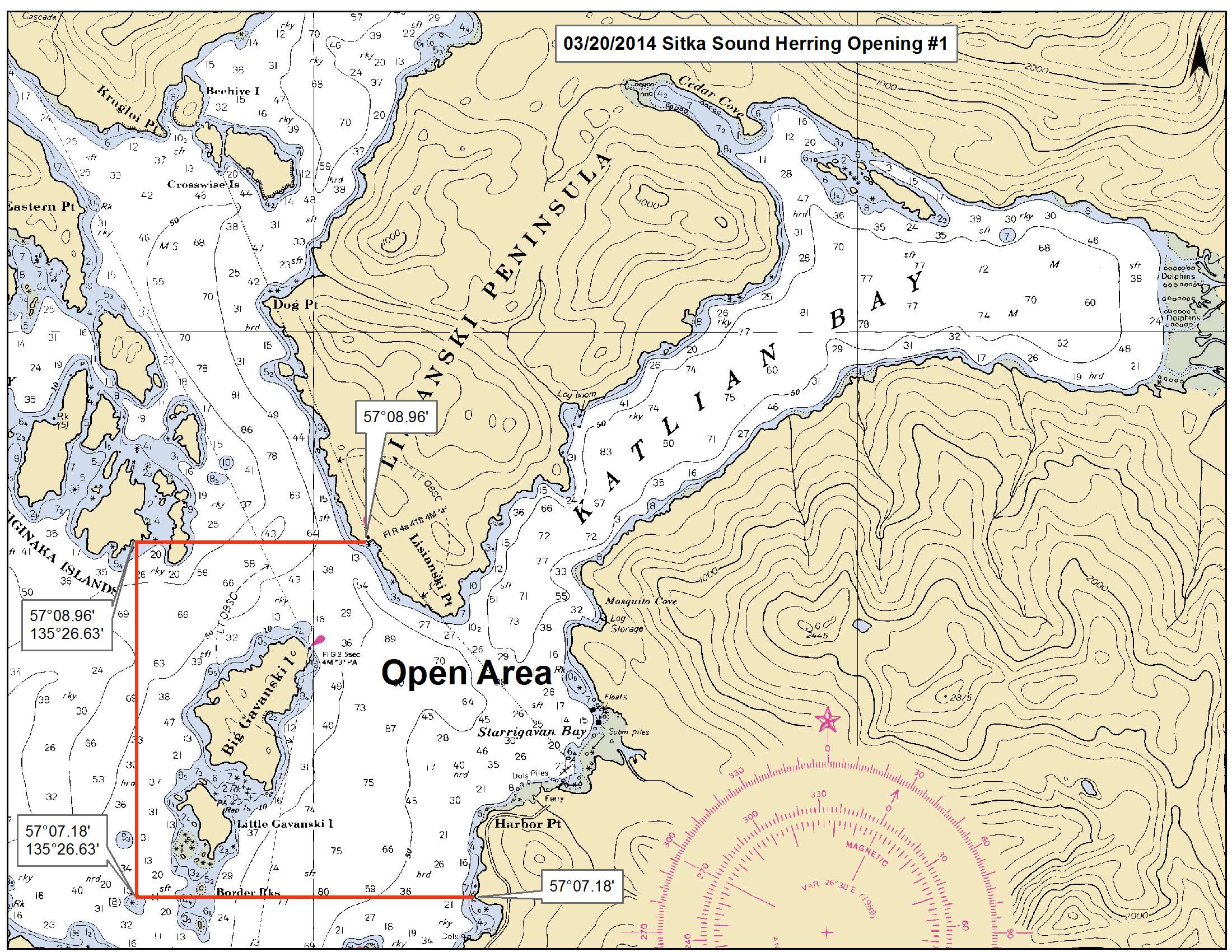
The Alaska Department of Fish & Game declared the Sitka Sound sac roe herring fishery open at 1:45 p.m. The fishing area covered much of Starrigavan and Katlian bays, north of Sitka.

The Alaska Department of Fish & Game released this map, showing the boundaries of Thurday’s herring season opener. Fishing was restricted to Starrigavan and Katlian bays, north of Sitka. (Map courtesy ADF&G)

The opening lasted two hours and thirty-five minutes, closing at 4:20 p.m. The Department estimated that the fleet caught at least 4,000 tons of herring, and announced that there will be no fishing Friday (3-21-14), to allow processors to work through the catch.

If sold at last year’s price, today’s catch would be worth about $2.4-million to fishermen at the docks. This year’s price, however, remains unclear.

The total harvest level for this year is over 16,000 tons. Speaking with KCAW earlier this week, Fish & Game biologist Dave Gordon estimated that it would take about four separate openings to reach the limit.

Officials gave the fleet two hours’ notice of the opening at 11:45 a.m. (Thu 3-20-14), after samples of fish tested in the morning found well over 10-percent mature roe, or eggs, in the herring.  10-percent mature roe is the Department’s threshold for a fishery. The most recent two samples came back with 12.5-percent and 13.1-percent mature roe, which is high even for the high-quality Sitka fishery.

The opening kicked off with a voice countdown from Gordon, on board the state’s research vessel, the Kestrel:

Ten, nine, eight, seven, six, five, four, three, two, one, OPEN! The Sitka Sound sac roe fishery is now open. The Sitka Sound sac roe fishery is now open. This is the Department of Fish & Game standing by, Channel 10.

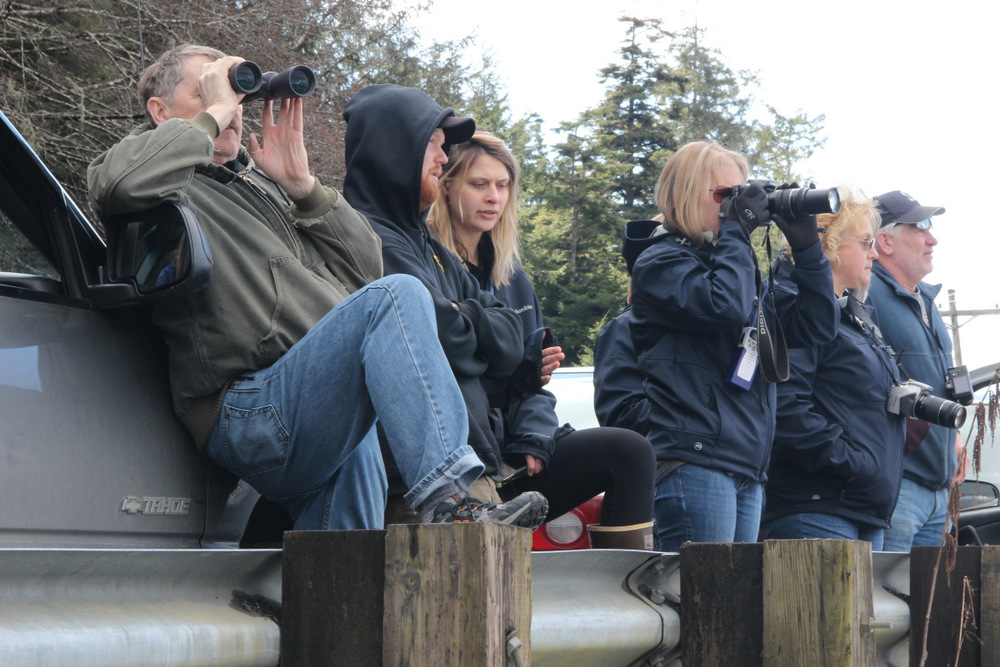
Sitkans lined Halibut Point Road near the ferry terminal to watch the fishery. From left: George Eliason, Dillon Bets, Alainah Nelson, Misty Smith, Sandee Holst. (Photo by Rachel Waldholz/KCAW)

There are forty-eight permit-holders in the lucrative seine fishery. On Thursday afternoon, most of those boats were concentrated in Starrigavan Bay, within sight of Sitka’s road system. People lined Halibut Point Road near Sitka’s ferry terminal, watching through binoculars and cameras as the fishery unfolded in front of them and spotter planes circled overhead.

Among the spectators were two women who identified themselves as Karen and Leanne.

Leanne: You’ve got your pilots flying, and you’ve got spotters actually looking down talking to boats, so you’ve got several people in the planes. And they just have to be very, very careful. They get special permission to work in this kind of airspace.  Normally you’re not supposed to fly that close to each other.”

Karen: It’s very exciting of  course when they do the count down and you see all the boats jockeying for position. And seeing what they catch — it’s actually amazing to see how many herring are in a net.

The Department of Fish & Game plans aerial and vessel surveys throughout the day on Friday (3-21-14), and will be issuing informational updates over the radio at 11 a.m. and 4 p.m. Those can be heard on VHF marine radio, on Channel 10.

Emily Forman contributed to this report.

Petersburg residents start letter campaign for hatchery rebuild

(Photo courtesy ADF&G)

Petersburg residents have started a letter writing campaign to urge the state to reconstruct the Crystal Lake hatchery facilities destroyed by fire earlier this month.

Crystal Lake is a king and coho salmon facility about 18 miles south of Petersburg. Salmon fry from the hatchery are released near Petersburg and in remote sites closer to Wrangell and Ketchikan. Crystal Lake’s incubation room burnt down March 4th.

The hatchery buildings are owned by the state of Alaska and they’re operated by the Southern Southeast Regional Aquaculture Association. Sally Dwyer and husband Al, former mayor of Petersburg, hope to gather over a thousand letters from area residents to send to Fish and Game Commissioner Cora Campbell, who grew up here.

Collection boxes have been placed at the library, Wild Celery, Coastal Cold Storage, Petersburg Pilot, visitor information center and Lees Clothing. Dwyer says they’ll be collecting all the letters next Friday, March 28th to send to the capital city in a fish box.

To hear more about the campaign listen to the audio at KFSK.

Site notifications
Update notification options
Subscribe to notifications