Fisheries

Industry says U.S. fish law works well in Alaska

Salmon were jumping out of the water in Amalga Harbor.
Salmon jumping out of the water in Amalga Harbor. (Photo by Heather Bryant/KTOO)

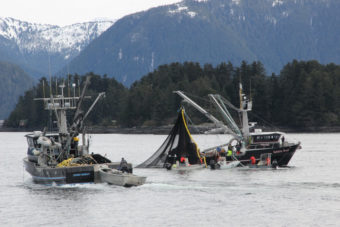
The Magnuson-Stevens Act, the 1976 law that governs fishing in the Bering Sea, Gulf of Alaska and other federal waters, is up for reauthorization in Congress. In past revisions, sectors of the Alaska industry squared off against each other. This time, the industry is mostly united in praising the law. But some of Alaska’s non-commercial fishermen say their needs aren’t getting enough attention.

Magnuson-Stevens is the law that extended U.S. jurisdiction 200 miles off the nation’s shore and pushed out foreign fishing fleets. It, and the North Pacific Fisheries Management Council it created, are said to have ended the dangerous “race for fish. “ Under council management, North Pacific fish and crab stocks have recovered from depletion.  The law is still controversial on the East Coast, but a parade of Alaska industry stakeholders told a U.S. Senate hearing today the Magnuson-Stevens Act is pretty good the way it is.

Here’s Julianne Curry of United Fishermen of Alaska: ”In general, MSA is working well in the North Pacific and we don’t want to see a radical overhaul of the act.”

John Plesha of Trident Seafoods: “The Magnuson Stevens Act has been incredibly successful.”

Lori Swanson of Groundfish Forum: “The result is a true success story for both the MSA and the Council process.”

And North Pacific Council Director Chris Oliver: “Major changes are frankly not necessary at this time.”

Other industry reps filled the back of the hearing room. Those from the At-Sea Processors Association and United Catcher Boats, said they’re mostly watching Congress to fend off revisions. The director of the Alaska Bering Sea Crabbers said he’d be happy if Congress did nothing but change the expiration date. But some witnesses at the hearing did suggest changes. The Alaska Longline Fishermen’s Association says consolidation has squeezed small fishing operators out. Director Linda Behnken says they’re also pressing for video monitoring in place of human observers to police the catch on smaller boats.

“Placing observers on these small vessels presents problems,” she says. “Living and deck space is cramped at best. Fishing families spend months living in a space the size of a station wagon.”

Sport and subsistence fishermen say the fishing law doesn’t give them due consideration. The accidental catch of chinook salmon in the pollock fishery is of particular concern to tribes in the Yukon-Kuskokwim Delta and in Interior Alaska. The pollock industry says it has vastly reduced bycatch, to roughly half the 60,000 salmon they’re allowed.  But chinook returns to the rivers have been devastatingly low in recent years. It’s decimated subsistence use, so Natasha Singh, of Tanana Chiefs Conference, says bycatch of 30,000 fish is troubling.

“When our village residents hear those numbers, they’re just astonished because some of our people who have depended on these king salmon to feed them throughout the river aren’t even able to take one fish today,” she says.

TCC and the Association of Village Council Presidents are asking for a dedicated tribal seat on the North Pacific council, which hasn’t met with support among the industry. The Magnuson-Stevens reauthorization process is continuing in both the Senate and the House. No official bill is on file yet.

Alaska gets $21 million in federal disaster funds

The National Oceanic and Atmospheric Administration yesterday announced it is sending Alaska $21 million in federal disaster funds for poor king salmon returns in three regions.

The money covers government-declared disasters for the 2011 and 2012 Chinook runs on the Yukon and Kuskokwim Rivers, plus the 2012 season in Cook Inlet.

NOAA says it will disperse the money through the federal grant process for projects aimed at restoring the fishery, preventing a future disaster or helping the fishing community.

The funds are from a $75 million appropriation Congress approved last month for fisheries disasters nationwide.

Assembly hopes to attract more federal research jobs to Juneau

TSMRI
The Ted Stevens Marine Research Institute at Lena Point. (Photo courtesy NOAA)

Did you know the Alaska Fisheries Science Center is not based in Alaska?

In fact, most of the National Oceanic and Atmospheric Administration researchers who support Alaska fisheries are based in Seattle.

The Juneau Assembly wants to change that. Mayor Merrill Sanford this week created a task force to look at bringing more federal marine science jobs to Alaska. While the task force will study the issue from a Juneau perspective, Sanford said other communities could benefit as well.

“There’s other places within Southeast where some of these jobs could go,” Sanford said at Monday’s assembly meeting. “Kodiak has a big fishing industry where some of these jobs might possibly go, and we want to look at all of that.”

Attracting more federal jobs to Juneau is an assembly priority. In addition to laboratory scientists, Sanford said the assembly also wants research vessels based in the state.

“If we could even move a few or some to our own research centers and our own fisheries areas, I think that would be a big advantage to us,” Sanford said.

NOAA Fisheries has about 180 full time employees throughout Alaska, most of them in Juneau. By comparison, the Alaska Fisheries Science Center in Seattle has about 250 full time employees.

Historic factors led the fisheries science center to be based in Seattle.

“That’s where the geographical distribution of the labor force developed around the time of statehood, and it’s mostly just been maintained there,” said NOAA Fisheries spokeswoman Julie Speegle.

She said the agency is spread out for a number of other reasons, including the availability of facilities and housing, and the willingness of some employees to live in Alaska. That’s not to mention the cost of relocating employees during a time of federal budget cuts, Speegle said.

Assemblyman Randy Wanamaker and fisheries consultant Greg Fisk will co-chair the city’s task force. The panel also includes Assemblywoman Kate Troll and Jim Becker, chair of the CBJ Fisheries Development Committee. The group hopes to add a retired NOAA employee.

The task force has six months to complete a report for the assembly.

U.S. pushes international ban on arctic fishing

Arctic cod. (Photo courtesy of NOAA)

The United States is gathering support for an international moratorium on commercial fishing in the Arctic Ocean.

The Globe and Mail reports that Denmark and Canada are prepared to back the ban at a meeting of Arctic states in Greenland this week. The other nations — Russia and Norway — are not currently on board.

The proposal on the table is to close down fishing beyond each nation’s 200-mile exclusive economic zone. The region would remain closed until scientists were able to conduct a comprehensive stock assessment of Arctic fish species.

In 2009, the United States outlawed commercial fishing within its exclusive waters off the northern coast of Alaska.

Scientists and environmentalists have been pushing for an international measure in recent years, as warming climates melt off more ice and expose potential fishing grounds in the Arctic Ocean.

Political solution sought for China geoduck ban

Geoducks for sale. (Photo courtesy Alaska Department of Fish and Game.)

Alaska Sen. Lisa Murkowski and members of the Southeast Alaska Regional Dive Fisheries Association talked last week about the possibility of a political solution to China’s ban on Alaska and Washington State geoducks.

Senator Murkowski stopped in Ketchikan after her trip to Juneau to address the Alaska State Legislature. She met with various groups, including some dive fishermen who are worried about China’s ongoing ban on geoduck clams.

“I liked how one gentleman put it,” she said during a press availability later that day. “He said, ‘Some are saying it’s an issue that relates to science. Some have suggested there’s more politics. It’s probably political science.’”

Phil Doherty is the executive director at SARDFA. He said he told the senator that scientific reasons behind China’s embargo are not clear to his group, or to divers in Washington State.

“We haven’t gotten all the information from China on their testing protocol, or whether any of our clams that were subsampled over there were hot. But certainly the PSP testing protocol that we do here in Alaska is very much more than adequate.”

PSP, or paralytic shellfish poisoning, is caused by eating shellfish contaminated with certain kinds of algae that produce toxins. It can be deadly, so all commercially harvested shellfish is tested before it can be sold.

The ban has been in place since mid-December, when Chinese officials claimed they found high toxin and arsenic levels in geoducks from Washington State and from dive areas around Ketchikan. Doherty said the ban is a serious issue for local divers.

“We’ve closed our fisheries down completely,” he said. “We haven’t fished for the better part of six now, going on seven weeks, because of the volatile market in China and the inability of our geoducks to reach the market. This is our No. 1 concern right now.”

Doherty said his group generally tests the geoduck fishing grounds weekly. If an area comes back “hot,” or above safe levels for PSP, divers won’t harvest there, fishing instead in tested safe areas.

However, the association has suspended testing, and hasn’t fished for weeks. Doherty said the economic impact could be significant.

“We’re less than halfway through our guideline harvest level. If this thing drags on much longer, it could be 300,000-400,000 pounds of geoducks that may go unharvested,” he said. “The price before the closure was close to $10 a pound, so you’re looking at an ex-vessel value of between $3-4 million that may not get harvested.”

Doherty noted that Canadian geoducks are not included in the ban, although Canada’s sampling protocols are similar to Alaska’s. He said that adds to the evidence that the move might have been political.

A group of U.S. officials are going to China on March 3 in hopes of resolving the geoduck issue. Murkowski says she’s going to pay attention to the outcome of that visit.

Judge hears arguments over Juneau cruise ship docks

The Alaska Commercial Fishermen's Memorial on Juneau's downtown waterfront. (Photo by Casey Kelly/KTOO)
The Alaska Commercial Fishermen’s Memorial on Juneau’s downtown waterfront. (Photo by Casey Kelly/KTOO)

The ongoing dispute between the Alaska Commercial Fishermen’s Memorial and the City and Borough of Juneau continued in court on Monday.

Juneau Superior Court Judge Louis Menendez heard arguments over whether to block the city from moving forward with a massive cruise ship dock project in front of the memorial.

Bruce Weyhrauch, an attorney and president of the Fishermen’s Memorial board of directors, argued the city should be barred from hiring a contractor or paying money for the two floating berths until the State of Alaska completes the transfer of submerged tidelands to the municipality. The Juneau Assembly last month approved a nearly $54 million contract award to Seattle-based Manson Construction.

The Alaska Department of Natural Resources in January approved the land transfer, but the Fishermen’s Memorial appealed. The decision was automatically put on hold pending a ruling from DNR Commissioner Joe Balash.

Weyhrauch said a massive dock in front of the memorial would permanently and negatively alter the annual Blessing of the Fleet.

Assistant City Attorney Christopher Orman argued the memorial does not have standing to try to block the project. Orman said the city does not believe the docks will cause irreparable harm to the memorial.

Menendez said he would issue a decision soon. The judge previously denied a motion from the Fishermen’s Memorial to immediately stop work on the project.

Site notifications
Update notification options
Subscribe to notifications